

Forty percent gross margin sounds reasonable until you subtract the project management hours, the revision cycles your client didn't flag upfront, and the Slack threads where your team debugged a partner's ACF field group at midnight. The gap between a 40% margin and a 65% one often traces back to which pricing structure an agency picked when it first signed with a white-label partner, and the uncomfortable truth is that agencies pick wrong because they optimize for the client's comfort rather than their own unit economics. The math here isn't complicated. But it's easy to ignore when deals are closing and projects are shipping, which is exactly when margin erosion does its worst damage.
This piece is about that math and about why agencies that frame outsourced WordPress development as a cost-reduction move instead of a profit architecture keep getting dragged into pricing wars they structurally cannot win.
The Markup Gap Nobody Talks About
A custom WordPress build from a white-label partner typically runs between $6,000 and $12,000. Agencies targeting 50–70% gross margins, according to ALM Corp's analysis of white-label web design economics, price those same builds to clients at $12,000 to $20,000 or more depending on positioning and market. That spread looks healthy on a proposal. Where it collapses is in the line items nobody prices: the internal hours spent translating client feedback into developer-ready specs, the QA cycles that happen in-house before the client ever sees a staging link, and the plugin license renewals that add $200 to $600 per site annually but never appear on the original quote.
The agencies that sustain growth are the ones that account for WordPress development costs as a full picture rather than a single line in a spreadsheet. Partner fee is one input. Internal project management is another. Revision overrun risk is a third. When you model all three and price accordingly, a $6,000 partner cost might warrant a $15,000 client price. When you model only the partner fee, you end up at $9,000 and wonder why your margins feel thinner than your proposals suggested.
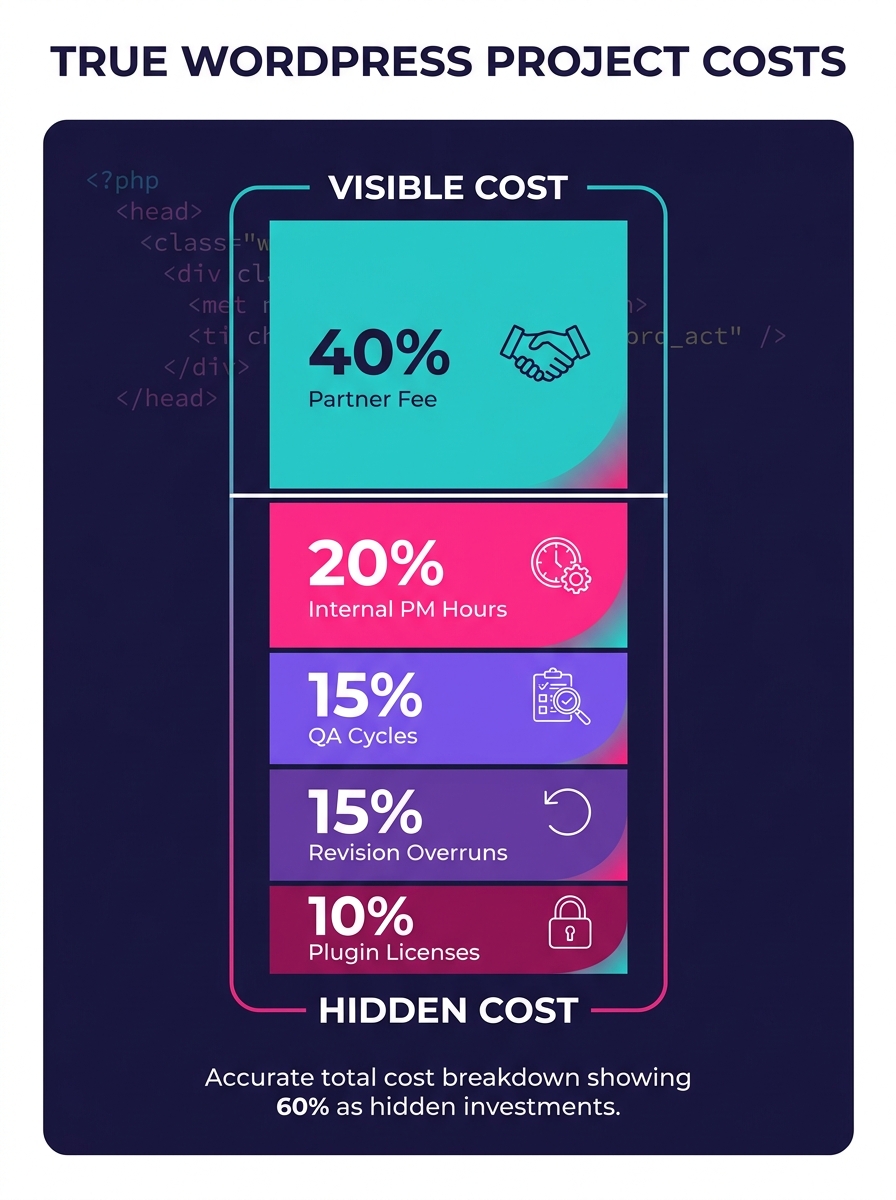
There's a psychological trap here too. Because your white-label partner's rate is lower than hiring in-house developers, you feel like you're already saving money and can afford to pass some of that savings to the client. This is how the race to the bottom starts. As Kinsta's analysis of bottom-pricing dynamics puts it, the focus should be on building a sustainable business model rather than competing on who can charge less. Every dollar you shave off your client price to win a deal is a dollar you're borrowing from your future operational capacity.
Retainers, Fixed-Price, and the Margin Geometry of Each
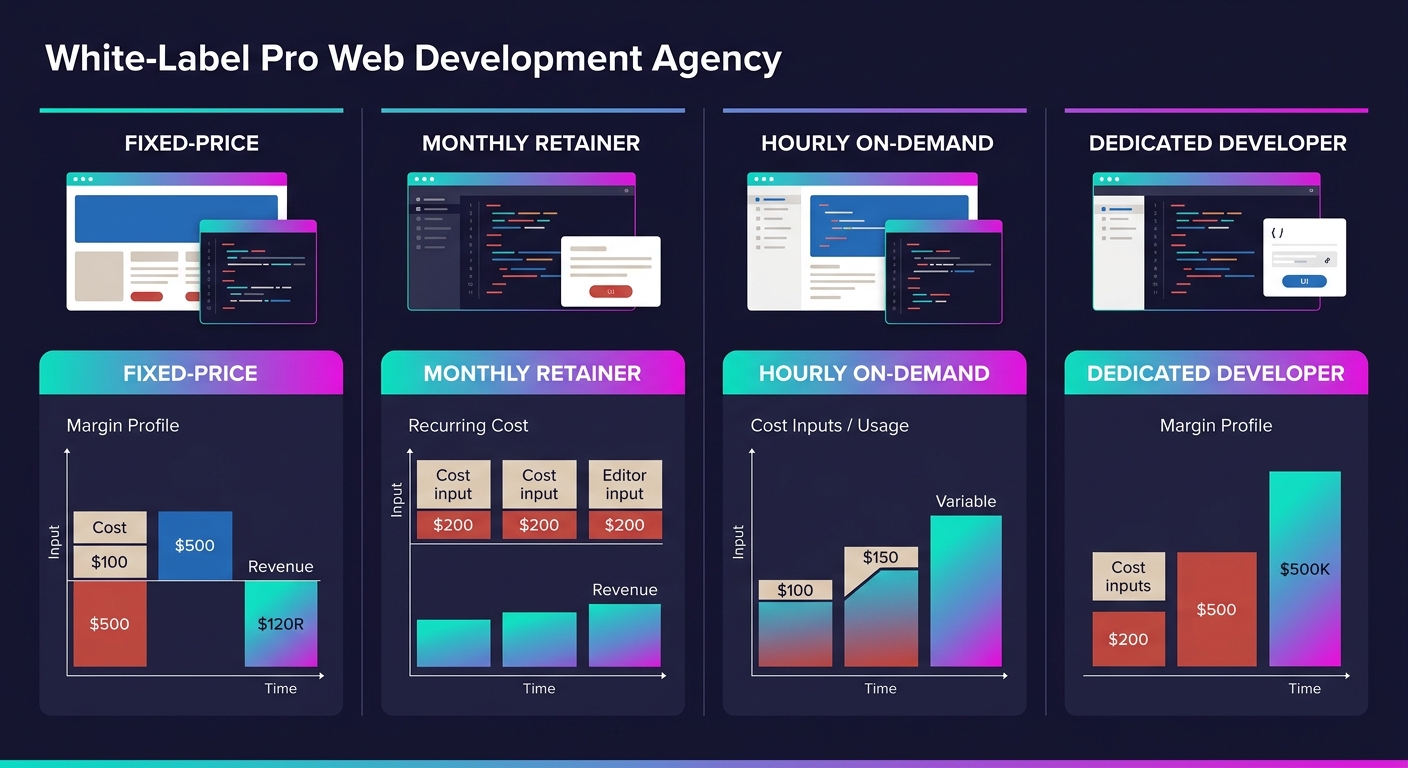
White-label pricing models fall into four broad buckets, and each one carries a different margin profile that behaves differently at scale. Fixed-price projects give you the tightest margin control because you negotiate a set cost with your partner and quote a set price to your client, and the spread is yours to protect. The catch is scope creep: without contractual revision caps (two to three rounds is standard), a $12,000 build can silently absorb enough internal hours to erode your effective margin below 30%. Agencies running fixed-price arrangements that thrive tend to invest heavily in standardized creative briefs so the partner gets clean specs on the first pass.
Monthly retainers, typically ranging from $499 to $2,000 per month at the partner level, solve a different problem. They create predictable revenue and predictable costs, which is the foundation of any scalable pricing structure. When a partner charges $150 to $800 per month per site for maintenance and the agency bills $100 to $250 per site to the client with a 70–150% markup baked in, the annual margin from a single retainer client often exceeds the margin from the original build project. The friction is lower, the client acquisition cost is zero (you're upselling an existing relationship), and churn rates on maintenance retainers tend to be surprisingly low because switching costs are high for the client. We've written extensively about why continuous maintenance models outperform reactive support, and the margin math here reinforces that argument from a purely financial angle.
The annual margin from a single maintenance retainer client often exceeds the margin from the original build project.
Hourly on-demand billing ($65 to $150 per hour at the partner level) offers flexibility but introduces budget unpredictability and typically gets you lower priority in the partner's queue. Dedicated developers at $3,000 to $6,000 per month provide consistency but require near-full utilization to be cost-effective. If your pipeline can't keep a dedicated developer busy 85% or more of their available hours, you're paying for idle capacity. As Web Help Agency's pricing breakdown notes, the smartest play for most agencies is a hybrid: retainers for ongoing maintenance clients and fixed-price for new builds, which lets you match each engagement type to the model that protects your margin best.
Pricing to Your Market, Not Your Cost Sheet
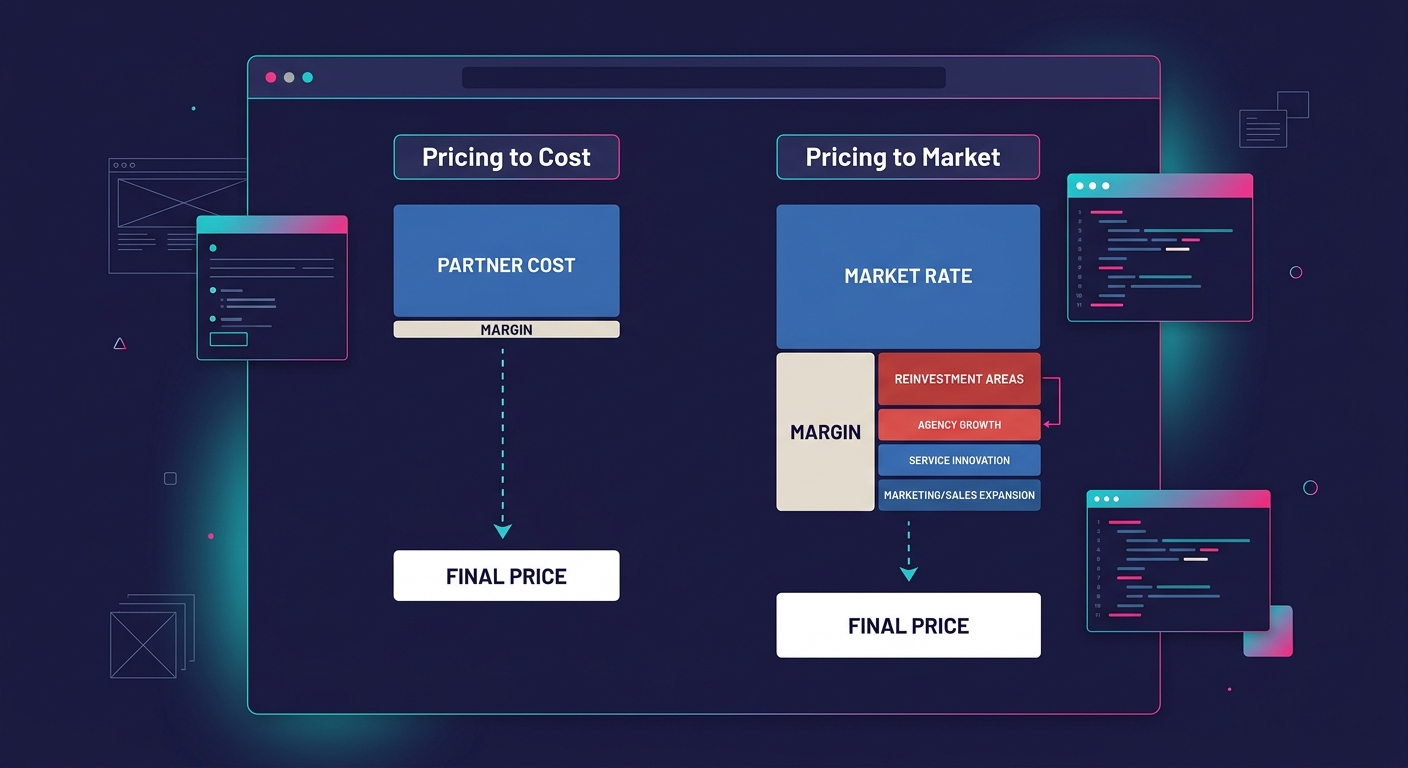
The single most destructive pricing instinct in white-label WordPress work is anchoring your client price to your partner cost. If your partner builds a custom WooCommerce store for $10,000, and you add 50% and quote $15,000, you've made a margin decision based on input cost rather than output value. The client doesn't know what your partner charges. The client knows what comparable agencies in their market charge for a WooCommerce store with similar complexity. If that market rate is $25,000 to $35,000, you've left $10,000 to $20,000 on the table by anchoring to the wrong number.
This is where outsourcing ROI becomes genuinely powerful. When you hire dedicated WordPress developers through a white-label partner at a fraction of what in-house senior talent costs, the savings aren't meant to flow to the client. They're meant to widen your margin while you price to market. A $7,000 build cost and a $20,000 client price gives you room to absorb scope creep, invest in better QA, fund business development, and still clear a 55–60% gross margin after accounting for internal hours. That breathing room is what separates agencies that grow from agencies that grind.
There's a practical discipline required here, though. Pricing to market means you need to know your market. What are comparable agencies in your region, serving similar client segments, charging for custom WordPress builds? For WooCommerce stores? For landing page packages? If you don't have at least a rough competitive pricing map, you're guessing, and guessing usually means underpricing. The research suggests agencies in North America should be quoting $12,000 to $20,000 for custom WordPress sites and $15,000 to $35,000 for WooCommerce stores, with agency profit margins of 50–75% being the target range for sustainable operations.
Rush delivery premiums are another margin lever agencies leave untouched. When a client needs a build in three weeks instead of six, your partner's cost goes up by 25–50%, but you can and should pass that premium through with your own markup intact. The alternative—absorbing the rush cost to keep the client happy—trains the client to expect fast turnarounds at standard pricing, which creates a pattern you'll regret within two quarters. Similarly, selling maintenance retainers at project handoff converts at three to five times the rate of pitching them cold six months later. The moment a site launches is when the client feels the most invested and the most anxious about things breaking, which makes it the ideal window to lock in recurring revenue.
Tip: Track your effective margin per project, not your quoted margin. Effective margin subtracts your internal PM hours, QA time, and revision cycles from the gross. If your effective margin is consistently 15+ points below your quoted margin, your scoping process or your revision policy needs fixing.
The agencies scaling fastest right now aren't the cheapest. They're the ones that understood their white-label partnership structure well enough to model costs accurately, price to what the market will bear, and reinvest the margin gap into better delivery and better sales rather than passing it along as a discount. Measuring outsourcing ROI, as Outsource Accelerator's framework recommends, should integrate both financial performance and strategic contributions—faster turnaround, broader service offerings, reduced hiring risk—into the calculation, not just the delta between partner cost and in-house salary.
Where the Math Stops Being Clean
Everything above treats margin as a static number you calculate once and protect. Reality is messier. Client scope changes mid-project, partners miss deadlines, a plugin vulnerability forces an emergency patch cycle that eats six hours nobody budgeted for. The agencies that handle these disruptions without hemorrhaging margin are the ones that built slack into their pricing from the start—not by padding estimates dishonestly, but by pricing to market rates that naturally include enough margin buffer to absorb the friction that every WordPress project generates.
There's also an unresolved tension between the advice to "price to market" and the reality that markets shift. When three new agencies in your metro area start offering white-label-backed WordPress builds at $8,000, your $18,000 price requires a value story that your sales team can actually deliver. Positioning, case studies, demonstrated expertise in specific verticals, and the reliability of your QA process all become margin-protection tools. The math gets you to the right price. Holding that price requires everything else in your agency to support the number.
And there's a question I don't think the industry has fully answered yet: what happens to agency margins as white-label pricing itself becomes more transparent? Partner pricing guides are public now, easily findable by any client willing to spend twenty minutes searching. When a client can see that a white-label WooCommerce build costs $10,000 and you're quoting $30,000, the value gap needs to be filled with something the client genuinely understands and believes in—your strategy, your project management, your accountability when things go sideways. The margin math only works long-term if the value layer above the build cost is real and defensible. Agencies that treat the markup as pure arbitrage, adding no visible value between partner and client, are the ones most vulnerable to the next round of pricing pressure. The math can tell you what to charge. It cannot tell you whether you've earned the right to charge it.