

Attackers hijacked JavaScript files for three WordPress plugins operated by vendor Awesome Motive to plant hidden backdoor accounts on as many as 1.2 million sites, according to a June 13 disclosure from Dutch malware research firm Sansec. The compromised plugins—OptinMonster, TrustPulse, and PushEngage—served tampered code directly from Awesome Motive's delivery network, bypassing traditional file-integrity checks that scan only local installations.
TL;DR: A supply-chain attack compromised three Awesome Motive WordPress plugins on June 12-13, 2026, injecting malicious JavaScript that created rogue administrator accounts and installed backdoor plugins on up to 1.2 million sites.
Attack Vector Bypassed Local Security Layers
The malicious code resided upstream in Awesome Motive's content delivery infrastructure rather than on victim servers, Sansec reported. Sites loading the scripts pulled tampered files from what appeared to be the legitimate source. The payload remained dormant until a logged-in administrator triggered it, leaving ordinary site visitors unaffected during the initial phase.
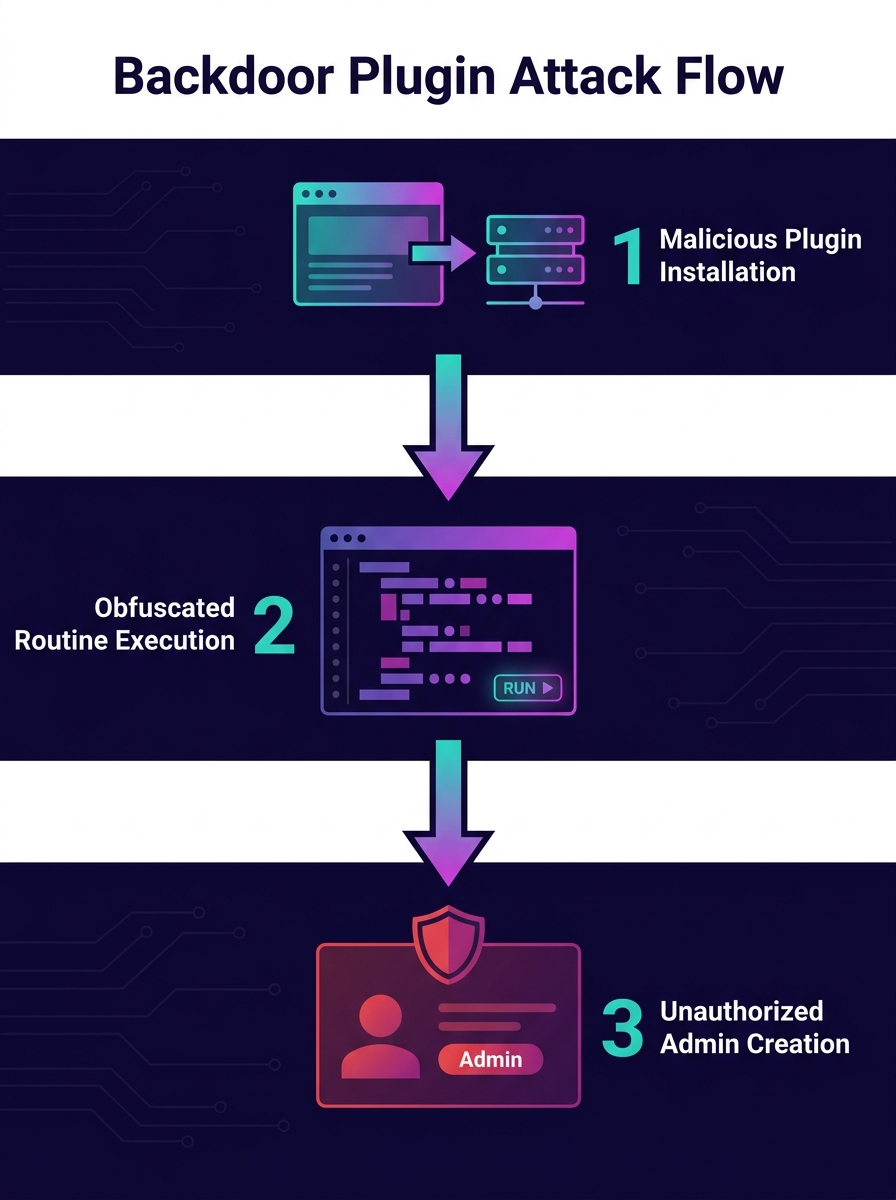
When an administrator session was detected, the script executed a three-step sequence: it created a new administrator account with full privileges, installed a self-concealing backdoor plugin to maintain access after the tampered script was removed, then transmitted the newly created credentials to a domain designed to resemble the legitimate chat service tidio.com, according to Sansec's technical analysis.
OptinMonster alone runs on more than one million WordPress installations. TrustPulse and PushEngage account for the remaining portion of the 1.2 million total, the firm said. Because attackers gained full administrative control of each compromised site, Sansec warned that secondary exploitation targeting regular visitors is likely.
Exposure Window Measured in Minutes
Sansec logged the tampered OptinMonster and TrustPulse code for approximately 30 minutes late on June 12, 2026, before the malicious versions disappeared. The firm interpreted the brief window as evidence that Awesome Motive detected and mitigated the compromise. PushEngage continued serving the malicious script as of June 13, the report stated.
The attack method resembles the 2024 Polyfill campaign, in which poisoning a single upstream JavaScript library affected thousands of downstream sites simultaneously, Sansec noted. That precedent underscores the risk profile agencies face when client sites depend on third-party content delivery networks for core functionality.
Entry Point Remains Under Investigation
How attackers gained access to Awesome Motive's delivery infrastructure was not confirmed in the June 13 disclosure. Sansec outlined three potential entry points: Awesome Motive's own servers, the vendor's CDN account credentials, or—less likely—the BunnyNet network that serves the files. None of the three scenarios was ruled out.
Only OptinMonster, TrustPulse, and PushEngage are confirmed compromised. Awesome Motive operates a significantly larger product portfolio, including WPForms with more than six million installations, All in One SEO on roughly three million sites, and MonsterInsights on approximately two million, according to WordPress.org plugin repository data. Sansec found no evidence those products were affected but recommended monitoring regardless.
The firm instructed WordPress administrators running any Awesome Motive plugin to audit admin user lists for unfamiliar accounts and to inspect outbound network traffic for connections to the tidio[.]cc domain. Both indicators suggest a successful compromise, Sansec said.
Similar Attacks Demonstrate Persistent Risk
This incident follows a pattern of plugin-based supply-chain attacks targeting WordPress sites, in which compromised upstream code creates persistent access without requiring individual site exploitation. The technique bypasses security measures that scan only local file systems, leaving sites reliant on vendor-side integrity controls.
Agencies managing WordPress infrastructure at scale face compounded exposure: a single compromised plugin dependency can propagate backdoors across entire client portfolios before detection. White-label WordPress security baselines typically include plugin review protocols, but those processes assume vendor-side code integrity.
Why This Matters Now
The 30-minute exposure window for OptinMonster and TrustPulse demonstrates that brief compromise periods can still affect hundreds of thousands of sites when attackers control upstream delivery infrastructure. Agencies relying on plugin ecosystems for client sites operate within vendor trust boundaries that security audits conducted at deployment cannot verify continuously.
For agencies that hire web developers to build custom WordPress solutions, this incident reinforces the risk calculus around third-party dependencies. A plugin installed across 40 client sites represents 40 potential backdoor installations from a single upstream compromise—no individual site vulnerability required. Post-launch monitoring must extend beyond server-level intrusion detection to include plugin code integrity verification, a layer many agencies omit.
Awesome Motive's product reach—spanning more than 10 million installations across its full plugin suite—illustrates the cascade potential of supply-chain attacks in the WordPress ecosystem. Agencies that consolidate vendor relationships to simplify white-label development services increase single-point-of-failure exposure. The attack vector Sansec documented does not require stealing credentials from individual sites or exploiting software flaws in the traditional sense; it requires compromising one vendor's delivery pipeline.