

PHP development outsourcing rates span $20 to $150+ per hour depending on geography and seniority, according to a vendor evaluation guide published July 9, 2026 by WP 301 Redirects. The 3,000-word framework addresses cost structures, engagement models, and technical vetting criteria for agencies evaluating white-label PHP capacity.
TL;DR: WP 301 Redirects published a PHP outsourcing guide July 9 mapping hourly rates from $20 (South Asia junior developers) to $150+ (North American senior specialists) and detailing vendor evaluation checklists for agencies scaling without headcount.
The guide segments hourly rates by region: South Asia and Southeast Asia at $20–$50, Eastern Europe and Latin America at $35–$80, and Western Europe plus North America at $75–$150+, according to the published framework. Project budgets for custom Laravel or Symfony applications range from $25,000 to $150,000+ depending on features, integrations, and security requirements, the guide states.
Small PHP website customizations may cost a few thousand dollars, while enterprise SaaS platforms exceed the upper budget range substantially, according to the analysis. The framework notes hourly rate alone does not predict value, senior teams charging higher rates may deliver cleaner architecture and lower long-term maintenance costs than budget providers who create rework through defects and weak code quality.
Four Engagement Models Compared
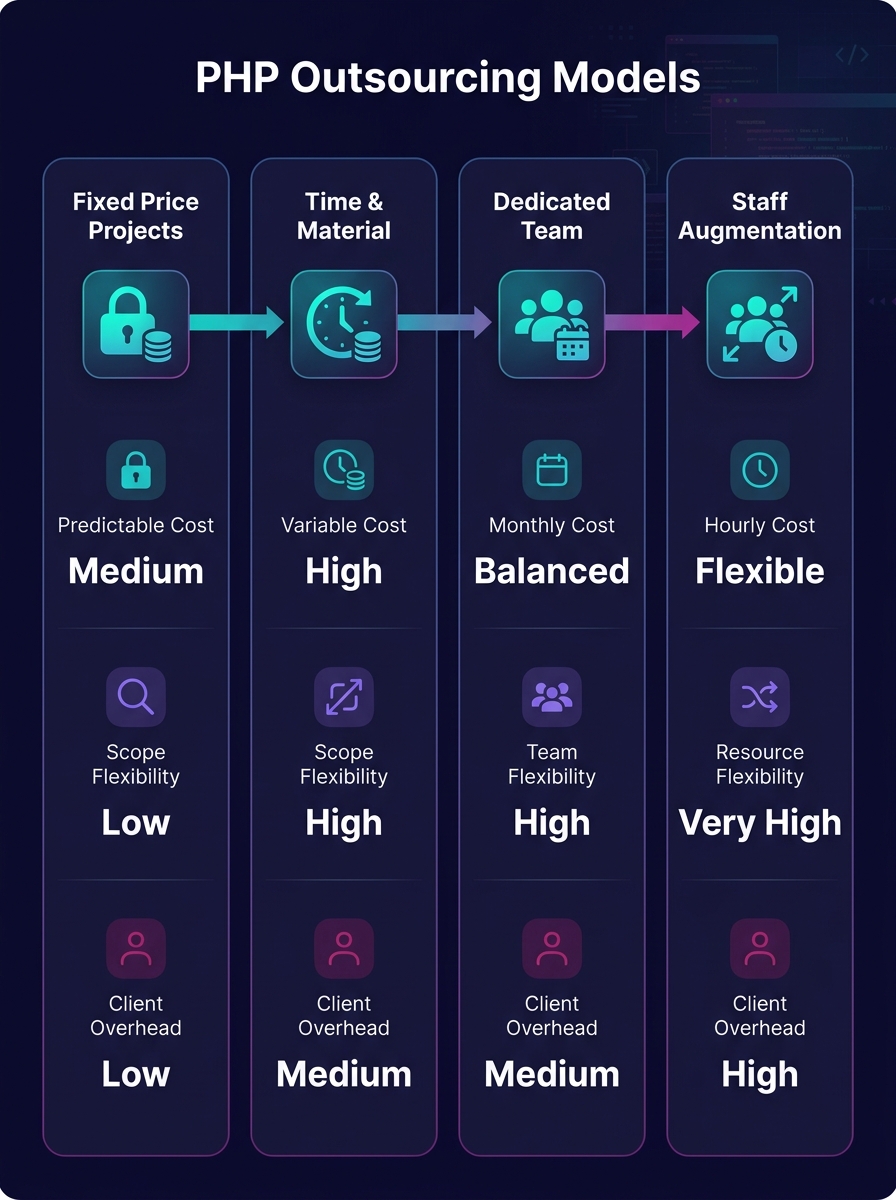
The guide maps four outsourcing structures: fixed-price projects for stable requirements, time-and-materials for evolving products, dedicated teams for long-term development, and staff augmentation where individual engineers join existing internal teams under client management.
Fixed-price arrangements offer budget predictability but become rigid when scope changes frequently, according to the framework. Time-and-materials models suit ongoing development where requirements shift, but require governance and transparency to control costs. Dedicated teams work primarily on one client's product and scale capacity without recruitment cycles. Staff augmentation requires strong internal technical leadership already in place, the guide states.
Agencies using white-label WordPress development partners often choose dedicated team or time-and-materials models for client projects requiring Laravel, Symfony, WordPress, WooCommerce, or custom CRM development, the analysis notes.
Vendor Vetting Checklist Emphasizes Security and Code Ownership
The guide provides a multi-point evaluation framework covering technical capability, communication quality, security practices, delivery process, and contractual terms. Key vetting criteria include verifying the vendor's experience with specific PHP frameworks, reviewing code samples or GitHub repositories, checking references from similar projects, and testing communication responsiveness during the proposal phase.
Security requirements deserve particular attention when vendors handle customer data, payment flows, or authentication systems, according to the framework. Agencies should verify the provider's approach to secure coding, data protection, access controls, and incident response before contract signature. The guide recommends clarifying intellectual property ownership, source code, documentation, designs, test cases, and infrastructure accounts, in writing before work begins.
Code repository access, issue tracker visibility, and deployment pipeline transparency should be contractual requirements rather than vendor concessions, the framework states. Agencies managing multiple client sites need real-time visibility into development progress, not weekly status emails that obscure problems until delivery deadlines approach.
The white-label partner vetting scorecard published by Webmastered in June 2026 applies similar quality-driven evaluation criteria, moving beyond hourly rate comparison to assess technical depth, process maturity, and communication discipline.
Common Risk Factors and Mitigation Strategies
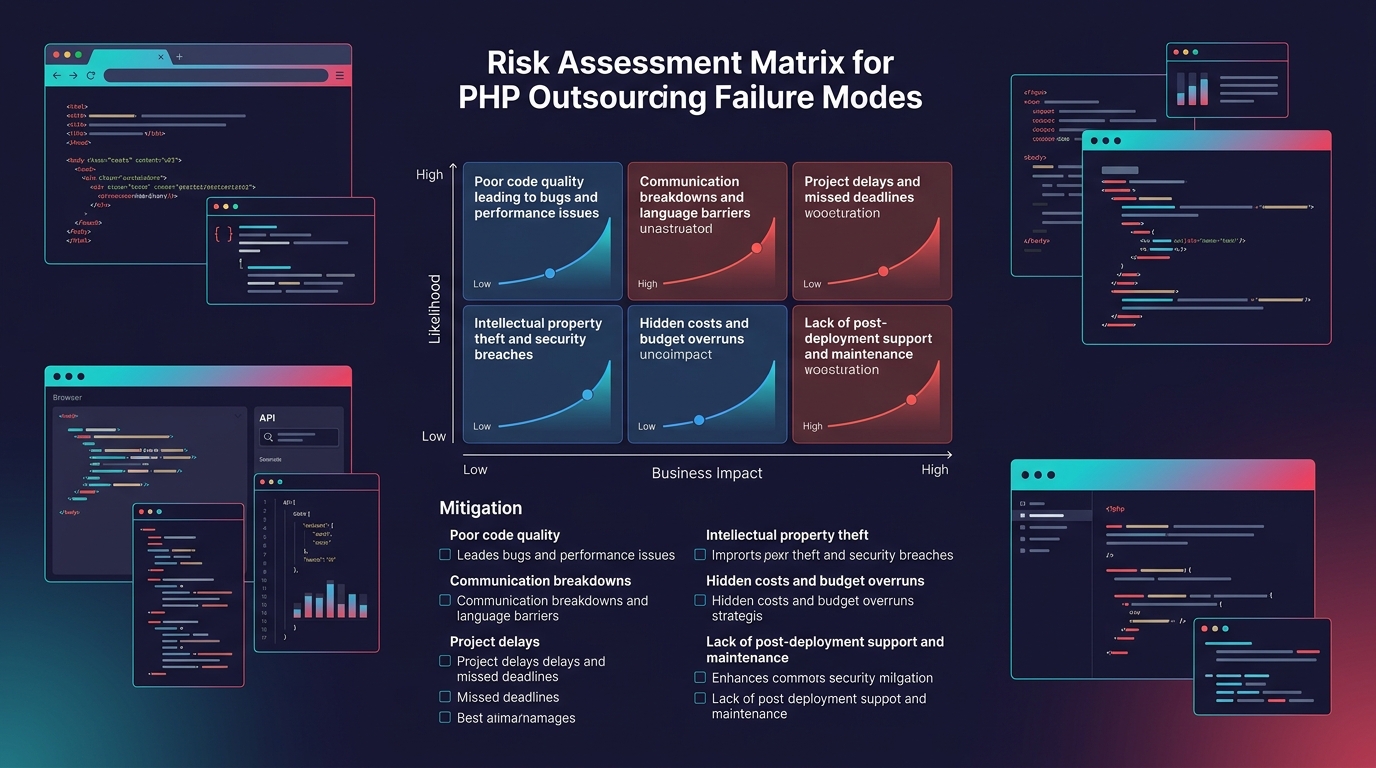
The guide identifies six frequent outsourcing failure modes: unclear requirements, poor communication rhythms, lack of ownership, inconsistent code standards, intellectual property disputes, and weak security controls. Mitigation starts with written scope documents that define acceptance criteria, reporting frequency, and escalation paths, according to the framework.
Treating vendors as disposable labor sources rather than delivery partners correlates with project failure, the analysis states. Successful engagements require clients to define priorities, approve architecture decisions, protect sensitive data, and track progress actively, outsourcing transfers execution work, not management responsibility.
Agencies should require written agreements on code standards, testing coverage, documentation expectations, and deployment procedures before development starts, the guide recommends. Post-launch support, monitoring, bug fixing, and security updates should be addressed in the initial contract rather than negotiated after handoff.
The vendor lock-in trap analysis published by Webmastered in April 2026 details exit clause negotiation strategies that prevent agencies from becoming dependent on a single outsourcing provider.
Context and Outlook
The vendor evaluation framework arrives as US digital marketing and web development agencies face capacity constraints without budget headroom for full-time hires. PHP remains the dominant server-side language for WordPress, WooCommerce, Laravel, and Symfony projects that constitute the majority of agency client work. A Coruzant analysis published June 2026 ranked 10 offshore development center providers as agencies confront tight budgets and talent shortages.
Agencies hiring WordPress developers on retainer or through dedicated teams can apply the guide's geographic rate benchmarks and technical vetting criteria to evaluate proposals from offshore and nearshore providers. The framework's emphasis on security practices and code ownership aligns with the operational requirements outlined in the white-label partner handoff protocol Webmastered published in May 2026, which addresses quality drift when developers never meet end clients.
The guide notes that the lowest hourly rate rarely produces the safest long-term outcome, a principle that extends to white-label WordPress partnerships where hidden costs from rework, missed deadlines, and poor architecture compound over multi-year client relationships. Agencies evaluating PHP outsourcing proposals should calculate total cost of ownership including technical debt, security remediation, and eventual migration costs rather than optimizing for the cheapest per-hour rate.