

Every white-label partnership autopsy your agency has ever conducted reached the wrong conclusion. You fired the developer, swapped the vendor, tightened the brief template, and watched the same failure pattern repeat with a different partner six months later. The reason is structural: agencies diagnose partnership failures at the deliverable layer (was the code clean? did the design match the mockup?) when the actual breakdown lives in the accountability architecture between the two organizations.
This is the core claim behind what we call the Outsourcing Organism Framework. A white-label partnership isn't a vendor relationship with a contract wrapper. It's a living system with circulatory dependencies, feedback mechanisms, and failure cascades that behave more like organ failure than like a bad hire. Treat organ failure with a bandage, and the patient keeps declining. Three specific failure layers account for the vast majority of white-label partnership collapses we've observed across WordPress agency operations. Here's the evidence for each.
The Silence Layer Kills Before Bad Work Does
The instinct when a white-label build goes sideways is to blame the output. The homepage loads slowly, the WooCommerce checkout has a bug, or the responsive breakpoints don't match the Figma file. These are real problems. But as one analysis of white-label PPC operations put it bluntly: most failures come from silence, misalignment, and rushed promises, not from the technical work itself.
What does "silence" look like operationally? It's the three-day gap between when your account manager asks a clarifying question in Slack and when the white-label team responds. It's the staging link shared without context on what was changed, what wasn't, and what's blocked. It's the weekly standup that was supposed to happen but quietly stopped after week two because everyone was "too busy building."
These silence gaps create accountability vacuums. When nobody flags a risk for 72 hours, the agency assumes progress is happening. The white-label team assumes the agency is reviewing their last update. Both sides operate on assumptions instead of information, and by the time the gap surfaces, the project is three scope decisions behind.
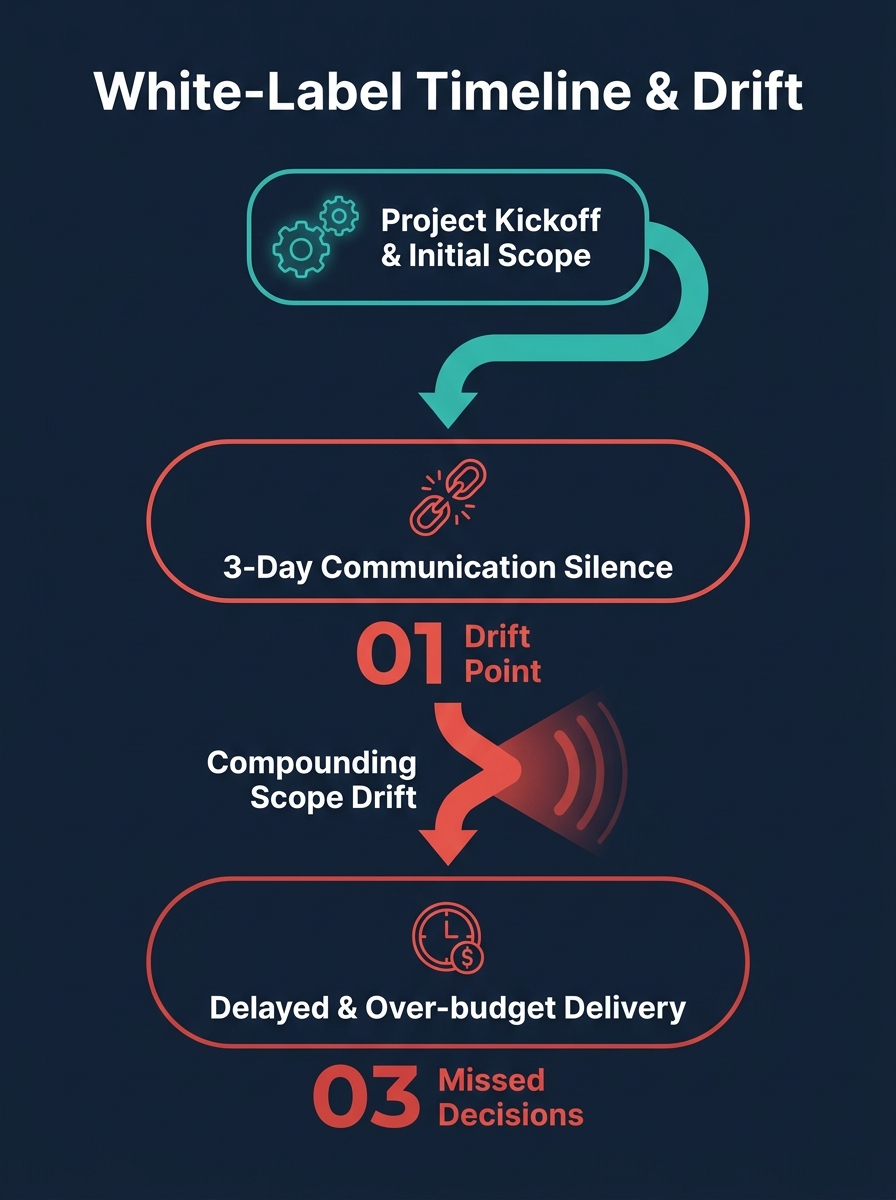
The fix lives in the communication cadence itself. Agencies that have standardized their white-label partner briefs report dramatically fewer revision cycles, and the primary reason isn't better briefs. It's that the standardization process forces both parties to agree on what gets communicated, when, and through which channel. The brief becomes a communication contract, and the communication contract prevents the silence layer from forming in the first place.
If you're thinking about white-label systems thinking, this is where it starts. The deliverable quality is downstream of the communication system. Fix the system, and the deliverables improve without changing a single line of code.
The Engagement Model Creates the Wrong Incentive Structure
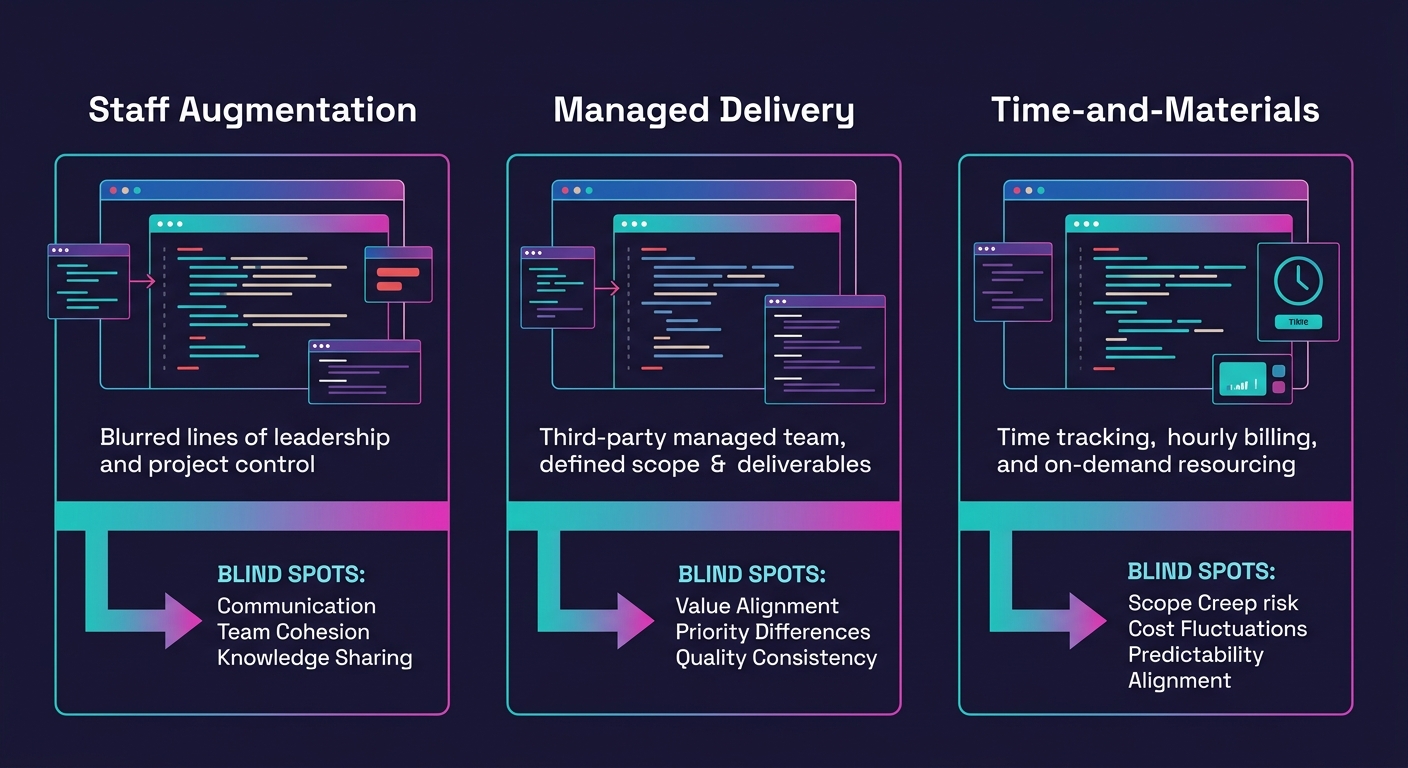
Here's where agency outsourcing alignment gets complicated. WordPress agencies typically engage white-label partners through one of three models: staff augmentation (you rent developers who work under your direction), managed delivery (the partner owns the build process and hands you finished work), or time-and-materials contracts where the vendor proposes scope and you supervise execution.
Each model creates a different accountability topology. And most agencies pick their model based on budget, not based on what kind of accountability they actually need.
Staff augmentation, for instance, gives you direct control over the work. But as Network World's breakdown of engagement models describes, the product vision and decision scope of augmented team members is so narrow that it doesn't encourage thinking outside the immediate task. You get hands on keyboards, but you don't get strategic input, quality ownership, or proactive problem-solving. If your internal team already has strong WordPress project management and can direct the work precisely, that's fine. If you're hiring a white-label partner because you're stretched thin on management capacity, you've just doubled your management burden while solving nothing.
Agencies pick their engagement model based on budget, not based on what kind of accountability they actually need.
Managed delivery solves the management problem but creates an opacity problem. The partner owns the build, which means you can't see the daily decisions being made about plugin selection, code architecture, or performance tradeoffs until the staging site shows up. If your agency runs on Oxygen or Bricks and the partner defaults to Elementor because that's what their team knows, you won't find out until the client review meeting.
The organism metaphor matters here because these outsourcing accountability gaps aren't bugs in the partnership. They're features of the model. Every engagement structure has a built-in blind spot, and the question isn't which model is best. The question is whether you've diagnosed which blind spot your current model creates and built a compensating mechanism for it.
We've written about why ticket-based outsourcing models break at scale in WordPress agency contexts. The pattern is consistent: the model that worked at 5 clients per month starts producing failures at 15 clients per month because the accountability architecture doesn't scale linearly with volume. The organism grows, but the nervous system stays the same size.
Failure Ownership Defaults to the Wrong Address
This is the most uncomfortable part of the framework, and the one agencies resist hardest. When a white-label partner builds something that fails in production, who owns that failure? Contractually, it might be the partner. Operationally, it's always you.
As WhiteLabelIQ documents in their analysis of partnership risk, when you involve a white-label partner in your project, the ownership of failure falls on you regardless of who did the work. Your client doesn't know the partner exists. Your client knows your agency's name, your agency's invoice, and your agency's reputation. The partner's accountability to you is contractual. Your accountability to your client is existential.
This ownership inversion creates a specific pathology in scalable partnership models. The agency absorbs all downside risk but delegates the execution that determines whether that risk materializes. The rational response is to over-specify, over-review, and over-manage the partner's work, which defeats the purpose of outsourcing in the first place.
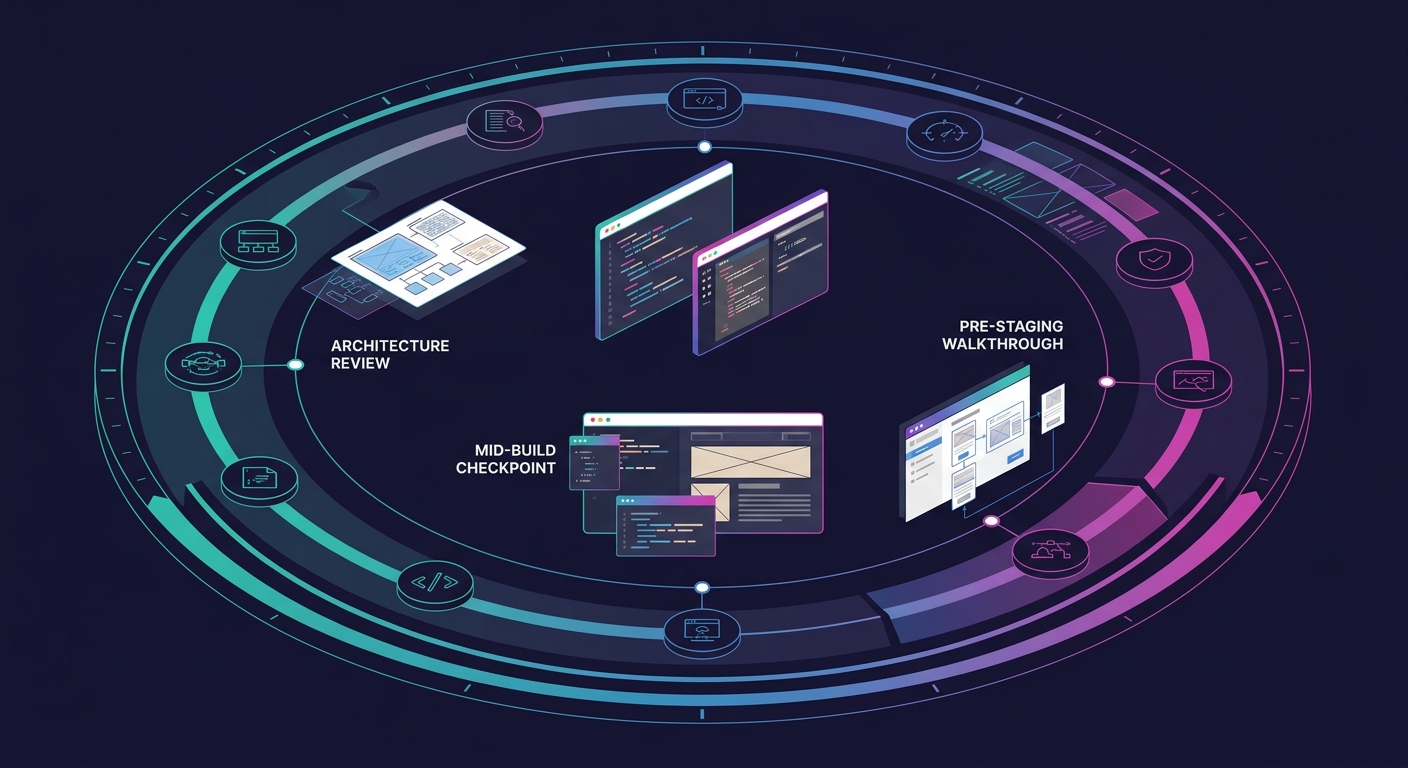
The organism framework suggests a different approach. Instead of concentrating all quality control at the handoff point (the staging review, the final QA), you distribute quality checkpoints throughout the build process. Think of it like a circulatory system: oxygen doesn't arrive at the heart and then get distributed once. It flows continuously through every organ.
For a WordPress team structure supporting white-label work, this means:
- Architecture review before the first line of code, where the partner confirms their approach to theme structure, plugin dependencies, and hosting requirements
- Mid-build checkpoint at roughly 40% completion, where the agency reviews not the finished pages but the underlying technical decisions
- Pre-staging walkthrough where the partner presents what they built and why, not where the agency discovers it through clicking around
Agencies scaling beyond 8-12 people face this challenge acutely. Flat structures can absorb the informal quality control that happens when the founder reviews every build personally. Once you're running 15+ concurrent projects with white-label support, you need a formal accountability architecture or you'll spend your weeks doing damage control instead of business development.
Warning: If your only quality checkpoint with a white-label partner is the staging review, you're catching problems at the most expensive possible moment. By the time a build reaches staging, reworking foundational decisions costs 3-5x what correcting them mid-build would have cost.
The systems thinking lens on this is straightforward: outsourced workflows that rely on endpoint inspection rather than process integration will always produce inconsistent results, because they treat the partnership like a black box when it needs to function like a shared organ.
The Diagnosis, Reconsidered
The contrarian claim at the top of this article was that your agency's white-label partnership postmortems reach the wrong conclusion. Having walked through the three failure layers, the revised claim is more specific: they reach the right conclusion about the symptom (the build was late, the code was messy, the design was off-brand) while missing the systemic cause entirely.
The silence layer, the engagement model mismatch, and the ownership inversion aren't three separate problems. They're three expressions of the same underlying condition. Your partnership lacks a shared accountability architecture, and without one, every process improvement you make addresses a symptom while leaving the condition untreated.
Building that architecture requires work that doesn't feel productive in the moment. Defining communication cadences, selecting engagement models based on accountability needs instead of budget, distributing quality checkpoints across the build timeline rather than concentrating them at the end. None of this ships pixels. None of it satisfies the urgent Slack message from a client asking where their homepage is. But it determines whether your feedback systems actually function or whether they're just rituals your team performs before going back to working in isolation.
The organism metaphor earns its keep here. You can't fix a kidney by operating on the liver, even if the liver is where the pain shows up. Diagnosing where the partnership actually breaks down means tracing the symptom backward through the system until you find the layer where information stops flowing, accountability becomes ambiguous, or ownership inverts. That layer is where your intervention needs to land. Everything else is surgery on the wrong organ.