

WP Curve launched in 2013 with a pricing page that listed exactly one option: $69 per month for unlimited small WordPress fixes. Dan Norris, the founder, had failed at a previous startup and needed recurring revenue fast. His thesis was simple enough to fit on a napkin: standardize the scope, flatten the price, and grow through volume. Within two years, WP Curve had hundreds of paying members and had become one of the most cited examples of a productized service in WordPress. By 2016, GoDaddy acquired the company. The story sounds like a clean win. Dig into the operational details, though, and you'll find the exact tension that every white-label agency hits when it tries to scale: the moment standardized delivery collides with the reality of what clients actually need done.
The $69 Unlimited Fix
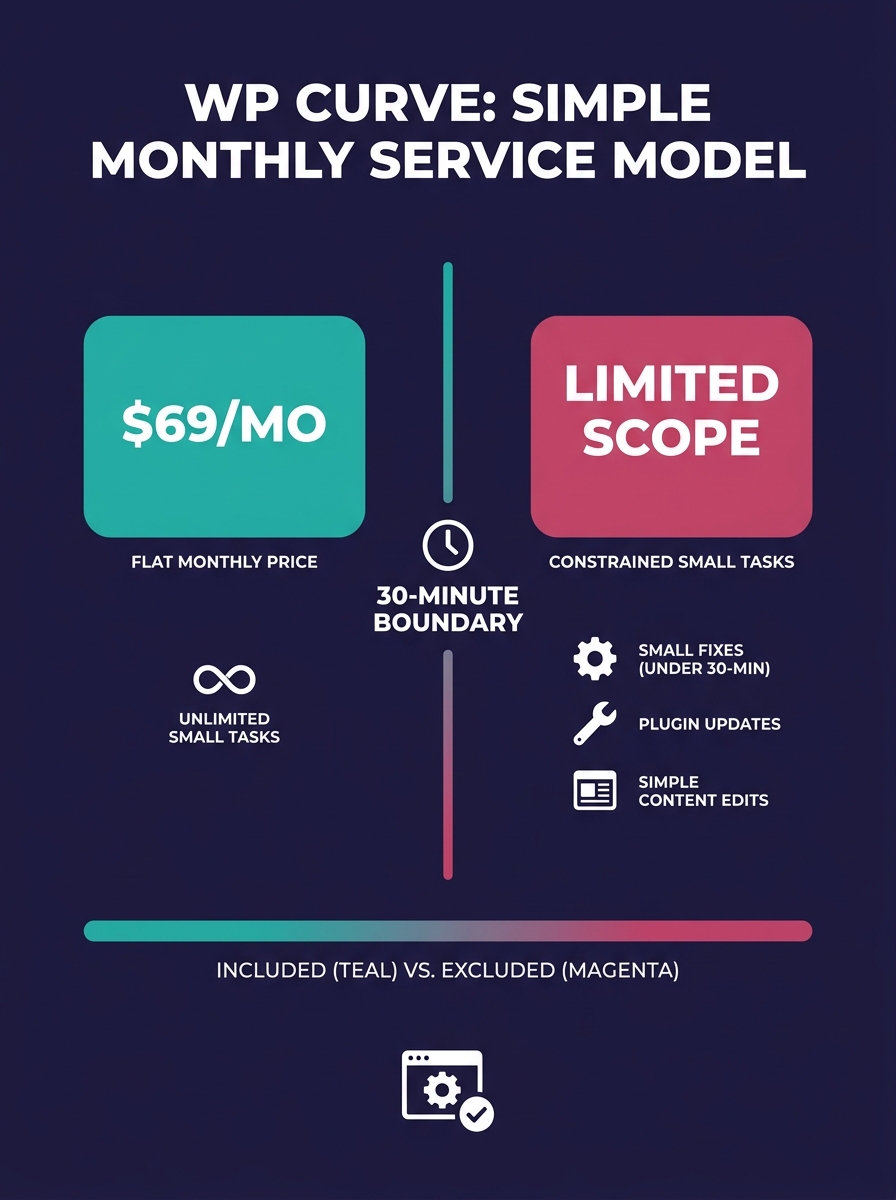
WP Curve's model was built on a specific constraint. "Unlimited" didn't mean unlimited scope. It meant unlimited small tasks, each capped at 30 minutes of developer time. Plugin updates, CSS tweaks, content changes, minor bug fixes. If a request exceeded that 30-minute boundary, it fell outside the service. This constraint was the entire business architecture. Without it, the economics of flat-rate pricing collapse instantly.
Richard Patey's definition of a productized service captures the principle well: a business that sells and packages up a service as a product with a standardized list of features, a fixed price, and delivered by a set date. WP Curve followed this playbook almost perfectly. Every client got the same promise, the same turnaround window, and the same scope boundary. The marketing was clean because the offer was clean. You could explain the product in one sentence, which meant word-of-mouth did most of the heavy lifting.
And for agencies thinking about white-label productization, that clarity is the seductive part. You can market a standardized offer with a landing page and a pricing table. You can train a team to deliver it without senior oversight on every ticket. You can forecast revenue because the inputs and outputs are predictable. If you've ever struggled to scope a custom WordPress build or argued with a client about what's included in "design revisions," you understand the appeal.
When Every Ticket Looked Different
The trouble started showing up in WP Curve's support queue. Clients didn't submit neat, uniform 15-minute CSS fixes. They submitted requests that sounded small but required investigation: "My contact form stopped working after an update." "The homepage loads slowly on mobile." "Can you add a feature to my WooCommerce checkout?" Each of these could take 10 minutes or 3 hours, and the person submitting the ticket had no way to know which.
This is the agency scaling trade-off that rarely gets discussed in productization guides. The more you standardize, the more you attract clients who don't understand where the boundary is. They signed up because the offer was simple, and they expect the delivery to match that simplicity. When you tell a client that their "small" request actually requires a custom plugin or a theme rebuild, you've created a support interaction that costs more than the monthly fee regardless of whether you do the work.
WP Curve dealt with this by building internal triage systems and training developers to estimate fast. But the overhead of sorting, scoping, and declining requests ate into the margin that flat pricing was supposed to protect. The company was functionally running two operations: the standardized delivery pipeline for tasks that fit the model, and an ad-hoc consulting process for everything that didn't.
The more you standardize your WordPress service, the more you attract clients who don't understand where the boundary is.
If you've worked on building a feature toggle architecture for white-label WordPress delivery, you'll recognize the pattern. Feature toggles exist precisely because different clients need different things activated, even when the underlying codebase is shared. WP Curve didn't have that kind of modularity in its service design. The product was binary: your request either fit, or it didn't.
The Margin Arithmetic Behind "Unlimited"
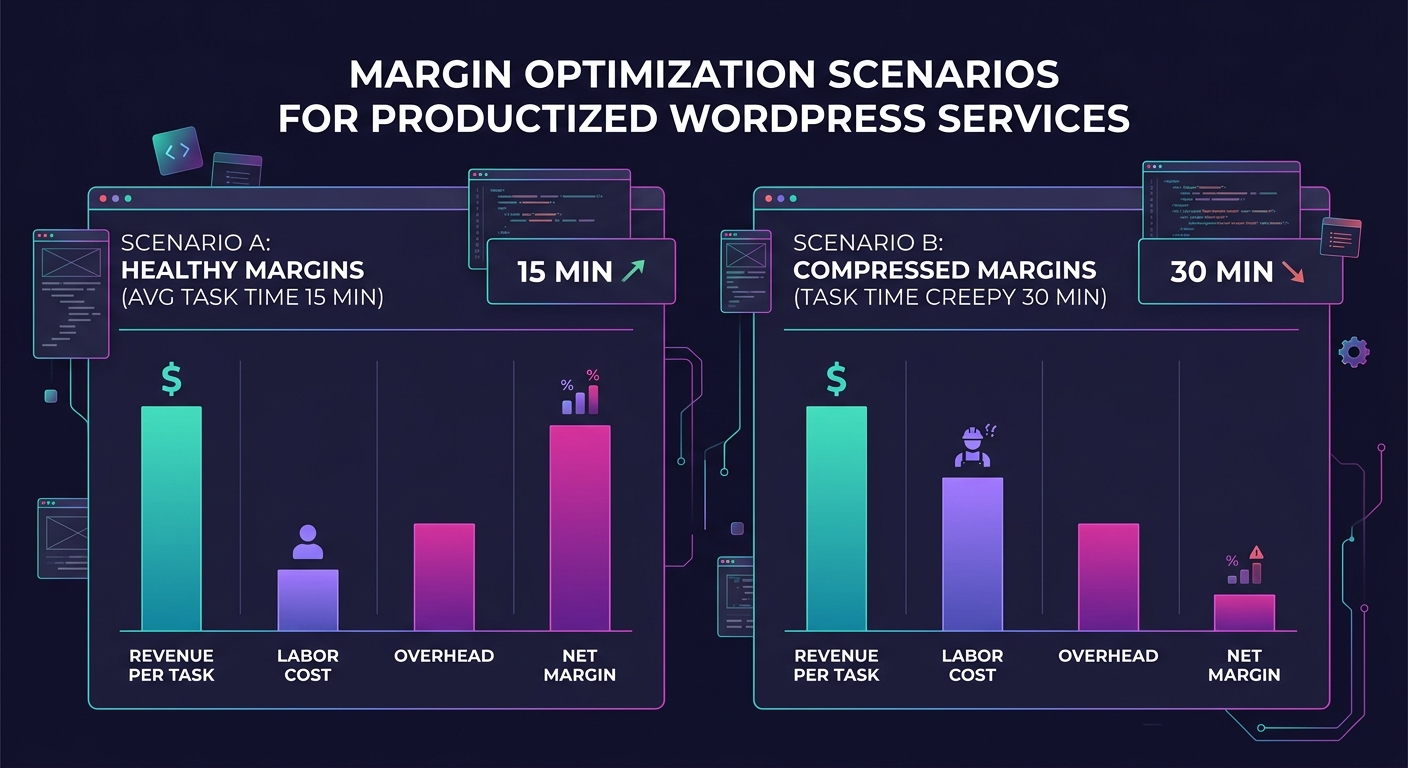
Here's where the custom vs. templated WordPress solutions debate gets concrete. The difference between a 40% gross margin and a 65% one often comes down to which pricing structure an agency picks when it first partners with a white-label provider. WP Curve's flat-rate model worked when the average task took 12-15 minutes. It broke when the average crept toward 25.
Consider the math. At $69 per month per client, with an average of 4 requests per month, that's roughly $17 per task. If your developer costs $30/hour and each task takes 15 minutes, you're paying $7.50 in labor. Healthy margin. But if the average task creeps to 30 minutes, labor cost doubles to $15 per task, and you're running at a much thinner margin before accounting for support overhead, tooling, and management time.
Many agencies today generate $100-500+ in monthly recurring revenue per client through white-label arrangements, paying significantly less to their provider. But that spread only holds when the scope is genuinely controlled. The moment you start absorbing custom work inside a standardized price, margin optimization becomes an illusion. You're subsidizing complex projects with revenue from simple ones, and you're doing it invisibly, which means the problem compounds before anyone notices.
WP Curve's team noticed. By the time GoDaddy came knocking, the company had already begun experimenting with higher-tier plans and add-on services for work that exceeded the 30-minute scope. The pure productized model was evolving into a hybrid, whether the marketing admitted it or not.
GoDaddy Buys the Tension
GoDaddy's acquisition of WP Curve in 2016 folded the service into GoDaddy Pro, a much larger platform targeting WordPress professionals and agencies. The "unlimited small fixes" positioning was absorbed into a broader ecosystem of managed hosting, site management tools, and support services. The standalone productized model effectively disappeared.
This is telling. GoDaddy didn't buy WP Curve to run the same model at larger scale. They bought the customer base and the operational knowledge, then wrapped it into a service bundle that could accommodate varying levels of customization. The acquirer solved the paradox by abandoning the constraint that made the original product possible.
For white-label agencies watching from the outside, the lesson is structural. WordPress service standardization works when you can genuinely control scope. The moment your client base outgrows the boundary, you need modular service tiers, clear upgrade paths, and a partner vetting framework that ensures your delivery team can handle both the templated and the custom work without context-switching penalties.
And here's the part that connects directly to how you position your agency in the market: your content, your pricing pages, and your sales conversations all need to reflect the actual hybrid nature of your service. Packaging a custom-capable service as if it's a simple productized offer creates the exact mismatch that eroded WP Curve's margins. Packaging a productized service with too many caveats and exclusions undermines the simplicity that makes productization attractive in the first place.
The Packaging WP Curve Couldn't Keep
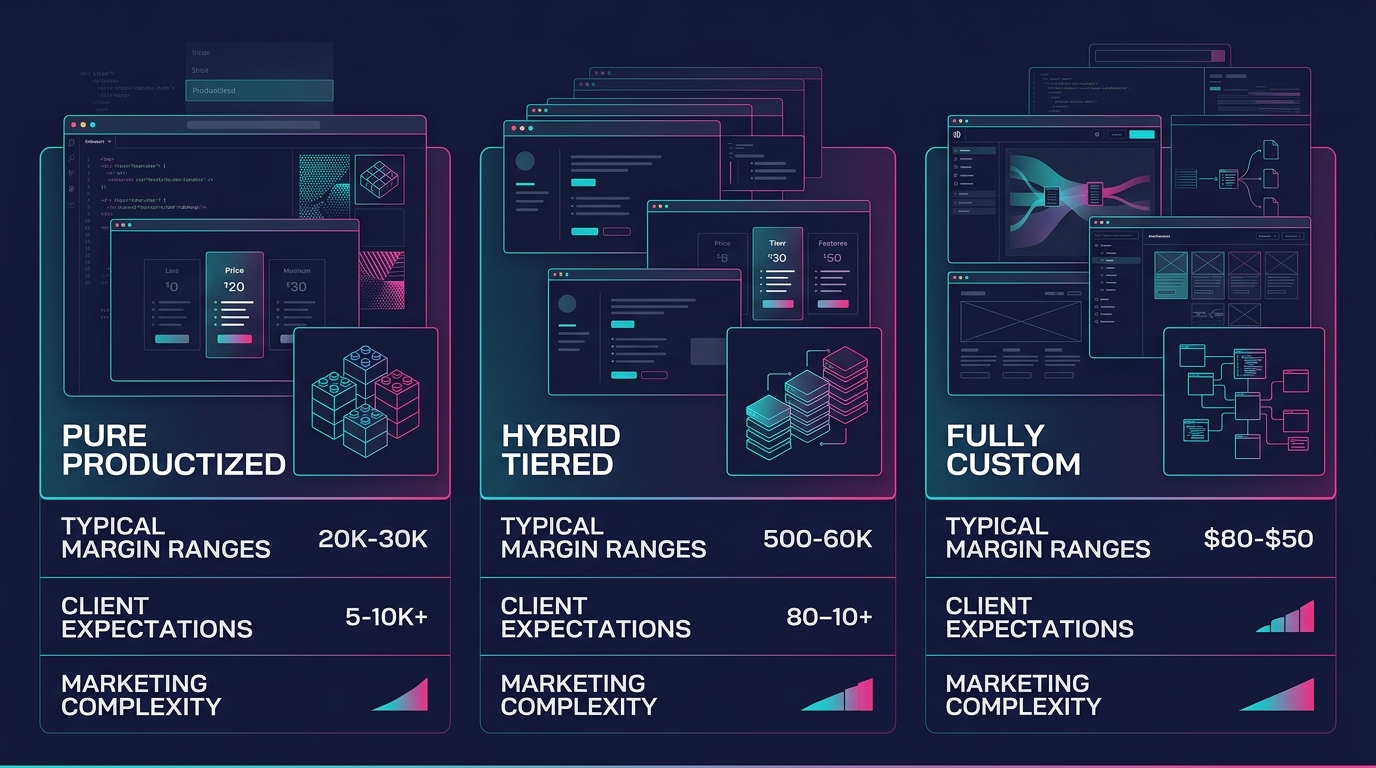
WP Curve's arc from pure productization to hybrid tiers to acquisition maps onto a pattern that repeats across the white-label WordPress space. The agencies that scale successfully tend to land somewhere in the middle of the spectrum, and they're honest about it in their positioning.
The practical shape of that middle ground looks something like this: a base tier of standardized maintenance and small-scope work, priced flat and delivered through documented processes. Above that, a clearly defined upgrade path for custom development, priced per project or per sprint, with separate SOWs and timelines. The two tiers share infrastructure, tooling, and developer access, but they're marketed and sold as distinct products.
The key insight from WP Curve's story is that the paradox between standardization and customization isn't something you resolve once. It's a tension you manage continuously through your pricing models and your service packaging. Custom theme development offers higher stability and precision for clients who need it, but that precision has a cost that your standardized tier shouldn't absorb. Template-based builds give speed and independence, but they carry reliability trade-offs that your marketing needs to acknowledge rather than hide.
Tip: If more than 20% of incoming requests in your standardized tier require scope exceptions or escalations, your tier boundary is in the wrong place. Track exception rates monthly and adjust your packaging quarterly.
WP Curve proved that white-label productization can build a real business with real recurring revenue. It also proved that the "unlimited" framing creates a scope expectation that eventually outpaces the delivery model. The agencies that learn from both halves of that story, the growth and the strain, are the ones building systems that actually hold up at scale. The packaging has to be as honest as the operations behind it, or the margin compression catches up with you the same way it caught up with a $69 unlimited promise.