

Automated design-to-code workflows now produce a 30% to 50% reduction in UI implementation time for enterprise teams, according to Builder.io's interviews with dozens of organizations that adopted them. The reduction sounds like a developer efficiency story, and most agencies treat it that way. They shouldn't. For white-label shops maintaining SEO integrity across ten or forty client properties simultaneously, the real payoff is consistency — the kind that determines whether every site ships with correct heading hierarchies, semantic HTML, proper image markup, and the Core Web Vitals scores your clients' organic rankings depend on.
When a designer hands off a mockup in Figma and a developer in another timezone interprets it manually, the result isn't random variation. It's systematic SEO degradation. Heading levels get skipped. Alt attributes get omitted. CSS bloats because every developer writes their own version of the same card component. Layout shift creeps in because the implementation doesn't match the spacing tokens the designer intended. Multiply that across a distributed team building sites for multiple agency clients, and you've got an SEO consistency problem that no amount of post-launch auditing can efficiently fix.
Design system handoff automation fixes this at the system level, before a single line of code gets written. And for white-label agencies specifically, getting this right determines whether your design-to-code process produces SEO-clean output by default or requires expensive manual remediation on every project.
Why Manual Handoffs Break SEO at Scale
The typical white-label workflow looks like this: a designer creates mockups in Figma, exports assets or shares a link, and a developer on a separate team builds the page in WordPress using Elementor, Oxygen, or a custom theme. The translation step between "what the designer intended" and "what the developer builds" is where SEO problems originate.
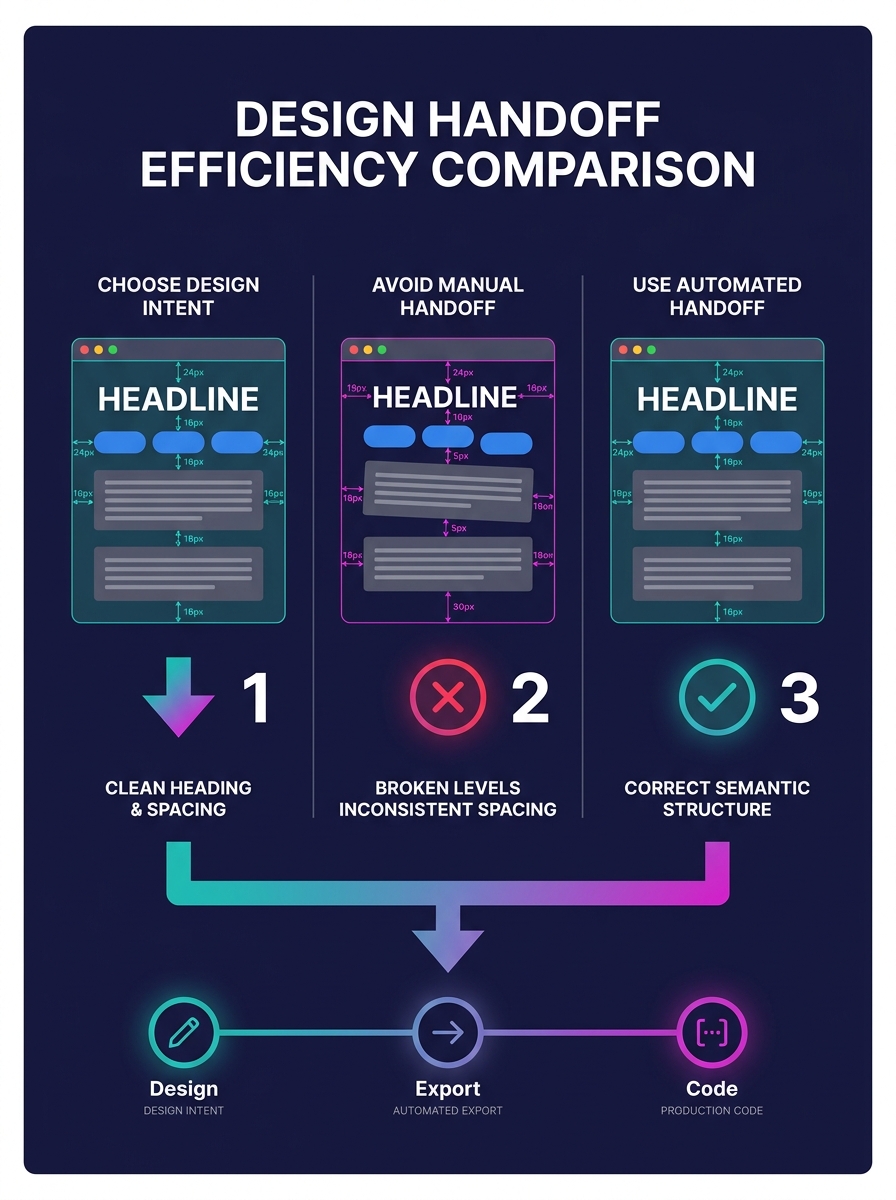
Heading structure is the most common casualty. A designer places text that visually looks like an H2 but doesn't annotate it. The developer, working from visual cues alone, might implement it as a styled paragraph, a div with a class, or an H3 because that's what fit the existing stylesheet. Across a 30-page site built by three different developers, you end up with heading hierarchies that make zero semantic sense. Google's crawlers care about this. Screen readers care about this. Your client's SEO audit will flag it.
Spacing and layout consistency affect CLS (Cumulative Layout Shift) scores directly. When developers estimate padding and margins from a screenshot rather than pulling values from design tokens, the rendered page shifts as assets load. We've written before about how the design-to-code bottleneck costs agencies hours, and the SEO damage compounds that time cost with ranking impact.
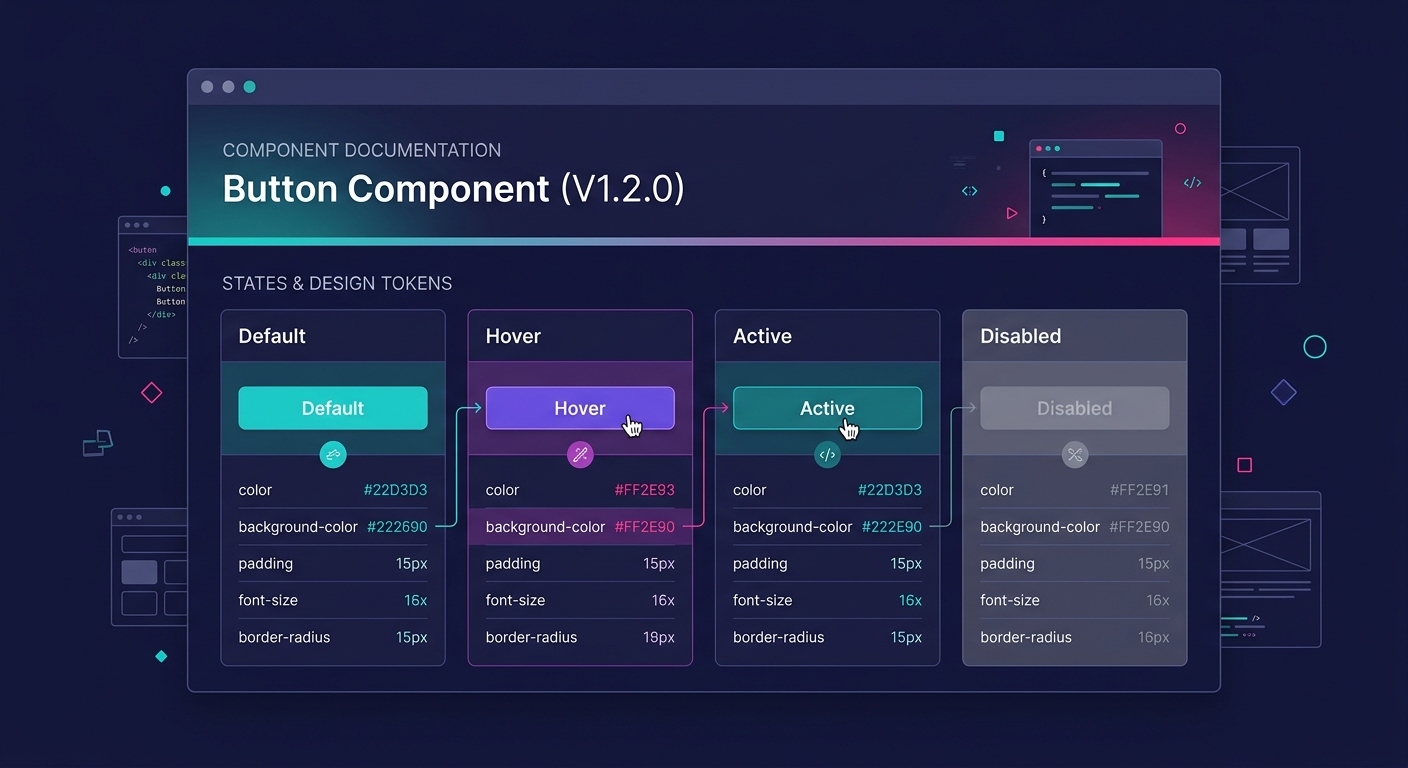
Component documentation failures are subtler but equally damaging. When a button component has hover states, focus states, and ARIA labels defined in the design system but none of that information travels to the developer, accessibility suffers. And accessibility is an SEO signal — Google's ranking algorithms factor in page experience metrics that include accessibility markers.
How Token-Based Automation Preserves Semantic Structure
Design tokens are the named values — colors, spacing, typography scales, border radii — that define a design system's visual language. When those tokens flow automatically from Figma into code, developers stop making interpretive decisions about font sizes, margins, and heading styles. The system decides.
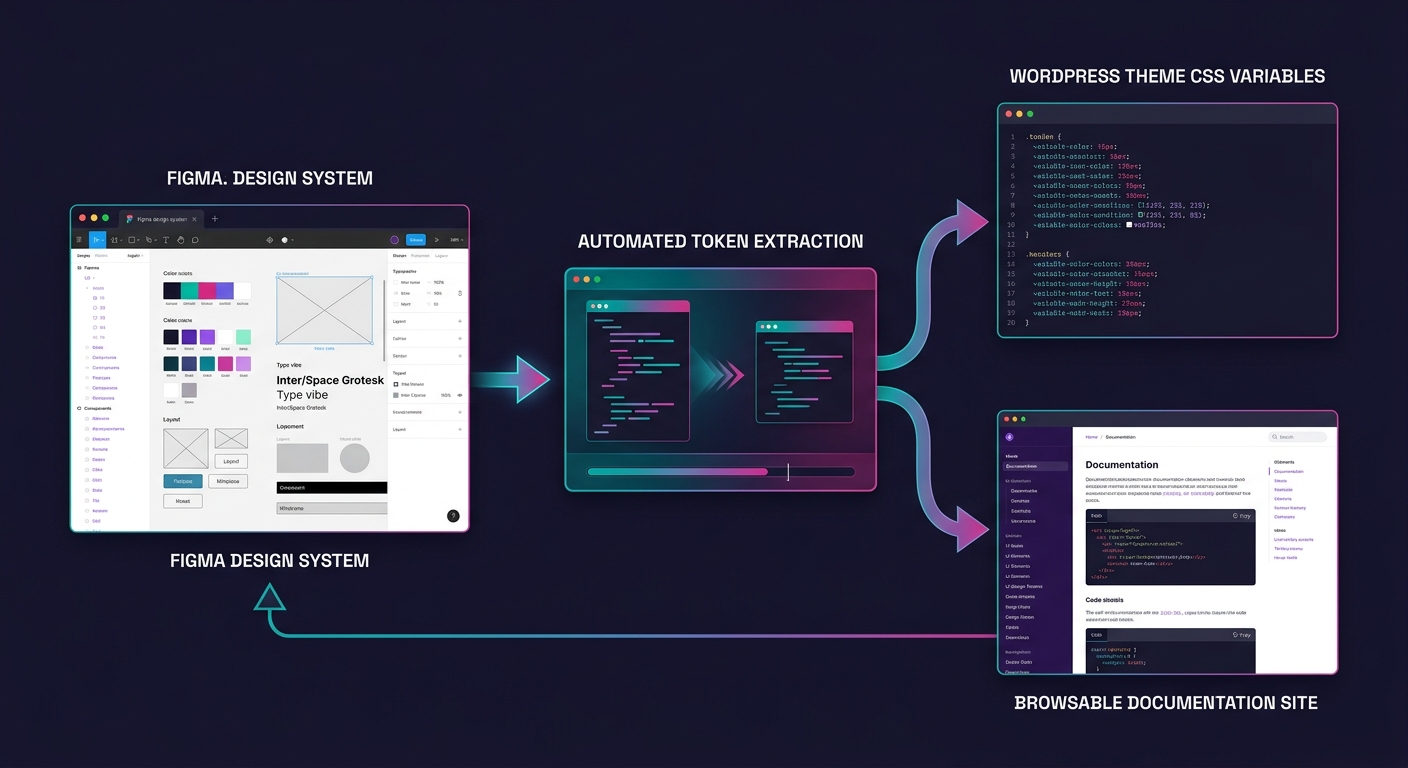
Handoff, an open-source toolset for Figma design systems, generates a documentation site from your design system tokens every time it fetches updates. This means the source of truth between design and development stays current without anyone manually updating a wiki page or Notion doc. For white-label agencies, this is significant: your distributed development team in Manila, Kraków, or Buenos Aires is always referencing the same token values your designer in Denver published that morning.
The SEO benefit is direct. When heading typography is defined as a token (H1 = 36px/bold Inter, H2 = 28px/semibold Inter, etc.), and the developer's build system pulls those tokens into CSS variables, heading levels can't drift. The visual output matches the semantic markup because both reference the same token. Nobody "guesses" that a section title should be an H3 because it looks smaller than the hero.
When heading typography is defined as a token and your build system pulls those values into CSS variables, heading levels can't drift. The visual output matches the semantic markup because both reference the same source.
Spacing tokens solve CLS the same way. Instead of a developer eyeballing 24px of padding and typing 20px, the component pulls its spacing from the design system. Layouts render predictably. Shift scores drop. Page experience improves. Rankings hold.
Component Documentation That Developers Actually Use
The phrase "component documentation" usually triggers eye-rolls from developers because it so often means a stale Confluence page with screenshots from two sprints ago. Automated documentation changes the equation because it regenerates with every design system update.
When a designer defines a card component in Figma with variants — default, hover, loading, error — and those variants are structured as Figma Component Sets, the automation layer can extract every variant's properties and publish them as browsable documentation. The developer doesn't interpret a flat mockup. They reference a living spec that includes the exact token values, state definitions, and accessibility annotations the designer provided.
For white-label agencies, this matters because you're typically onboarding new developers to client projects frequently. A new developer joining a project mid-sprint doesn't need a 45-minute walkthrough from the designer. They read the auto-generated component docs, see exactly how the card component should render at each breakpoint with which spacing tokens, and build it correctly the first time.
The SEO implication: fewer revisions means fewer opportunities to introduce semantic regressions. Every time a developer rebuilds a component after a QA catch, there's a risk of breaking something that was previously correct. Automated component documentation reduces that cycle dramatically.
Distributed Team Coordination Without Architecture Fragmentation
White-label agencies almost always operate with distributed teams. Your designers might be in-house, your WordPress developers offshore, and your SEO team freelance. This separation creates what distributed systems researchers describe clearly: when teams with unclear boundaries work on a shared system, they stop communicating about the parts requiring cross-team coordination. Each group optimizes locally. The architecture fragments along informal team boundaries.
In SEO terms, this fragmentation shows up as inconsistent schema markup across pages, varying internal link structures depending on which developer built which template, and differing approaches to image optimization. One developer uses WebP everywhere; another ships uncompressed PNGs because the design handoff didn't specify format requirements.
Design system handoff automation addresses this by making the system itself the coordinator. When every developer on every timezone pulls from the same token set and references the same auto-generated component docs, local optimization decisions get constrained by the system's rules. You can still fragment on architecture if your white-label design workflows lack governance, but the design system becomes a forcing function for consistency where none existed before.
This pairs well with standardizing your white-label partner briefs — the brief defines what to build, and the design system defines how to build it. Together, they reduce the ambiguity that causes distributed teams to produce inconsistent SEO outputs.
Tip: If your white-label team uses a code-based component library (React, Vue, or even ACF-driven WordPress blocks), pair it with auto-generated token documentation so that offshore developers don't need to ask designers about spacing, colors, or typography values. The documentation answers those questions 24/7, across all timezones.
Where WordPress White-Label Agencies Should Start
If you're building client sites in WordPress — whether with Gutenberg blocks, Oxygen Builder, or a custom theme — your design-to-code process probably doesn't involve React components syncing from a Git repo. That's fine. The principles still apply, and the path forward is incremental.
First, get your design tokens out of Figma and into a format your developers can reference without opening Figma. Tools like Handoff generate static documentation sites from your token set. Even if your developers are building pages in Elementor, having a browsable reference for "this client's primary color is #2D5F8A, heading font stack is Inter/600, section padding is 64px top and bottom" eliminates an entire class of interpretation errors.
Second, enforce naming conventions in your Figma files. According to LogRocket's research on design system organization, distributed teams perform better with a code-based component library that everyone accesses simultaneously. For WordPress agencies, this might mean your ACF flexible content layouts mirror your Figma component names exactly. When the designer calls it "Feature Grid — 3 Column," the ACF layout is named "Feature Grid — 3 Column." No translation step, no ambiguity.
Third, connect your component documentation to your SEO requirements. Every component spec should include: required heading level, whether images need specific alt text patterns, which schema type applies (if any), and the expected semantic HTML structure. This turns component documentation into an SEO compliance checklist that developers follow automatically.
Agencies already dealing with collaboration silos between white-label teams will find that design system automation reduces the surface area for miscommunication. The design system becomes shared infrastructure rather than a PDF that nobody updates.
What's Gained When the Process Actually Works
Agencies that implement design system handoff automation for their white-label workflows tend to see three specific SEO-related improvements:
- Heading consistency across all client pages. When heading styles are token-driven, developers can't accidentally skip from H2 to H4 because the visual hierarchy is enforced by the system. Site-wide heading audits come back clean.
- Lower CLS scores from first deploy. Spacing tokens eliminate the guesswork that produces layout shift. Components render at their intended dimensions on first paint because the values are exact, not estimated.
- Faster multi-site deployment with consistent SEO patterns. When you're running white-label design workflows for multiple agency clients, each new site inherits the SEO-correct component library rather than starting from scratch. The tenth site you build with the same design system ships with the same semantic quality as the first.
The speed gains matter, but the consistency gains matter more for SEO. Google rewards predictable, well-structured pages. Automated handoffs produce them reliably; manual handoffs produce them sometimes.
The Open Threads
Several questions about design system handoff automation remain genuinely unresolved for WordPress-focused white-label agencies. AI-assisted code generation from Figma mockups is improving fast — UXPin's AI Component Creator and Builder.io's Figma plugin both show promising accuracy — but neither produces WordPress-native output that works with Gutenberg or popular page builders without significant adaptation. The gap between "generates clean React" and "generates an ACF block with correct semantic markup" is still wide.
Distributed team coordination also surfaces a governance question: who owns the design system in a white-label relationship? If your agency owns it, your client's future development team inherits your token structure. If the client owns it, your offshore developers need onboarding to a system they didn't build. Neither answer is obviously correct, and the tooling doesn't solve organizational ownership.
What's clear is that the design-to-code process, left manual, produces SEO inconsistencies that compound across every project and every client. Automating the handoff — even partially, even starting with token documentation alone — reduces that compounding. For agencies whose reputation depends on delivering SEO-clean sites at scale, the math on investing in this infrastructure gets more favorable with every site you ship.