

White-label development partnerships that lack a structured handoff protocol introduce silent partner integration risks that surface months later as declining Core Web Vitals, broken schema markup, and ranking losses your client blames on you. A documented protocol at every handoff point is the fix, and building one follows a predictable sequence that every agency can replicate.
The Signed Contract and the Missing Specification
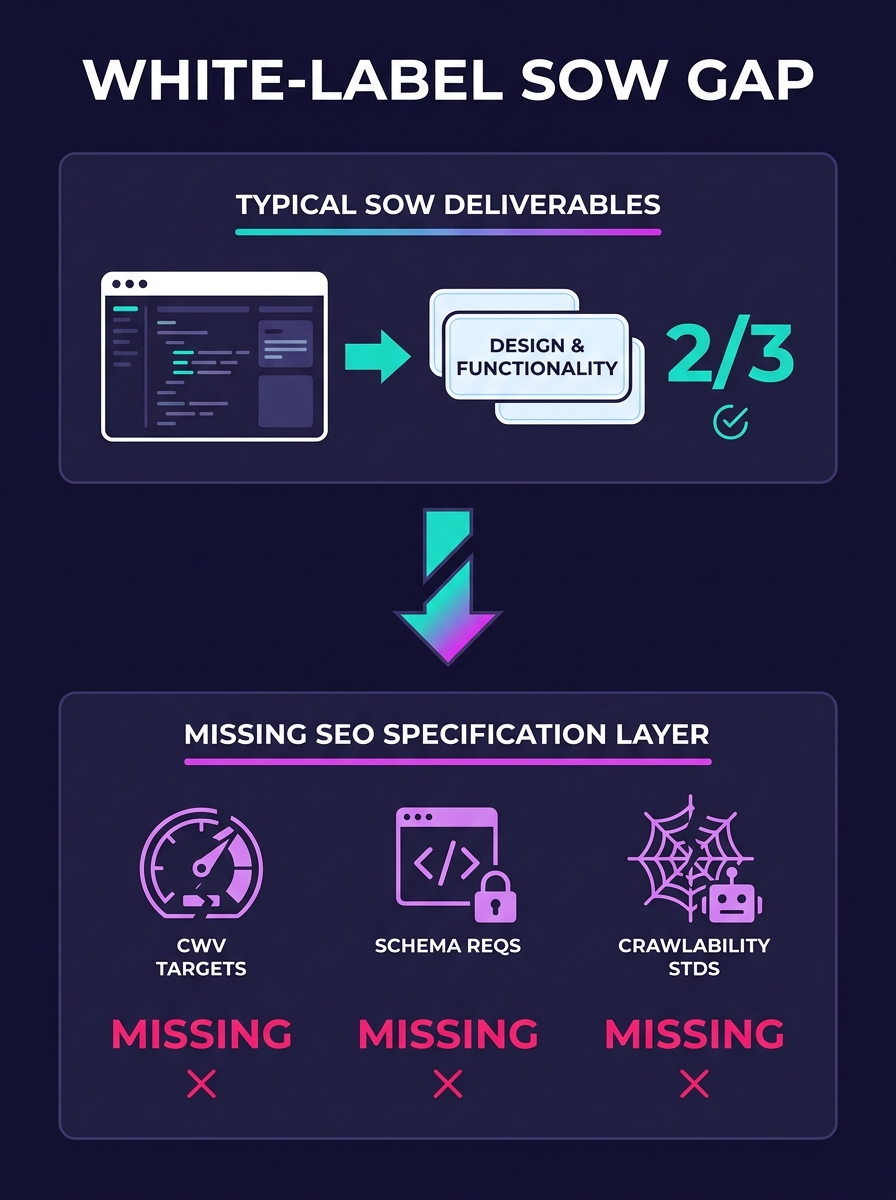
Every white-label engagement starts the same way: a signed SOW, a Slack channel, and a shared staging URL. What's almost always absent is a binding specification for SEO deliverables. According to Growth Rocket's agency workflow research, most agencies have onboarding checklists and offboarding procedures, but very few have documented, step-by-step handoff protocols for the dozens of internal transitions that happen every week. That finding tracks with what we see across the white-label WordPress space constantly.
The problem compounds when you remember that your developer never meets your client. They don't hear the client say "organic traffic is our top priority" or "we're spending $14,000 per month on paid search and need the landing pages to load under 2 seconds." Without that context, the developer optimizes for visual fidelity and functional completeness. LCP thresholds of 2.5 seconds, CLS limits of 0.1, and INP targets under 200 milliseconds become afterthoughts because nobody wrote them into the handoff document.
This is the origin of white-label quality assurance failures. The contract covers deliverables (pages, features, plugins), but the specification gap around SEO performance means the developer is working to a standard that doesn't match what the client's rankings depend on. If your partner vetting process didn't include SEO benchmarks, this gap was baked in from the start.
Week Three: Builds Start Arriving
The first staging build typically drops 2 to 3 weeks into a project. The agency PM reviews it against the design comp. Colors match. Layout works on mobile. Contact forms submit. The build gets approved and pushed to the client for feedback.
What nobody checks at this stage tells the real story. Sonar's research on outsourced development identifies hidden code quality issues as the number-one risk of outsourcing, with security vulnerabilities and scope misalignment following close behind. In a WordPress context, those hidden issues look like: render-blocking CSS loaded in the header adding 800 to 1,200 milliseconds to LCP, uncompressed hero images at 2.4 MB, missing alt attributes on 40% or more of images, schema markup that validates syntactically but references the wrong entity type, and redirect chains from staging URLs that persist into production.
A practical pre-review workflow helps here. AlterSquare's QA research recommends running automated tools like SonarQube or ESLint for a maximum of 15 minutes to identify basic issues before human review begins. For SEO-specific checks, that 15-minute automated pass should include a Lighthouse audit (flagging any performance score below 75), a Screaming Frog crawl of the staging URL (checking for 404 errors, missing H1 tags, and duplicate title tags), and a structured data test through Google's Rich Results validator.
The white-label developer doesn't skip these checks out of malice. They skip them because the handoff document didn't specify them, and because developer accountability without visibility is structurally impossible when nobody defined what "quality" includes.
When Google Search Console Tells You What Your Partner Didn't
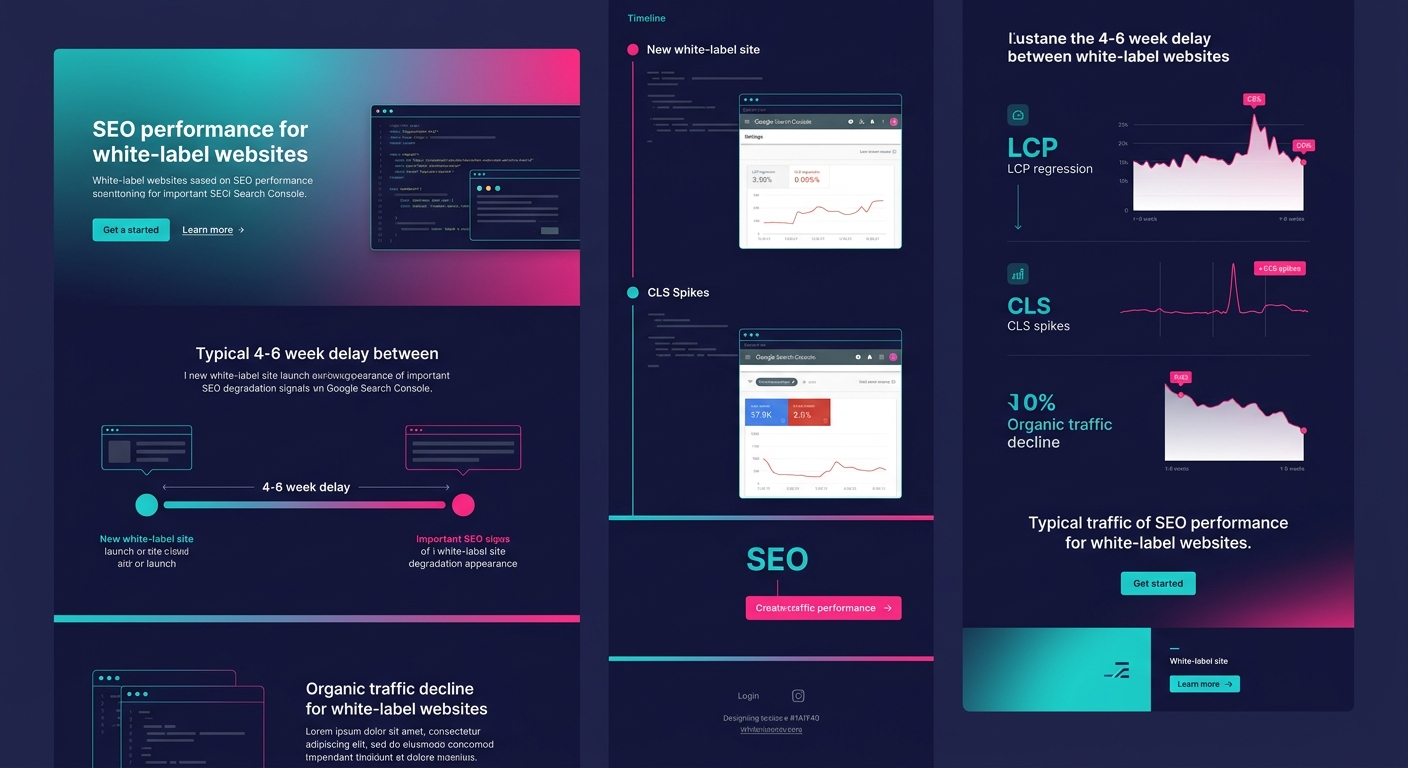
The timeline is consistent. The site launches. Organic impressions hold steady for 4 to 6 weeks because Google is recrawling and reassessing. Then the drops begin.
A typical pattern: pages that previously loaded in 1.8 seconds now report 3.6-second LCP in CWV field data. CLS spikes to 0.22 because a lazy-loaded ad container doesn't have explicit width and height attributes. The new WooCommerce product pages use JavaScript-rendered content that Googlebot doesn't fully index, and 30% of product listings disappear from search results within 8 weeks.
Your client sees a 15% to 25% decline in organic traffic and asks what happened. You didn't change the SEO strategy. You didn't touch the content. The developer built exactly what was requested. The problem is that agency client handoff protocols didn't include SEO acceptance criteria, so nobody caught the performance regression before launch.
This is where the concept of design system drift extends into SEO territory. Drift happens silently across your portfolio as each build introduces slightly different performance characteristics, slightly different schema implementations, and slightly different crawlability profiles. Multiply that across 20 or 50 client sites and the pattern becomes a systemic SEO liability.
Building the Feedback Loop That Should Have Existed on Day One
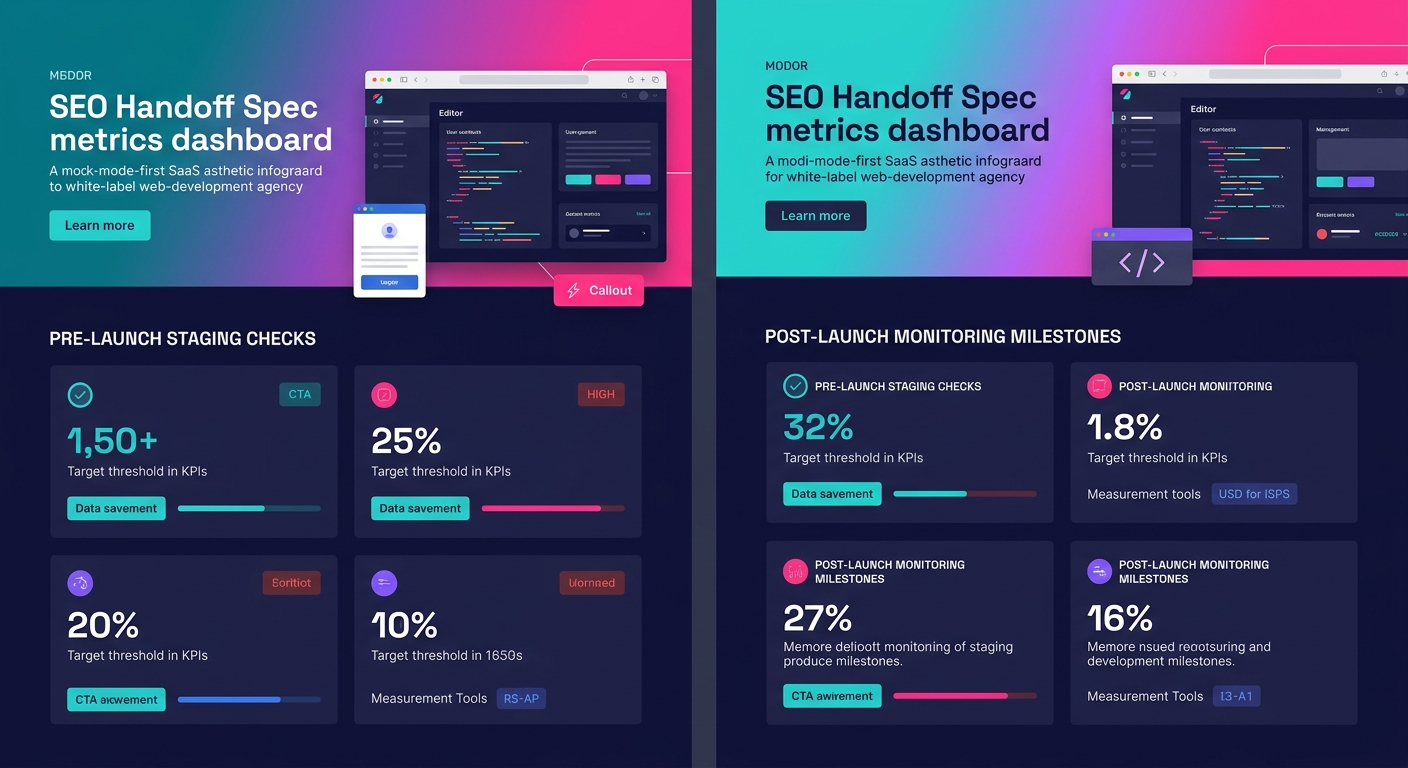
The fix starts with a single document that becomes mandatory at every handoff point: brief-to-developer, staging review, pre-launch QA, and post-launch monitoring. We call this the SEO Handoff Spec, and it travels alongside every project brief your white-label partner receives.
BMD Creatives' evaluation framework emphasizes that cross-browser testing and responsive design validation should be standard practices, and that agencies should ask for concrete examples of how partners handle compatibility challenges. Extend that principle to SEO. The spec should include 7 non-negotiable checkpoints:
- Target LCP for the page type (under 2.5 seconds for landing pages, under 2.0 seconds for pages with paid traffic)
- CLS budget per template (0.1 maximum, with explicit dimension requirements for all dynamic elements)
- Schema type and properties for each page template (Product, LocalBusiness, Article, FAQ, with required fields listed)
- Internal linking structure requirements (minimum 3 contextual internal links per page, breadcrumb markup on all subpages)
- Image optimization standards (WebP format, maximum 200 KB per image, mandatory alt text with keyword context)
- Crawlability requirements (no JavaScript-dependent rendering for primary content, XML sitemap inclusion verified, canonical tags specified)
- Redirect mapping document for any URL changes, reviewed by the SEO team before implementation
The developer gets this document with every brief. The staging review doesn't pass without a Lighthouse report attached. The post-launch check happens at 48 hours, 2 weeks, and 6 weeks using Search Console data.
Developer accountability without visibility requires that the specification itself carries the client context your partner will never get from a face-to-face conversation.
Metrics That Replaced Gut Feeling
Unifyr's partner metrics research puts it bluntly: without defined metrics, partner programs run on intuition and anecdote. Channel account managers develop opinions about which partners are "good" based on personal relationships, and program decisions get driven by the loudest voices rather than data.
The same dynamic plays out in white-label WordPress partnerships. Your PM thinks the developer "does great work" because the sites look good. Your SEO team thinks the developer "keeps breaking things" because rankings slip after every launch. Neither perspective includes numbers.
Here's what measurable developer accountability looks like for SEO outcomes across a white-label portfolio:
| Metric | Target | Measurement Point | Tool |
|---|---|---|---|
| LCP (field data) | Under 2.5s | 6 weeks post-launch | CrUX / Search Console |
| CLS (field data) | Under 0.1 | 6 weeks post-launch | CrUX / Search Console |
| INP (field data) | Under 200ms | 6 weeks post-launch | CrUX / Search Console |
| Lighthouse Performance | 80+ | Pre-launch staging | Lighthouse CI |
| Schema validation errors | 0 | Pre-launch staging | Rich Results Test |
| Broken internal links | 0 | Pre-launch staging | Screaming Frog |
| Missing alt text | 0% of images | Pre-launch staging | Screaming Frog |
| Index coverage errors | 0 new errors | 2 weeks post-launch | Search Console |
Track these per developer, per project, over 6 months. Patterns emerge fast. One developer might consistently hit performance targets but miss schema requirements. Another might nail technical SEO but introduce CLS regressions on every WooCommerce build. The data tells you where to tighten the spec and where to invest in training.
Organizations with structured onboarding protocols see 2.5 times more revenue growth and 82% higher retention among team members, according to recent industry benchmarks. Those numbers apply to white-label partnerships as directly as they apply to internal hires. Your onboarding playbook should include this metrics framework from day one.
Where the Protocol Stands Now
The agencies running structured agency client handoff protocols with embedded SEO specifications report catching 85% to 90% of performance regressions before launch instead of discovering them through Search Console alerts 6 weeks later. The protocol adds roughly 45 minutes of review time per project (15 minutes automated tooling, 30 minutes human review against the spec), and that investment prevents the 8 to 12 hours of emergency debugging and client relationship repair that a post-launch SEO regression demands.
The protocol also changes the relationship with your white-label partner. When technical debt compounds across client portfolios, it's usually because feedback was vague ("make it faster") rather than specific ("LCP on the /services page is 3.8 seconds; the hero image is 1.9 MB and the above-fold CSS bundle is render-blocking at 340 KB"). Specific feedback, anchored to the metrics table above, gives your developer actionable information they can fix in a single revision cycle instead of 3 rounds of back-and-forth.
Silent quality drift in white-label SEO work is a structural problem with a structural solution. The developer who never meets your client will never absorb their priorities through osmosis. The handoff spec carries that context in a format that's measurable, auditable, and tied to the ranking outcomes your agency's reputation depends on. Write the spec once, enforce it at every handoff, and update it quarterly as Google's ranking signals shift. The 45 minutes per project is the cheapest insurance your SEO retainers will ever buy.