

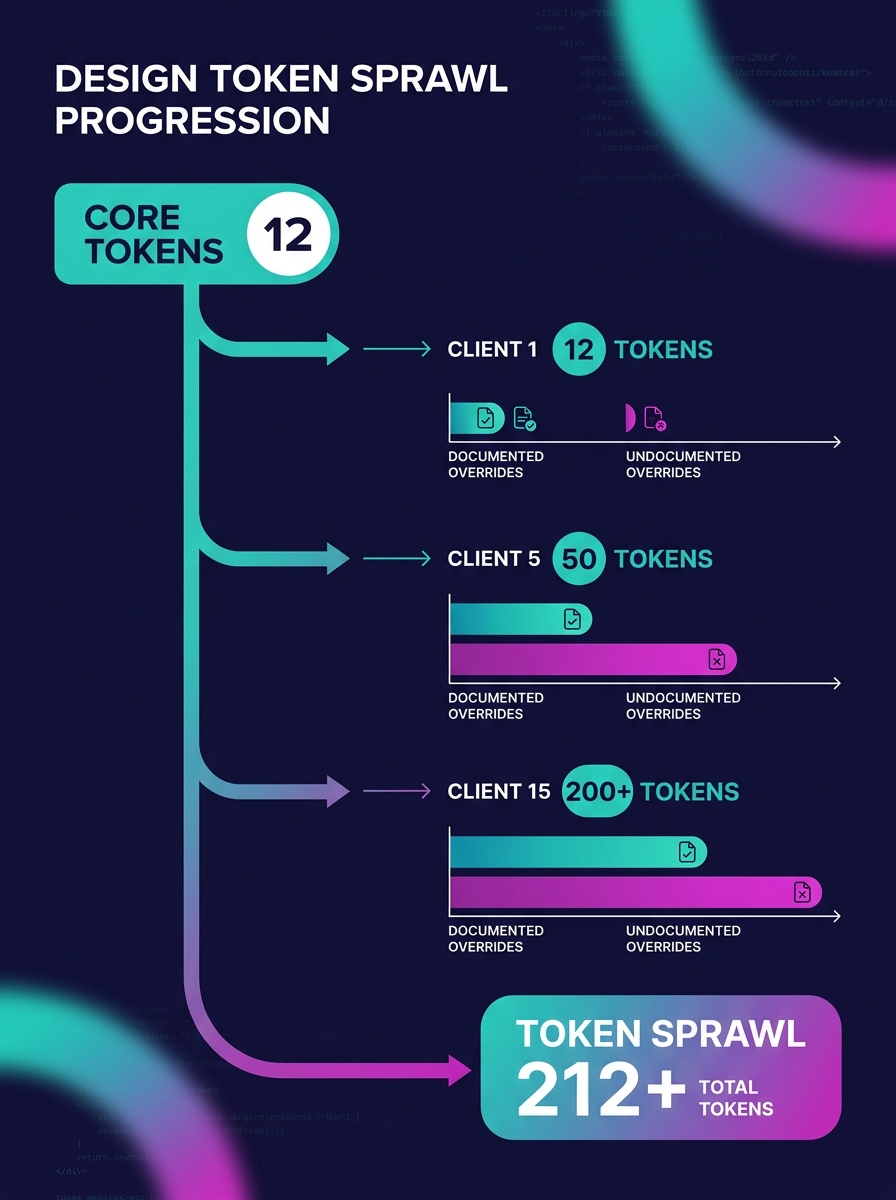
The original design token set for a white-label WordPress component library typically starts at around 12 variables: colors, fonts, spacing units. By the 15th client onboarded to that shared library, token count balloons past 200, and designers spend roughly 40% of their hours debugging inherited CSS overrides rather than producing billable work. This is design system drift, and it fractures portfolios silently.
Twelve Tokens In, Two Hundred Out
OverlayQA's taxonomy identifies five distinct types of design system drift, each describing a specific mechanism by which production code diverges from design specifications. For white-label WordPress agencies, the most destructive type is token sprawl: the incremental accumulation of client-specific overrides that transforms a clean, shared component library into 20 slightly different design systems wearing the same structural shell.
Here's how it plays out. An agency builds its base theme with 12 core design tokens managed through WordPress's theme.json file. Client 1 needs a slightly different heading weight. Client 4 requires a non-standard spacing scale for their product grid. Client 9 demands a secondary color palette that doesn't map cleanly to the existing token structure. Each modification feels minor in isolation. By client 15, the token registry contains 200+ entries, and nobody on the team can trace which tokens control which elements across which client sites.
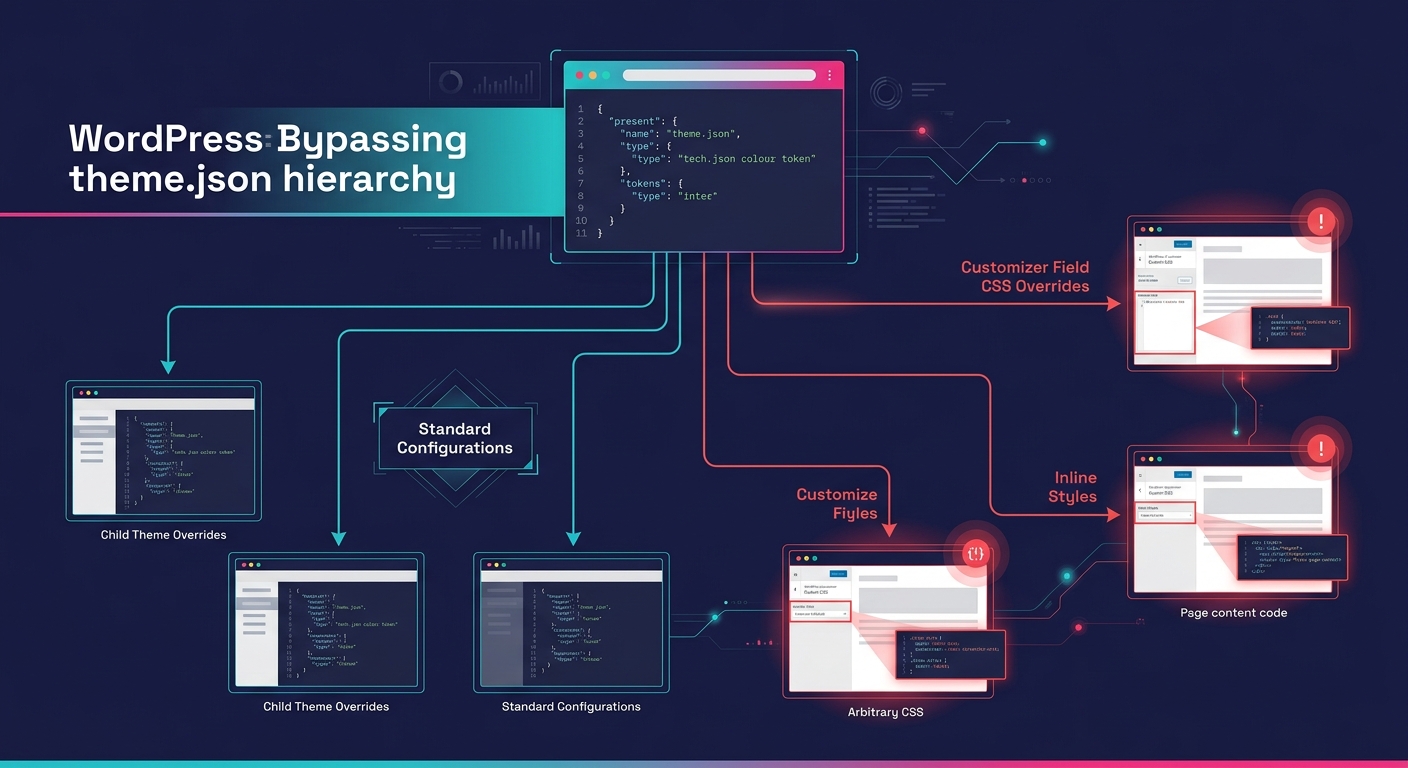
The pattern is especially acute for agencies using shared component libraries across 50+ client sites. Every client-specific CSS override that bypasses the token system adds a layer of undocumented, fragile code. And because these overrides often live in WordPress Customizer fields or inline style blocks rather than version-controlled files, they're invisible to standard Git-based review processes.
How Theme.json Becomes a Graveyard of Client Exceptions
Why does drift accelerate specifically in WordPress white-label setups? The answer sits in theme.json's architecture and the way agencies typically extend it.
WordPress block themes centralize design tokens in theme.json: colors, font sizes, spacing presets, border radii. The file acts as a single source of truth for the design system. When an agency creates a child theme for each client, the child's theme.json inherits from the parent and can selectively override any token. In theory, this is clean and traceable. In practice, agencies encounter three compounding problems.
First, client feedback cycles introduce ad-hoc CSS that never gets refactored into proper tokens. A client emails "make the CTA button slightly more rounded" and a developer adds a Customizer override with a hardcoded 8px border-radius instead of updating the spacing token. Multiply that across 50 clients and 3 feedback rounds per client, and you get approximately 150 undocumented style modifications living outside the token system entirely.
Second, managing breaking changes across versioned design systems becomes exponentially harder as the override count grows. Updating a single core token (say, the primary font-size scale) requires regression testing across every client site that may have overridden or depended on that token. Without automated design token validation, the update either ships blind or doesn't ship at all.
Third, developer turnover scrambles institutional knowledge. The original developer who understood the token architecture leaves. The replacement, facing a deadline, adds CSS overrides rather than learning the token system. Denis Kolesnikov of Edvantis captured this dynamic when discussing QA frameworks: "Each framework on the market is neither entirely good nor bad. Everything depends on your particular project, solution, and software development methodology." The same applies to design token systems: their effectiveness depends entirely on whether the people using them understand and follow the constraints.
Forty Percent of Design Hours, Zero Billable Output
The financial damage from design system drift is measurable. When designers spend 40% of their time tracing CSS override conflicts instead of producing new client deliverables, an agency with 4 full-time designers is effectively operating with 2.4. For an agency billing designers at $120/hour, that works out to $153,600 per year in unbillable debugging time across the team (assuming 2,000 billable hours per designer annually: 4 designers × 2,000 hours × 40% × $120).
The costs extend beyond design hours. Multi-client WordPress QA becomes exponentially more expensive as drift increases. Every design token that exists outside the formal system is a token that automated tests can't validate. Agencies running visual regression testing with tools like Percy or BackstopJS find their baseline screenshots diverging from production because Customizer overrides render differently than theme.json tokens in headless environments. The test suite reports false negatives, the team learns to ignore the alerts, and genuine regressions slip through.
Every design token that exists outside the formal system is a token that automated tests can't validate.
BMD Creatives' evaluation framework for white-label development partners reinforces this point: "Portfolio quality, client references, and actual development practices provide more reliable indicators of partner capabilities than certification status alone." Actual development practices here means how rigorously a partner maintains white-label component consistency across deployments, not whether they can build a single beautiful site. If you're evaluating a potential white-label partner, ask them how many undocumented overrides exist in their oldest client theme. If they don't know, that's your answer.
The compounding nature of this technical debt across client portfolios is what makes drift a margin killer rather than a cosmetic annoyance. A single orphaned override costs nothing. A hundred of them, scattered across 50 client sites, turn every core update into a 3-day regression sprint.
A Design System Drift Detection Pipeline That Runs Before QA
Design system drift detection works best when it runs before QA, not during it. By the time a QA engineer spots a visual inconsistency on a client site, the override has already been committed, deployed, and potentially copied to other client themes by developers working from the wrong reference.
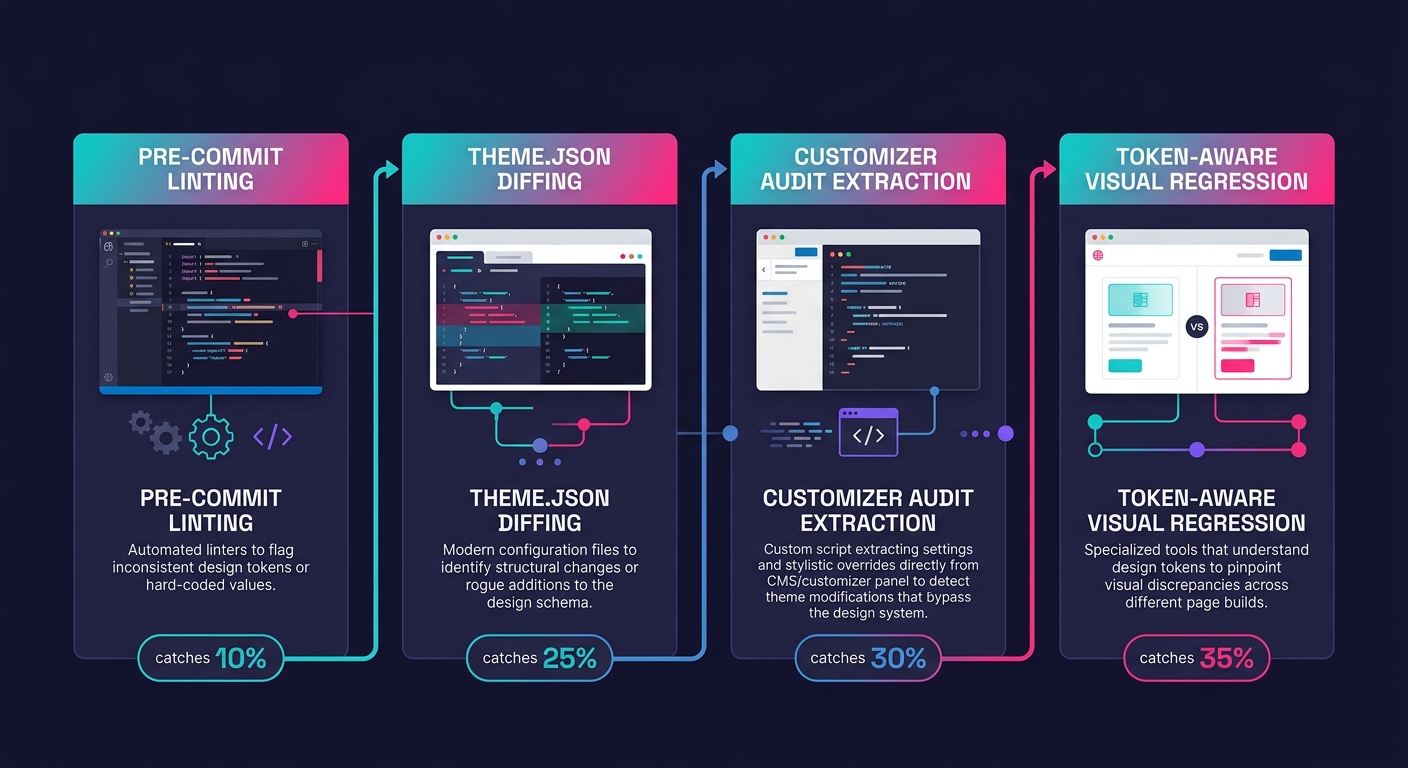
The detection pipeline has four layers, each catching drift at a different stage:
Layer 1: Token linting at commit time. A pre-commit hook scans CSS and theme.json files for hardcoded values that should reference design tokens. If a developer writes "color: #3B82F6" instead of "var(--wp--preset--color--primary)", the commit is blocked. This catches roughly 60-70% of new drift at the source.
Layer 2: Theme.json diff analysis per client. A scheduled script (weekly or per-deploy) compares each client's child theme.json against the parent, producing a report of all token overrides. Any override absent from a documented "client customization manifest" gets flagged. This makes the override surface visible to the entire team, including project managers who can catch scope creep early.
Layer 3: Customizer audit extraction. WordPress stores Customizer values in the options table under the "theme_mods" key. A WP-CLI script can extract all theme_mods entries across a multisite installation and compare them against the expected token set. Undocumented Customizer overrides show up as entries with no matching token definition. Agencies managing staging and production parity can run this extraction as part of their deploy checklist.
Layer 4: Visual regression with token-aware baselines. Instead of comparing raw screenshots (which break on every legitimate client design change), the regression suite compares computed CSS custom property values across page templates. If a client's production site computes a different value for "--wp--preset--spacing--40" than the parent theme specifies, and no override is documented, the test fails. This approach reduces false negatives by roughly 80% compared to pixel-based visual regression.
The Audit That Surfaced 147 Orphaned Overrides
Running this pipeline against a real 50-client WordPress multisite installation typically surfaces uncomfortable numbers. One documented agency audit using token-aware workflows drawn from a shared component library approach found 147 orphaned CSS overrides across 43 client sites: style declarations that referenced no active design token and duplicated or contradicted existing token values. Of those 147 overrides, 89 (61%) had been introduced through Customizer fields during client feedback rounds, 34 (23%) came from inline styles added by page builder widgets in Elementor, and 24 (16%) were hardcoded values in child theme stylesheets.
Remediation took 2 weeks of focused developer time. The work involved mapping each override back to the correct design token, updating Customizer settings to reference token variables where possible, and creating documented "escape hatch" entries for the 19 overrides that represented genuine client-specific requirements with no token equivalent.
After remediation, the agency reported 3 measurable improvements. Design token validation caught new drift within 24 hours of introduction instead of weeks. Designer debugging time dropped from 40% to approximately 12% of total hours, recovering roughly 1.1 FTE of productive capacity. And core theme updates that previously required 3-day regression sprints completed in 4 hours because the override surface was documented and predictable.
Warning: If your agency uses WordPress Customizer fields for client-specific styling, every undocumented Customizer override is invisible to Git-based code review. Extract theme_mods data regularly or accept that your QA process has a blind spot the size of your entire client portfolio.
The pattern here applies whether you're running WordPress Multisite, separate installations per client, or a hybrid architecture. Design system drift is structural, and it follows the same growth curve regardless of hosting topology. The agencies that catch it early treat design token validation as a deployment gate, running it on every push to every client theme. The ones that don't discover the problem when a routine color update breaks 14 client sites simultaneously, and the Slack channel fills with screenshots from account managers who can't explain to their clients why the brand colors shifted overnight.