

Spendflo's 2026 SaaS agreement guide specifies three mandatory exit components for vendor contracts: data portability, transition support, and explicit exit costs. White-label WordPress outsourcing contracts routinely omit at least one of these, creating lock-in risk that agencies discover only when they try to leave.
TL;DR: White-label vendor lock-in stems from missing contract clauses, not bad intentions. Agencies need data portability agreements, defined transition support, and documented exit costs in every WordPress outsourcing contract. Negotiate all three before signing, because your leverage drops to zero once you're mid-engagement.
How Lock-In Builds Inside WordPress Outsourcing Contracts
Lock-in rarely starts as a deliberate trap. It accumulates through contract omissions that seem minor at signing but become expensive at exit. Codeable's agency partnership guide identifies the core trade-off: month-to-month agreements allow quick exits but expose agencies to price increases with minimal notice, while long-term contracts lock in pricing and capacity but reduce flexibility.
FatLab Web Support's vendor evaluation guide flags mandatory 12-month contracts as a warning sign. Their reasoning: "Long-term lock-in suggests they're worried about retention." If a vendor needs a 12-month minimum to keep your business, the quality of their work alone isn't doing it for them.
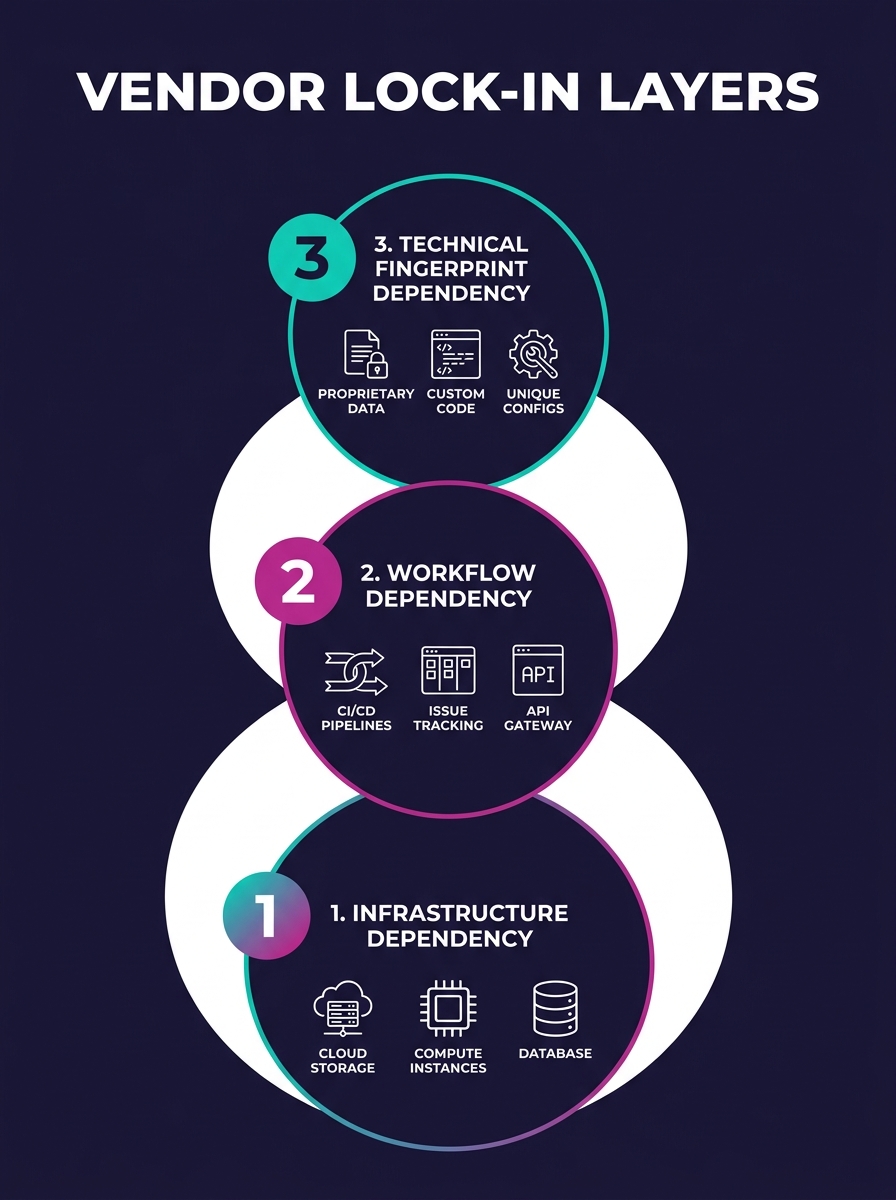
Lock-in compounds in three layers. First, your client sites accumulate custom code, plugin configurations, and staging environments on the vendor's infrastructure. Second, your team builds workflows around the vendor's communication patterns, deployment tools, and revision cycles. Third, your clients start interacting with deliverables that carry the vendor's technical fingerprint. Each layer adds switching cost.
An agency managing 30 client sites through a single white-label partner faces a migration timeline measured in weeks, not days. Every custom theme, every WooCommerce configuration, every ACF field group represents data that needs extraction, testing, and redeployment. Without pre-negotiated terms for how that extraction works, you're negotiating from weakness.
Five Clauses That Decide Whether You Can Walk Away
The difference between a clean exit and a costly one comes down to contract language you set before the work begins. These are the five clauses that matter most, ranked by the damage their absence causes.
1. Data Export and Portability. SaaS agreement clauses with data portability terms define the scope and eligible data types transferable between providers, specifying common export formats such as CSV and JSON to ensure interoperability. Your WordPress outsourcing contract needs the same specificity. Define which assets you get back: theme files, plugin licenses, database exports, media libraries, DNS records, staging environments, and Git repositories.
2. Termination for Cause. Sirion's contract negotiation framework outlines that termination for cause must specify the exact breaches that trigger contract end. For white-label partnerships, those triggers should include missed deadlines exceeding 5 business days, security incidents affecting client data, unauthorized subcontracting, and consistent quality scores below your agreed threshold.
3. Transition Support Period. Spendflo's 2026 guide recommends that contracts describe "the process of secure deletion or destruction of customer data, as well as business continuity during migration." Your contract should specify 30, 60, or 90 days of transition support where the departing vendor assists with handoff to your new partner or internal team.
4. Notice Period and Termination Window. Standard WordPress outsourcing contracts range from 15-day to 90-day notice periods. A 90-day notice requirement on a month-to-month contract effectively makes it a quarterly contract. Match the notice period to your actual ability to find a replacement, which typically takes 2 to 4 weeks for agencies that maintain a vetted partner scorecard.
5. IP and Code Ownership. Every line of code written for your clients should transfer to you upon payment. This includes custom plugins, theme modifications, deployment scripts, and documentation. If the vendor retains IP rights, you're licensing your own client deliverables back from them.
Warning: If your vendor refuses to sign NDAs, that's a separate red flag. FatLab Web Support notes: "Any legitimate white label partner should sign non-disclosure and non-compete agreements. If they won't, they're not committed to invisibility."
Data Portability Agreements: The Clause Agencies Negotiate Last and Regret First
Why does data portability get skipped? Because at contract signing, nobody is thinking about leaving. The relationship is new. Optimism runs high. Data portability agreements feel like planning for failure. But agency vendor risk management requires exactly this kind of uncomfortable foresight.
A WordPress site contains at least 7 distinct data categories that need portability coverage: database content (posts, pages, custom post types, user data), media files, theme and child theme files, plugin configurations, server-level settings (cron jobs, .htaccess rules, PHP configurations), DNS and SSL records, and analytics or tracking integrations. Your data portability clause should list each category and specify the export format.
The PayPal data portability clause referenced on Law Insider provides a useful model. Upon termination or expiry, the vendor agrees to provide the new service provider with transferable data upon written request. The critical phrase is "upon written request," because without a contractual obligation, vendors have no deadline or format requirement for delivering your data.
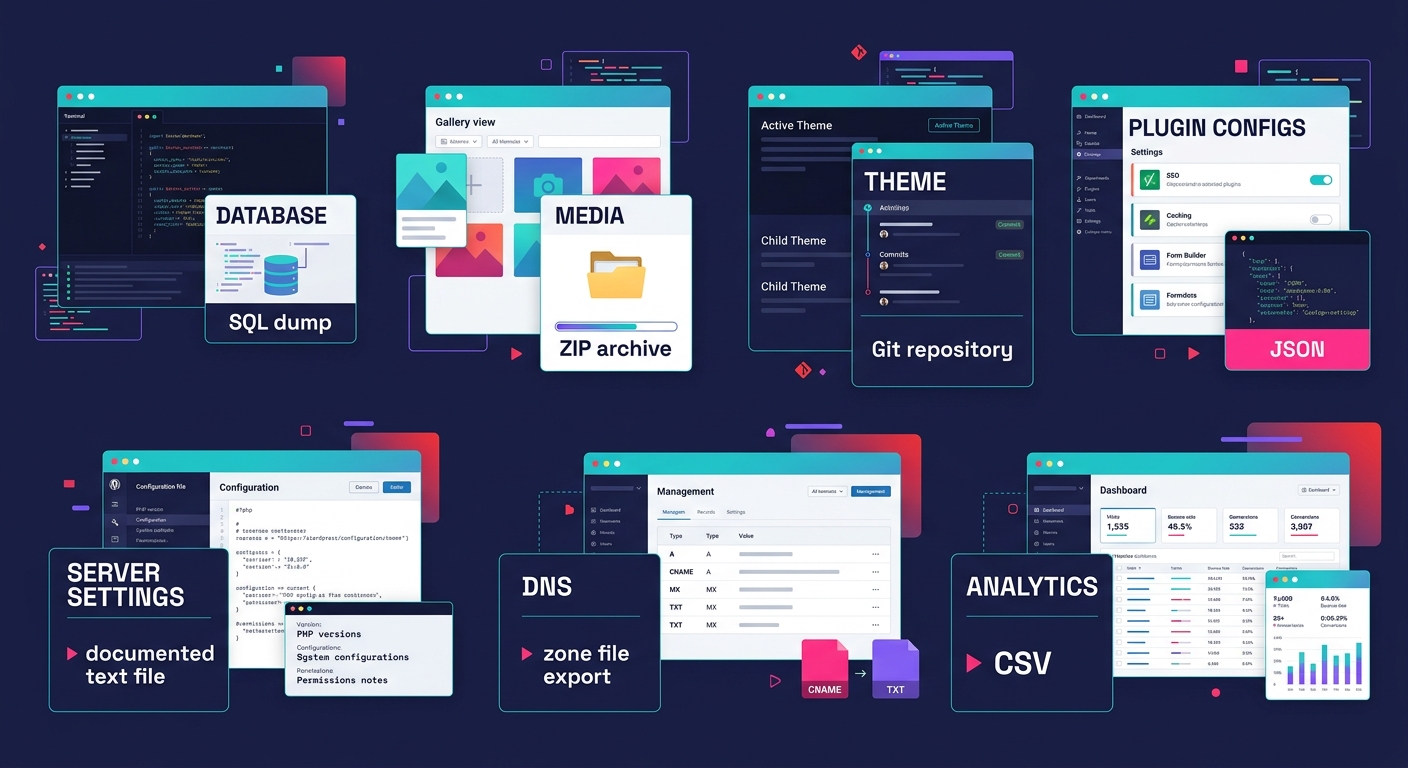
Specify three things in every data portability agreement. Format: SQL dumps for databases, ZIP archives for media, Git repositories for code. Timeline: delivery within 5 to 15 business days of written request. Cost: data export included in the base contract, with no per-export fees.
If you're building WordPress outsourcing contracts from scratch, the StandardFusion DPA framework offers useful guardrails. Their guidance requires that organizations outsourcing data processing demonstrate an assessment and monitoring process guaranteeing sub-processors maintain equivalent security standards. For agencies working with dedicated WordPress developers through a white-label partner, this means your contract should address whether the vendor uses sub-contractors and what security requirements apply to them.
Month-to-Month vs. Annual: A Side-by-Side Contract Comparison
The choice between contract lengths involves trade-offs that go beyond monthly cost. Here's how the two models compare across 6 dimensions that affect white-label vendor lock-in:
| Dimension | Month-to-Month | 12-Month Annual |
|---|---|---|
| Exit Speed | 15-30 day notice typical | 30-90 day notice plus early termination fees of 2-4 remaining months |
| Pricing Stability | Vendor can raise rates with 30-day notice | Rate locked for 12 months |
| Capacity Guarantee | No guaranteed developer allocation | Dedicated hours per month |
| Leverage at Renewal | High (you can leave anytime) | Low until final 60 days of term |
| Data Portability Risk | Lower (shorter relationship, less data accumulation) | Higher (12+ months of custom work, configs, dependencies) |
| Typical Discount | 0% (base rate) | 10-20% below month-to-month rate |
As Codeable's research frames it: "Long-term contracts lock in pricing and capacity but reduce flexibility." The 10-20% discount on annual contracts looks attractive until you calculate the early termination penalty. If your annual contract charges 3 remaining months as an exit fee, your effective savings evaporate in the first quarter.
Your leverage as a client drops to near-zero between month 3 and month 10 of a 12-month contract. The vendor knows you won't pay the termination fee, and you know you can't leave without one.
The hybrid approach works better for agencies managing 20 or more client sites. Start month-to-month for the first 90 days while you evaluate quality. If the work holds up, convert to a 6-month term (not 12) with a data portability clause and a 30-day termination-for-cause provision. This structure gives you pricing stability without a full year of commitment. Our white-label development services are built to work within these kinds of flexible arrangements.
For agencies looking to reduce single-vendor dependency entirely, a split-vendor model distributes risk. Assign 60% of project volume to your primary partner and 40% to a secondary partner. Both operate under identical WordPress outsourcing contracts with matching portability clauses. If either vendor underperforms, you shift volume without scrambling. Having pre-vetted web development talent ready as a secondary option makes this model practical rather than theoretical.
Quarterly Vendor Risk Audit in Practice
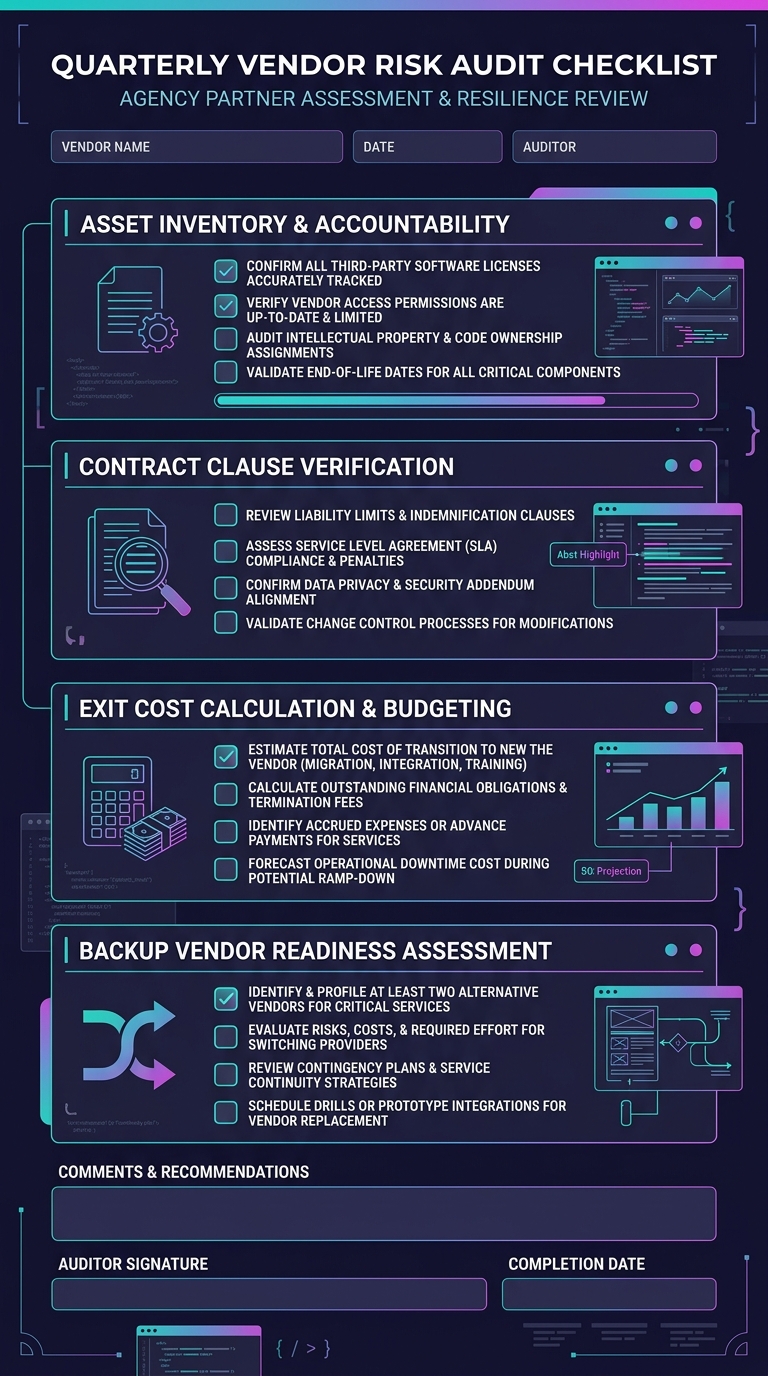
Every 90 days, run a 15-minute agency vendor risk management review across your active white-label partnerships. Check 4 items:
- Asset inventory. Can you list every client site, repository, and configuration file that lives on the vendor's infrastructure? If you can't produce this list in under 10 minutes, your portability is already at risk. Maintaining a structured partner handoff protocol keeps this inventory current.
- Contract clause check. Pull up your contract and verify that data export, termination for cause, transition support, notice period, and IP ownership are all present with specific terms. Vague language like "reasonable efforts" or "standard procedures" offers zero protection during a dispute.
- Exit cost calculation. If you left this vendor today, what would it cost? Add up early termination fees, migration labor (estimate 2 to 4 hours per client site for a standard WordPress migration), replacement vendor onboarding time, and any client-facing disruption.
- Backup vendor readiness. Do you have a second vetted partner who could absorb 50% of your volume within 2 weeks? If the answer is no, your risk exposure is higher than it should be.
This quarterly review takes less time than a single scope creep incident, and it directly reduces exposure to the budget overruns that spiral when vendor relationships go sideways.
What The Data Doesn't Tell Us
The contract frameworks from Spendflo, Sirion, and Codeable provide solid structural guidance. But they're built for SaaS and general outsourcing, not specifically for the white-label WordPress agency model where you're reselling work under your own brand. The gap shows up in a few areas.
None of the existing frameworks address brand continuity during transitions. When you switch vendors, your clients shouldn't notice. There's no standard clause language for ensuring visual and functional consistency across the handoff. Agencies treating their developers as partner-class relationships rather than interchangeable vendors tend to navigate these transitions more smoothly, but the contract language hasn't caught up to that reality.
The warranty window data (28 to 90 days post-launch) comes from general industry practice, not from controlled studies of white-label WordPress outcomes. We don't have solid numbers on what percentage of agencies actually enforce warranty claims, or how often those claims succeed under typical contract language.
And the cost of white-label vendor lock-in itself remains poorly quantified. Agencies know it's expensive to switch vendors mid-stream. But the actual dollar figure, broken into direct costs (termination fees, migration labor) and indirect costs (project delays, client churn, team disruption), hasn't been studied at scale in the WordPress agency segment. Until it is, the best proxy remains your own quarterly exit cost calculation, updated every 90 days and treated as a core business metric.