

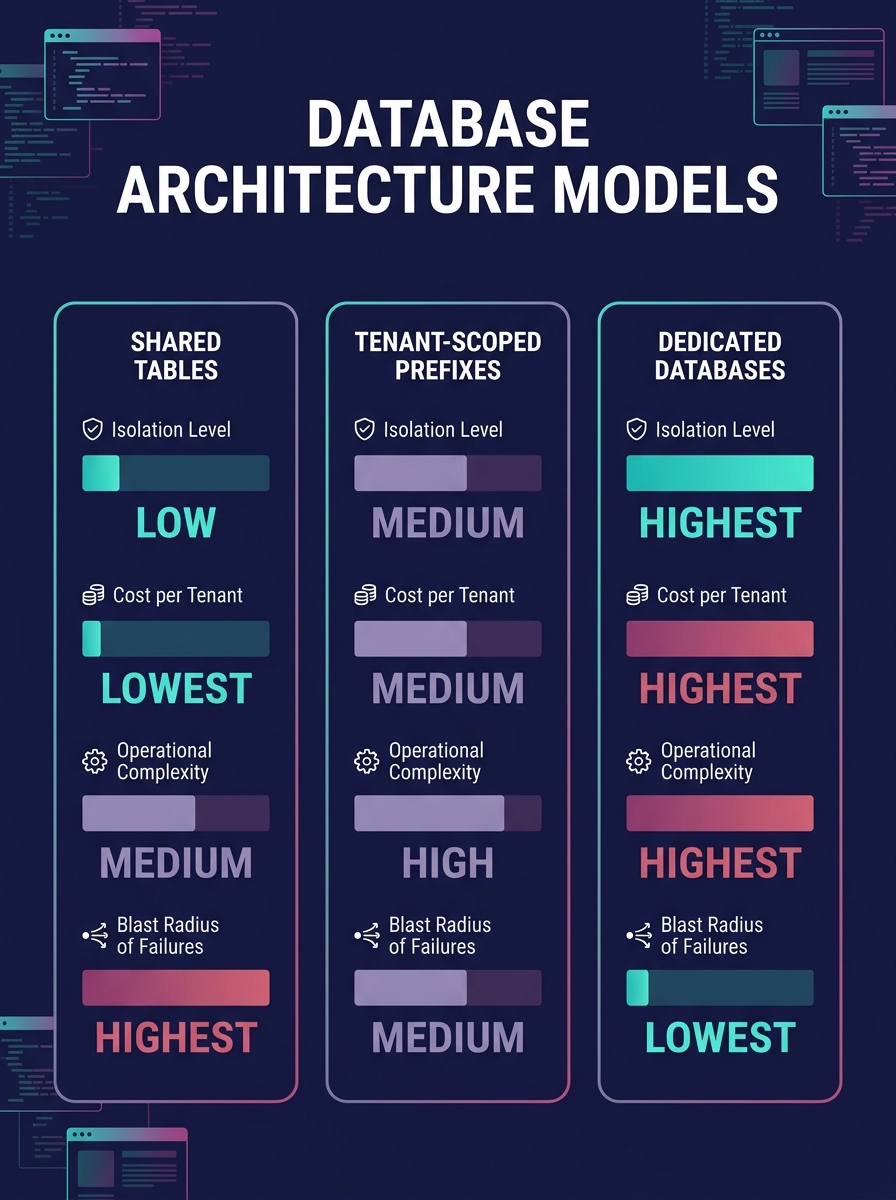
Three multi-tenant database models dominate white-label WordPress architecture: shared tables with row-level filtering, tenant-scoped table prefixes on a single MySQL instance, and fully dedicated databases per client. Each model trades isolation guarantees against query performance and operational overhead, and picking wrong locks agencies into infrastructure they can't afford to rebuild after 25 clients.
TL;DR: Shared tables are cheapest but carry the highest data-leak risk. Tenant-scoped prefixes balance isolation and cost for 20–80 client portfolios. Dedicated databases provide full isolation but demand serious DevOps maturity. The migration pain point typically hits between 15 and 25 clients, when per-site maintenance costs start eating margins.
Why the Database Layer Is the Real Architecture Decision
Everything else in a white-label WordPress stack sits downstream of how you partition tenant data. The database model determines whether one client's traffic spike crashes another client's site, whether a rogue plugin query leaks data across accounts, and whether your team spends 15 minutes per site on core updates or deploys once for 200 sites simultaneously.
BigScoots' analysis of shared hosting environments found that all WordPress sites on shared hosting rely on the same pool of database resources, which means a single slow query from one tenant's WooCommerce checkout can starve every other site's database connections. That's the baseline problem every multi-tenant database design has to solve.
All three models address it at different layers, with different cost profiles and fundamentally different failure modes.
Shared Tables with Row-Level Filtering
The lightest-weight approach stores all tenant data in the same WordPress tables and separates records using a tenant_id column or WordPress's built-in blog_id in Multisite. Every query includes a WHERE clause filtering by tenant identifier.
Upfront cost is minimal — you run one MySQL instance, one set of tables, one backup routine. For agencies managing fewer than 20 clients with similar site structures, this pattern works fine. WordPress Multisite is essentially this model in practice: shared wp_users, shared core tables, tenant-specific content tables prefixed with blog_id.
But the data leakage risk is real and constant. A single missing WHERE clause in a custom query, a plugin that doesn't respect Multisite boundaries, or a poorly written WP_Query filter can expose one client's data to another. The authorization bypass in NEX-Forms that exposed client form submissions is exactly this failure mode in action: a gap in shared data structures that should never have been reachable. According to Plugintify's analysis of multi-tenant data isolation strategies, many plugins that manage data for different user roles within Multisite implicitly use row-level filtering, often relying on blog_id without enforcing strict query discipline at the application layer.
Performance degrades predictably as tenant count rises. At 50+ tenants sharing tables, index sizes grow, query plans shift, and the MySQL query cache (deprecated since MySQL 8.0 but still relevant on MariaDB) becomes less effective. Row counts in wp_posts, wp_postmeta, and wp_options balloon into the millions, and full-table scans that were tolerable at 5 tenants become 3–5 second query times at 80.
Tenant-Scoped Table Prefixes on a Single Database
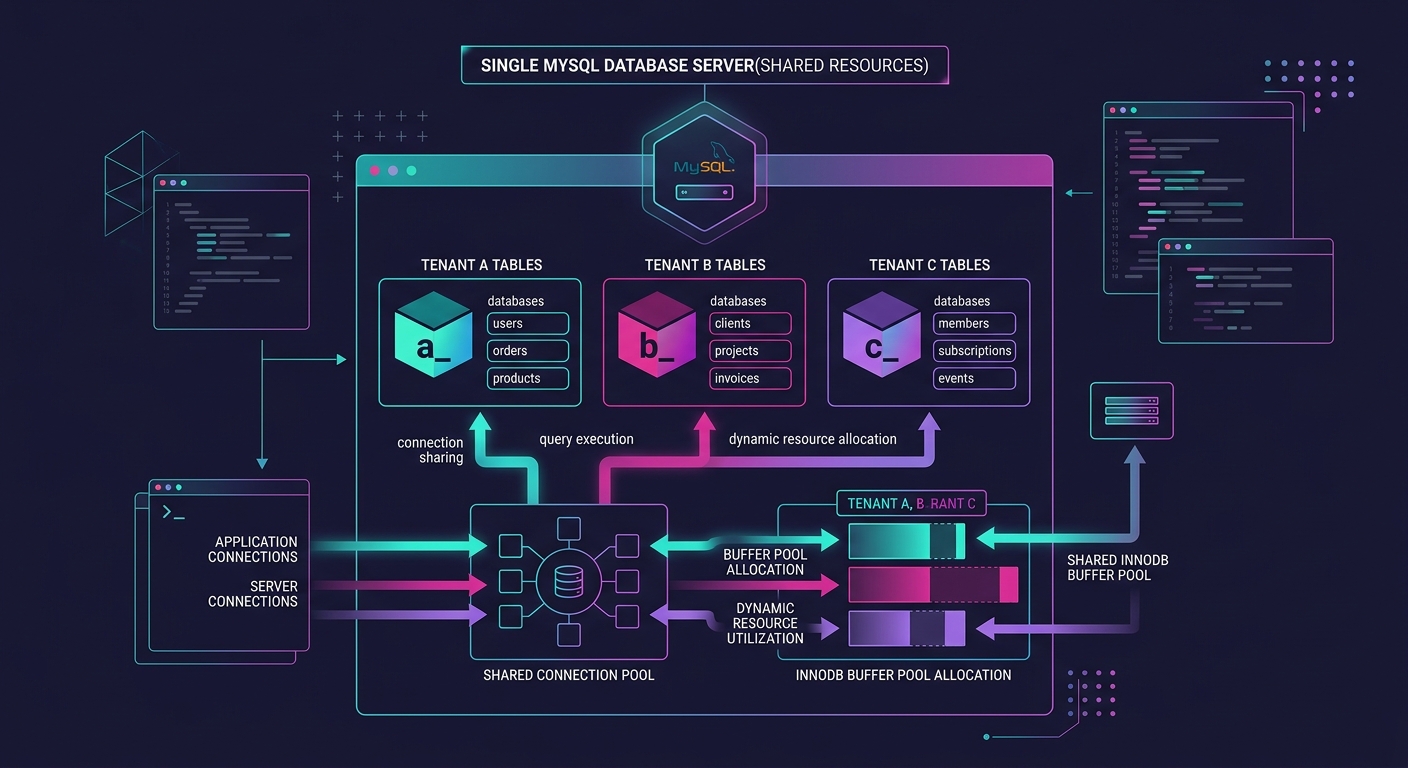
This middle-ground approach gives each tenant its own set of WordPress tables (wp_tenant1_posts, wp_tenant2_posts, etc.) within a single MySQL instance. The GrabWP Tenancy plugin implements exactly this pattern: each tenant gets separate table prefixes and separate upload directories, with the Pro tier adding completely dedicated databases and per-tenant plugin and theme control.
WordPress tenant isolation improves significantly over shared tables with this model. A bug in Tenant A's custom post type query can't accidentally return Tenant B's rows because the tables are physically separate. There's no WHERE clause to forget. Data backups can target individual tenants without dumping the entire database.
The performance profile is more nuanced than agencies expect, though. You still share a single MySQL process, which means all tenants compete for the same InnoDB buffer pool, the same connection limit, and the same I/O bandwidth. A 16GB buffer pool shared across 60 tenants gives each tenant roughly 270MB of warm data in memory. If any single tenant runs a WooCommerce site with 50,000+ products, that tenant's index and data pages push everyone else's warm cache out.
Where this model truly shines is operational efficiency. Updating WordPress core, applying security patches, and deploying plugin updates happens once per server rather than per-site. Tools like wp-multitenant reduce what would be a 15-minute-per-site update across 100 clients down to a single deployment cycle. For agencies that deliver white-label WordPress development at volume, the time savings alone justify this model through 80–100 tenants.
Dedicated Databases Per Tenant
Full database-per-tenant isolation assigns each client their own MySQL instance or, at minimum, a distinct database on a dedicated database server. SpinupWP's scaling guide describes the approach: "A separate database and filesystem will sit behind the app servers. These will both be clustered to improve redundancy and resilience."
One tenant's database crash, corruption, or runaway query affects zero other tenants under this model. Backups, restores, and migrations operate independently. If a client needs PCI compliance for their WooCommerce store, you can point auditors at a single, clearly bounded database with no shared data surface.
The cost is operational complexity that compounds quickly. Plugintify's analysis found that "managing unique environments for each tenant demands extensive automation and highly skilled DevOps" and results in "slower feature deployment" because "rolling out updates across many distinct, dedicated environments is more complex and time-consuming." At 50 tenants, you're managing 50 database instances, 50 backup schedules, 50 sets of credentials, and 50 independent monitoring configurations.
Agencies that adopt this model below 30–40 clients almost always underestimate the ops burden. The common failure pattern: an agency spins up dedicated databases for each client, handles it manually through the first 15, then hits 25 and realizes they've built themselves a full-time database administration job. Without Infrastructure-as-Code tooling (Terraform, Ansible, or Kubernetes operators), dedicated databases become a scaling trap rather than a scaling solution.
The question agencies should ask about their database architecture isn't "which model is most secure?" — it's "at what client count does our current model's operational cost exceed the isolation benefit?"
Side-by-Side Comparison
| Attribute | Shared Tables (Multisite) | Tenant-Scoped Prefixes | Dedicated Databases |
|---|---|---|---|
| Data isolation level | Row-level (WHERE clause) | Table-level (prefix separation) | Instance-level (full separation) |
| Blast radius of failures | All tenants | All tenants (shared MySQL process) | Single tenant |
| Marginal cost per tenant | ~$0 | ~$0.50–2/mo | ~$5–30/mo per instance |
| Update deployment | Once per server | Once per server | Once per tenant |
| Sweet spot (client count) | 5–20 similar sites | 20–80 mixed sites | 30+ high-value or compliance-bound sites |
| Backup granularity | Whole database dump | Per-prefix extraction possible | Per-tenant by default |
| PCI/SOC 2 auditability | Difficult to demonstrate | Possible with documented controls | Straightforward |
How the REST API Layer Changes the Performance Math
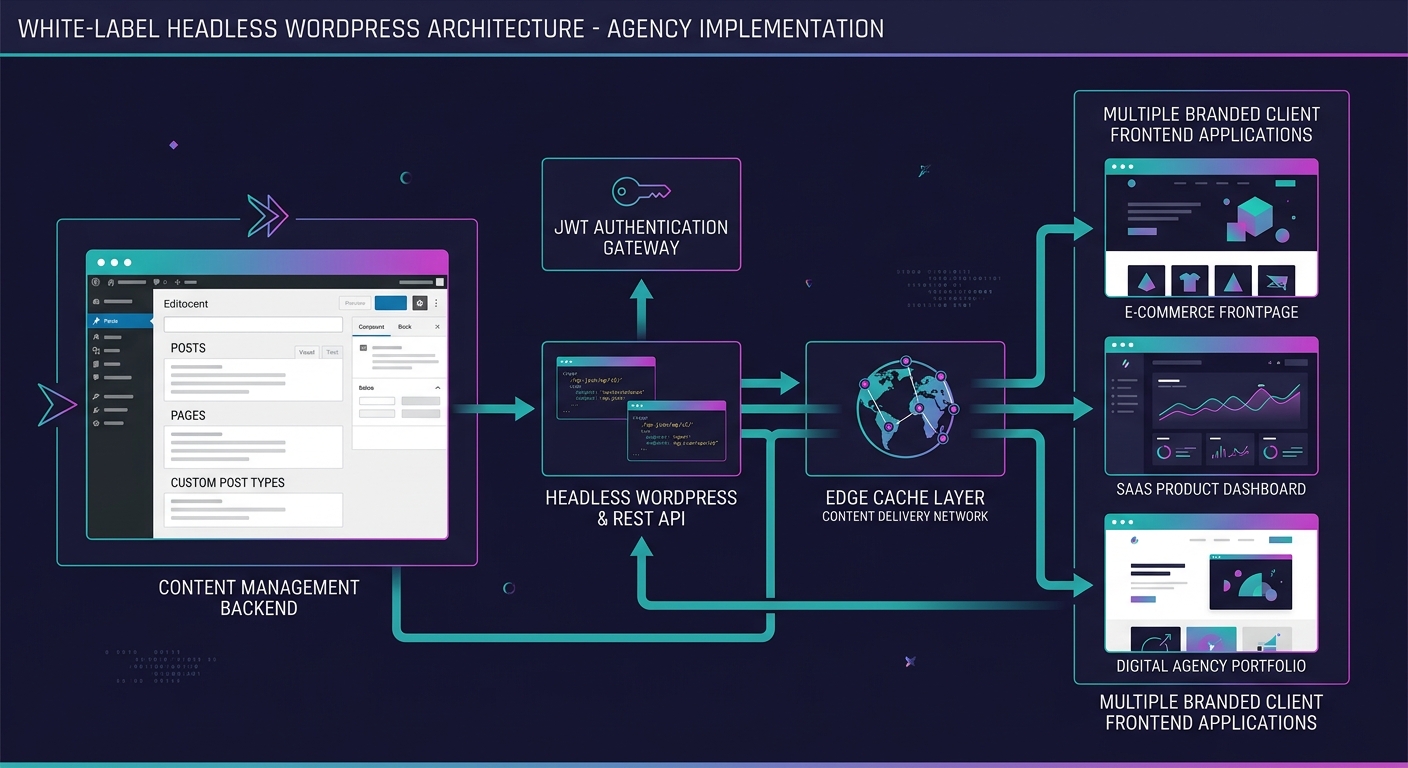
Performance concerns with shared infrastructure scaling shift substantially when you stop serving WordPress directly to browsers and treat it as a headless content engine instead. Developex's white-label SaaS architecture guide argues that white-label platforms need to handle unique operational requirements per client without compromising performance, security, or maintainability — and the architectural pattern that delivers on that is API-first.
Put an edge cache or CDN in front of your REST API endpoints, and most read requests never reach MySQL at all. WordPress handles writes and content management; cached JSON serves the frontend. Cache invalidation fires through WordPress hooks (save_post, updated_option, etc.) so tenants see fresh content within seconds of publishing.
This matters for multi-tenant database design because it drastically reduces the read load that causes contention on shared MySQL instances. A tenant-scoped prefix setup handling 80 clients with aggressive edge caching on API responses sees less database pressure than 15 clients hitting wp-admin and frontend PHP rendering simultaneously. The bottleneck moves from database reads (which caching eliminates for 90–95% of requests) to database writes (content publishing, form submissions, WooCommerce transactions), which are inherently lower-volume.
JWT tokens scoped to specific tenants add an authentication boundary that prevents cross-tenant API access regardless of the underlying database model. We've covered the identity side of this architecture in depth when discussing securing multi-tenant SSO and identity management across shared WordPress infrastructure.
The Decision Framework: Three Variables
Choosing between these models comes down to three variables that interact in ways agencies tend to oversimplify.
Client count trajectory matters more than current headcount. Not where you are today, but where you'll be in 18 months. Starting with shared tables at 8 clients and migrating to tenant-scoped prefixes at 25 is feasible. Starting with dedicated databases at 8 clients and trying to consolidate at 40 because ops costs are crushing you is a painful, data-migration-heavy project that disrupts every client in your portfolio.
Compliance requirements per client can force your hand even at low tenant counts. If even one client needs SOC 2 or PCI-DSS, that client needs demonstrable data isolation. This doesn't mean every client needs a dedicated database; it means your architecture must support mixed isolation levels. GrabWP Tenancy's tiered approach (free shared MySQL, Pro dedicated databases) reflects this reality pragmatically.
Team DevOps capacity determines which model's failure modes you can actually handle. Dedicated databases require Infrastructure-as-Code maturity. Tenant-scoped prefixes require careful MySQL administration. Shared tables require disciplined query writing and plugin vetting. None of these models is "simpler" in absolute terms — they're simpler in different skill dimensions. Match the model to the skills your team already has, and build toward the next tier's requirements before you need them. If you're already working on environment parity across dev, staging, and production, you have much of the foundational discipline that tenant-scoped or dedicated models demand.
Warning: Agencies running 30+ client sites on shared hosting with a single database and no table-prefix isolation are operating with illusory separation. A single plugin vulnerability or rogue query affects every client simultaneously. Audit your [security baseline](/blog/white-label-wordpress-security-checklist) before scaling further.
What Still Isn't Settled
The WordPress ecosystem still lacks a standardized multi-tenant database abstraction layer. GrabWP Tenancy handles prefix isolation and basic dedicated database routing, but no widely adopted plugin covers automatic tenant migration between isolation tiers, cross-tenant query auditing, or per-tenant resource metering on shared MySQL instances.
Kubernetes-based approaches like WPCS.io, documented by WP Mayor as combining multi-tenancy with Kubernetes orchestration, are promising for agencies past 50 tenants but remain opaque in terms of published performance benchmarks. Agencies evaluating these platforms can't easily compare container-per-tenant overhead against traditional VPS-per-tenant setups because the providers haven't released side-by-side throughput data.
The write-contention problem on shared MySQL instances also remains under-explored in WordPress-specific contexts. WooCommerce stores processing concurrent transactions across 40+ tenants on a single database will eventually hit InnoDB row-lock contention on the wp_options table (specifically autoloaded options), and the WordPress community has published very little guidance on mitigating this at the multi-tenant level. Until these gaps close, agencies will continue choosing database models based on operational intuition rather than measured data — which tends to mean over-investing in isolation they don't need or under-investing in isolation they'll eventually regret.