

Response time during the first week of engagement is the single strongest predictor of white-label partnership success, outperforming portfolio reviews, pricing comparisons, and even technical assessments. Agencies using structured vendor vetting criteria with weighted scoring find that partners falling below 80 out of 150 points consistently deliver work that damages client relationships.
TL;DR: Price-based white-label partner selection leads to rework, missed deadlines, and client churn. A weighted scorecard assigning 3x importance to communication, 2x to code quality and security, and 1x to pricing produces dramatically better outcomes. These six rules give you a repeatable system for development partner evaluation.
Every agency that outsources WordPress development eventually gets burned by a vendor who aced the intro call. The portfolio looked sharp. The rate was $15/hour below the next bid. Then the first project shipped nine days late, stuffed with undocumented code, and the "senior developer" on your account rotated out after week three. The problem is rarely that affordable partners produce bad work. The problem is that most agencies evaluate partners using criteria that fail to predict real-world delivery. These six rules restructure how you score, test, and select white-label partners so your quality vs cost trade-offs actually map to the risks you're taking on.
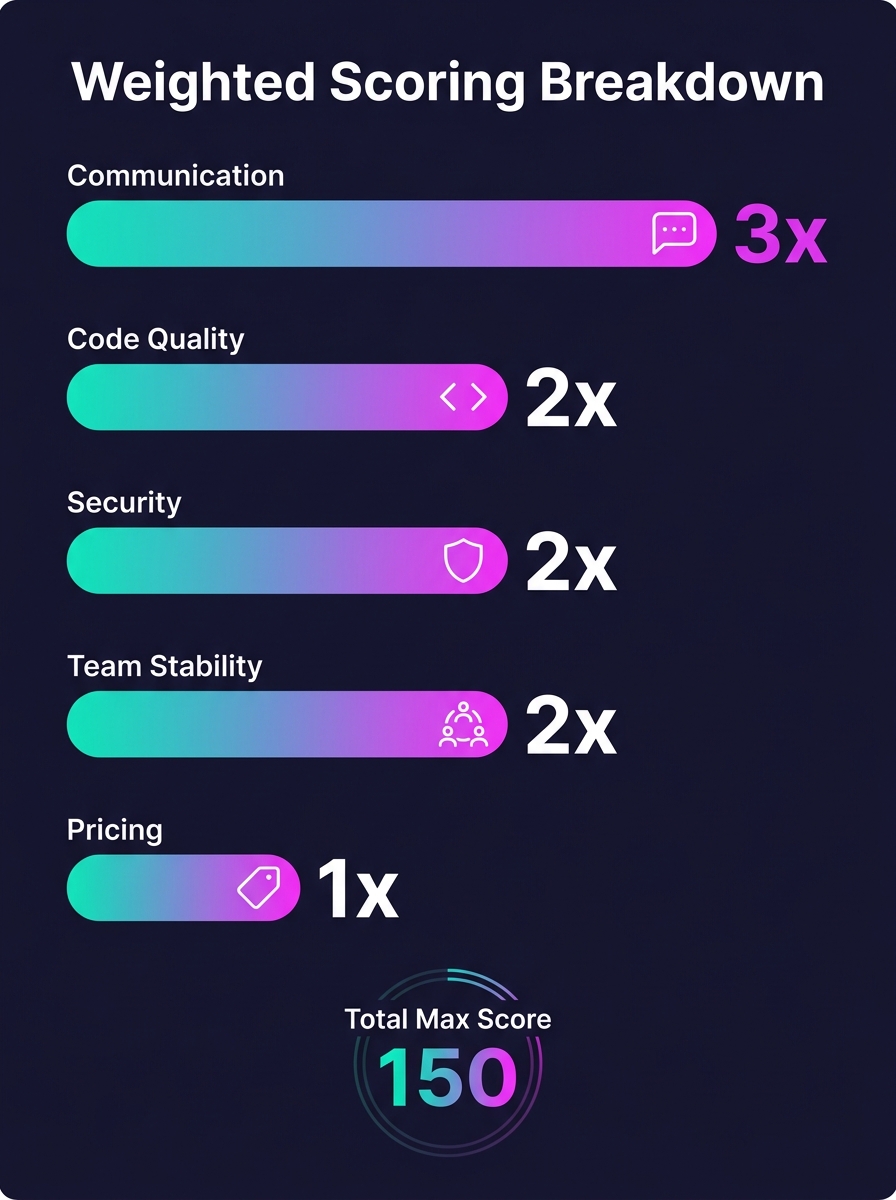
Weigh communication at three times the value of hourly rate
The difference between a $40/hour partner who responds in 90 minutes and a $28/hour partner who goes dark for two days is roughly one lost client per quarter. Communication deserves 3x weight in any agency outsourcing decisions scorecard because it's the factor that cascades into everything else: missed deadlines, scope misunderstandings, QA failures, and silent quality drift.
Set a clear benchmark during evaluation. Partners should offer a 4-hour response guarantee during overlap hours, with escalation protocols for urgent bugs. Vague promises like "we're very responsive" carry zero predictive value. Ask for their average Slack or email response time over the past 30 days. If they can't produce that number, they aren't tracking it, which tells you everything.
When you're evaluating how handoff protocols prevent silent quality drift, communication speed and clarity are the variables that matter most. A partner who writes detailed ticket updates and asks clarifying questions before building will save you 10-15 hours of revision time per project compared to one who builds first and asks questions after your client complains.
Demand a paid trial before signing any contract
A 2-week paid trial with defined deliverables is the single most reliable filter in white-label partner selection. According to ARDURA Consulting's vendor evaluation scorecard, vendors who refuse a trial period are signaling a lack of confidence in their own delivery capabilities. That refusal should disqualify them.
Structure the trial around a low-stakes internal project, not a live client site. You're testing three things: how accurately the partner interprets requirements, whether they hit milestones on time, and how they handle revision requests. Grade each on a 1-5 scale. A partner scoring below 3 on any single axis during a controlled two-week window will perform worse under real deadline pressure.
Tip: Use the trial to test the actual developers who'll work on your projects. If the partner sends a senior dev for the trial and swaps in a junior for production work, you'll catch the bait-and-switch before it costs you a client.
Pay trial rates at the partner's standard billing. Free trials incentivize partners to assign B-team developers and treat your project as expendable. You're paying for signal quality, and the $800-$1,500 a trial costs is cheap insurance against a $15,000 failed project.
Verify that code ownership lives in your repositories
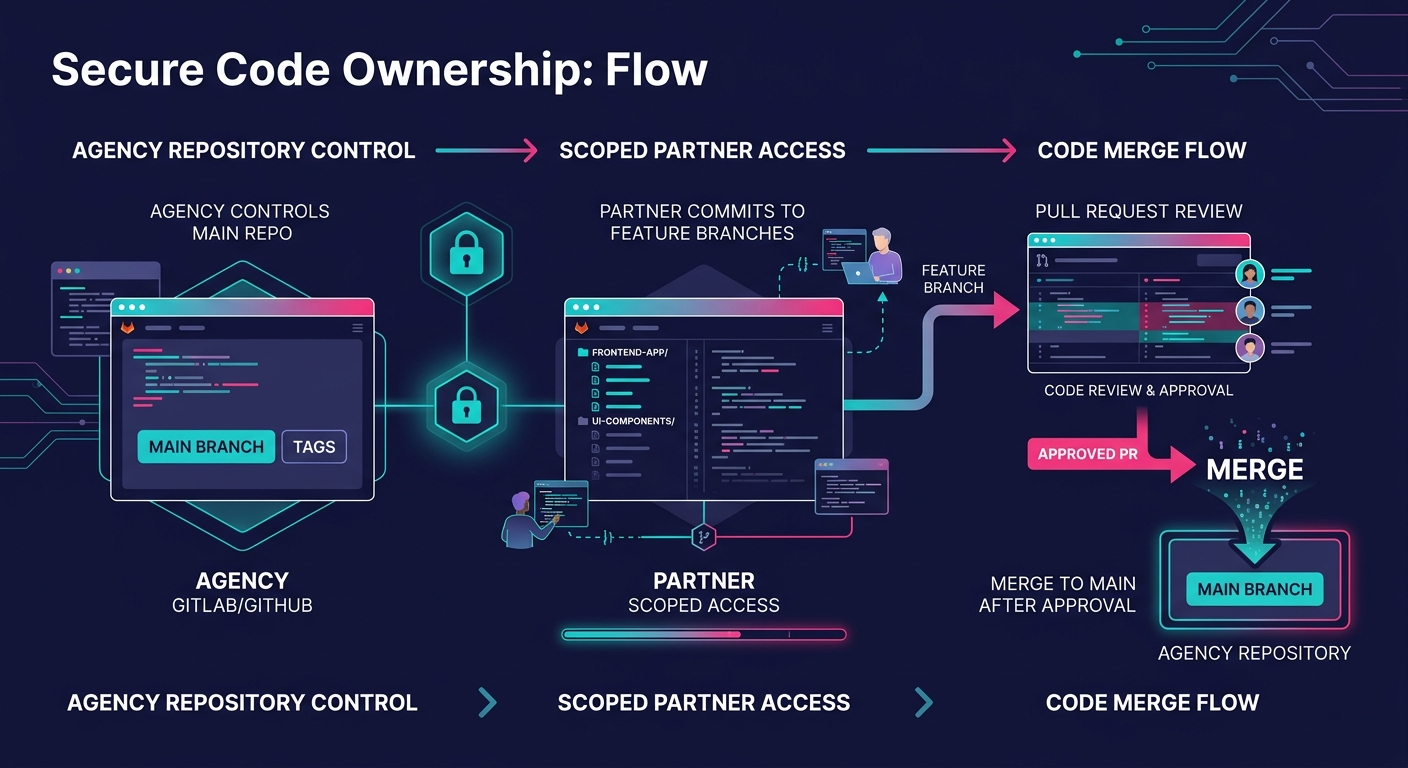
Code must be committed to repositories you control from day one. This is a non-negotiable item in any vendor vetting criteria checklist. Partners who insist on working in their own Git environments and delivering code via zip files or FTP are creating dependency risk that compounds with every project.
Require named developers to push commits to your GitHub or GitLab organization. Insist on role-based access controls with no shared credentials. The 12-point partner vetting checklist covers this in detail: partners should sign NDAs within 24-48 hours and accept that all intellectual property belongs to your agency (and by extension, your clients).
As a structured evaluation tool from Arbisoft's vendor scorecard framework puts it, the criteria "that tend to predict real world outcomes" are operational, not decorative. Code ownership is operational. If you skip this step and later need to negotiate exit clauses, you'll discover how expensive that shortcut was.
Check team stability, not team size
A partner with 400 developers and 60% annual turnover will deliver worse results than a 12-person shop where the average tenure exceeds two years. Team stability predicts code consistency, institutional knowledge retention, and the likelihood that the developer who built your client's site will still be around to maintain it six months later.
During evaluation, ask for the names of the specific developers who'll work on your projects. Ask how long each has been with the company. "Recruit-to-order" models, where the vendor hires a developer after signing your contract, introduce 4-8 weeks of ramp-up time you'll pay for in slower delivery and shallow platform knowledge. According to Edvantis's outsourcing selection best practices, smaller boutique agencies sometimes can't handle scale, but transnational firms with deep benches often sacrifice continuity for capacity. The sweet spot for most digital marketing agencies sits in the 15-50 developer range, large enough to absorb sick days and vacations, small enough that you work with consistent people.
A partner with 400 developers and 60% annual turnover will deliver worse results than a 12-person shop where the average tenure exceeds two years.
This rule applies whether you're sourcing WordPress development, a white-label Shopify build team, or any other platform-specific work. The technology changes; the human reliability factor doesn't.
Score every candidate on the same weighted rubric
Gut-feel decisions produce gut-feel results. Assign numerical weights to each evaluation category and score every candidate against the same rubric. The scoring structure that works for most agencies running development partner evaluation processes uses three tiers:
- Critical factors (3x weight): Communication responsiveness, IP ownership terms, NDA compliance. Maximum 45 points per factor.
- High factors (2x weight): Code quality (70%+ test coverage, ESLint/Prettier consistency, pull request reviews), team stability, security hygiene. Maximum 30 points per factor.
- Medium factors (1x weight): Hourly rate, scaling capacity, timezone overlap. Maximum 15 points per factor.
| Category | Weight | Score Range | What You're Measuring |
|---|---|---|---|
| Communication | 3x | 0-45 | Response time, update clarity, escalation protocol |
| IP / Code Ownership | 3x | 0-45 | NDA speed, repo access model, credential hygiene |
| Code Quality | 2x | 0-30 | Test coverage, style guide adherence, PR reviews |
| Team Stability | 2x | 0-30 | Named devs, average tenure, rotation policies |
| Security Practices | 2x | 0-30 | Staging environments, vulnerability scanning, access controls |
| Pricing | 1x | 0-15 | Rate competitiveness within quality tier |
| Scaling Flexibility | 1x | 0-15 | Ability to add/remove developers on 2-week notice |
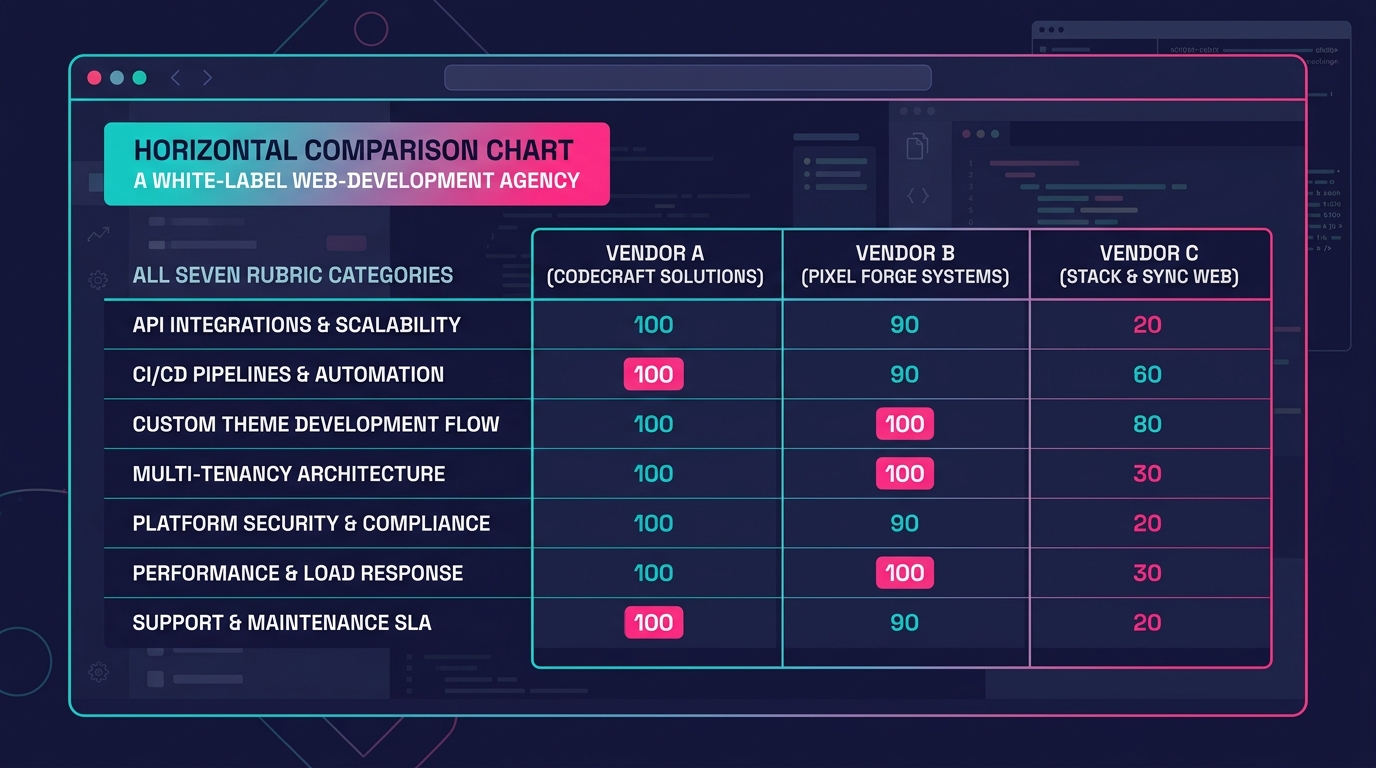
Partners scoring below 100 out of a possible 210 should be eliminated. Those falling between 100-140 deserve a trial period with close monitoring. Above 140 signals a strong candidate worth fast-tracking. This approach transforms subjective agency outsourcing decisions into a comparable, documented process. The same rubric also protects you in conversations with business partners who want to pick the cheapest bid. You can point to the scores rather than arguing from instinct.
For agencies evaluating partners across multiple platforms, the rubric transfers directly. If you're looking to hire Shopify experts alongside your WordPress team, run them through the same scorecard so you're comparing apples to apples.
Run reference checks that go beyond review pages
Yelp ratings and Google reviews tell you what a partner's marketing team wants you to see. Genuine reference checks require direct conversations with current clients, specifically agencies similar to yours in size and project volume.
Ask the partner to connect you with two or three current customers. Then ask those references pointed questions: How often do deadlines slip? What happens when a revision request conflicts with the original scope? Has the partner ever lost a key developer mid-project, and how did they handle it? These questions surface operational patterns that portfolio reviews and review pages never reveal. As PacificABS recommends, checking a partner's reputation through direct customer conversations should be "high on the priority list" of your evaluation process.
Cross-reference what you hear with your own security due diligence. A partner who claims excellent WordPress practices should be running staging environments for all updates and automated vulnerability scanning. With 250+ weekly plugin vulnerabilities now documented across the WordPress ecosystem, security hygiene has moved from a nice-to-have to a disqualifying criterion. If a reference tells you the partner once pushed a plugin update directly to production without staging, weight that information heavily.
Warning: If a partner can't produce references from agencies (as opposed to direct end-clients), they likely haven't done white-label work at scale. White-label relationships have unique demands around branding, client invisibility, and handoff protocols that end-client references won't validate.
When These Rules Collapse
These six rules assume you have time to evaluate. Sometimes you don't. A major client signs unexpectedly, your lead developer quits, or a project scope doubles overnight. In those moments, agencies default to price-based selection because speed feels more important than process.
The compromise position is to keep a pre-vetted shortlist of two or three partners who've already passed your scorecard. Invest the evaluation time before the emergency arrives, not during it. Run one partner through the full rubric each quarter, even if you don't have an immediate project for them. Build a bench. The agencies that avoid catastrophic outsourcing failures aren't the ones with the best scorecards; they're the ones who filled out the scorecard six months before they needed the answer.
The other scenario where these rules bend is when you're working with a partner you've used for years and trust deeply. Established relationships carry their own data: hundreds of completed projects, known communication patterns, proven reliability. A partner who scored 170 on your rubric three years ago doesn't need to re-qualify for every new project. But they do need periodic re-evaluation, especially if their team composition shifts or they scale rapidly. Trust is earned data, and it expires when the underlying conditions change.