

AZ Big Media published a scope-change management guide on July 8, 2026, compiling 18 strategies from project managers and agency leaders who have successfully contained scope creep without sacrificing client relationships, according to the article. The framework includes formal change control gates, shared scope ledgers, and impact quantification protocols designed to prevent budget overruns and timeline collapses.
TL;DR: A July 8, 2026 guide from AZ Big Media details 18 expert-backed strategies for managing scope changes in client projects, including shared documentation systems and impact quantification methods that prevent budget strain while maintaining flexibility.
The guide addresses what the authors identify as the single largest cause of project derailment and client relationship damage in professional services. Scope creep, the uncontrolled expansion of project requirements, drains agency profitability, forces internal teams into crisis mode, and creates delivery delays that compound across multiple client engagements.
Documentation Systems That Track Changes Without Adding Friction
Patric Edwards, Founder and Principal Software Architect at Cirrus Bridge, described a "scope ledger" approach that avoids adversarial change order processes, according to the guide. The system maintains a shared, plain-English document accessible to both agency and client teams that captures every decision, addition, and change throughout the project lifecycle.
"When a client asks for something new, I open that document and say 'let's look at what's currently in scope and figure out what this trades against,'" Edwards said in the guide. The method positions scope discussions as priority conversations rather than rejection scenarios, allowing clients to see the full project context before requesting additions.
The ledger system contrasts with formal change order workflows that introduce legal friction. Edwards noted that clients who participate in explicit trade-off decisions maintain trust levels higher than those managed through silent scope absorption followed by late-stage timeline conflicts.
Impact Quantification Before Approval
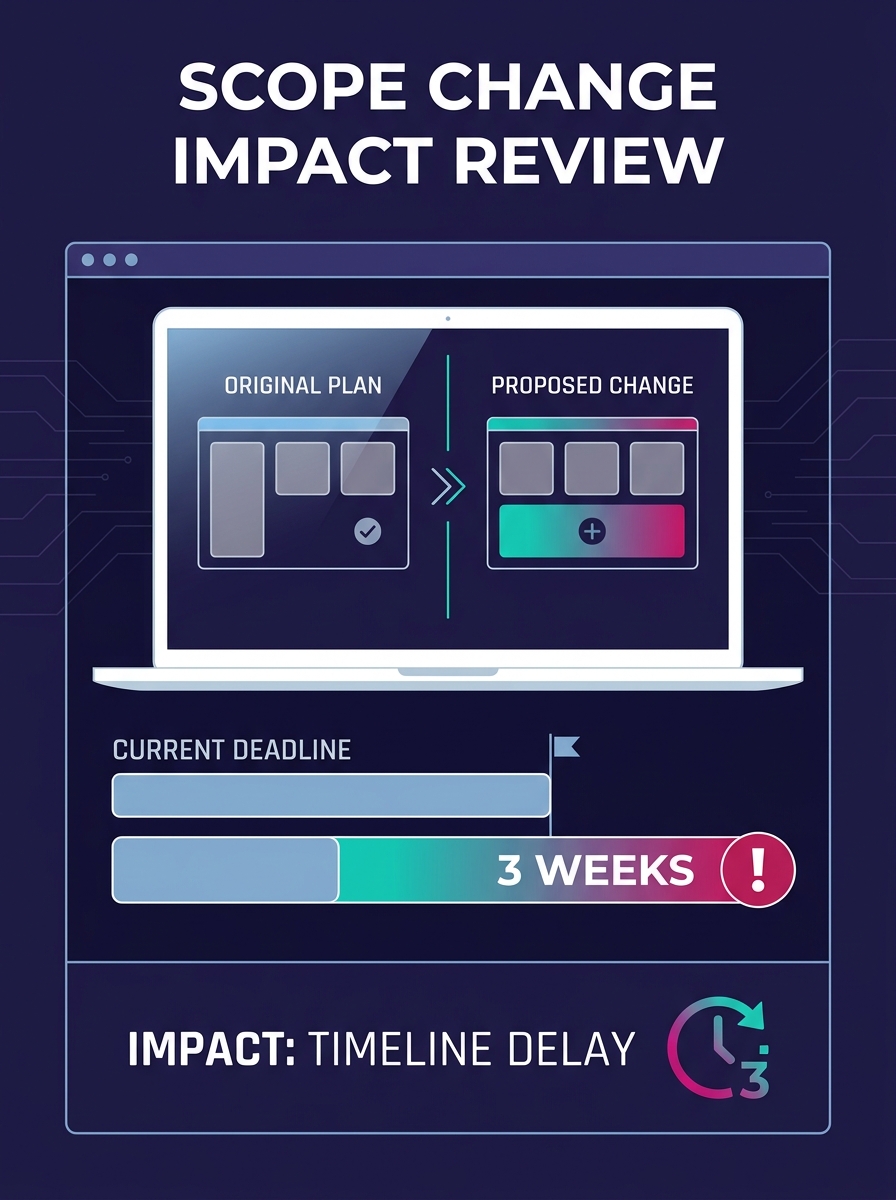
Ievgen Yamamoto, CTO at CQUELLE, outlined a written impact assessment protocol in the guide that evaluates scope changes against critical path dependencies, architectural unknowns, and reversibility thresholds. The assessment examines whether changes introduce new integrations, data model modifications, or security requirements that extend beyond immediate feature additions.
"We never absorb scope changes silently," Yamamoto said in the guide. The written impact note requirement applies to every change request regardless of perceived size, preventing quality degradation that occurs when teams scramble to deliver expanded scope within fixed timelines.
The protocol operates under a principle that clients who understand delivery mechanics make better priority decisions than those shielded from implementation details. Yamamoto reported that explicit impact communication accelerates project velocity by eliminating the internal corner-cutting and client surprise scenarios that emerge from vague scope management.
Lauren Lerner, Founder of Living with Lolo, contributed a "change order conversation" framework that distinguishes additive requests from disruptive modifications. The method walks clients through downstream effects including lead time extensions, subcontractor rescheduling requirements, and cascading decision dependencies before formalizing any scope adjustment.
Formal Control Gates and Written Modification Protocols
The guide details formal change control gates used by enterprise project teams to evaluate scope requests against impact thresholds and reversibility constraints. Control gates examine whether changes affect architectural foundations, introduce SQL data model alterations, or create new security review requirements that extend beyond the original statement of work.
Several contributors emphasized same-day written modification requirements that prevent verbal scope expansion from creating delivery gaps. The written requirement forces both agency and client teams to articulate business justification, technical implications, and timeline trade-offs before development work begins.
The framework includes classification systems that identify hidden drivers behind scope requests, whether changes stem from market shifts, competitive pressure, stakeholder feedback, or evolving internal requirements. Classification helps agencies distinguish between legitimate business pivots and feature requests driven by individual preferences rather than strategic necessity.
Project managers in the guide recommended structured review sessions at defined project milestones where scope boundaries receive explicit confirmation before subsequent phases begin. The milestone review pattern creates natural intervention points where accumulated small changes get evaluated collectively rather than individually, revealing scope drift patterns invisible in incremental request assessments.
What Happens Next
White-label WordPress agencies face compounding scope creep challenges because client-facing account teams and delivery partners operate in separate organizations with different incentive structures. The boundary-setting frameworks in the AZ Big Media guide become critical when agencies scale capacity through outsourced development partnerships, where scope changes ripple across handoff protocols, quality assurance checkpoints, and partner communication workflows detailed in the white-label partner handoff protocol.
Agencies implementing shared scope ledgers with both clients and white-label partners create three-party visibility that prevents the silent quality drift that occurs when developers never interact directly with end clients. The written impact assessment requirement translates especially well to white-label relationships where timezone gaps and asynchronous communication make verbal scope discussions unreliable.
The formal control gate approach gives agency operations leads a framework for evaluating which scope requests can be absorbed within existing white-label partner agreements and which require contract amendments, additional budget allocation, or timeline extensions. Agencies that build impact quantification into their client engagement process and their white-label vendor management process simultaneously create scope discipline that protects both client relationships and partner delivery quality.