

Bennett Financials published a capacity planning framework on July 15, 2026, establishing a 3.5x revenue-to-delivery-labor ratio as the minimum threshold agencies must reach before adding headcount, according to founder Arron Bennett, who argues most hiring decisions fail because pricing and efficiency problems remain unfixed.
TL;DR: Fractional CFO firm Bennett Financials released a diagnostic framework showing agencies need 3.5x revenue-to-delivery-labor efficiency before hiring, with close rates above 60% indicating underpricing rather than genuine capacity constraints.
The framework addresses what Bennett calls the most expensive gut-feel decision agency founders make: hiring when utilization feels high but margins remain thin. The 3.5x ratio represents the point where delivery labor costs drop to roughly 29% of revenue, enabling the 60% gross margin required for profitable scaling, according to the Bennett Financials analysis.
Bennett Financials is a fractional CFO and tax planning firm serving service businesses generating $1 million to $20 million in annual revenue. Bennett, who runs the firm's fractional CFO practice, developed the framework after diagnosing capacity bottlenecks across marketing and web development agencies.
The Math Behind the 3.5x Threshold
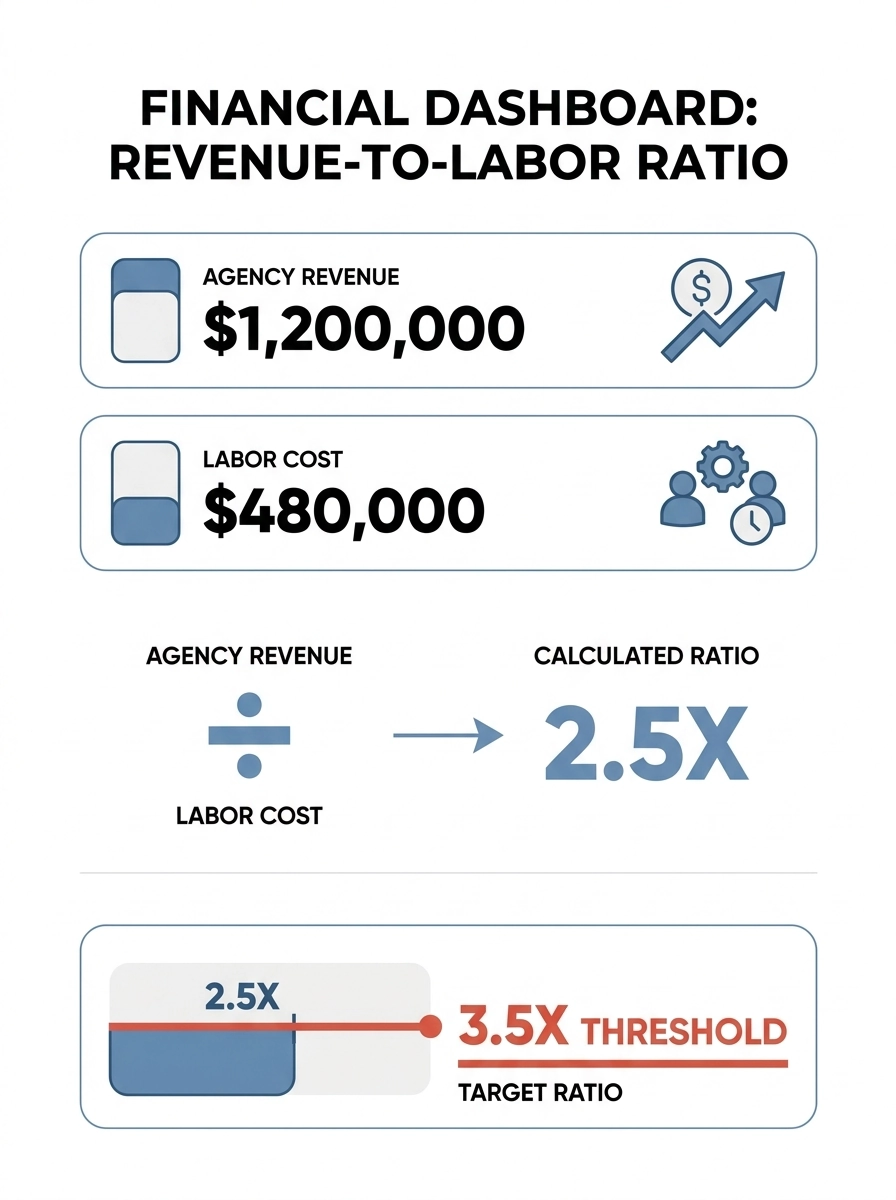
Labor efficiency equals annual revenue divided by all delivery labor costs, including delivery salaries, benefits, subcontractors, and the delivery portion of owner compensation, Bennett explained in the July 15 analysis. Sales and administrative costs are excluded from the calculation.
The framework establishes five efficiency bands. Agencies operating at 7.0x or higher qualify as exceptional. The 5.0x to 7.0x range indicates strong performance, while 3.5x to 5.0x represents healthy operations. Performance between 2.5x and 3.5x enters what Bennett defines as the danger zone, and ratios below 2.5x signal crisis-level inefficiency.
Bennett illustrated the calculation with a $3 million marketing agency carrying $1.2 million in delivery payroll and contractor costs, producing a 2.5x ratio. Adding typical delivery tools and processing costs of $240,000 yields a 52% gross margin, within the 50% to 58% range Promethean Research reported as typical for agencies at that revenue level. "This agency can't afford the team it already has," Bennett wrote.
The analysis noted two common calculation errors. Founders frequently omit their own delivery time from the denominator, which artificially inflates the ratio. A $300,000 owner spending half their week on client work should include $150,000 in delivery labor costs. The second error involves confusing labor efficiency with revenue per employee, which Promethean Research pegged at $163,000 per full-time employee across marketing agencies in 2025.
Close Rate as Pricing Signal
Bennett's framework rejects high utilization as a hiring trigger, instead using proposal close rates to diagnose whether capacity constraints are real or whether underpricing creates artificial demand. The diagnostic establishes six close-rate bands tied to recommended pricing adjustments.
Agencies closing 80% or more of proposals should triple to quadruple prices, according to the framework. Close rates between 60% and 80% indicate pricing should double to triple. The 50% to 60% band suggests 50% to 100% increases, while 40% to 50% close rates warrant 25% to 50% adjustments.
Only when close rates fall into the 30% to 40% range does the framework validate pricing as appropriate and capacity as the true constraint. "A maxed-out calendar with a 70% close rate isn't a hiring signal," Bennett stated. "It's an underpricing signal."
Close rates below 30% indicate a sales problem rather than a capacity problem, according to the analysis. The framework argues that applying a conservative 40% effective price increase to the $3 million agency example—operating at 2.5x efficiency with a 65% close rate—would lift revenue to $4.2 million on the same team, achieving 3.5x efficiency and clearing the 60% gross margin threshold without hiring costs.
When Hiring Makes Sense
The framework requires three conditions before hiring becomes financially viable. Labor efficiency must reach 3.5x or better, demonstrating the current team operates profitably enough to absorb dilution from a new hire. The team must be genuinely maxed out, with no slack capacity hiding in low performer productivity or unbilled scope creep.
Third, close rates must fall within the 30% to 40% band, confirming pricing is appropriate and new demand represents real market demand rather than artificially cheap positioning. Bennett emphasized all three conditions must be present simultaneously.
According to SPI Research data cited in the framework, professional services firms maintaining 70% or higher billable utilization average 18% to 22% net margins, compared to 8% to 12% for firms below 60% utilization. Promethean Research found digital agencies averaged 13% after-tax net margin in 2025, placing most agencies near the bottom of the profitability range despite busy calendars.
The Agency Management Institute's profitability benchmarks imply a healthy range of $135,000 to $257,000 in revenue per employee, though Bennett cautioned against using total-employee metrics for delivery-specific capacity decisions.
Why This Matters Now
Agency owners and operations leads face mounting pressure to scale delivery capacity while maintaining margins in an environment where, according to recent industry analysis, partner vetting decisions increasingly separate reliable outcomes from budget traps. The 3.5x framework provides a quantifiable alternative to utilization-based hiring decisions that often add payroll without adding profitability.
The framework arrives as agencies confront what Bennett identifies as the $3 million squeeze, where teams feel maxed out but gross margins remain in the low-50% range—too thin to fund growth. The diagnostic redirects capacity planning conversations from scheduling tools toward P&L fundamentals, forcing founders to address pricing and efficiency failures before adding headcount. For agencies evaluating whether to hire internally or engage white-label partners, the 3.5x threshold establishes a clear decision point: fix the ratio first, regardless of which path you choose.
Bennett Financials made the full capacity planning framework available at no cost on its website. The firm specializes in fractional CFO services and tax planning for service businesses, with diagnostic engagements focused on margin improvement and exit planning.