

Clutch.co lists over 4,000 WordPress development companies. Filtering that field down to a white-label partner who ships production-ready WooCommerce builds on schedule requires a structured scoring framework weighted toward technical proof, operational transparency, and contractual safeguards rather than polished profile pages.
When the Directory Listing Falls Apart
The typical agency outsourcing checklist starts and ends with a Clutch profile, a portfolio page, and a 30-minute discovery call. That process works fine for selecting a caterer. For a white-label partner who'll touch your clients' checkout flows, payment integrations, and customer data, it's dangerously thin.
The problem became visible as WooCommerce stores grew more complex. High-SKU catalogs, custom checkout blocks, subscription logic, multi-currency support. These aren't template drops. They demand partners who understand WordPress security baselines and can prove they've shipped similar builds under white-label constraints. And proof is the operative word. As Forbes Tech Council guidance on evaluating outsourcing partners emphasizes, track records, client testimonials, and verifiable case studies provide insights that no amount of sales-call charm replaces.
The partner selection framework below emerged from that gap. It assigns weighted scores across 12 criteria grouped into three categories: technical credibility, operational fit, and risk controls. High-weight items carry double points. A partner who scores 80% or above across all three categories moves to a paid trial. Below 60% in any single category is a disqualification.
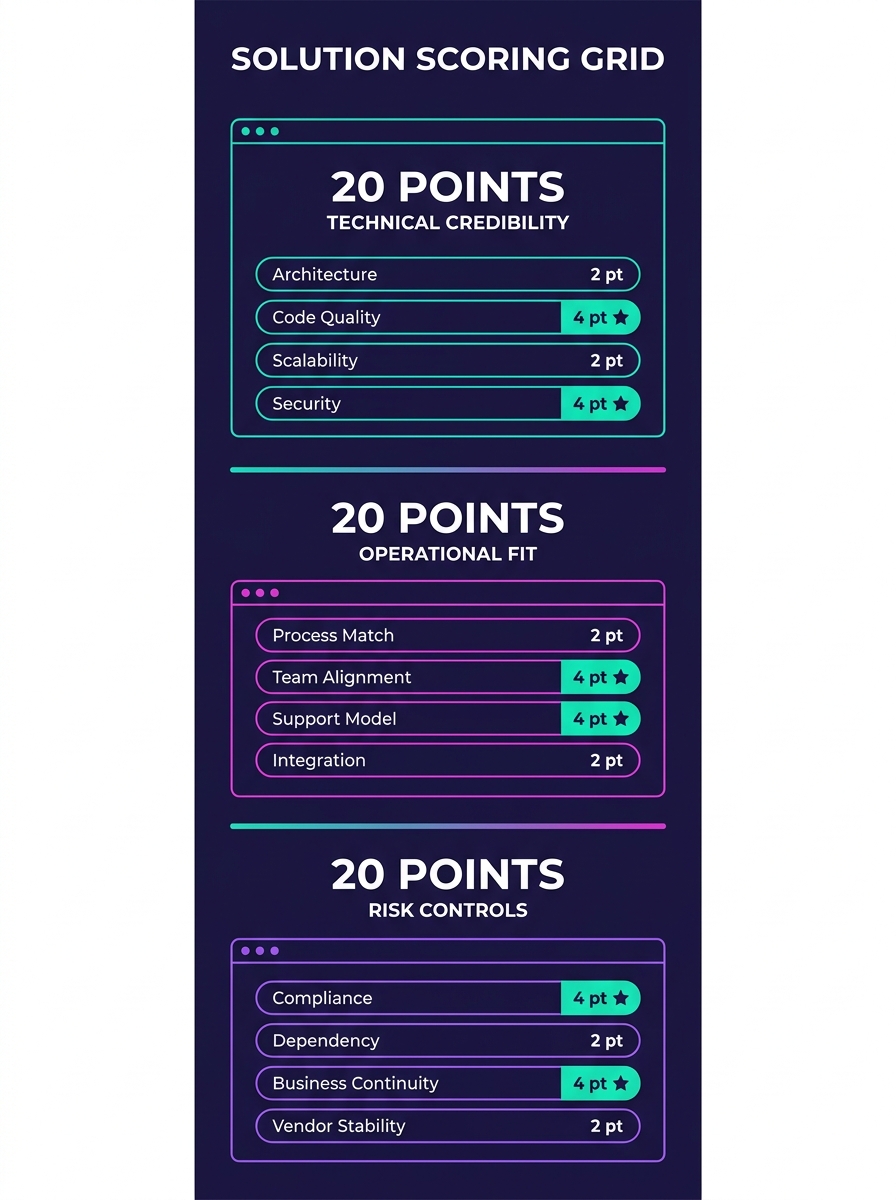
The Weighted Scoring Grid
Why weight at all? Because agencies consistently over-index on price and under-index on quality assurance criteria that predict actual delivery outcomes. A partner's hourly rate tells you nothing about their first-pass defect rate on WooCommerce checkout customizations. Their Git workflow tells you a lot.
The grid works on a 1-5 scale per criterion. Four criteria are designated high-weight (scored 1-10 effectively), and eight are standard weight (scored 1-5). Maximum possible score: 80 points. The 80% threshold for advancing to a paid trial is 64 points.
Here's why this matters for e-commerce specifically: a botched product page template on a brochure site causes embarrassment. A botched payment gateway integration causes lost revenue, chargebacks, and potential PCI compliance exposure. The weight distribution reflects that reality.
Evaluating Technical Credibility (Points 1–4)
These four criteria carry the heaviest weight in the scorecard because they predict whether code will survive contact with real customers placing real orders.
Point 1: Portfolio relevance to your niche. The benchmark is five or more similar WooCommerce or e-commerce projects completed within the past 18 months. "Similar" means similar in complexity, not just in platform. A partner who's built 30 brochure WordPress sites but zero stores with 500+ SKUs doesn't qualify. Ask for live URLs, not screenshots. Check examples of our work against theirs for an honest comparison of build quality and attention to detail.
Point 2: QA process documentation. Partners who can produce written QA checklists, code review policies, and automated testing configurations score high. Partners who say "we test everything thoroughly" without documentation score a 1. According to NetSuite's outsourcing KPI framework, defining quality standards that include acceptable error rates and customer satisfaction thresholds is foundational to measuring outsourcing success.
Point 3: Version control and deployment pipeline. Git usage is baseline. What you're scoring is the full pipeline: branching strategy, staging environments, deployment automation, and rollback procedures. If your agency already maintains staging-production parity across client sites, your partner needs to match that standard or exceed it.
Point 4: Security posture. For WooCommerce partners specifically, this means demonstrated familiarity with role-based access controls, automated vulnerability scanning, and secure handling of payment-adjacent data. A partner who can't articulate how they manage wp-config.php secrets across environments is a liability.
Warning: A partner quoting $5,000 for a project that should cost $50,000 is the single clearest budget-trap signal. As Chop Dawg's agency red flags guide puts it: they're either using offshore template builders who'll ship generic output, or they're undercutting to win the deal and will stack "scope change" fees later.
Testing Operational Fit (Points 5–8)
Technical skill without operational compatibility creates a different kind of failure. The partner ships good code, but late, or without communicating blockers, or in formats your team can't hand off to clients.
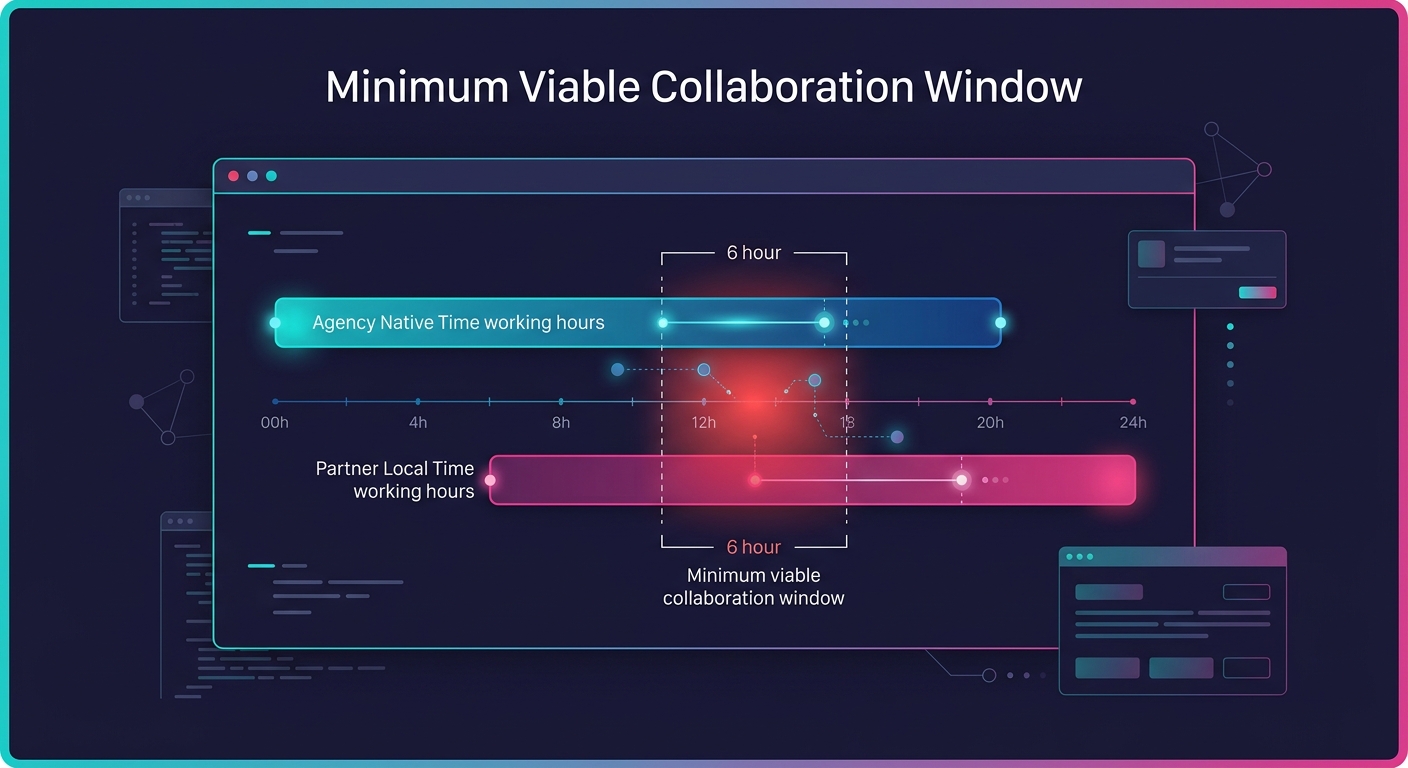
Point 5: Communication cadence and response time. The benchmark is 24-hour maximum response time during business hours across a minimum 6-hour timezone overlap. Score based on demonstrated communication practices, not promises. Ask for Slack or project management screenshots (redacted) from previous engagements.
Point 6: Timezone and availability alignment. This matters more for WooCommerce builds than brochure sites because e-commerce launches have hard deadlines tied to promotional calendars, inventory drops, and seasonal sales. A partner 12 hours offset with no overlap window will create bottlenecks during the checkout QA phase when rapid iteration is critical.
Point 7: Process transparency. Can the partner show you their project management tool, their task breakdown structure, and their status reporting format? Codeable's guidance on white-label WordPress development emphasizes that vague requirements increase the partner's risk buffer and raise costs. The same principle applies in reverse: vague processes from the partner increase your risk.
Point 8: Team stability and key-person risk. Ask directly: who will work on my projects, and what happens if that person leaves? Partners with a single senior developer handling all builds represent a concentration risk. Score based on team size relative to your expected volume, documented handoff procedures between team members, and historical retention data if they'll share it.
A partner who gets defensive when you ask about their methods is telling you everything without saying a word. Transparency under scrutiny is the most reliable predictor of transparency under pressure.
Protecting the Relationship (Points 9–12)
The final four criteria protect you when things go wrong. And with enough project volume, something always goes wrong.
Point 9: NDA and IP assignment clarity. White-label work means your clients never know the partner exists. The NDA needs to cover not just confidentiality but IP assignment, ensuring all code, designs, and documentation produced under the engagement belong to your agency. Mindmatrix's partnership guide stresses that contracts should cover deliverables, timelines, payment terms, and confidentiality explicitly.
Point 10: Pricing transparency and change control. Geeks for Growth's research on white-label vendor red flags warns against vendors who advertise low-cost packages while hiding fees for revisions, "rush" timelines, or software licenses. These hidden costs erode agency margins and make profitable retainers impossible. Score based on whether the partner provides written change-order procedures with pre-approved rate cards for out-of-scope work.
Point 11: Reference checks from similar agencies. Request three references, and specify that you want to speak with agencies of similar size running similar project types. A reference from a Fortune 500 enterprise doesn't tell you how the partner handles a 10-person agency's WooCommerce workflow. When you reach references, ask specifically about the partner's behavior during scope changes and budget pressure.
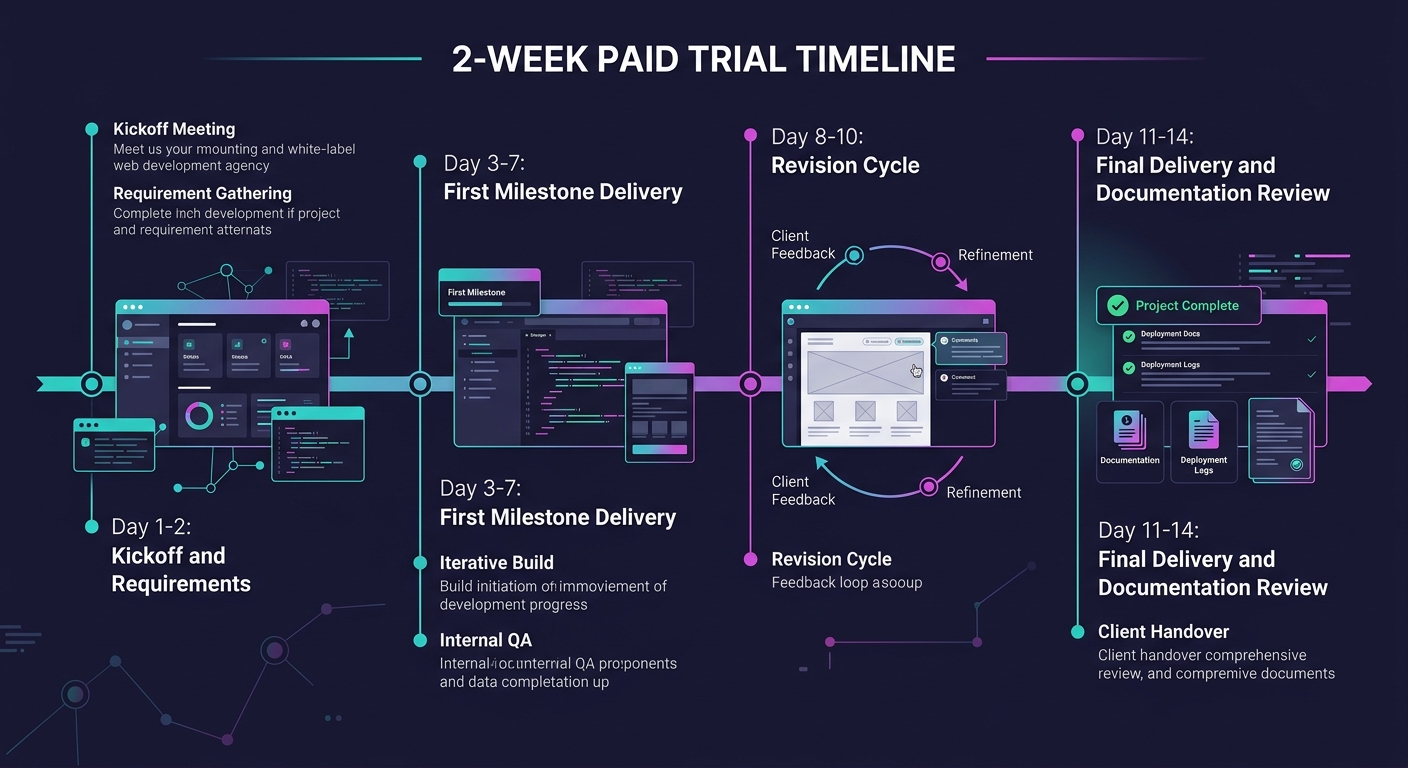
Point 12: Willingness to run a paid trial. This is a pass/fail criterion weighted at high importance. A partner who refuses a 2-week paid trial project before committing to ongoing work is either overbooked or hiding capability gaps. The Kwiqwork partner vetting checklist recommends always running a 2-week paid trial before committing, covering communication, code quality, timezone alignment, and delivery consistency in a controlled setting.
| Criteria Category | Point | What You're Scoring | Weight | Passing Threshold |
|---|---|---|---|---|
| Technical Credibility | 1 | Portfolio relevance (5+ similar projects, 18 months) | High (2×) | 7/10 |
| Technical Credibility | 2 | QA process documentation | High (2×) | 7/10 |
| Technical Credibility | 3 | Version control and deployment pipeline | Standard | 3/5 |
| Technical Credibility | 4 | Security posture | High (2×) | 7/10 |
| Operational Fit | 5 | Communication cadence (24hr response) | Standard | 3/5 |
| Operational Fit | 6 | Timezone overlap (6+ hours) | Standard | 3/5 |
| Operational Fit | 7 | Process transparency | Standard | 3/5 |
| Operational Fit | 8 | Team stability and key-person risk | Standard | 3/5 |
| Risk Controls | 9 | NDA and IP assignment | High (2×) | 7/10 |
| Risk Controls | 10 | Pricing transparency and change control | Standard | 3/5 |
| Risk Controls | 11 | Reference checks | Standard | 3/5 |
| Risk Controls | 12 | Willingness to run paid trial | Pass/Fail | Pass |
The Two-Week Paid Trial That Reveals Everything
A partner who clears the scorecard with 64+ points earns the right to prove it under working conditions. The paid trial is where white-label developer vetting shifts from evaluation to evidence.
Structure the trial around a real but low-stakes WooCommerce deliverable: a product archive template, a custom shipping calculator, or a checkout field modification. The project should be complex enough to test five operational areas: requirement gathering accuracy, milestone adherence, first-pass deliverable quality, revision responsiveness, and documentation completeness.
Pay market rate for the trial. A $500 "test project" attracts $500 effort. If your standard WooCommerce build rate is $85-$120/hour, the trial should reflect that. You're testing the partnership at production fidelity, not at a discount.
During the 2 weeks, track these metrics against the scores you assigned during the checklist phase. A partner who scored 4/5 on communication cadence but takes 48 hours to respond during the trial has revealed a gap between their pitch and their practice. Adjust the scorecard retroactively and make your decision based on observed behavior.
Where This Lands Now
The agencies that treat partner relationships as strategic investments rather than vendor transactions consistently report lower project defect rates, tighter delivery timelines, and better client retention on WooCommerce engagements. The 12-point scorecard gives that instinct a structure you can repeat across every new partner evaluation.
The framework also creates an institutional record. When a partner relationship sours 8 months in, your original scorecard tells you whether the warning signs were there from the start (and you ignored a marginal score) or whether the partner's quality genuinely degraded over time. Both are useful data points. One tells you to trust the framework more. The other tells you to add ongoing performance reviews to your contractor onboarding playbook.
No scorecard eliminates risk entirely. But running 12 structured checks, weighting them toward the criteria that predict e-commerce delivery outcomes, and validating everything through a paid trial eliminates the category of risk that costs agencies the most: the slow-motion discovery, three projects deep, that your "budget-friendly" partner was the most expensive decision you made all year.