

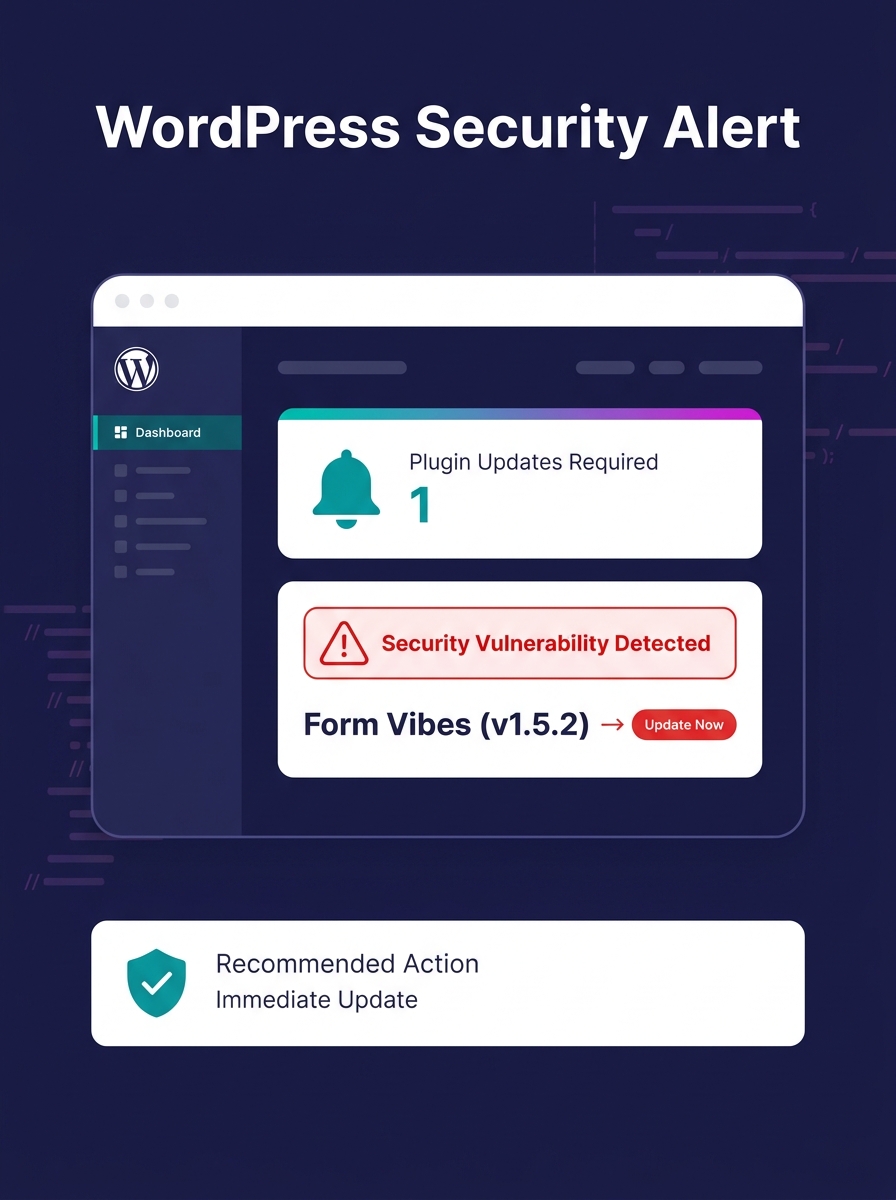
Unauthenticated attackers can inject malicious scripts into WordPress sites running Form Vibes plugin versions up to 1.5.2 through a stored cross-site scripting (XSS) vulnerability disclosed July 11, 2026 by BitNinja Security, according to their vulnerability alert. The vulnerability, tracked as CVE-2026-13378, exploits Contact Form 7 form fields to embed code that executes when users visit compromised pages, exposing agency client sites to data theft, session hijacking, and defacement.
TL;DR: CVE-2026-13378 enables unauthenticated attackers to inject stored XSS payloads via Form Vibes plugin versions through 1.5.2, executing malicious code when site visitors load affected pages.
Vulnerability Allows Script Injection Without Authentication
The flaw permits attackers to inject arbitrary JavaScript without requiring login credentials, BitNinja Security reported in the disclosure. The stored XSS vector uses Contact Form 7 form field submissions to plant malicious code that persists on the server. When site visitors navigate to pages containing the injected script, their browsers automatically execute the attacker's code.
Form Vibes is a form analytics and database plugin that integrates with Contact Form 7, one of WordPress's most widely deployed contact form solutions. The combination makes the attack surface significant for agencies managing multiple client sites with form capture requirements.
BitNinja Security's disclosure noted that stored XSS vulnerabilities carry higher risk than reflected XSS because the malicious payload remains on the server, triggering repeatedly as different users access the compromised resource. Attack outcomes include credential theft through keylogging, forced actions under hijacked user sessions, and visual defacement that damages client brand reputation.
Agencies Face Client Trust and Liability Exposure
The unauthenticated nature of CVE-2026-13378 elevates the threat for agencies operating white-label WordPress portfolios. Unlike vulnerabilities requiring author-level or higher privileges, this flaw permits exploitation before an attacker gains any site access. Agencies managing dozens of client sites can face cascading incident-response workloads if a single outdated plugin version exists across multiple deployments.
BitNinja Security recommended immediate plugin updates as the primary mitigation, though the disclosure did not specify whether Form Vibes maintainers have released a patched version beyond 1.5.2. Agencies unable to update immediately should consider disabling the plugin until a secure version ships, accepting the trade-off of lost form analytics.
The broader WordPress plugin vulnerability landscape has intensified through 2026, with the ecosystem reporting 250+ weekly plugin vulnerabilities, 43% of which are exploitable without authentication. CVE-2026-13378 adds to a pattern forcing agencies to accelerate update cadences or adopt automated vulnerability scanning across client portfolios.
Security Hardening Steps Beyond Plugin Updates
BitNinja Security outlined four defense layers beyond immediate updates. Web application firewalls filter malicious traffic before requests reach WordPress, blocking exploit attempts at the network perimeter. WAFs configured with virtual patching rules can prevent CVE-2026-13378 exploitation even on unpatched plugin versions, providing temporary protection during update deployment windows.
Server log monitoring detects unusual form submission patterns that may indicate injection attempts. BitNinja Security advised administrators to flag unexpected POST requests to Contact Form 7 endpoints, particularly submissions containing JavaScript syntax or HTML tags. Agencies with centralized logging infrastructure can correlate suspicious activity across client sites to identify coordinated attack campaigns.
Automated security tools deliver continuous monitoring and threat detection that manual processes cannot match at scale. BitNinja Security cited their platform's proactive scanning, though agencies may also use alternatives like Wordfence, Sucuri SiteCheck, or Patchstack depending on existing toolchains.
The disclosure emphasized regular plugin update schedules as foundational hygiene. Agencies managing white-label WordPress portfolios should implement update testing workflows that balance speed against stability, deploying security patches within 24-48 hours while catching compatibility breaks before they reach production client sites.
Agencies Implications
CVE-2026-13378 highlights operational risk in agencies that lack automated plugin update pipelines across client portfolios. A single outdated Form Vibes installation creates liability exposure through data theft, brand damage, or regulatory penalties if compromised sites process customer information. Agencies should audit client sites immediately for Form Vibes versions through 1.5.2, prioritizing sites with Contact Form 7 deployments.
The unauthenticated attack vector makes this vulnerability particularly dangerous for agencies guaranteeing security SLAs to clients. Unlike author-level exploits that require compromised credentials, CVE-2026-13378 can be triggered by any internet user submitting a crafted form. Agencies without web application firewalls or plugin update automation face extended windows of exposure between disclosure and remediation.
White-label development partners should clarify vulnerability response protocols with agency clients before incidents occur. Define update turnaround times for critical-severity flaws, establish communication chains for client notification, and document liability boundaries when agencies delay patch deployment against partner recommendations. CVE-2026-13378 demonstrates why security responsibilities belong in service agreements, not post-incident finger-pointing.