

Digital agency white-label provider Nice Digitals published a cost-comparison framework on August 13 breaking down when in-house web development teams become more economical than outsourced partnerships, concluding that the break-even threshold depends on workload consistency rather than total project count, according to the analysis.
TL;DR: Nice Digitals' August 13 cost analysis found that agencies with fluctuating development demand pay lower total costs through per-project white-label rates than through fixed in-house salaries, with the break-even point tied to monthly workload consistency rather than annual project volume.
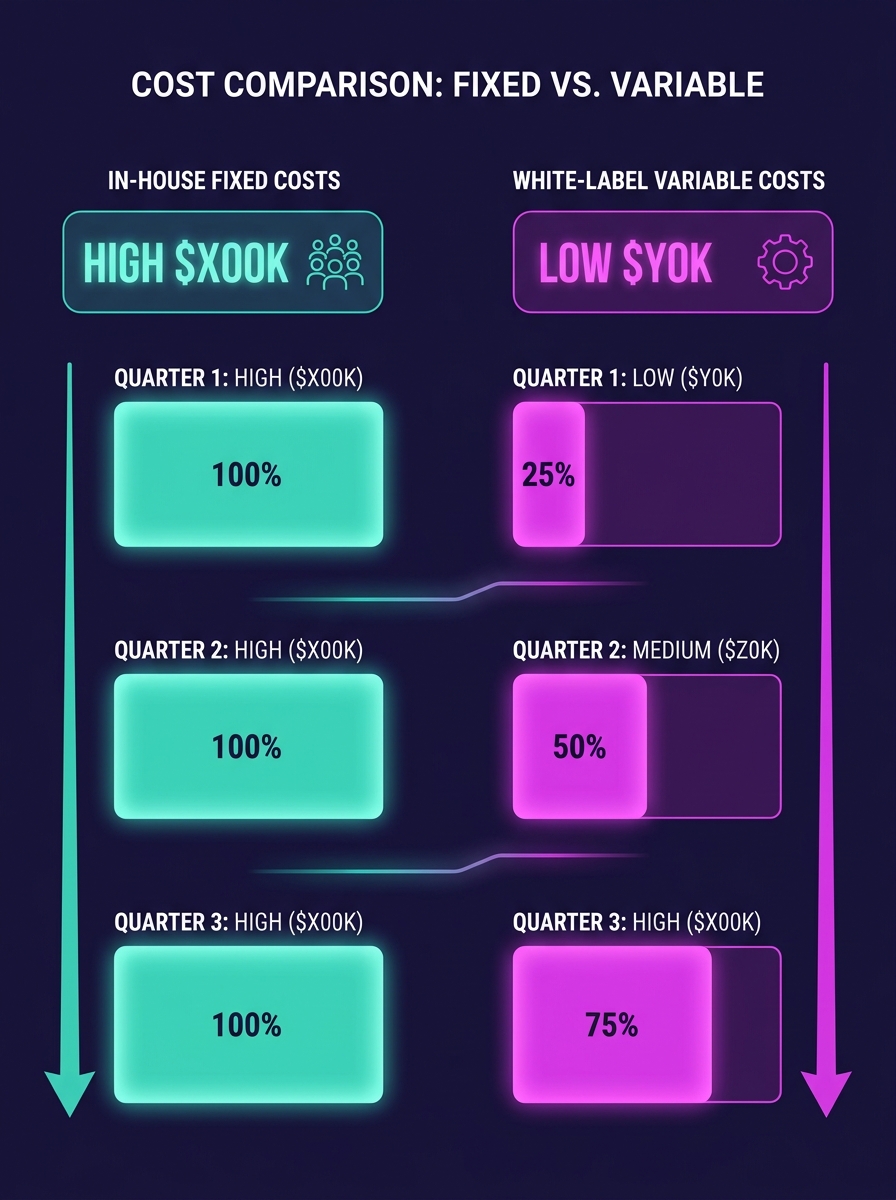
The analysis identifies fully-loaded in-house developer costs—salary plus recruiting overhead, benefits, software licenses, training, and management time—as a fixed monthly expense that persists during slow periods when billable project work doesn't justify headcount. White-label per-project pricing, by contrast, eliminates idle costs during low-demand months, the report states.
Scalability Emerges as Cost Differentiator
Nice Digitals' framework positions scalability as "the deciding factor" in the cost comparison. In-house teams require weeks or months to add capacity through hiring and face termination costs during downturns, while white-label partnerships scale immediately without staffing changes, according to the published analysis.
The report includes a six-factor comparison table contrasting fixed monthly costs (high for in-house, zero for white-label), recruiting overhead (yes for in-house, no for white-label), scalability speed (slow versus immediate), turnaround capacity during busy periods (limited by team size versus typically faster), and direct workflow control (high versus moderate).
Break-Even Calculation Methodology
The analysis instructs agencies to calculate fully-loaded in-house monthly cost, then compare that figure to projected white-label expenses for equivalent work volume over the same period. "If your agency consistently exceeds that volume every month, in-house is likely to make sense. If it doesn't, white-label remains the more cost-efficient option," the framework states.
Agencies evaluating white-label WordPress development capacity can apply this comparative methodology to WordPress-specific project pipelines. The break-even threshold shifts when consistent monthly WordPress builds justify fixed developer salaries versus per-project outsourcing rates.
Turnaround time represents the one area where in-house teams deliver advantages through direct reporting lines and faster priority shifts, Nice Digitals notes. White-label partners typically deploy larger available teams that accelerate individual project delivery during peak periods when in-house capacity reaches limits, though agencies sacrifice day-to-day workflow control.
For agencies approaching hiring thresholds, the agency capacity planning framework published earlier this year established a 3.5x revenue-to-labor ratio as minimum justification for bringing development in-house, complementing the consistency-based break-even analysis Nice Digitals released.
The Takeaway
The August 13 cost framework provides agencies with a quantifiable decision model beyond vague "it depends" guidance. Agency principals evaluating whether to hire WordPress developers now have a specific calculation: compare fixed monthly all-in costs against projected white-label spend at current volumes, then assess whether development demand maintains that volume consistently month-over-month or fluctuates seasonally.
For most US digital agencies, the consistency variable matters more than total annual projects. An agency handling 30 WordPress builds annually through three peak months and sparse work the remaining nine months likely pays less through per-project white-label rates than through nine months of underutilized in-house salary—even if the headline developer cost seems competitive. The framework makes that math explicit rather than intuitive.