

Spinning up a fresh WordPress install for every new client feels responsible—until you're maintaining forty-seven of them and a single plugin update takes your team an entire afternoon. The conventional white-label WordPress architecture, where each client gets a fully isolated installation, produces exactly the kind of operational drag it was supposed to eliminate. Agencies that don't rethink this pattern by their twentieth client will spend more time on infrastructure babysitting than on billable design and development work.
The Maintenance Multiplication Problem
When you run one WordPress install per client, every operational task multiplies by your client count. Plugin updates, PHP version bumps, security patches, performance tuning. At five clients, this is manageable. By thirty, you're looking at a part-time DevOps role disguised as "site maintenance."
The math gets uncomfortable fast. A WordPress core update takes roughly 15 minutes per site when you include staging, testing, and deployment. Multiply that by 40 clients and you've burned 10 hours on a task that, under a multi-tenant architecture, could be a single coordinated deployment. An open-source project called wp-multitenant illustrates this exact principle: it lets you run hundreds of WordPress installations using one core set of configuration files, so updating WordPress core or shared plugins happens once instead of once per client.
The isolation model does have genuine benefits. If Client A's custom plugin explodes, Client B's site stays online. But this safety net comes at a steep price in operational time, and most agencies never do the accounting to see whether the insurance is worth the premium.
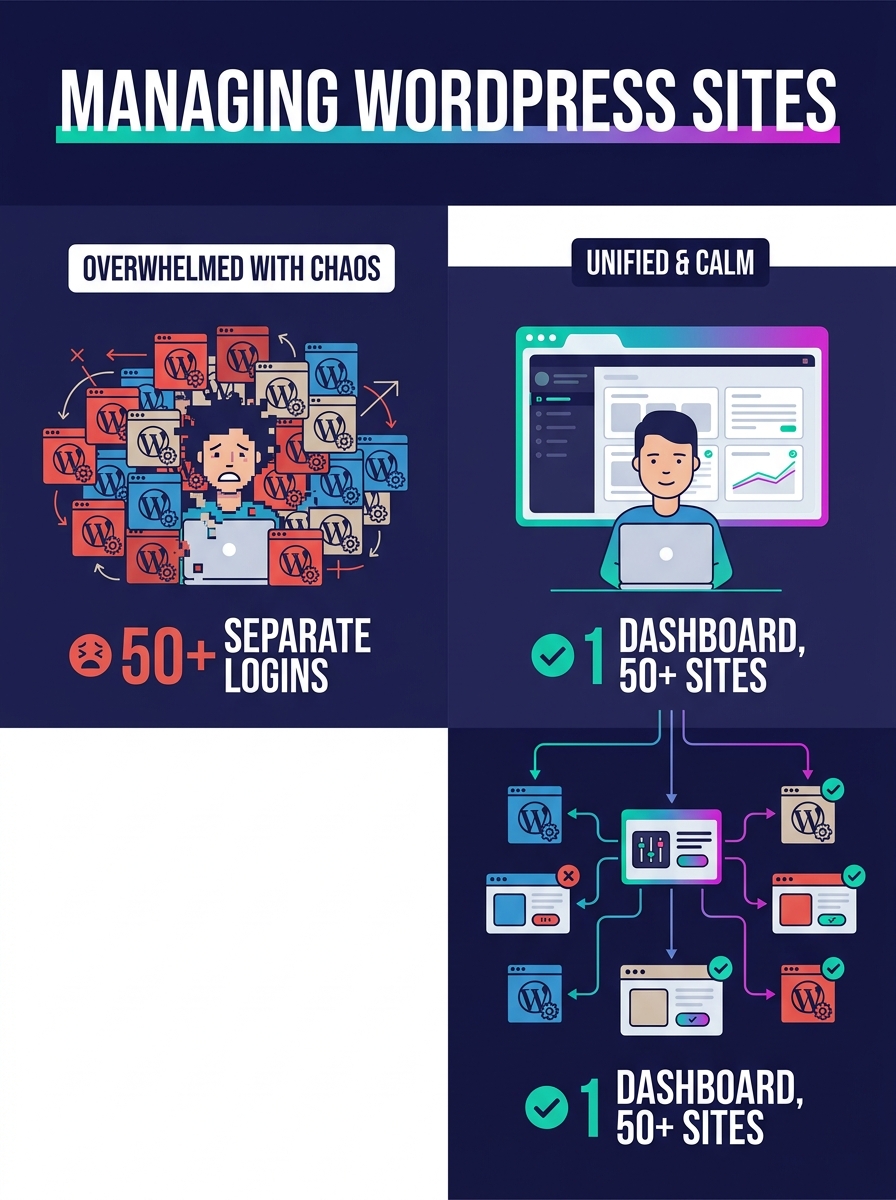
And here's the thing most agency owners miss: the isolation you think you have is often illusory. If all forty clients live on the same shared hosting account with the same PHP version, the same server resources, and the same IP address, a DDoS attack on one affects all of them anyway. You've paid the complexity tax of separate installs without getting real fault isolation in return.
Agencies that have already navigated the pitfalls of white-label WordPress services know that operational overhead is the silent killer of margins. The fix is architectural, and it starts with understanding the actual flavors of multi-tenancy available to you.
Shared Core, Scoped Data
Multi-tenant WordPress systems come in roughly three flavors, and picking the wrong one wastes months of engineering time.
WordPress Multisite is the platform's built-in multi-tenancy. It shares a single WordPress core across a network of sites, each with its own content tables but a shared user table and plugin/theme directory. It works well for agencies where clients use a similar stack. If you need per-client plugin variations, Multisite becomes a constraint fast, because activating a plugin network-wide means every site gets it, and per-site activation still loads the plugin code into memory for every request.
Tenant-scoped database rows represent the second approach. This means running one set of application logic with a tenant identifier on every data record. In WordPress terms, custom post types and taxonomies are filtered by a client ID on every query. It's the lightest-weight approach and the fastest to build, but it demands discipline. One missing WHERE clause and you're leaking Client A's data into Client B's dashboard.
Containerized per-tenant instances managed by an orchestration layer make up the third option. Platforms like WPCS take this approach, using Kubernetes to manage hundreds or thousands of WordPress sites under a single administrative interface. Each client gets actual process-level isolation, but the provisioning, updating, and monitoring happen centrally. This is the model that scales best for agencies above 50 clients who need real isolation without managing each install by hand.
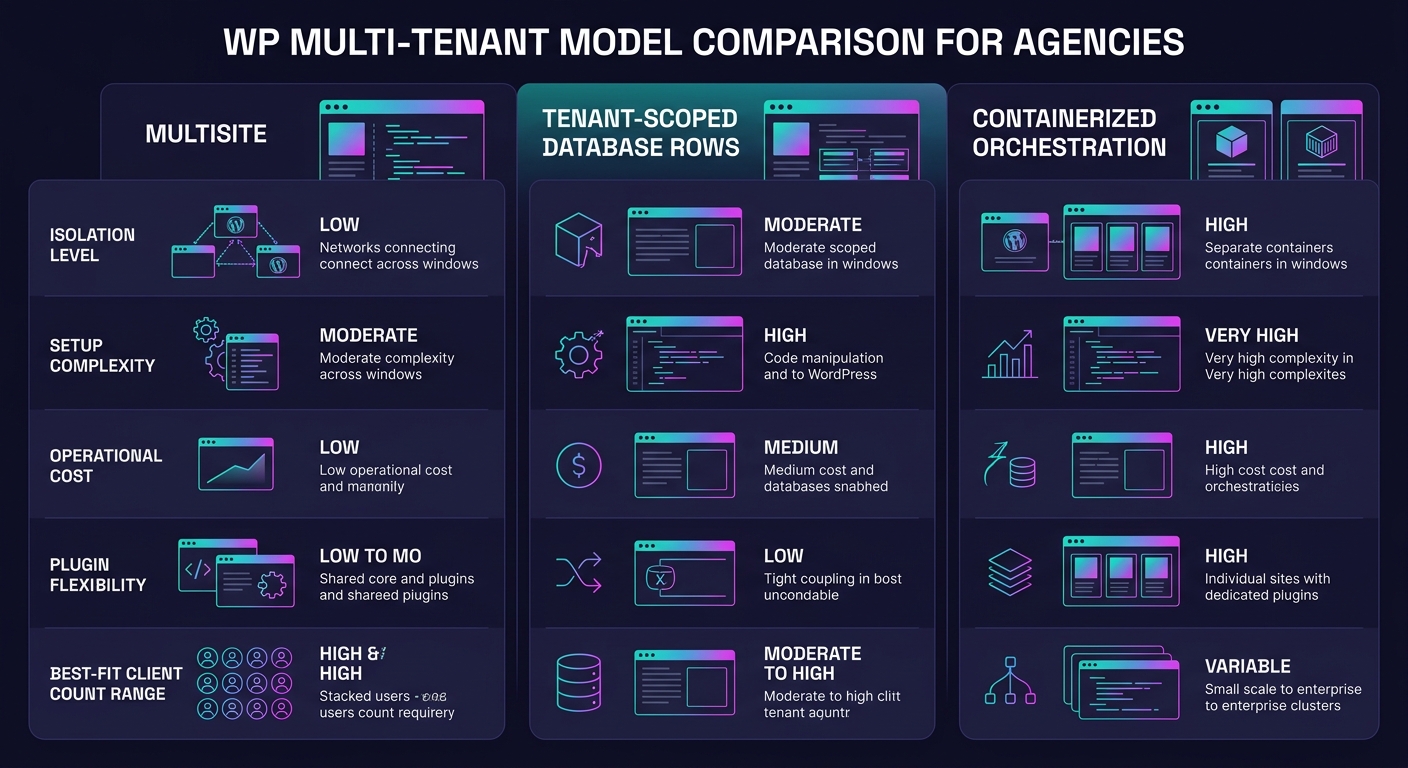
Tip: If your client base is under 20 sites and they all run similar themes and plugin sets, WordPress Multisite is the pragmatic starting point. The containerized model makes sense once you outgrow Multisite's constraints or need per-client plugin flexibility. Don't engineer for 500 clients when you have 12.
For agencies offering WooCommerce builds at scale, the choice matters even more. Store data carries PCI implications, and tenant isolation becomes a compliance question rather than a convenience preference. When you hire WooCommerce experts for these projects, make sure they understand the multi-tenant model you've chosen. A developer who's only built single-install WooCommerce stores will make assumptions that break under shared architecture.
The REST API as Connective Tissue
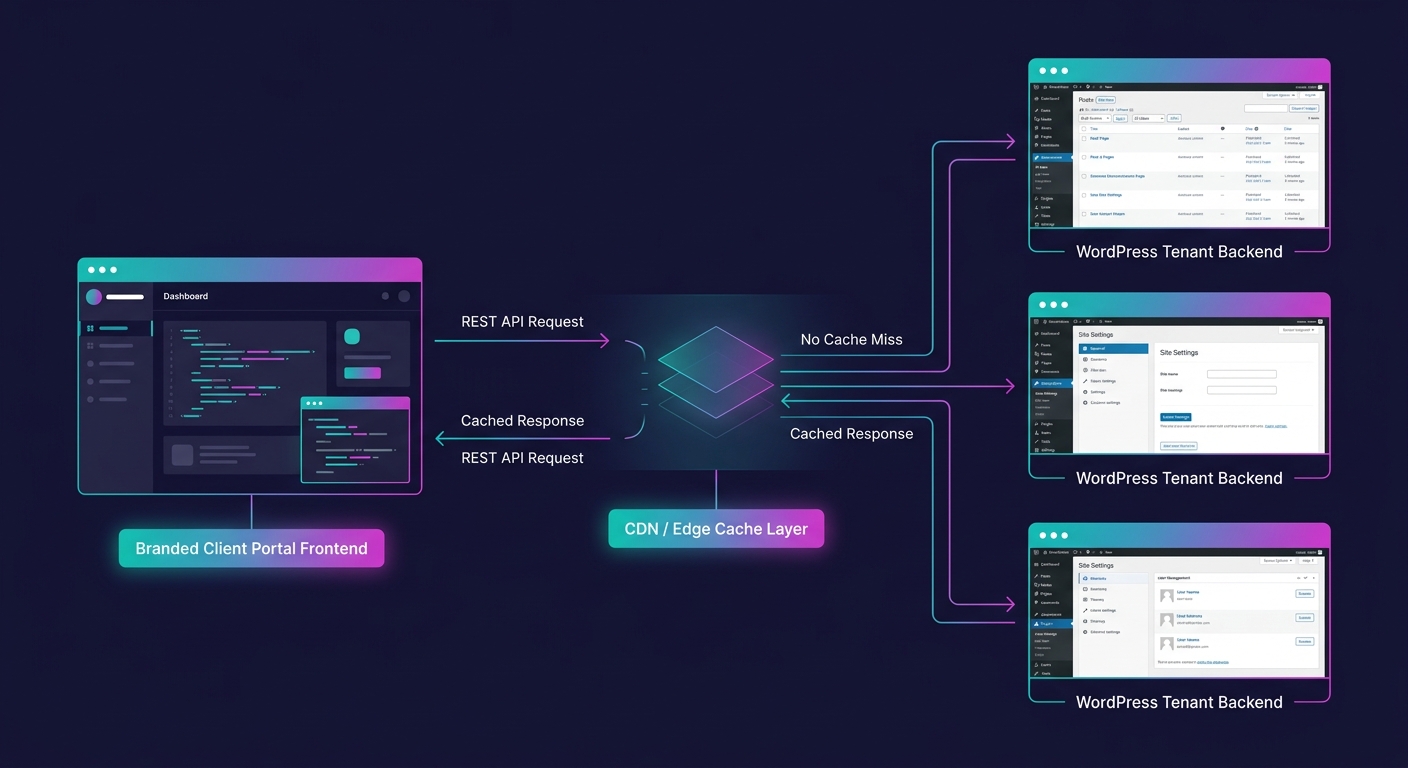
Here's where white-label WordPress architecture gets interesting for agencies with custom client dashboards or branded portals. The WordPress REST API turns each tenant's WordPress instance into a headless content backend, and your agency's branded frontend can pull from multiple tenants through a single interface.
This matters because the white-label promise falls apart if your client has to log into wp-admin. The moment they see the WordPress dashboard, your brand disappears. Building a REST API for white-label apps solves this by putting your custom-built frontend between the client and WordPress. The client interacts with your branded interface; your interface talks to WordPress via API calls; WordPress handles content storage and business logic behind the curtain.
The white-label promise falls apart the moment your client sees wp-admin. A REST API layer puts your brand between the client and the CMS, and that separation is what makes the architecture worth building.
Performance is the critical concern with this approach, and it's where many agency builds fall short. Remkus de Vries makes a compelling case that solving caching before the request reaches your server is the more scalable path to REST API performance. In practice, this means putting a CDN or edge cache in front of your API endpoints, with cache invalidation triggered by WordPress post-save hooks. For multi-tenant systems where dozens of sites are serving API responses simultaneously, this architectural decision separates a responsive branded portal from one that feels sluggish under load.
Authentication across tenants requires careful design. JWT tokens scoped to a specific tenant prevent cross-tenant data access, and OAuth flows let you build single-sign-on experiences where a client logs into your branded dashboard once and can manage all their properties from one screen. WordPress scalability patterns at this layer tend to follow the same principle: push computation to the edge, cache aggressively, and treat WordPress as a content engine rather than a presentation layer.
If you're troubleshooting API performance issues across tenants, having a structured approach to replicating client issues in staging environments becomes essential. A bug that only appears under multi-tenant load patterns won't show up on a single-install dev environment, and guessing at the cause burns hours your team doesn't have.
The Claim, Revisited
The argument here isn't that isolated WordPress installs are inherently bad. They're fine for an agency with five clients and a developer who enjoys spending Friday afternoons running updates. The argument is that the default approach stops scaling gracefully somewhere between 15 and 25 clients, and most agencies don't recognize the inflection point until they're already drowning in maintenance tickets.
Multi-tenant WordPress systems, whether built on Multisite, tenant-scoped databases, or containerized orchestration, consolidate operational work into repeatable patterns. Shared core files, edge-cached REST APIs, and centralized plugin management turn linear maintenance costs into something closer to fixed costs. Each new client adds revenue without proportionally adding ops burden. That's the economic engine behind every agency that's scaled past 50 white-label sites without tripling their infrastructure team.
The conventional wisdom that every client deserves their own install assumes isolation equals quality. In practice, a well-architected multi-tenant system delivers better uptime, faster updates, and more consistent security than forty individually-managed installs that are each slightly behind on patches. Agencies that have made the shift, particularly those who know how to evaluate a white-label development partner for the transition, report spending significantly less time on infrastructure and more on client-facing work that grows the business.
The conventional wisdom holds for edge cases: clients with unusual compliance requirements, wildly divergent tech stacks, or contractual mandates for physical separation. For the other 80% of agency clients, shared architecture with strong tenant boundaries is the faster, cheaper, and more reliable path. The agencies that recognized this early are the ones currently onboarding their hundredth client without hiring another sysadmin.