

Guideline 4.3 rejects apps for "duplicating the content and functionality of apps currently available on the App Store." WordPress agencies building white-label mobile companions or branded web apps for dozens of clients see this rejection code with discouraging regularity. The typical response is frustration, an appeal, maybe a superficial reskin, and then another rejection. But here's what experienced agencies have figured out: that rejection is doing you a favor. It's telling you that your multi-client WordPress architecture has a differentiation problem that would have caught up with you anyway, whether through client churn, brand confusion, or operational collapse at 20+ sites.
The real question is how you restructure. There are three common approaches agencies take once they recognize the clone-and-rebrand model won't scale. Each carries distinct tradeoffs in cost, maintenance burden, and the degree of customization your clients actually get.
The Separate-Install Model
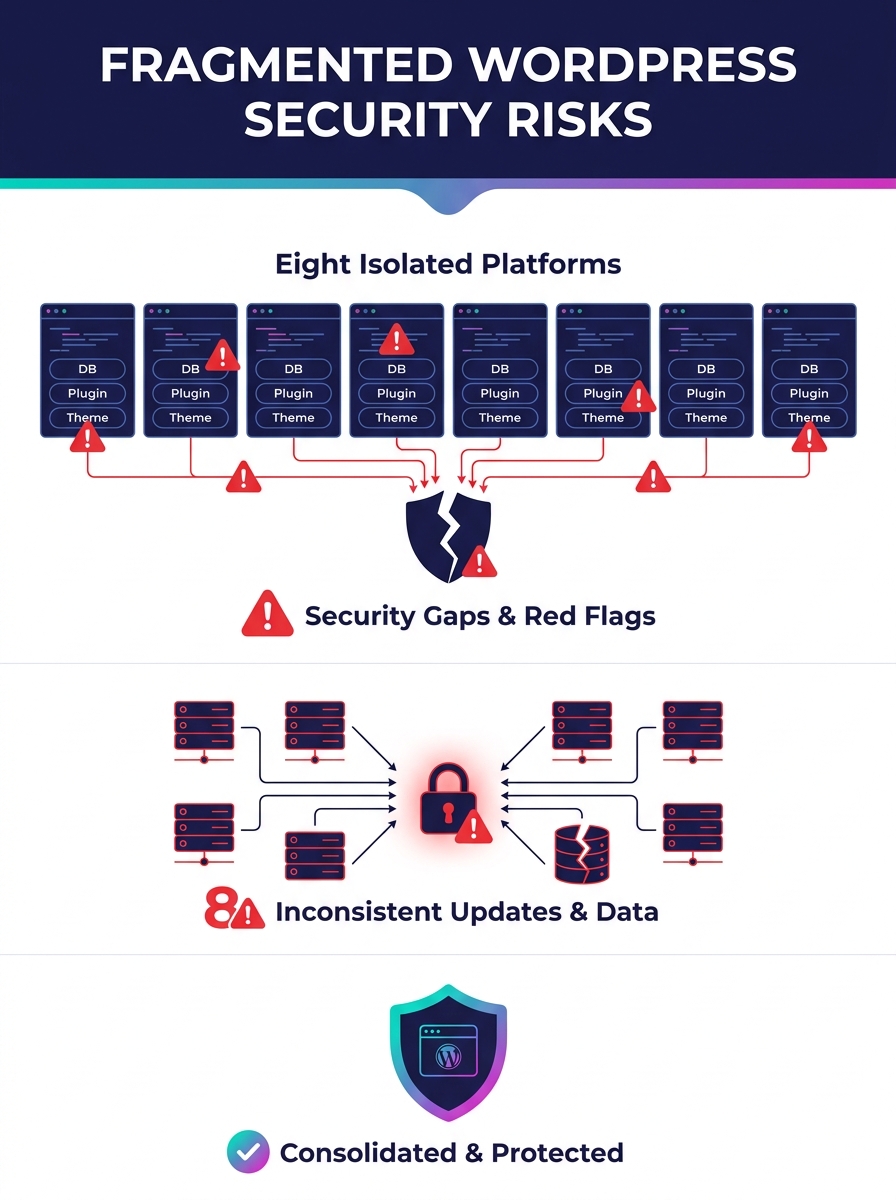
This is where most agencies start. Every client gets their own WordPress installation, their own theme (usually a child theme of the same parent), their own plugin stack, and if mobile apps are involved, their own app submission. The appeal is obvious: total isolation. Client A's plugin conflict doesn't cascade into Client B's site. You can customize freely without worrying about breaking shared infrastructure.
The problem surfaces somewhere around client number eight or twelve. Updates become a manual grind. A security patch for a caching layer or a firewall plugin needs to be applied across every installation individually. If you've read about how plugin vulnerabilities account for the majority of WordPress compromises, you understand why this delay is dangerous. One missed update on one install, and you're explaining a breach to a client whose site you forgot about.
On the app store side, this model maps directly to the pattern Apple and Google flag under their app store repetitive content policy. If you submit 15 apps that share 90% of their codebase and differ only in logo, color scheme, and a few content strings, Apple's reviewers will catch it. Developers on the Apple Developer Forums have reported rejections with the exact language: "your app duplicates the content and functionality of apps currently available on the App Store." The same enforcement pattern shows up in Google Play's spam policies, though with less consistency.
When separate installs still make sense
If you serve fewer than five clients with genuinely distinct functionality requirements, and each site has its own development team or dedicated maintainer, separate installs remain defensible. The operational overhead stays manageable. Some agencies intentionally stay in this bracket, charging premium rates that justify the per-client infrastructure cost.
But if your growth plan involves onboarding two to three new clients per month, you'll hit a wall. The wall looks like missed updates, inconsistent performance optimization, and a support team that spends 60% of its time on repetitive deployment tasks instead of meaningful development work.
Multi-Tenant WordPress on a Shared Core
Multi-tenant architecture puts all your clients on a single WordPress core installation while keeping their data, themes, and content separate. WordPress Multisite is the most familiar version of this approach, but agencies building at scale often go further. Custom multi-tenant configurations modify the wp-config.php per tenant while sharing the core codebase, as documented in detail by Jason McCreary's WordPress multitenancy guide.
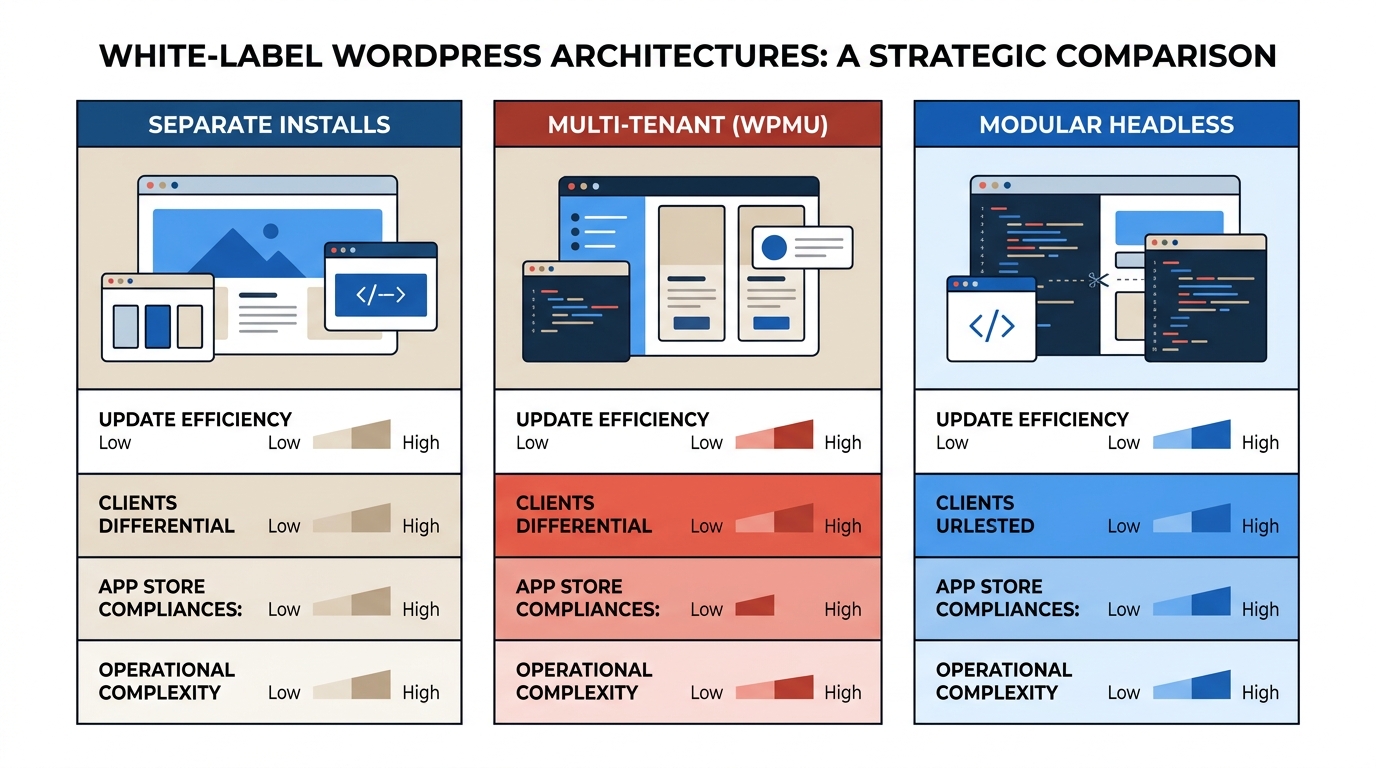
The advantages are significant. One core update covers every client. Plugin patches deploy once. Performance optimizations apply universally. And for app store compliance, the multi-tenant approach solves the Guideline 4.3 problem elegantly. Instead of submitting separate apps, you submit one app that dynamically rebrands based on the authenticated tenant. The user downloads a single app, enters their organization's credentials or scans a QR code, and sees their branded experience. Apple explicitly recommends this pattern for content-driven apps where the underlying functionality is shared.
App store rejections and client churn share the same root cause: your clients' products look and feel identical to each other, and everyone can tell.
White-label WordPress scalability depends on finding a balance between shared infrastructure and client-specific experience. The multi-tenant model sits right in the middle of that spectrum, which is both its strength and its limitation.
The tradeoffs agencies underestimate
Multi-tenancy introduces coupling. When one tenant needs a WordPress version that conflicts with another tenant's critical plugin, you have a genuine problem with no easy answer. Database architecture gets complicated fast. You're choosing between shared tables with tenant identifiers (simpler, riskier for data isolation) and separate databases per tenant (safer, harder to manage).
There's also a ceiling on differentiation. If Client A needs WooCommerce with complex subscription logic and Client B needs a membership portal with LearnDash, you're running two very different plugin ecosystems on a shared core. Plugin conflicts become architectural conflicts. Agencies that have experienced outsourcing models breaking at scale recognize this pattern: what works at three tenants collapses at fifteen when the shared environment can't accommodate divergent requirements.
Modular Headless with Per-Client Frontends
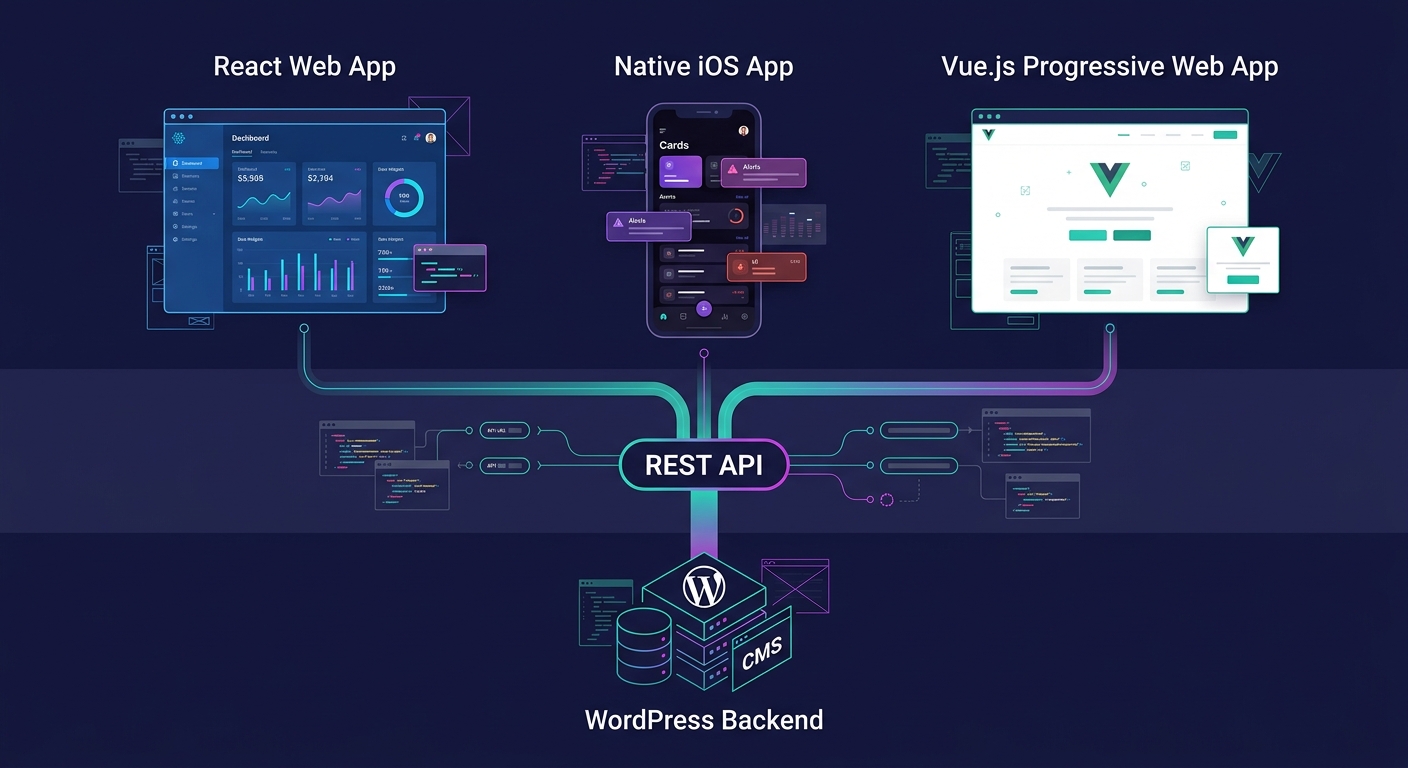
The third approach treats white-label WordPress as a platform layer. You maintain a shared WordPress backend for content management, user data, and business logic, but each client gets a genuinely distinct frontend experience. In practice, this often means headless WordPress with separate React, Next.js, or even native mobile frontends per client.
This is the most expensive option upfront. You're building and maintaining multiple frontend codebases. But it produces the strongest white-label differentiation strategy because each client's product genuinely looks, feels, and behaves differently. From Apple's perspective, these are different apps. The shared WordPress backend is invisible to the reviewer. What they see is distinct UI, distinct user flows, and distinct functionality.
Tip: If you're submitting companion apps for white-label WordPress clients, make sure each app has at least two unique user-facing features that don't exist in any other app you've submitted. Cosmetic changes like colors, logos, and fonts don't count. Apple's reviewers compare functionality, not branding.
The white-label SaaS architecture guide from Developex describes this as the "core platform, custom shell" model. The provider develops one platform that multiple partners rebrand and extend. The key word is extend. Each tenant isn't getting a reskin; they're getting a product that builds on top of shared infrastructure while adding capabilities specific to their market or audience.
Where this model gets difficult
Cost and coordination. Every new client frontend is a mini-project. Your development team needs to understand the shared API layer deeply enough to build against it without introducing regressions. If your agency relies on ticket-based outsourcing, this approach will strain that relationship because the work requires architectural context that ticket queues don't preserve well. Agencies working through the tradeoffs between feedback loops and ticket-based structures find that modular architecture demands the former.
There's also a talent bottleneck. WordPress developers who can build and maintain headless API layers, write GraphQL queries, and collaborate with frontend engineers working in React or Swift are not abundant. You'll either need to invest in training your existing team or partner with a white-label development shop that already has this depth. Planning your scalable white-label architecture before you start onboarding clients into a headless setup can save months of rework later.
How to Choose Between These Three
The right answer depends on three variables: how many clients you're serving, how different their products need to be, and how much operational overhead your team can absorb.
If you're running under five clients with similar needs and no mobile app requirements, separate installs work. Keep them patched, keep them backed up, and don't pretend you're building a platform. You're running a services business, and that's fine.
If you're scaling past ten clients with overlapping functionality and you want to submit a single app (or skip native apps entirely, relying on PWA delivery), multi-tenant WordPress gives you the best ratio of efficiency to control. Invest in your multi-client WordPress architecture planning before you onboard client number six, not after client number twelve when everything is on fire.
If your clients compete in different markets and need products that genuinely stand apart, the modular headless approach is where you end up. It costs more. It requires better developers. And it's the only model where app store rejection stops being a recurring anxiety, because each submission represents a product with its own identity.
The agencies that treat Guideline 4.3 rejections as a structural signal rather than a bureaucratic annoyance are the ones that end up with architecture worth scaling. Every rejection is pointing at the same underlying weakness: your clients' products are too similar to survive scrutiny, whether that scrutiny comes from an Apple reviewer, a Google Play automated scan, or the clients themselves when they realize their competitor's site looks exactly like theirs. Fixing the architecture fixes all three problems at once, and the agencies that figure this out early tend to keep their clients longer, charge higher retainers, and spend far less time on the kind of emergency maintenance work that eats margins alive.