

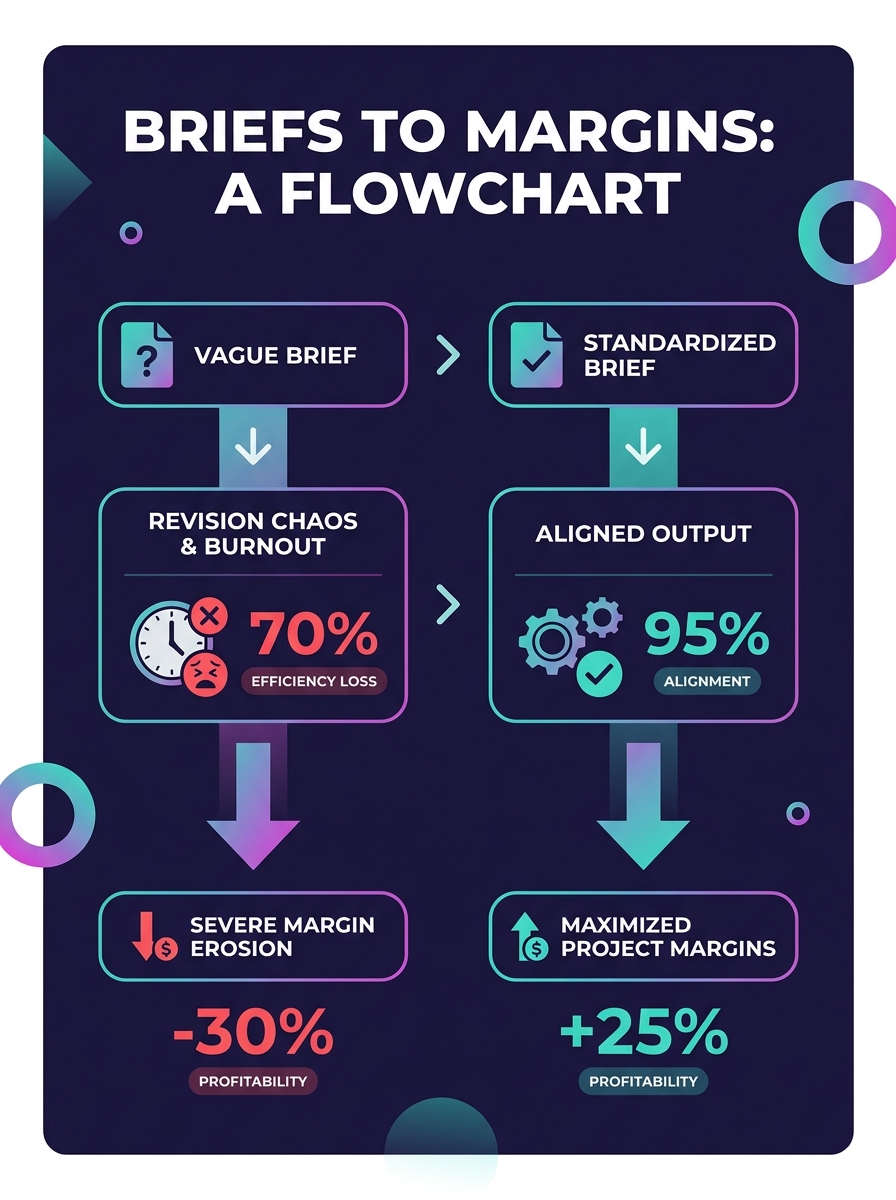
Workfront's research from April 2026 found that projects backed by complete creative briefs require 40% fewer revisions than those with vague direction, and agencies with standardized creative processes finish projects 40% faster. For white-label shops juggling 15 to 20 clients, that gap translates to dozens of recovered hours per month and margins that don't erode with every round of "just one more tweak."
The implication is straightforward: if your briefs to a white-label partner are inconsistent, your output will be too, regardless of how talented the development or design team on the other end happens to be. White-label brief standardization is the single highest-impact process improvement most mid-size agencies haven't made yet, because the brief is where every downstream problem (missed deadlines, off-brand deliverables, scope disputes) gets its start.
Why Briefs Fail Between Agency and Partner
The failure mode almost never looks dramatic. Nobody sends a blank email and expects a homepage back. Instead, you get briefs that are 80% complete. Enough information for the partner to start, but missing the 20% that determines whether the work lands on the first pass or the third.
Common gaps include:
- Search intent classification left unstated, so writers guess whether the piece should educate or sell
- Brand voice notes that amount to "professional but approachable" (which describes every B2B company on earth)
- Target reader details that stop at job title without addressing beliefs, goals, or friction points
- Internal linking requirements mentioned vaguely ("add some links") instead of specifying exact URLs and anchor context
When agencies managing outsourced teams struggle with feedback loops versus ticket queues, the root cause is often the brief itself. A thin brief forces the partner to make assumptions. Assumptions create rework. Rework eats margin. The cycle repeats until someone either fixes the intake process or burns out.
The Seven Fields That Eliminate Guesswork
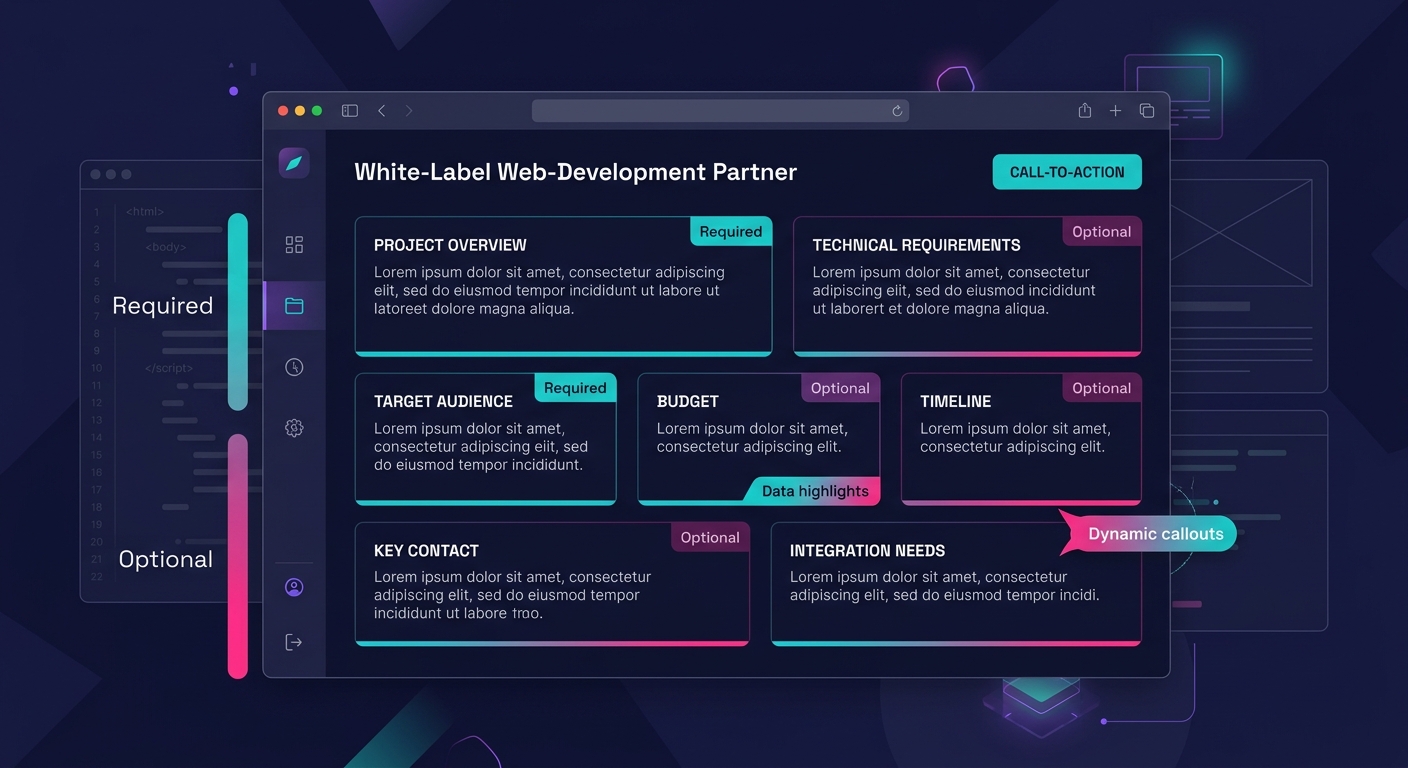
A partner communication framework doesn't need to be a 30-field form that nobody fills out. The best templates we've seen in production agencies cover seven areas, each with a specific purpose:
- Working title and primary keyword. Validated through actual SEO research, not gut feel. This anchors the entire piece and prevents the partner from optimizing for the wrong term.
- Content objective in one sentence. Something like "move enterprise prospects at the consideration stage toward requesting a demo." If you can't write this sentence, you're not ready to brief.
- Target reader profile. Go beyond "marketing managers aged 30–45." Include what they believe about the problem, what they've already tried, and what makes them skeptical. Pull this from sales call transcripts or customer interviews.
- Search intent type. Informational, navigational, commercial, or transactional. This determines structure, CTA placement, and tone more than any other single field.
- SERP and competitor context. A two-sentence summary of what's ranking and where the gap is. The partner shouldn't need to run their own competitive analysis to understand your angle.
- Recommended structure. Suggested H2s and H3s based on your SERP analysis. The partner can deviate, but they need a starting scaffold.
- Brand voice and differentiation notes. Specific do's and don'ts. "We never use exclamation points in body copy" is useful. "Be engaging" is not.
As Smart Insights notes in their SOP framework, each brief template should be editable and white-label-ready so agencies can adapt it across different client accounts without rebuilding from scratch every time.
Scope Creep Starts Before the First Revision
Scope creep prevention is the unsexy reason most agencies eventually standardize their briefs. The pattern is predictable: a brief says "build a landing page," the partner delivers a landing page, and then the agency says "oh, we also need a thank-you page, a form integration, and mobile-specific hero variants." The partner either absorbs the extra work (and resents it) or pushes back (and the relationship gets tense).
According to Scribbl's agency guide on the topic, effective scope creep prevention comes down to three strategies: an ironclad Scope of Work, clear client communication, and a non-negotiable change control process. The brief is where all three start. When every deliverable, revision limit, and approval milestone is spelled out before work begins, there's a shared document both sides can point to when requests expand.
The change control piece is especially critical for agency outsourcing workflows. Your brief template should include a section, even just two lines, that states: changes beyond what's documented here require a separate request with its own timeline and cost estimate. This isn't adversarial. It's protective for both parties, and experienced white-label partners actually prefer it because it means they won't get surprised by unpaid work three days before a deadline.
The brief is where scope creep either gets prevented or gets its first foothold. Everything after is damage control.
Building Repeatable Deliverables Without Killing Flexibility
There's a tension every agency hits when standardizing: if you template everything, you lose the ability to handle unusual client requests. If you template nothing, every project is a one-off that depends on whoever happens to write the brief that day.
The answer, as we've explored in the context of when to customize versus standardize WordPress solutions, is to standardize the structure while leaving room for the content to flex. Your brief template stays the same across every project. The fields get filled in differently depending on the client, the deliverable type, and the complexity.
Practical ways to build in flexibility:
- Use dropdown fields for repeating choices (tone: formal / conversational / technical; intent: informational / commercial / transactional) so the person filling out the brief doesn't need to invent language every time
- Include a freeform "context" field for anything that doesn't fit the structured sections: edge cases, political sensitivities, client quirks
- Embed links to two or three examples of past work that hit the mark, so the partner has a visual reference alongside the written spec
- Version your templates quarterly and track which template version produces the fewest revision cycles, then iterate from there
For agencies that work with graphic designers or other creative partners alongside developers, a parallel brief template for visual repeatable deliverables prevents the same chaos from spreading across disciplines. The fields change (color palette, asset dimensions, brand guidelines PDF) but the principle of "document everything the partner needs before they start" stays constant.
Rolling It Out Without a Big-Bang Disaster
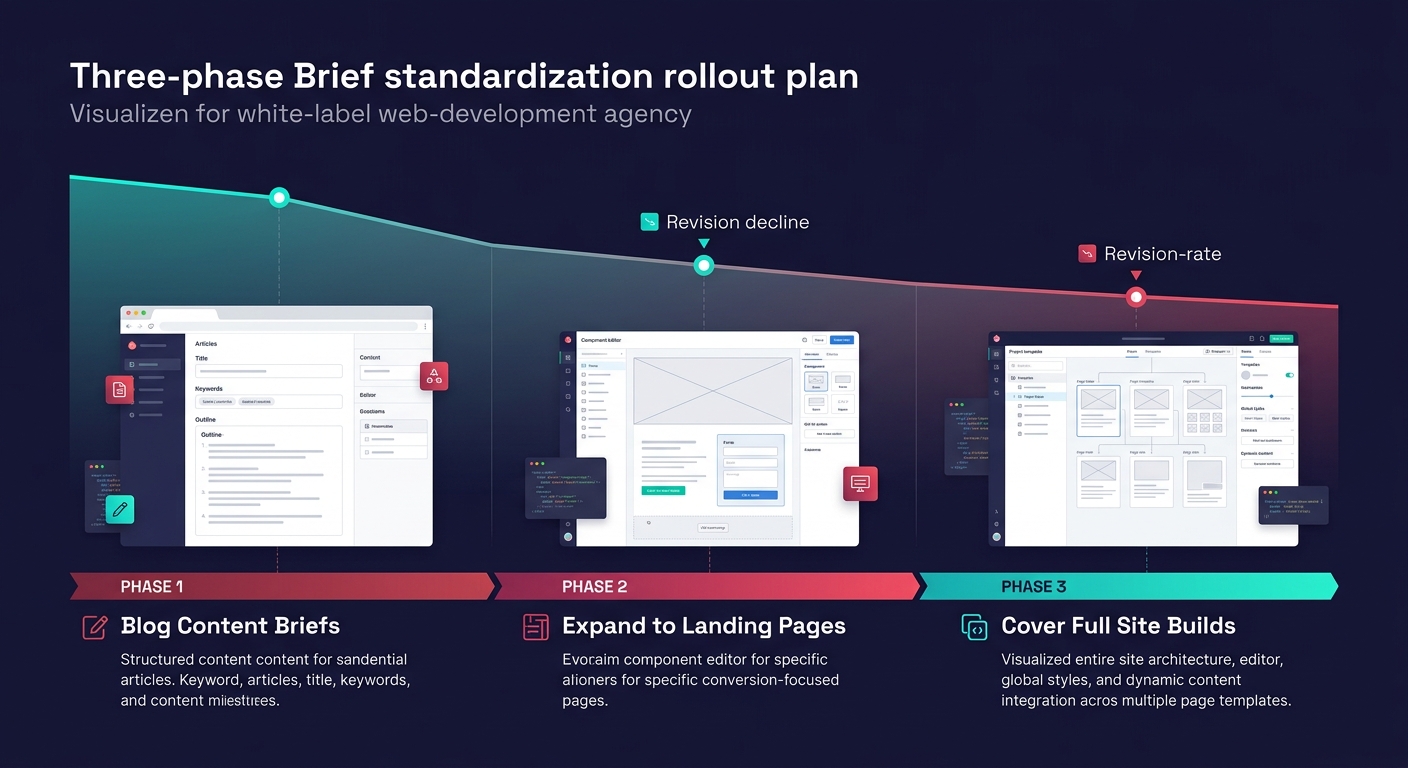
Research on process standardization consistently shows phased rollouts succeed at roughly three times the rate of all-at-once implementations. The agencies that do this well typically start with one deliverable type, usually blog posts, and run the new brief template alongside their old process for two to four weeks.
During that parallel period, you're watching for:
- Revision count. Are briefs produced on the new template generating fewer rounds?
- Time from brief to first draft. Does the partner deliver faster when they have better inputs?
- Partner satisfaction. Are they asking fewer clarifying questions in Slack before starting?
Once the numbers confirm the new template works for that deliverable type, expand to landing pages, then to full site builds, then to WooCommerce customizations. Each deliverable type will need its own template variant, but the underlying structure and philosophy stay the same.
This phased approach also gives your team time to build the muscle memory of filling out briefs thoroughly. The biggest failure point in white-label brief standardization isn't the template itself. It's the account managers who shortcut the fields because they're in a rush. Phased rollouts give you time to coach that behavior before it becomes the norm across the whole agency.
If your partner vetting process is already structured, and if you've built a quality control checklist for evaluating white-label partners, adding brief standardization is a natural next step. Partners who pass your vetting criteria will perform even better when they receive consistently high-quality inputs.
What Still Isn't Settled
A few open questions remain for agencies working through this process. The role of AI in brief creation is evolving fast. Some agencies use AI tools to pre-populate SERP analysis and suggested headers, which speeds up brief creation but risks homogenizing the strategic thinking if the person reviewing the output doesn't push back on generic suggestions. As one 2026 analysis noted, inconsistent briefs produce wildly inconsistent AI output, so the template becomes even more important when AI is part of your workflow, not less.
There's also the question of how much of the brief should be visible to end clients. Some agencies share a simplified version with clients for approval before sending the full brief to the partner. Others keep the brief entirely internal. Both approaches work, but mixing them across accounts without a clear policy creates confusion about who owns what.
And the measurement piece still needs work industry-wide. Tracking revision counts and turnaround times is a start, but connecting brief quality to long-term content performance (rankings, conversions, client retention) requires attribution modeling that most agencies haven't built yet. The agencies that close that loop first will have real data on which brief components actually matter versus which ones are process theater dressed up as rigor. For now, fewer revisions and faster delivery are strong enough proxies to justify the investment in getting your briefs right.