

A white-label architecture audit uses automated code analysis and defined measurement frameworks to quantify the shortcuts, plugin bloat, and theming overrides accumulating across a WordPress client portfolio. The output converts vague delivery slowdowns into dollar figures, showing exactly where margins are leaking before client complaints surface.
Without measurement, as one technical debt framework comparison puts it, "every conversation about technical debt is opinion versus opinion." That line captures why so many agency retrospectives end in finger-pointing rather than fixes. The agency lead says delivery is slow. The developers say the client keeps changing scope. The white-label partner says the briefs are unclear. Everyone is partially right, and nobody has data. A WordPress architecture audit breaks that deadlock by attaching numbers to the decay: how many orphaned database queries run on each page load, how many plugin dependencies are redundant, how many one-off CSS values have been injected outside the design token system. Those numbers transform a political conversation into an engineering one, and they're the difference between building scalable WordPress patterns and rebuilding the same broken foundation every quarter.
Where Debt Concentrates in Multi-Tenant WordPress
Debt in a white-label WordPress setup doesn't spread evenly. It concentrates in three predictable zones: the theme layer, the plugin dependency graph, and the database. Understanding where to look matters because auditing everything at once produces a report so long that nobody acts on it.
The theme layer is where most agencies hemorrhage margin without realizing it. A typical white-label WordPress theme launches with around 12 design tokens: brand colors, a font stack or two, spacing units, border radii. By the fifteenth client, that number can balloon past 200 unique values as designers and clients push one-off overrides to meet campaign deadlines. We've written at length about how flexible theming collapses under client customization pressure, and the pattern repeats itself almost identically from agency to agency. When designers spend up to 40% of their time debugging CSS overrides instead of building new pages, you're paying senior rates for junior-level work. That time cost compounds linearly with every client you onboard because there's no economy of scale once customization runs unchecked.
Plugin dependency is the second concentration point. White-label builds are worse than standard WordPress projects because each client often brings a preferred plugin: a specific form builder, a specific SEO tool, a specific analytics integration. The white-label team accommodates them all. The result is a plugin footprint that grows with the client count rather than the feature set, and each additional plugin introduces potential conflicts, update overhead, and security surface area. As documented in our coverage of how plugin vulnerabilities account for the majority of WordPress site compromises, every unnecessary dependency is a liability you're maintaining for free.
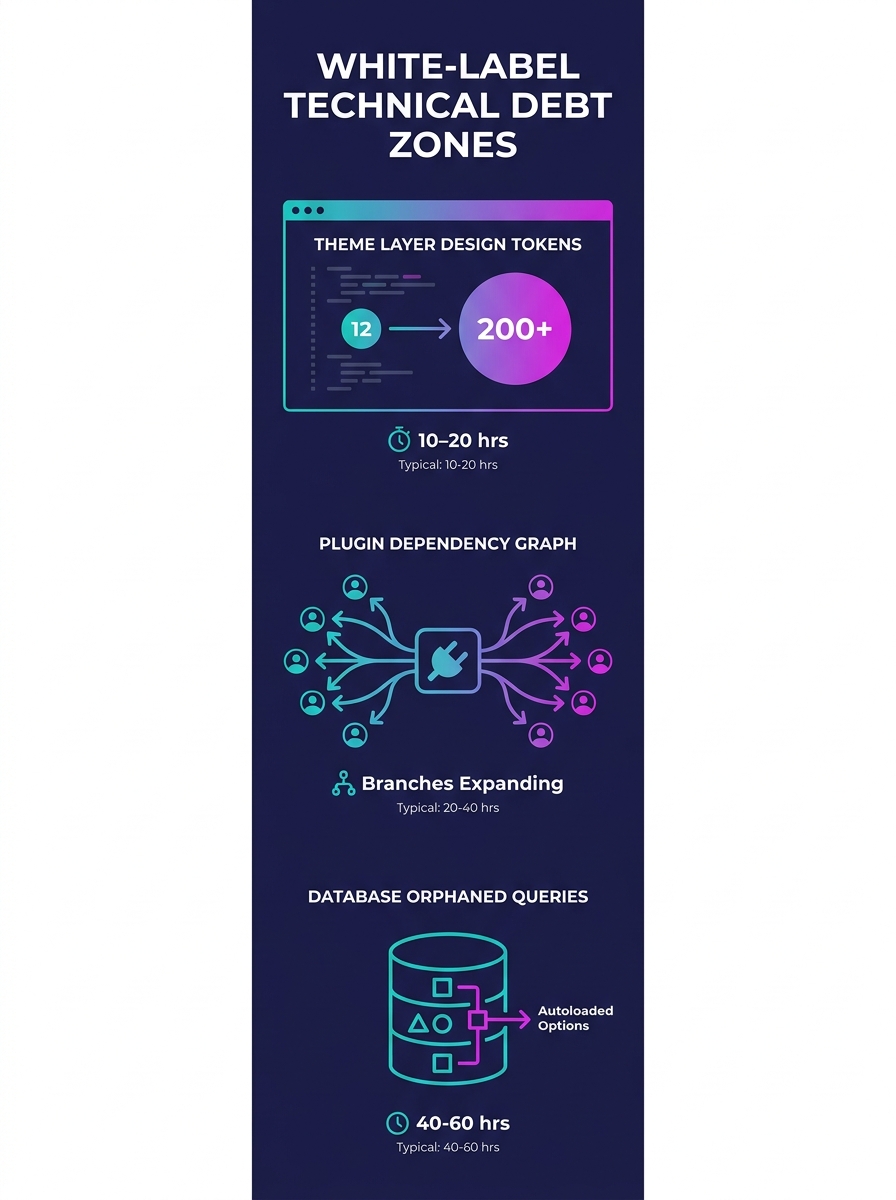
The database is quieter but expensive. Orphaned post meta, autoloaded options from deactivated plugins, and unindexed custom queries accumulate over months. A site that loaded in 1.8 seconds at launch loads in 4.2 seconds eighteen months later, and nobody changed the theme or the hosting. The speed penalty that plagues white-label builds traces back to this silent accumulation more often than to bad hosting or unoptimized images.
Picking a Measurement Framework That Fits Agency Work
Why does choosing a framework matter more than choosing a tool? Because the tool generates numbers, and the framework tells you what those numbers mean. SonarQube provides in-depth code analysis that reports on code smells, bugs, and vulnerabilities while assigning a maintainability score to every codebase. But without a framework for interpreting that score, you can't answer the question that actually matters to an agency owner: is 87 hours of remediation debt catastrophic for a five-page brochure site, or acceptable for a 200-page WooCommerce store?
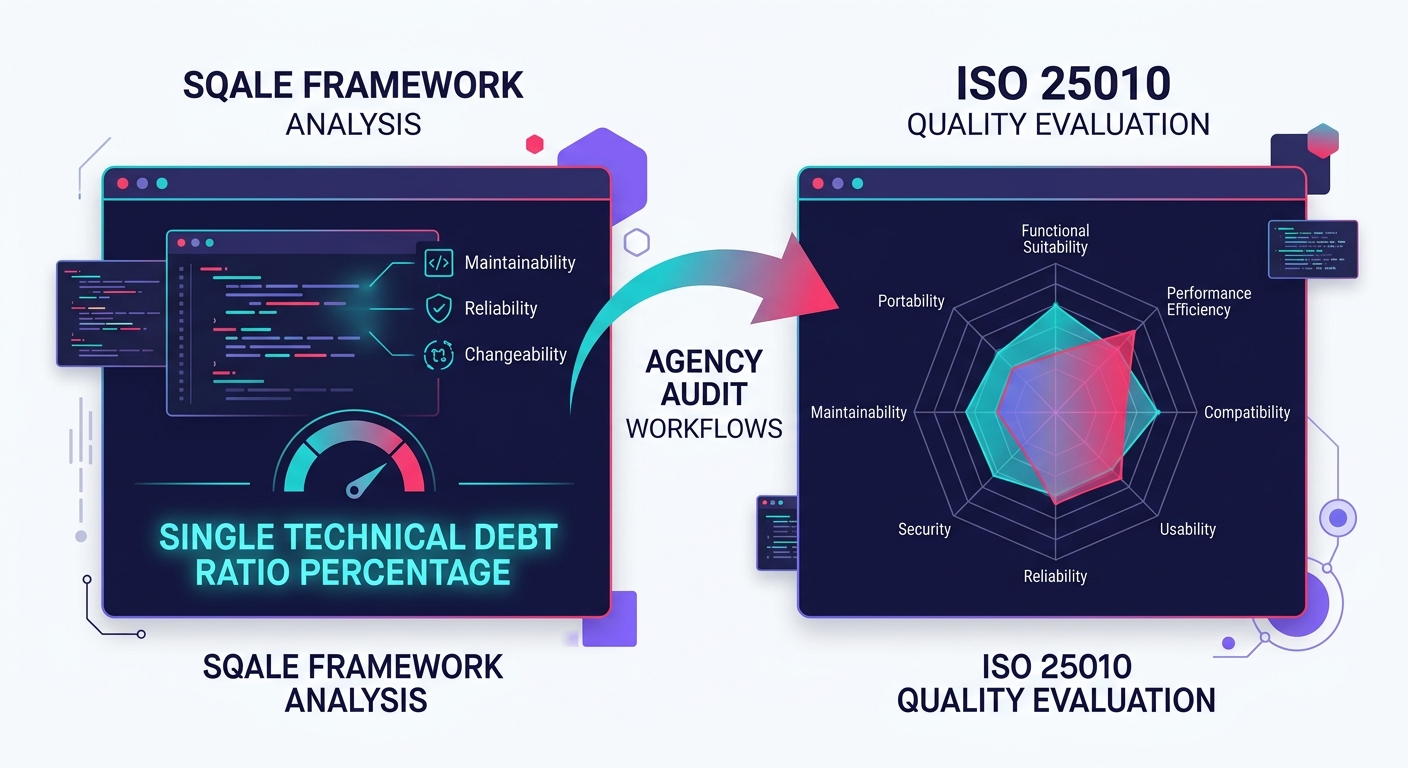
The two frameworks worth evaluating for agency work are SQALE and ISO 25010. SQALE (Software Quality Assessment based on Lifecycle Expectations) maps code issues to remediation time and assigns them to quality characteristics like testability, changeability, and reliability. It's what SonarQube uses under the hood, and it produces a single "technical debt ratio" expressed as a percentage of total development time. A ratio above 5% means the codebase is eating more than a twentieth of every future development hour in maintenance overhead. For a white-label agency running 30 active client sites, even a 3% ratio across the portfolio translates to losing roughly one full-time developer's worth of capacity to invisible maintenance. ISO 25010 takes a broader view, evaluating software against eight quality characteristics including security, performance efficiency, and maintainability. It's less granular than SQALE for day-to-day technical debt measurement but more useful when presenting findings to a non-technical agency owner who needs to understand business risk rather than code smells.
For white-label infrastructure specifically, I'd argue you need to supplement either framework with a custom metric: Debt-Per-Client Density, calculated as total remediation hours divided by active client count. This number exposes whether your architecture is scaling cleanly or whether each new client is adding disproportionate maintenance weight. A healthy white-label infrastructure shows a flat or declining debt-per-client trend as shared components absorb new clients. A rising trend means your customization layer is outgrowing your shared architecture, and you're approaching the point where standardizing versus customizing becomes an existential decision rather than a strategic preference.
The Margin Equation That Makes This Urgent
Technical debt doesn't appear on a P&L statement. As one analysis of technical debt in SaaS valuations describes it, debt is "the single biggest destroyer of post-acquisition value" precisely because it doesn't show up in the financial reports that buyers and operators review. For white-label agencies, the dynamic is identical but plays out faster. You don't need an acquisition event to feel the damage; you feel it every quarter when deployment speed declines and bug fixes pile up.
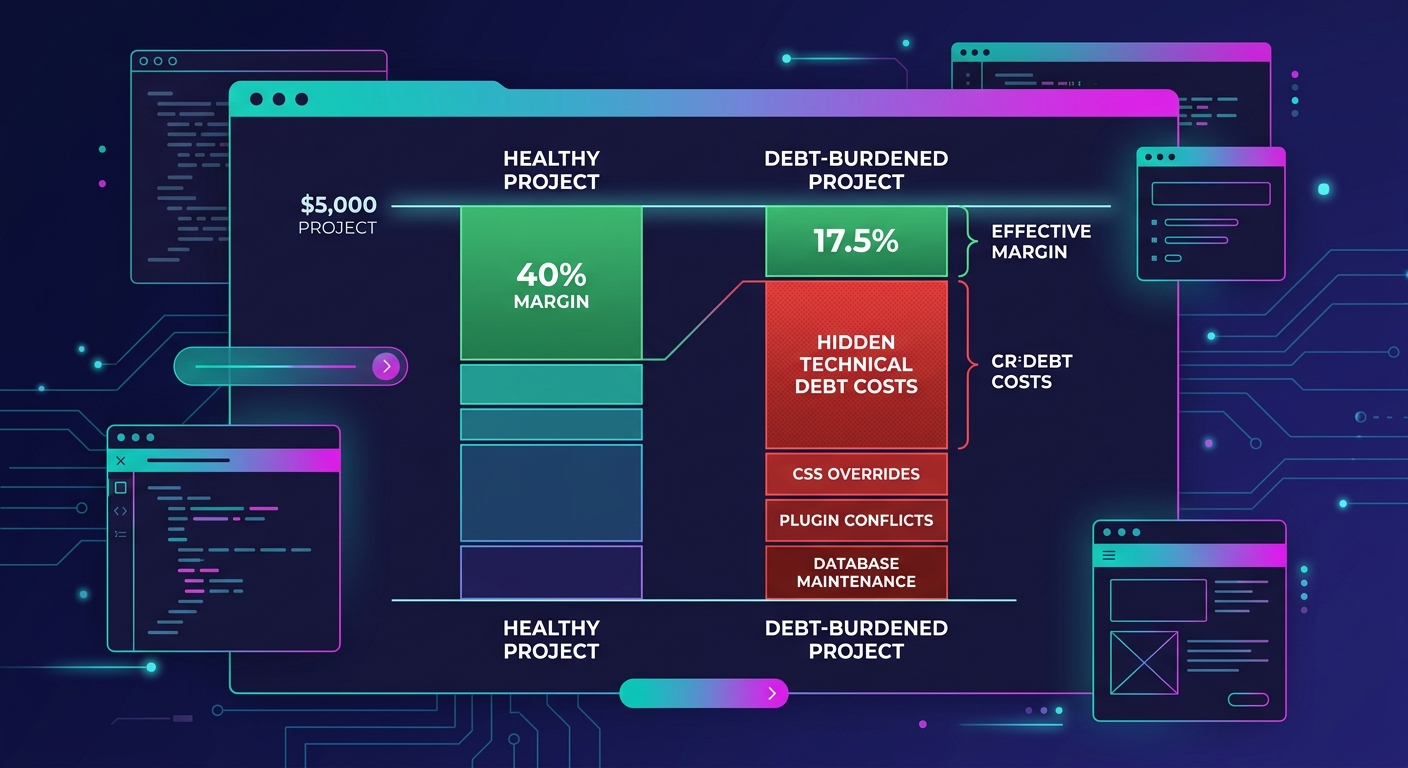
The math works like this. A white-label agency billing $5,000 per site build with a 40% gross margin has $2,000 of delivery room per project. If accumulated technical debt adds 15 hours of unplanned maintenance per project at a blended developer rate of $75/hour, that's $1,125 in invisible cost, cutting the effective margin from 40% to 17.5%. Scale that across 10 projects per month and the agency is leaking $11,250 monthly, or $135,000 annually, into work that doesn't appear on any invoice. That's the revenue of two to three additional projects per month, evaporating into CSS override debugging, plugin conflict resolution, and database optimization that should have been prevented by architecture decisions made at the template level. Agencies already wrestling with the margin math of white-label pricing know that even small erosions in delivery efficiency cascade into pricing models that can't sustain the business.
A rising Debt-Per-Client Density trend means your customization layer is outgrowing your shared architecture, and you're approaching the point where standardizing versus customizing becomes an existential decision.
The urgency accelerates because technical debt compounds. When deployment speed declines, testing phases stretch and developers adopt more shortcuts to hit deadlines. Those shortcuts generate more debt, which slows the next project further. Lee Firman, writing about evaluating white-label platform readiness, captured the core test: "If cloning your platform for a new use case feels impossible or requires rebuilding most of it from scratch, you're not white-label ready." The WordPress architecture audit is how you find out whether you've crossed that threshold before a failed client delivery tells you the hard way.
What the Numbers Can't Tell You
An architecture audit will give you a technical debt score, a remediation priority list, and a dollar figure for the maintenance burden hiding in your codebase. What it won't give you is a strategy. The numbers can't tell you whether to invest six weeks in refactoring your theme architecture or to scrap it and rebuild from a block-theme foundation. They can't weigh the client relationship cost of temporarily slowing delivery while you pay down debt against the margin cost of ignoring it. And they can't account for the organizational debt that often accompanies the technical kind: the undocumented handoff processes, the tribal knowledge locked in a senior developer's head, the QA steps that get skipped when deadlines tighten.
The measurement is necessary. Without it, you're flying blind on one of the biggest line items that never appears in your books. But treating the audit output as a to-do list rather than a diagnostic input leads to a different kind of waste, where teams burn weeks fixing low-priority code smells while the real margin killer (say, a plugin dependency graph that makes every update a two-hour regression test) sits untouched because it scored lower on the automated report. The frameworks and tools described here give you the vocabulary and the data to have the right conversation. The judgment about what to fix, what to tolerate, and what to redesign entirely still belongs to the people who understand both the code and the client relationships that depend on it. Technical debt measurement is the beginning of a strategy, and agencies that confuse it for the whole strategy tend to generate impressive audit reports that change nothing about how the next project ships.