

Scope creep gets blamed for most outsourced WordPress project failures. The diagnosis is wrong. Scope creep is a downstream symptom. The actual mechanism that kills white-label builds fires much earlier, during the handoff itself, when an agency's internal understanding of a project gets compressed into a brief and transmitted across an organizational boundary to a development team that has zero shared context. What arrives on the other side is structurally incomplete, no matter how detailed it looks. Understanding how this compression works, layer by layer, is the difference between a white-label handoff process that produces reliable output and one that generates rework on every project.
The Brief Is a Lossy Compression Algorithm
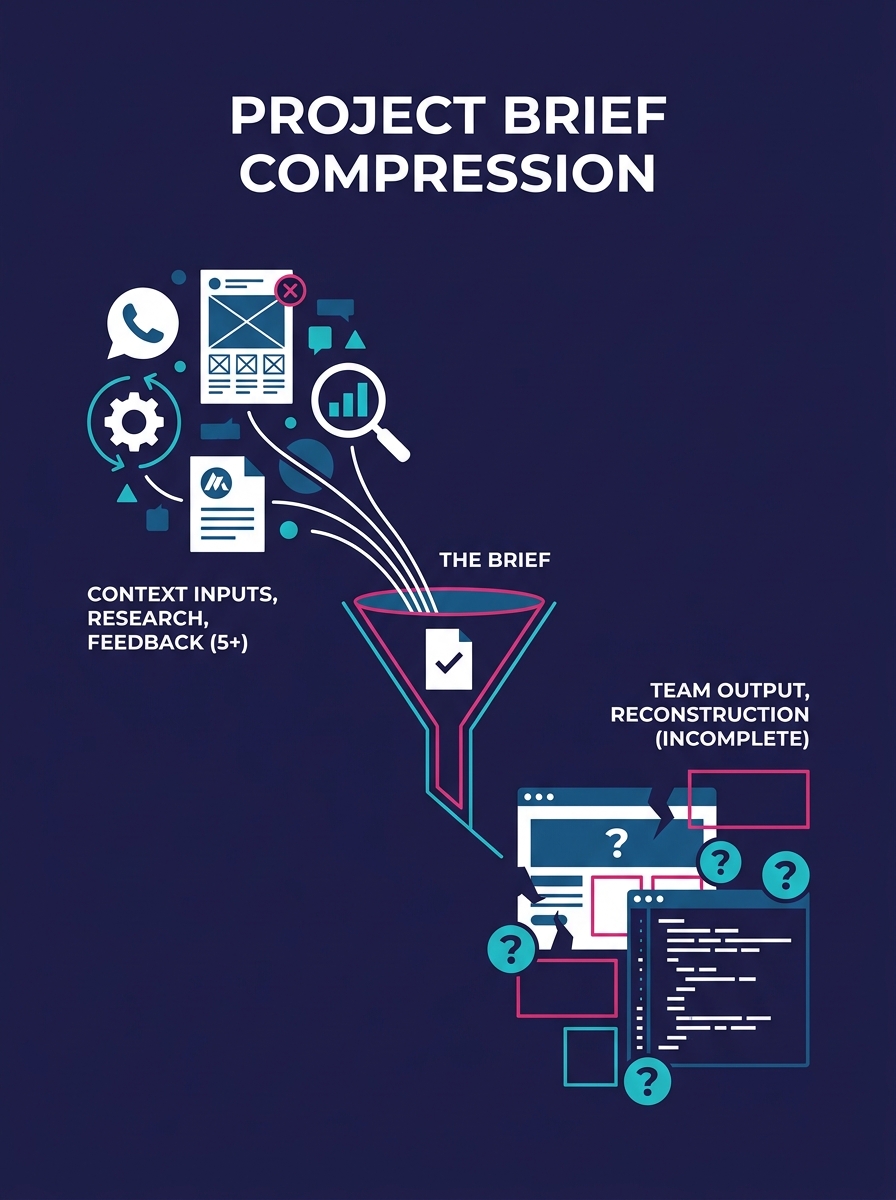
Think of the brief as a file format. Your agency holds the full, uncompressed version of the project in its collective memory: every conversation with the client, every rejected mockup, every stakeholder preference mentioned in passing on a Zoom call. The brief compresses all of that into a document, a Figma link, maybe a Loom walkthrough.
The dev team then decompresses that document on their end, filling in the gaps with their own assumptions, defaults, and past experience. The problem is structural. Two different organizations can't share context the way two people on the same team can. The brief looks complete because it answers the questions the agency thought to ask. It doesn't answer the questions the dev team would ask if they'd been in the room.
This is why agencies that have worked through standardizing their white-label partner briefs see immediate improvements. The fix is treating the brief as a translation layer that needs explicit rules for both sides, rather than a one-directional document that gets tossed over a wall.
Where Assumptions Bury Themselves Inside Requirements
Here's a concrete example. An agency writes "standard WooCommerce checkout" in a brief. To the agency, that means the checkout flow the client saw in the competitor audit, with Apple Pay, a guest checkout option, and address auto-complete. To the dev team, "standard WooCommerce checkout" means the default WooCommerce checkout template with whatever payment gateways get specified elsewhere in the document.
Nobody is wrong. Both readings are reasonable. But the gap between them is 8-15 hours of unplanned work, and neither side discovers it until the staging review.
These buried assumptions cluster around a few predictable areas:
- Third-party integrations. The brief says "Mailchimp integration" but doesn't specify whether that means a simple newsletter signup form or a full behavioral sync with WooCommerce purchase data. As FatLab's documentation of white-label support scenarios points out, something as routine as a Mailchimp sync can break when API authentication requirements change, and the developer needs judgment about how deep the fix should go.
- Payment gateway configuration. "We need Stripe" can mean basic card processing or a full subscription billing setup with proration logic, webhook handling, and failed-payment retry flows.
- Performance expectations. The agency expects sub-3-second page loads because that's what they promised the client. The dev team builds to functional correctness and assumes performance optimization is a separate phase.
Every one of these is a site of future outsourced WordPress scope creep, and every one is preventable by making the implicit explicit before a single line of code gets written.
The Approval Authority Gap
When something falls outside the original brief (and it will), who decides whether it gets built? This question almost never gets answered during the white-label handoff process, and it causes more damage than any ambiguous requirement.
A Sonar analysis of outsourced development scope creep found that it typically stems from poorly defined requirements combined with the absence of clear oversight into development activities. The requirements problem gets all the attention. The oversight problem is the one that compounds.
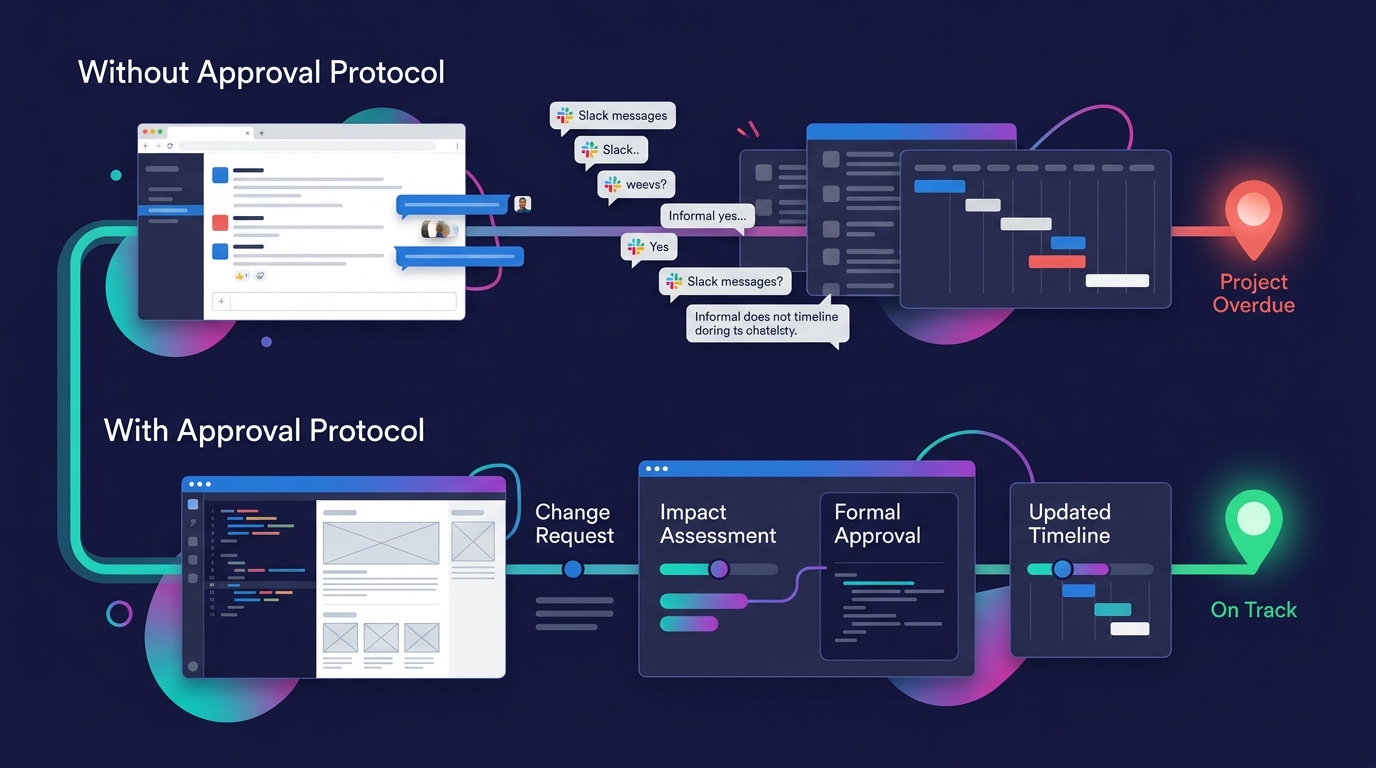
Without a change management protocol, what happens is predictable: the dev team encounters something ambiguous, makes a judgment call, and keeps building. Or the agency's project manager says "yeah, add that too" in a Slack thread without realizing they've just expanded the scope by 20%. Nobody tracks the addition formally. Nobody re-estimates the timeline. Three weeks later, the project is behind schedule and both sides blame each other.
The fix is a documented protocol that specifies three things:
- Who on the agency side can approve scope additions (by name, not by role)
- What impact assessment is required before anything new enters a sprint
- How approved additions get logged so both sides have the same version of truth
This aligns with what 365Outsource identifies as a critical element of project scope definition for outsourced timelines: a change management protocol covering who can approve scope additions and what assessment is required before new work enters a sprint.
Technical Constraints That Never Make It Into the Brief
Agency briefs overwhelmingly focus on what a site should do and look like. They rarely specify the technical environment it needs to operate within. And that missing layer creates an entire category of handoff failures.
Think about what typically goes undocumented:
- Hosting environment details. Is the client on shared hosting with a 256MB PHP memory limit, or a managed WordPress host with Redis object caching and server-level CDN? The answer changes plugin choices, caching strategy, and what's even possible to build.
- Browser and device support. "Mobile responsive" is not a specification. Does the client's audience skew toward Safari on iOS 16, or are they a B2B company where 60% of traffic comes from Chrome on desktop?
- Plugin architecture decisions. Whether the build uses Elementor, Oxygen, block themes with Full Site Editing, or a custom theme with ACF has massive implications for maintainability, performance, and what the client can edit themselves. If your agency has been putting off the block themes vs. ACF decision, the white-label handoff is exactly where that indecision turns into rework.
- Security and compliance requirements. Does the site handle personally identifiable information? Is GDPR consent management required? Are there specific plugin vetting standards?
When these constraints go unstated, the dev team makes reasonable default choices. Those defaults frequently collide with the agency's unstated expectations, and the collision usually happens late in the build when fixing it is expensive.
Every undocumented technical constraint is a decision your dev partner will make for you, using their defaults instead of your requirements.
Definition of Done at Each Milestone
The most reliable predictor of handoff failure isn't brief length or call frequency. It's whether both sides share a concrete definition of what "done" looks like at each milestone, not just at final delivery.
Agencies that work with a white-label WordPress development partner tend to define "done" once: the finished site, approved and launched. Everything between kickoff and launch is a gray zone where the dev team self-assesses progress and the agency gets surprised at review checkpoints.
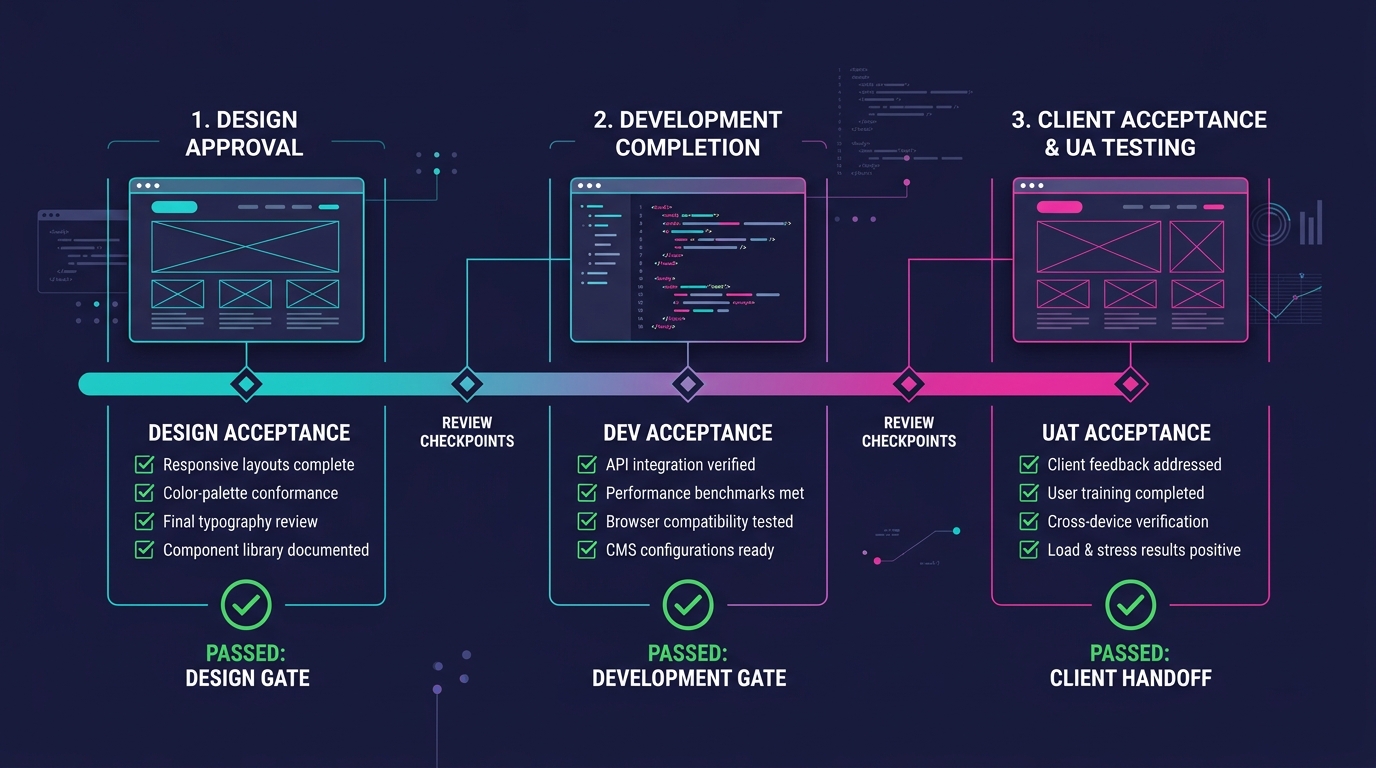
A better structure breaks the build into milestones with specific, testable criteria:
- Milestone 1 (Theme Setup): Theme installed, global styles configured to match brand guide, header/footer built, responsive down to 375px. Done means: agency reviewer can visit staging URL, see correct fonts/colors/spacing, and confirm navigation works on mobile.
- Milestone 2 (Core Pages): Homepage, about, services, contact built to approved designs. Done means: content matches provided copy document, all CTAs link correctly, page speed scores above 75 on mobile PageSpeed Insights.
- Milestone 3 (Dynamic Functionality): WooCommerce configured, forms connected, third-party integrations live. Done means: test transaction completes successfully in Stripe test mode, form submissions arrive in specified inbox, Mailchimp subscribers sync within 5 minutes.
Each milestone gets its own review cycle. Problems surface in week two instead of week eight. And both sides can point to a shared document when disagreements arise about what was promised versus what was delivered.
This kind of agency brief standardization feels bureaucratic until you run the math on how much rework it prevents. Agencies that formalize these milestone definitions consistently report dramatic drops in revision cycles, because the arguments about subjective quality ("this doesn't feel right") get replaced by pass/fail checks against documented criteria.
Getting Development Partnership Alignment Before Code Starts
The structural fix for handoff breakdown is a shared kickoff ritual that both sides commit to before any development begins. This is the point where the lossy compression described above gets corrected, where the dev team asks the questions the brief didn't anticipate, and where technical constraints get surfaced.
A strong kickoff covers five items in roughly this order:
- Walk the designs live, screen by screen. Don't send a Figma link and assume it's self-explanatory. The agency PM narrates each page, explaining what the client expects to happen when a user interacts with each element. The dev lead asks questions in real time.
- Document every third-party integration with its expected behavior. Not "add Mailchimp" but "newsletter signup form in footer syncs email and first name to Audience X within 5 minutes, tags subscriber as Website Signup."
- State the hosting environment and its limits. The dev team needs to know if they're building for WP Engine, Cloudways, a client's janky GoDaddy shared plan, or something else entirely.
- Agree on the approval authority and change protocol. One named person on the agency side approves additions. All scope changes get a time estimate before approval.
- Lock in milestone definitions and review dates. Both sides sign off on what "done" means at each stage.
If you're evaluating whether to hire a WordPress developer or engage a white-label team, the willingness of a potential partner to participate in this kind of structured kickoff is one of the strongest signals of reliability. Teams that resist process up front are the same teams that generate confusion downstream.
And this is where the outsourcing organism framework becomes useful for diagnosing which layer of your partnership is actually broken: if your handoff documents are thorough but projects still go sideways, the failure might live in your feedback loops or QA process rather than in requirements.
Where the Model Breaks
Even with perfect documentation, structured kickoffs, and clearly defined milestones, the handoff mechanism has inherent limits.
The biggest one is that documentation can't fully replace shared context. An agency that's been working with a client for two years carries institutional knowledge about that client's communication style, risk tolerance, aesthetic preferences, and organizational politics. No brief captures "the CEO hates blue" or "the marketing director will reject anything that looks like their competitor's site." These soft requirements influence the build in ways that surface as subjective revision requests at review time.
The second limit is speed. Heavy process front-loads time into the project. A 90-minute kickoff plus a detailed milestone document adds a day or two to the start of every engagement. For a 40-hour build, that overhead is proportionally significant. For a 200-hour build, it's trivial. Agencies need to calibrate their handoff weight to the size and complexity of the project.
The third limit is that development partnership alignment is a two-way commitment. If the agency invests in structured handoffs but the dev team doesn't invest in reading the documentation carefully, asking clarifying questions, or flagging ambiguities early, the process still fails. Good process requires good faith on both sides.
None of these limits are arguments against structured handoffs. They're arguments for understanding that documentation is necessary but insufficient, and that the ongoing relationship between agency and dev partner carries load that no brief can bear alone. The agencies that maintain the best white-label partnerships treat the handoff as the first conversation, not the last one before code starts.