

WordPress 7.0 "Armstrong" shipped its new AI agent infrastructure on May 20, 2026. Within 48 hours, Patchstack founder Oliver Sild warned the security community about an incoming wave of AI API key theft targeting the platform's centralized credentials store, calling it "free AI tokens" for hackers.
TL;DR: WordPress 7.0 stores high-value AI API keys (OpenAI, Anthropic, Google) in a centralized admin screen already exposed to browser autofill bugs and plugin-level vulnerabilities. White-label agencies running dozens of client sites face compounded multi-tenant security risks and uncharted white-label liability. These seven rules should be your baseline before you connect a single key.
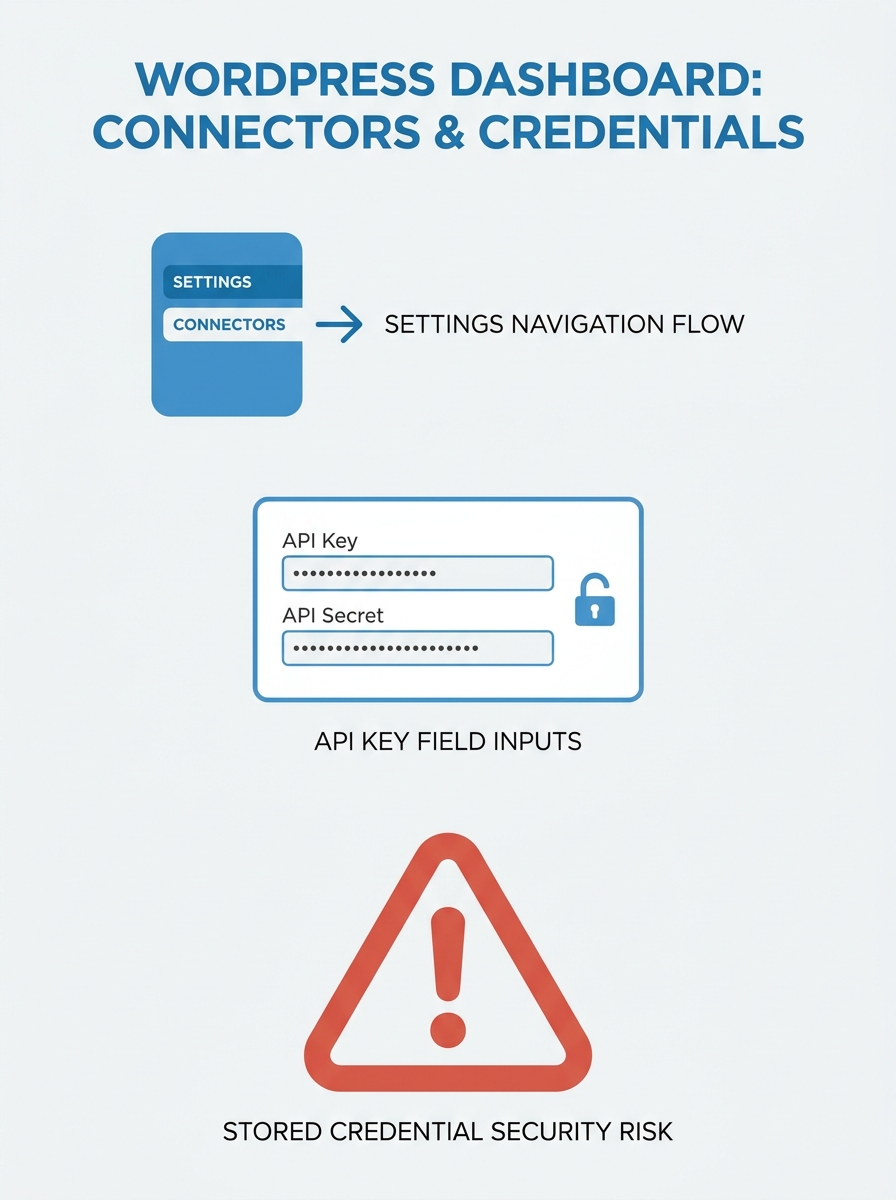
The new Connectors API, WP AI Client, and JavaScript Abilities API turn WordPress into an agent-addressable CMS. AI services can now be wired into any site through a Settings > Connectors screen. That's a genuine architectural leap. But it also means every WordPress installation now holds billing credentials worth thousands of dollars, stored in the same database that plugin vulnerabilities have been exposing for years. According to the Patchstack 2026 State of WordPress Security report, 46% of plugin vulnerabilities have no available patch at the time of disclosure, and the median time to mass exploitation of high-impact flaws is five hours.
For white-label agencies managing 20, 50, or 100+ client installations, those numbers reshape how you think about WordPress 7.0 security. Here are seven rules to follow before you touch the AI features on any client site.
Treat every stored API key as a billing credential, not a password
Why does this distinction matter? A stolen password locks someone out. A stolen API key runs up someone's bill. OpenAI, Anthropic, and Google AI keys represent prepaid or consumption-based billing access. A compromised key gives an attacker the ability to run AI bot networks, generate phishing content at scale, or produce malware, all charged directly to your client's account.
Oliver Sild, founder of WordPress security firm Patchstack, warned on X on May 22, 2026: "WordPress 7.0 combined with plugin vulnerabilities = free AI tokens. There will be an absolute rush by hackers to steal API keys."
The rule breaks when keys are scoped to specific models with tight rate limits and zero billing exposure. But most providers default to broad access, and most agencies don't reconfigure that default.
Audit which plugins register Abilities API functions before you update
The Abilities API, introduced in WordPress 6.9 and expanded in 7.0, allows plugins to register functions that external AI agents can discover and invoke. Any plugin on a client site can register read or write operations through this system. If you update to 7.0 without auditing your plugin stack, you're giving every installed plugin potential access to the centralized AI credentials store.
Steve Jones of Equalize Digital told the WordPress development community that the platform needs "a more granular permissions model" to control which plugins can access sensitive credentials. That model doesn't exist yet. So the audit is manual: review every active plugin, check whether it hooks into the Abilities API, and determine what level of database access it has. The Account Switcher vulnerability (CVE-2026-6456, CVSS 8.8) demonstrated how a single plugin flaw can escalate Subscriber-level access to full Administrator privileges. Now picture that escalation path leading to API keys carrying $10,000 or more in billing exposure.
Effective plugin vulnerability management under WordPress 7.0 means treating the Abilities API registry as a first-class security audit target. Before every update, pull the list of registered abilities and map them against your known plugin inventory. Anything unrecognized gets deactivated until reviewed.
Disable browser autofill on every admin screen that handles secrets
WordPress core ticket Trac #65303 documents a bug reported on launch day: the AI integration setup form in 7.0 does not disable browser autofill for API key fields. Keys can be visibly autofilled in plain text on shared or compromised devices. As of May 23, 2026, no patch has been released.
If you're building or maintaining sites for clients, add autocomplete="off" and autocomplete="new-password" attributes to any input field handling API keys. This is a one-line fix in a custom plugin or mu-plugin. Don't wait for core to patch it. The 5-hour median exploitation window documented by Patchstack means the fix needs to arrive before the official patch does.
Warning: Browser autofill can expose API keys in plain text on shared devices. WordPress 7.0's Connectors screen does not disable this by default. Patch it yourself with an mu-plugin before connecting any client keys.
Set hard billing caps with every AI provider before connecting
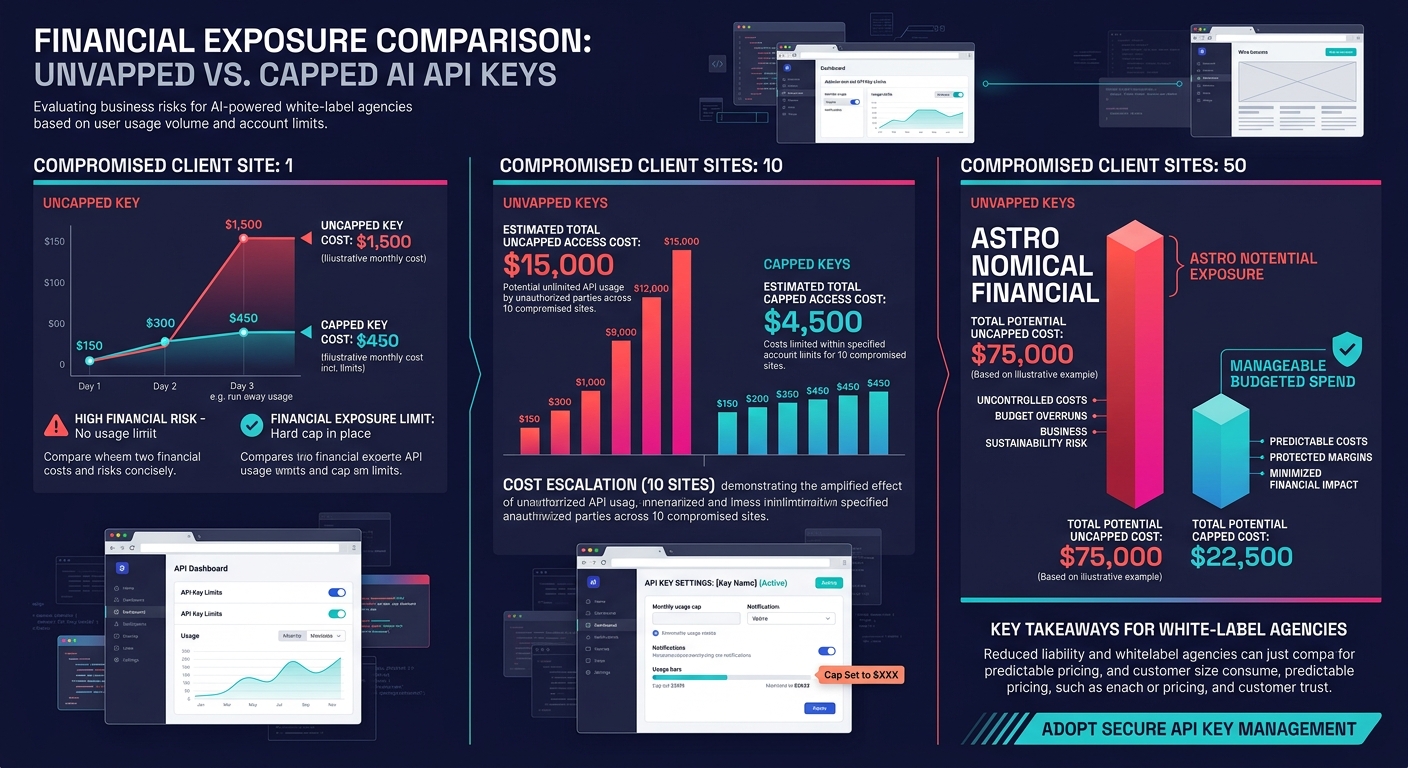
This rule applies universally and has no exceptions. Before entering a single API key into WordPress 7.0's Connectors screen, configure monthly spend limits with OpenAI, Anthropic, Google, or whichever provider you're integrating. OpenAI allows hard caps in its billing dashboard. Anthropic supports usage limits at the organization level. Google Cloud's budget alerts can be configured with automatic billing cutoffs.
A stolen key with a $50 monthly cap is a nuisance. A stolen key on an uncapped enterprise account can generate tens of thousands of dollars in charges before anyone notices. For agencies running white-label AI integrations across 30 client sites with uncapped keys, a coordinated breach becomes a six-figure liability event overnight.
Scope your white-label liability before a client's key gets stolen
When you offer white-label development services under your own brand, you're the entity clients contact when something breaks. The question of who bears financial responsibility for a stolen AI API key (the agency that built the site, or the client who owns the billing account) needs a clear contractual answer before an incident occurs.
The EU AI Act and updated product liability rules are accelerating regulatory expectations around AI governance. Organizations deploying AI integrations without documented accountability structures face increasingly difficult compliance situations. For white-label agencies, white-label liability extends well beyond uptime SLAs. If you connected the key, configured the integration, and chose the plugins, a client's legal team will argue you owned the security posture. Build explicit AI credential liability clauses into your contracts now: define who provisions keys, who monitors usage, who responds to anomalies, and who pays when credentials are compromised.
If you connected the key, configured the integration, and chose the plugins, a client's legal team will argue you owned the security posture.
The developer community has flagged a related concern: if all architectural context lives with your white-label partner and nothing is documented, accountability becomes impossible to assign after a breach. Standardized documentation of architecture, plugin choices, and hosting configurations is a legal shield as much as an operational one.
Isolate tenant credentials in multi-site deployments
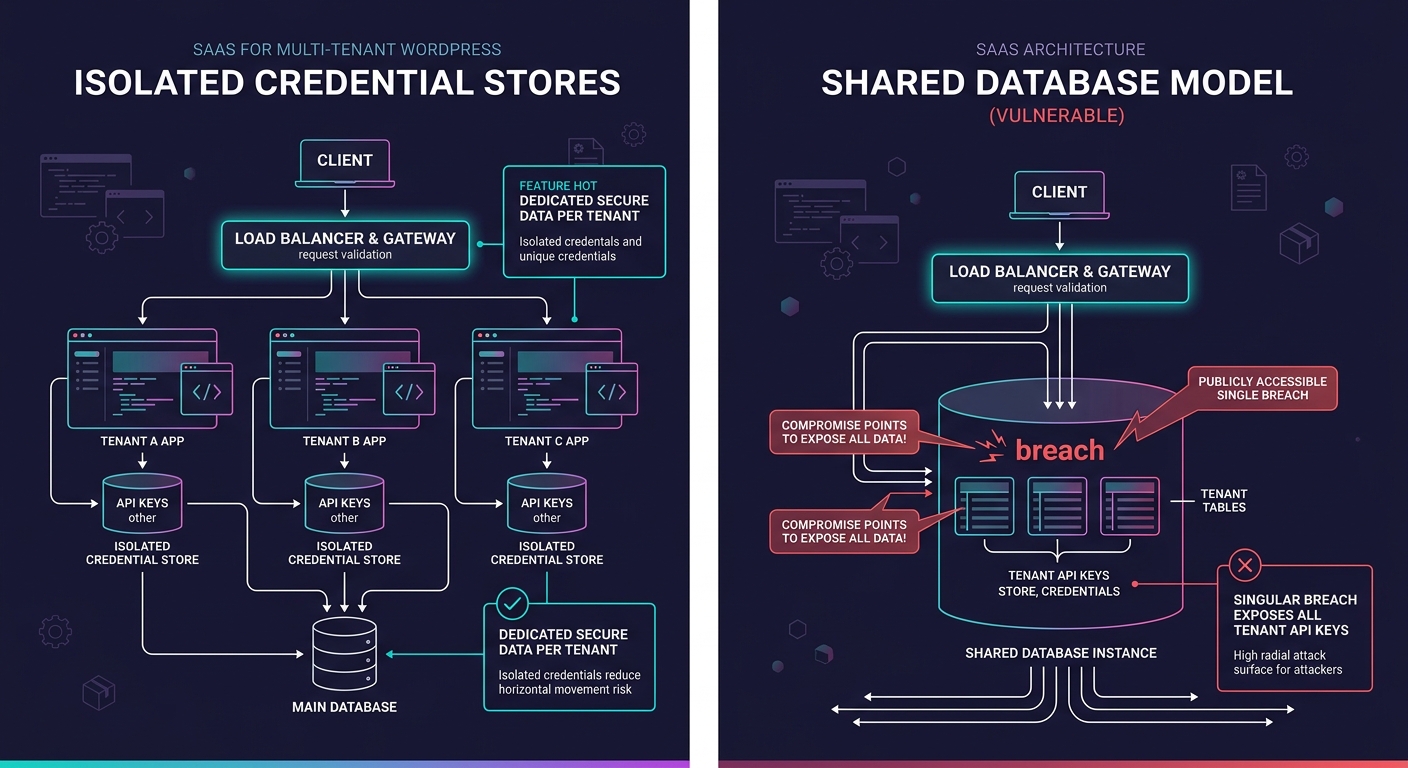
Multi-tenant WordPress deployments compound every risk described above. A single database breach exposes credentials for every tenant on the installation. Developer Andrei Lupu noted during the WordPress 7.0 launch discussion that once an attacker gains database access, "any secret stored in WordPress is potentially exposed," because the platform's trust model allows arbitrary PHP execution at the application layer.
The multi-tenant security risks are structural. Managing multiple WordPress sites on shared infrastructure results in higher maintenance overhead and compounded security exposure. For agencies running white-label multi-tenant setups, the minimum standard should be per-tenant credential isolation: separate database tables for API keys, separate encryption keys per tenant, and network-level segmentation between tenant environments. If your staging environments share credentials with production, you've doubled the attack surface with zero added protection.
Research from The Hacker News published this week found that identity dark matter (unmanaged accounts, orphaned access, excess privileges) now exceeds visible IAM assets 57% to 43% across enterprise environments. Multi-tenant WordPress sits squarely in that exposure zone.
When These Rules Break
These seven rules assume you control the stack. They assume your team has root-level access to the server, the ability to write mu-plugins, and the contractual authority to dictate security policy to clients. When any of those conditions fail, the rules degrade.
If you're reselling hosting from a provider that manages WordPress updates and you can't delay the 7.0 rollout, you lose the ability to audit before updating. If your client insists on managing their own API keys without caps because their marketing team "needs unlimited access," your billing-cap rule is contractually unenforceable. If your multi-tenant architecture is inherited from a previous agency and you can't restructure the database layer, credential isolation becomes a migration project with its own budget and timeline.
Matt Mullenweg, WordPress co-founder, has stated he has run WordPress sites for over 20 years without a security incident. That track record doesn't transfer automatically to agencies running 50 client sites with 15 active plugins each and newly stored AI billing credentials in every database.
The honest assessment: WordPress 7.0's AI infrastructure is real, useful, and architecturally forward-looking. The Connectors API and WP AI Client standardize something that plugins have been doing in fragmented, inconsistent ways for years. But the security model hasn't caught up to the value of what's being stored. When you need to hire web developers for WordPress 7.0 projects, vet their understanding of API credential security as aggressively as you'd vet their front-end skills. The 46% no-patch-at-disclosure rate, the 5-hour exploitation window, and the tens of thousands of dollars at stake per compromised key combine into a risk profile that most white-label agencies haven't priced into their contracts or their operations. The agencies that update those contracts this week will be far better positioned than those scrambling to assign blame after the first breach hits.