

CVE-2026-8438, a stored cross-site scripting vulnerability disclosed June 6, affects All-In-One Security (AIOS) – Security and Firewall plugin for WordPress versions 5.4.7 and earlier, carrying a CVSS severity score of 7.2, according to TheHackerWire. Unauthenticated attackers can inject arbitrary JavaScript into debug logs that execute when an administrator views the AIOS Dashboard Debug Logs page, enabling nonce theft, privileged REST actions, and potential full site compromise.
TL;DR: CVE-2026-8438 enables unauthenticated attackers to inject JavaScript into All-In-One Security plugin debug logs on WordPress sites running versions 5.4.7 or earlier when both REST API blocking and debug logging are enabled simultaneously.
The flaw surfaces only when site administrators enable two specific AIOS features concurrently: the "Disable REST API for non-logged in users" option (aiowps_disallow_unauthorized_rest_requests) and debug logging (aiowps_enable_debug). This configuration overlap exists on an estimated subset of the plugin's 1 million active installations, though no usage statistics for the dual-feature combination are publicly available. White-label agencies running AIOS across client portfolios should audit which sites have debug logging enabled in production environments—a practice common during troubleshooting phases but rarely disabled afterward.
How the Exploit Chain Works
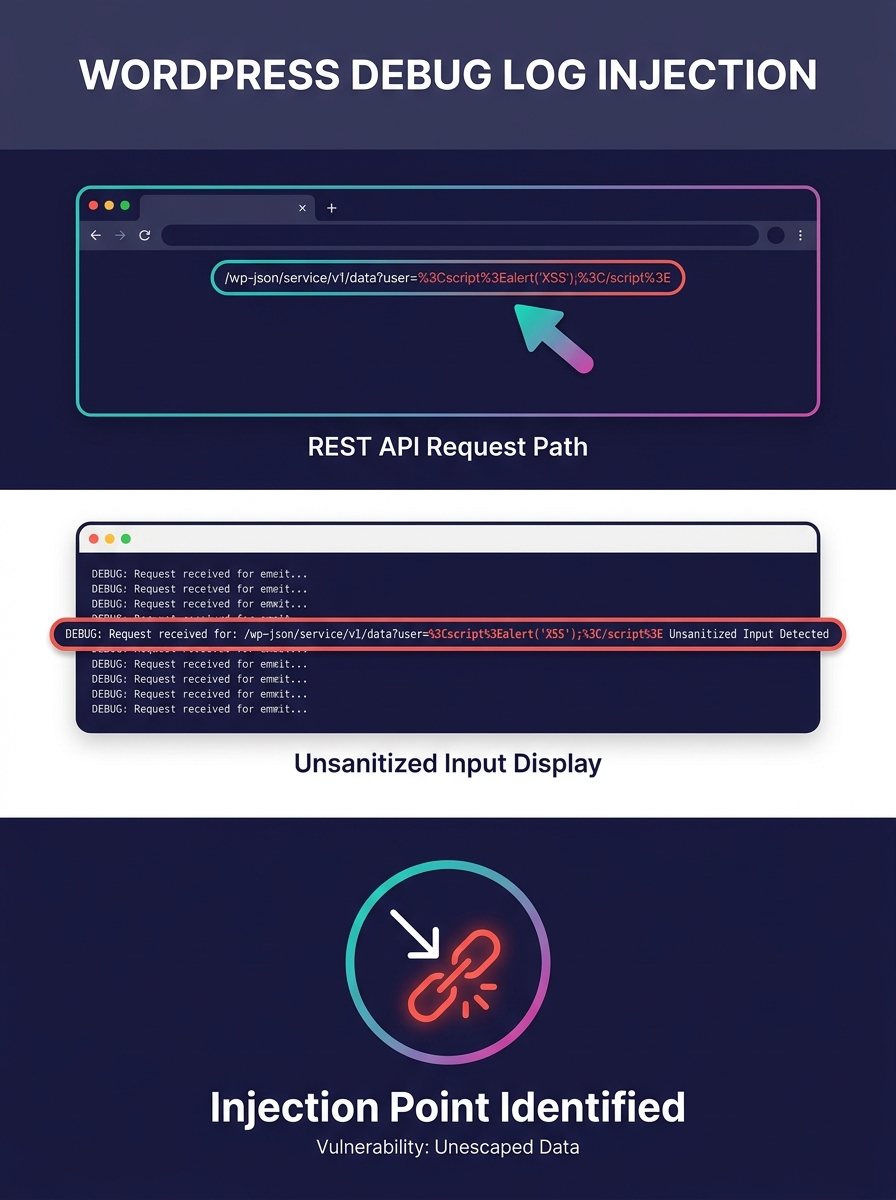
The vulnerability originates in insufficient input sanitization within AIOS's get_rest_route() function and missing output escaping in the column_default() method of the debug log list table. When an unauthenticated visitor sends a crafted REST API request with URL-encoded HTML or JavaScript in the path, the plugin retrieves the payload via urldecode($_SERVER['REQUEST_URI']), decoding URL-encoded characters into literal HTML.
This decoded, unsanitized value concatenates directly into a debug log message and stores in the WordPress database. The plugin's debug log interface then retrieves the raw database value without escaping and echoes it into the admin dashboard HTML when an administrator navigates to the AIOS Debug Logs page.
"The path is retrieved via urldecode, which decodes URL-encoded payloads into literal HTML characters," the vulnerability disclosure states. "This decoded, unsanitized value is concatenated directly into a debug log message and stored in the database."
A successful exploit requires no authentication and no user interaction beyond an administrator eventually viewing the debug log page—a routine task during troubleshooting or security audits.
Patch Status and Affected Versions
Plugin maintainers patched the vulnerability in a commit tracked as changeset 3558989, visible in the WordPress plugin repository. Sites running All-In-One Security versions 5.4.7 or earlier remain vulnerable when both REST API blocking and debug logging are active. The disclosure includes direct links to vulnerable code in the plugin's Trac repository, showing the flawed implementation in wp-security-list-debug.php line 43, wp-security-debug-logger.php line 81, and wp-security-general-init-tasks.php line 887.
Wordfence Threat Intelligence cataloged the flaw as ID d2b7ed73-a654-40ef-8d80-6171393da8e7, categorizing it under CWE-79 (Improper Neutralization of Input During Web Page Generation). The CVSS 3.1 vector—CVSS:3.1/AV:N/AC:L/PR:N/UI:N/S:C/C:L/I:L/A:N—reflects network-exploitable access, low attack complexity, no privileges required, and changed scope with low confidentiality and integrity impact.
Agencies should cross-reference this disclosure with recent Kirki plugin exploitation, which followed a similar unauthenticated-to-admin escalation pattern, and the Gravity Forms file deletion vulnerability, both of which prompted managed hosting providers to force-update affected plugins.
Context and Outlook
For white-label agencies, CVE-2026-8438 underscores the operational risk of leaving debug logging enabled in production client environments. The vulnerability requires two concurrent feature flags—a configuration state agencies often inherit from prior troubleshooting sessions or retain "just in case" without formal review. Unlike vulnerabilities that exploit core WordPress or universally installed plugins, this flaw targets a specific security tool marketed as a hardening layer, creating a false sense of protection among site administrators who assume AIOS itself cannot introduce attack surface.
The stored XSS vector mirrors the admin-hijack mechanics documented in recent high-severity WordPress plugin vulnerabilities, where attackers chain seemingly minor flaws—log injection, unescaped output, admin-only page views—into full site compromise. White-label operations teams should add "disable debug logging in production" to post-launch checklists and integrate automated checks into their architecture audit protocols that flag sites running security plugins with active debug modes.
AIOS's 1 million installation base makes this a portfolio-scale concern for agencies managing dozens or hundreds of WordPress sites. The patch is available, but update velocity depends on whether agencies maintain centralized plugin management or rely on individual site administrators to apply updates—a handoff gap that typically extends exposure windows by weeks.