

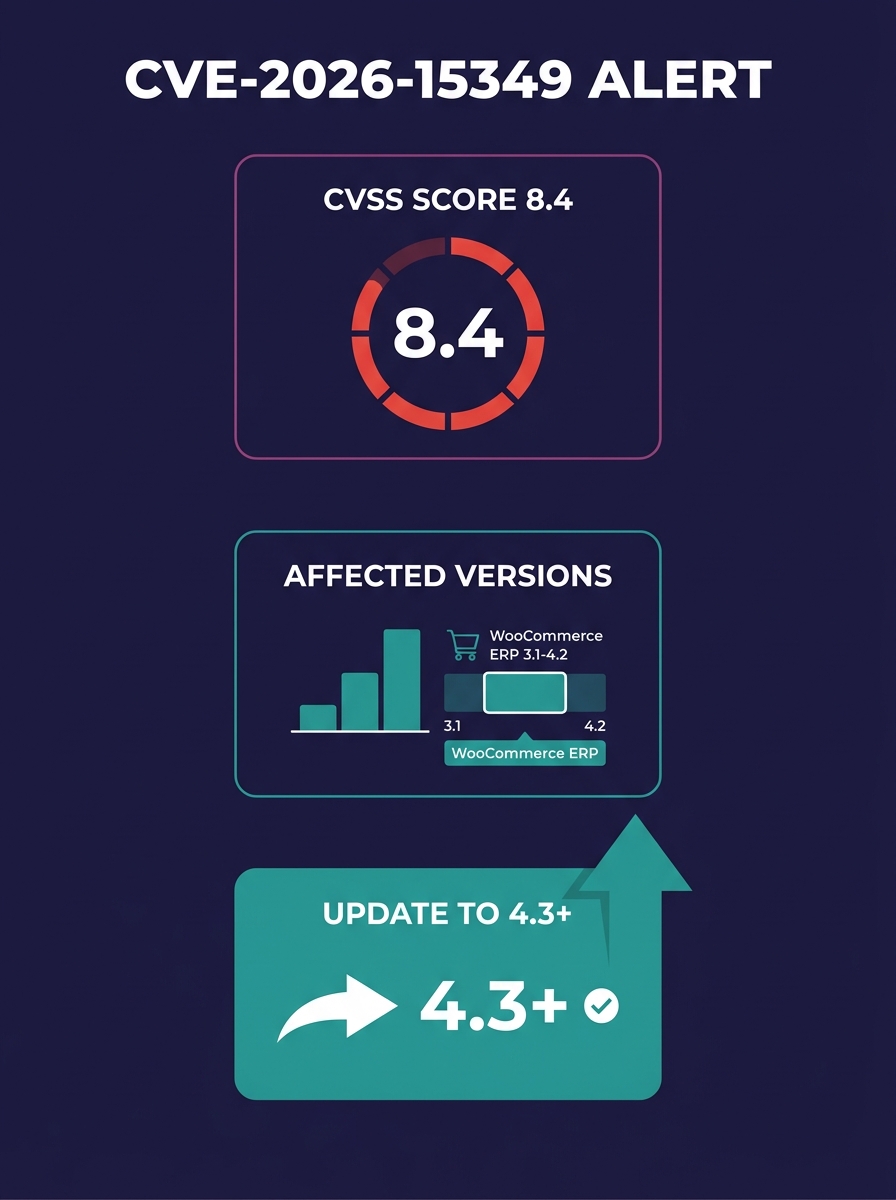
A missing authorization vulnerability in the wedevs ERP: Complete HR, Accounting & CRM Suite Built for WooCommerce plugin allows authenticated users with subscriber-level access to create arbitrary company locations in the ERP database, according to CVE Database V5 disclosure published July 17, 2026. The flaw affects all versions up to and including 1.17.6, carries a CVSS v3.1 base score of 4.3, and requires no user interaction to exploit.
TL;DR: A medium-severity authorization bypass vulnerability disclosed today in the wedevs WooCommerce ERP plugin allows low-privilege authenticated users to create unauthorized company locations in client ERP databases without proper permission checks.
The vulnerability was classified as CWE-862 (Missing Authorization) by the CVE Database V5. No official patch or vendor advisory has been published as of the disclosure timestamp at 03:43:41 UTC. No active exploits have been reported in the wild, but the low attack complexity and network-accessible attack vector create immediate exposure for agencies managing WooCommerce-based e-commerce clients using the plugin.
Technical Details of the Authorization Bypass
The wedevs ERP plugin fails to properly verify user authorization before allowing certain database actions, enabling any authenticated user with subscriber-level privileges or higher to create company location records in the ERP database. The CVSS v3.1 vector string CVSS:3.1/AV:N/AC:L/PR:L/UI:N/S:U/C:N/I:L/A:N reflects a network-exploitable flaw with low attack complexity, low privileges required, and no user interaction needed. The integrity impact is rated low, with no confidentiality or availability impact indicated in the CVE record.
The vulnerability exists in the plugin's failure to implement proper capability checks before processing location creation requests. In WordPress's role hierarchy, subscriber-level users typically have minimal permissions limited to managing their own profile and reading published content. The authorization bypass allows these low-privilege accounts to execute administrative functions normally restricted to manager or administrator roles within the ERP system.
Agencies running the wedevs ERP plugin on client sites should audit user role assignments immediately. The plugin is marketed as a complete HR, accounting, and CRM solution integrated with WooCommerce, making it a common choice for e-commerce clients requiring business management functionality beyond basic storefront operations. Client sites using the plugin for payroll, employee records, or financial tracking face data integrity risks if subscriber or customer accounts exist on the WordPress installation.
Impact on Agency Client Sites
Client e-commerce sites running affected versions face unauthorized data creation in their ERP database, potentially corrupting business-critical records for HR, accounting, and CRM workflows. While the CVE disclosure indicates no confidentiality or availability impact, the integrity breach allows malicious or compromised subscriber accounts to inject false company locations into the database. For multi-location retailers, wholesale distributors, or franchise operations using the ERP suite to manage inventory and fulfillment across physical sites, unauthorized location records could disrupt order routing, inventory allocation, and financial reporting.
The vulnerability's medium severity rating reflects the authentication requirement (the attacker needs an existing account) balanced against the low privilege threshold and absence of technical exploitation barriers. Agencies managing WooCommerce sites with open customer registration enabled face higher risk, as subscriber-level accounts are created automatically when shoppers register during checkout. Sites with comment registration, membership features, or loyalty programs also expand the subscriber account surface area.
According to the broader threat landscape documented in WordPress Ecosystem Reported 250+ Weekly Plugin Vulnerabilities Through 2026, 43 percent of disclosed WordPress plugin vulnerabilities are exploitable without authentication. This authorization bypass requires authentication but demands only the lowest privilege level, placing it in the "easily exploitable by existing users" category that agencies must monitor alongside unauthenticated threats. For agencies managing client sites through WooCommerce developers or white-label teams, the ERP plugin vulnerability adds to the ongoing security audit workload that has accompanied the plugin ecosystem's sustained disclosure rate.
Immediate Mitigation Steps
The CVE Database V5 disclosure provides no confirmation of a patch release from wedevs at the time of publication. Agencies should check the wedevs ERP plugin changelog and WordPress.org repository for version 1.17.7 or higher indicating a security fix. Until an official remediation is released, restrict user role assignments on client sites running the plugin to trusted staff members only. Remove or demote subscriber-level accounts to a custom role with explicitly restricted capabilities, and disable new user registration if the client's business model permits.
Monitor the affected client sites for unauthorized company location records created in the ERP database. Location creation events should log administrative actions tied to specific user accounts; agencies with access to the ERP admin panel can audit the locations table for entries created by unexpected users or during suspicious timeframes. If unauthorized locations are detected, document the incident, remove the malicious records, and investigate whether the compromised subscriber account was created through registration abuse or credential compromise.
For agencies without direct access to client ERP databases, escalate to the client's IT administrator with specific mitigation guidance. The vulnerability does not appear to enable code execution, file deletion, or privilege escalation beyond the location-creation function, limiting the immediate containment scope. However, data integrity issues in accounting and HR systems can have compliance and operational consequences that require prompt client notification even for medium-severity vulnerabilities.
Reading Between the Lines
The wedevs ERP vulnerability arrives during a period of sustained WordPress plugin security disclosure that shows no signs of abating. The 250-plus weekly plugin vulnerabilities documented through 2026 have made client site security auditing a recurring operational expense for agencies, not a one-time project. Authorization bypass flaws rank among the most common vulnerability classes because plugin developers frequently assume WordPress's built-in capability checks without explicitly enforcing them in custom endpoints and AJAX handlers.
For agencies operating at scale with dozens or hundreds of WooCommerce clients, manual vulnerability triage becomes unsustainable. This particular CVE affects a niche plugin used primarily by e-commerce clients requiring integrated business management, not the mass-market plugins that trigger industry-wide scrambles. That segmentation creates visibility challenges, the disclosure landed in a threat intelligence feed, not in WordPress core's automatic update notifications, requiring agencies to actively monitor CVE databases or subscribe to WordPress security bulletins.
The missing patch at time of disclosure extends the exposure window and forces agencies into a risk-acceptance decision: continue operating the plugin with access restrictions while waiting for a fix, or remove the plugin and break client ERP workflows. Neither option is clean, which is why agencies increasingly build security response runbooks that define escalation paths, client notification templates, and vendor communication protocols before vulnerabilities land. The authorization bypass itself is narrow in scope, but its appearance in a WooCommerce-adjacent business tool underscores that plugin security extends beyond page builders and contact forms into the specialized extensions that power client operations.