

White-label WordPress projects built for social media campaigns blow budgets because campaign timelines move faster than development scopes can absorb. The fix is structural: documented scope gates, formal change orders, and a clear contractual wall between "campaign support" and "new development work."
Campaign Velocity Versus Development Scope
Social media agencies operate on a rhythm that WordPress development was never designed to match. A paid social campaign launches on a two-week cycle. The landing page supporting that campaign sits inside a WordPress build scoped three months earlier, long before the creative team finalized ad copy, chose hero images, or decided they needed a dynamic UTM-tagged form instead of a static contact block. Every one of those changes generates a revision request that lands on a white-label development partner's desk without a change order attached. According to research from Productive on cost overrun causes, inaccurate estimation, schedule delays, and changes in scope are the three primary drivers of budget overruns across agency projects, and all three compound when campaign-driven work collides with fixed-scope builds.
The compounding effect is what makes social media-adjacent WordPress work particularly vulnerable. A brand awareness campaign in March demands one landing page. The retargeting campaign in April needs a variant with different social proof widgets. By May, the client's social strategist wants Instagram feed embeds, TikTok video integrations, and a results page pulling real-time metrics. None of this appeared in the original brief because the social strategy hadn't been developed yet. Each request feels small in isolation, adding perhaps 2-4 hours of development time. But data from agencies implementing structured scope controls shows that these incremental requests averaged 14.4 hours of rework per project when left unmanaged, with 38% of that rework traced directly to missing assets and ambiguous requirements rather than genuine feature additions.
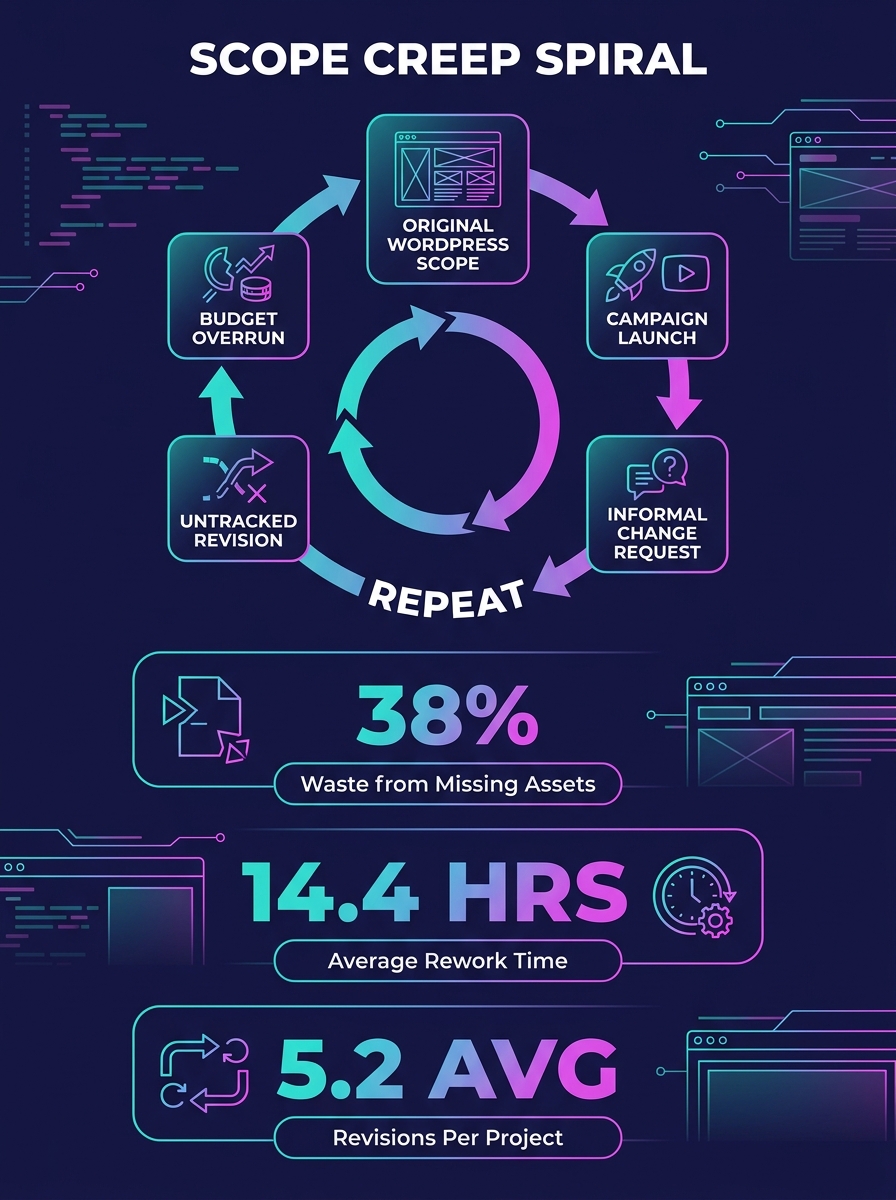
The problem isn't that social campaigns evolve. Of course they do. The problem is that WordPress project scopes get written as if the campaign strategy feeding them is static, when every social media professional knows it won't be. Agencies that understand how technical debt compounds across client portfolios recognize this pattern: each untracked revision creates a small pocket of undocumented work that makes the next revision harder to estimate, slower to deliver, and more expensive to test.
The Documentation Failure Underneath Every Budget Overrun
Why does scope creep in white-label WordPress development resist the obvious solution of "just say no to out-of-scope requests"? Because in practice, the person requesting the change, often a social media manager or account lead, genuinely doesn't know where the scope boundary sits. The original project brief lives in a Google Doc that was last edited during kickoff. The social team's Slack channel has become the de facto change request system. And the white-label developers, three layers removed from the client relationship, have no authority to push back on requests that arrive formatted as casual messages rather than formal tickets.
Delicious Brains' research on scope management recommends documenting every feature, plugin, and design element in writing before development begins, explicitly listing approved plugins, theme specifications, and the exact number and type of page templates. For social media agency WordPress builds, this documentation needs an additional layer: a clear inventory of which social platform integrations are included, which tracking pixels will be implemented, and how many campaign-specific landing pages the build supports before additional development fees apply. Without that specificity, every new Facebook pixel variant, every Open Graph customization, and every "quick" social sharing button addition becomes an ambiguous gray zone where scope bleeds out.
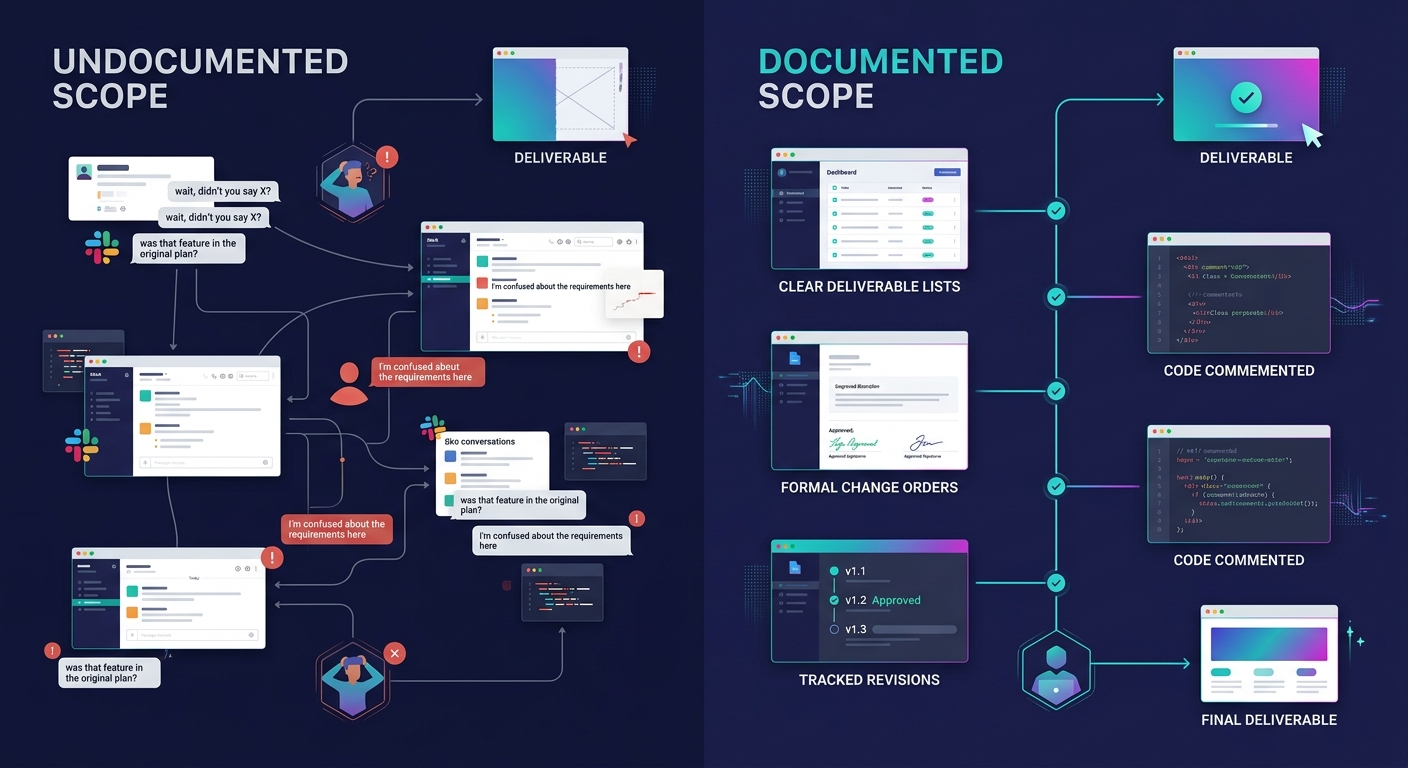
The agencies that fail at the requirements stage tend to share a common trait: they treat the project brief as a starting direction rather than a binding specification. When the client's social media calendar shifts, which it will within the first 30 days of any engagement, the brief offers no clear answer to whether the resulting website changes are included or billable. The development partner absorbs the work because refusing it risks the relationship. The agency absorbs the cost because they never built a mechanism to pass it through. And the budget overrun, by the time anyone identifies it, has already happened. As research from ActiveCollab on budget overruns puts it, the biggest problem is that by the time you identify the cause, it's usually too late to make changes that lessen the negative cost impact.
Turning Scope Into a Contractual Instrument
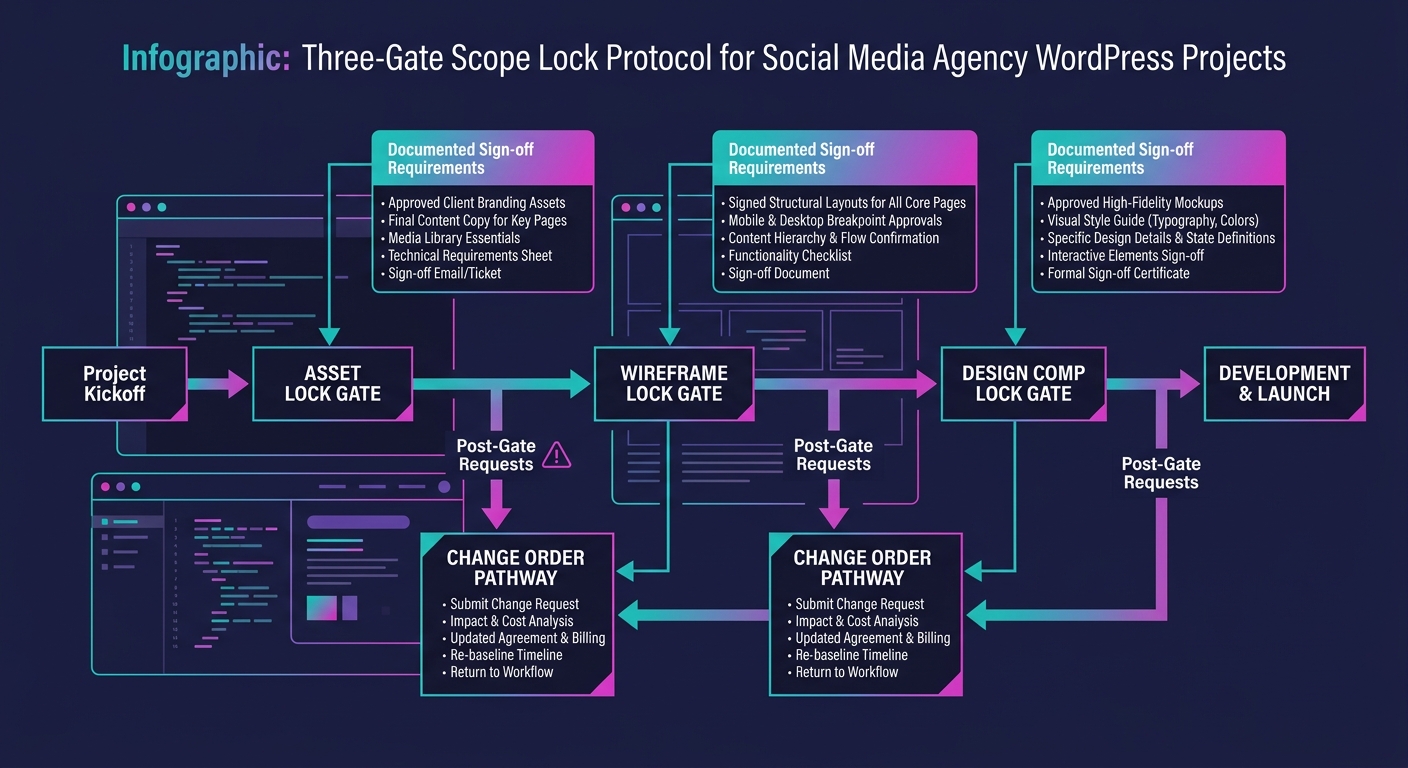
The scope lock protocol that emerged from white-label agency case studies in early 2026 treats scope as a financial instrument rather than a creative guideline. One mid-size agency reduced revision cycles by 60%, dropping from an average of 5.2 revisions per project to 2.1, by enforcing three mandatory gates before development proceeds: Asset Lock, Wireframe Lock, and Design Comp Lock. Each gate requires documented sign-off from the client-facing team and the development partner before the project advances. Any request that arrives after a gate closes triggers a formal change order with explicit cost and timeline impact.
For social media agencies running white-label WordPress builds, the practical implementation of scope lock means adding a fourth consideration to every gate: campaign dependency mapping. At Asset Lock, the social team confirms which campaigns the WordPress build will support during its initial scope period and which platform integrations those campaigns require. At Wireframe Lock, the page templates tied to specific campaign types get documented with enough specificity that a developer can distinguish between "included landing page variant" and "new development request." At Design Comp Lock, social proof elements, feed embeds, and tracking implementations get frozen. Anything that arrives after that gate is billable, tracked, and estimated before work begins.
Agencies burn margin on revisions because they treat scope as a conversation rather than a contract.
The financial impact of this approach is significant. Agencies implementing structured review processes reported saving between 15% and 45% of total project hours within their first quarter of adoption. When you're running five or six concurrent WordPress builds for social media clients, each generating its own stream of campaign-driven change requests, that recovery translates directly to margin. The protocol also changes the relationship dynamic with white-label development partners: when you can hand off a scope-locked brief with documented gates and clear change order procedures, you'll find that dedicated WordPress developers deliver more predictable timelines and fewer emergency revision cycles. The structured scope lock approach converts what feels like a creative negotiation into an operational process with measurable outputs.
Where the Pattern Resists Easy Fixes
The scope lock protocol works. The data supports it. But applying it to social media agency workflows exposes a tension that documentation alone can't resolve: social media campaigns are inherently iterative, and WordPress development, particularly white-label WordPress development with its additional communication layers, resists iteration by design. A social media strategist testing three different audience segments on Meta Ads needs landing page variants that match each segment's messaging. That's the nature of performance marketing. Telling that strategist "your wireframe is locked, file a change order" creates organizational friction that, in some agencies, becomes more expensive than the scope creep it prevents.
The honest answer is that scope creep prevention for social media-driven WordPress projects requires agencies to make a choice about their operating model. Fixed-scope contracts work when the campaign strategy precedes the website build and remains stable throughout development. Retainer-based models with built-in monthly development hours work when campaign strategies evolve continuously and the website needs to keep pace. The worst outcome, and the most common one, is a fixed-scope contract applied to a fluid campaign environment, where every iteration creates an untracked revision that nobody explicitly approved but everyone implicitly expected. Agencies that recognize this mismatch early can price their white-label WordPress partnerships accordingly, building campaign variability into the budget as a line item rather than discovering it as a loss at project close. Those that don't will keep landing in the same spiral: campaign shifts, informal requests, absorbed development hours, and a P&L that never quite matches the proposal.