

Giving every white-label client a separate WordPress installation doesn't strengthen SSO security. It multiplies your attack surface across dozens of unpatched, inconsistently configured instances where a single leaked OAuth secret can compromise your entire client roster. Multi-tenant authentication on shared infrastructure, with proper identity provider isolation, is the more defensible architecture.
TL;DR: Per-client WordPress installs feel safer for SSO but are harder to patch, audit, and lock down at scale. Shared infrastructure with per-tenant credential boundaries (separate OAuth client IDs, dedicated redirect URIs, tenant-scoped token validation) gives you one place to enforce security instead of 40.
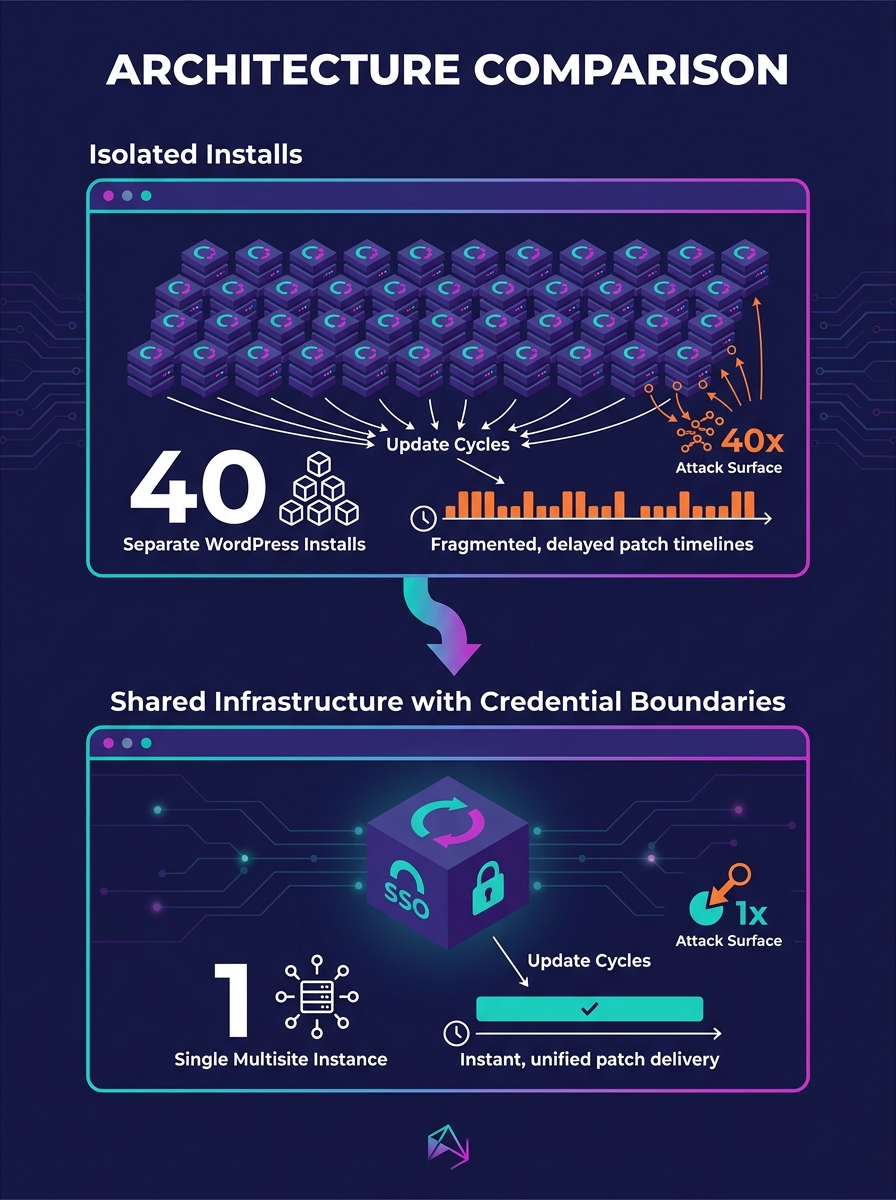
The standard agency playbook says: each client gets their own WordPress install, their own SSO config, their own server or container. The assumption is that physical separation equals security. But the agencies running 20, 30, 50 client sites this way aren't more secure. They're drowning in 50 separate OAuth configurations that nobody audits consistently, 50 sets of redirect URIs that drift out of sync, and 50 plugin stacks where authentication vulnerabilities go unpatched for weeks because the update cadence can't keep up. That's not identity provider isolation. That's identity provider chaos.
Here are three pieces of evidence for why shared multi-tenant WordPress infrastructure, built with the right credential boundaries, outperforms the isolated-install model for white-label SSO.
Separate Installs Multiply Unpatched Attack Surface
Every isolated WordPress installation needs its own authentication plugin, its own OAuth credentials, its own SAML metadata, and its own update schedule. When you run 40 client installs, you maintain 40 copies of your SSO plugin. If a critical authentication bypass drops (like the UpdraftPlus vulnerability that forced Reclaim Hosting into emergency updates), you have 40 separate patches to deploy, test, and verify. The math works against you.
Architect Bojan Josifoski noted on his technical blog that "WordPress Multisite was designed to keep site data separate," with posts, postmeta, options, and custom tables for each site physically isolated at the database level. But he also stressed that cross-tenant operations like authentication require "deliberate, custom engineering" beyond what Multisite provides out of the box. The tenancy primitive exists. The security boundary around SSO does not come for free.
On a shared Multisite installation, your SSO plugin exists once. One codebase. One update path. One audit target. When you pair that with per-tenant credential storage (separate OAuth client IDs and secrets stored in tenant-scoped database rows or encrypted vaults), you get the data separation benefits of Multisite plus a single, auditable authentication layer. For agencies managing fewer than 20 clients, Multisite handles this well. For agencies above 50 clients or those with strict PCI compliance needs for WooCommerce stores, containerized per-tenant instances on Kubernetes offer process-level isolation while still sharing a centralized identity management layer.
The key insight here connects to the broader security baseline every white-label deployment needs. A security model you can't maintain consistently isn't a security model. It's a liability schedule.
The Credential Boundary Is Where Real Tenant Isolation Happens
Why does the "separate install per client" model feel safe? Because agencies conflate infrastructure isolation with identity isolation. They're different problems.
Multi-tenant authentication requires 3 specific credential boundaries per tenant: separate OAuth client IDs and secrets, dedicated redirect URIs per tenant, and tenant-scoped token validation that prevents a token issued for Client A from granting access to Client B's data. As miniOrange documented in their Azure AD integration guide, SSO lets "users log in with their existing work or school accounts, eliminating the need for separate credentials, reducing password fatigue, and keeping access secure." But that security guarantee depends entirely on how per-tenant identity provider isolation is enforced at the WordPress layer.
The Auth0 engineering blog explains this well. Their Organizations feature provides per-subscription context from an application tenancy perspective, while the centralized user data store "provides for consistent user profiling no matter the users' membership(s)." One set of application logic serves all tenants. The isolation happens at the credential and token layer, not the application layer. This is the pattern that scales.
Warning: Plugin-level SSO separation (where each site picks its own SSO plugin or config page) is insufficient for agencies running 10 or more tenants. A compromised token from one tenant's identity provider should never allow lateral movement to another tenant. Store each tenant's OAuth credentials and SAML metadata in tenant-scoped database rows or encrypted vaults, and validate tokens against tenant-specific issuer claims.
For webhook integrations with tools like HubSpot or Salesforce, verify payloads using HMAC-SHA256 with tenant-specific secrets stored in encrypted vaults. This ensures signature integrity and correct tenant mapping even when 30 or 40 tenants share the same webhook endpoint.
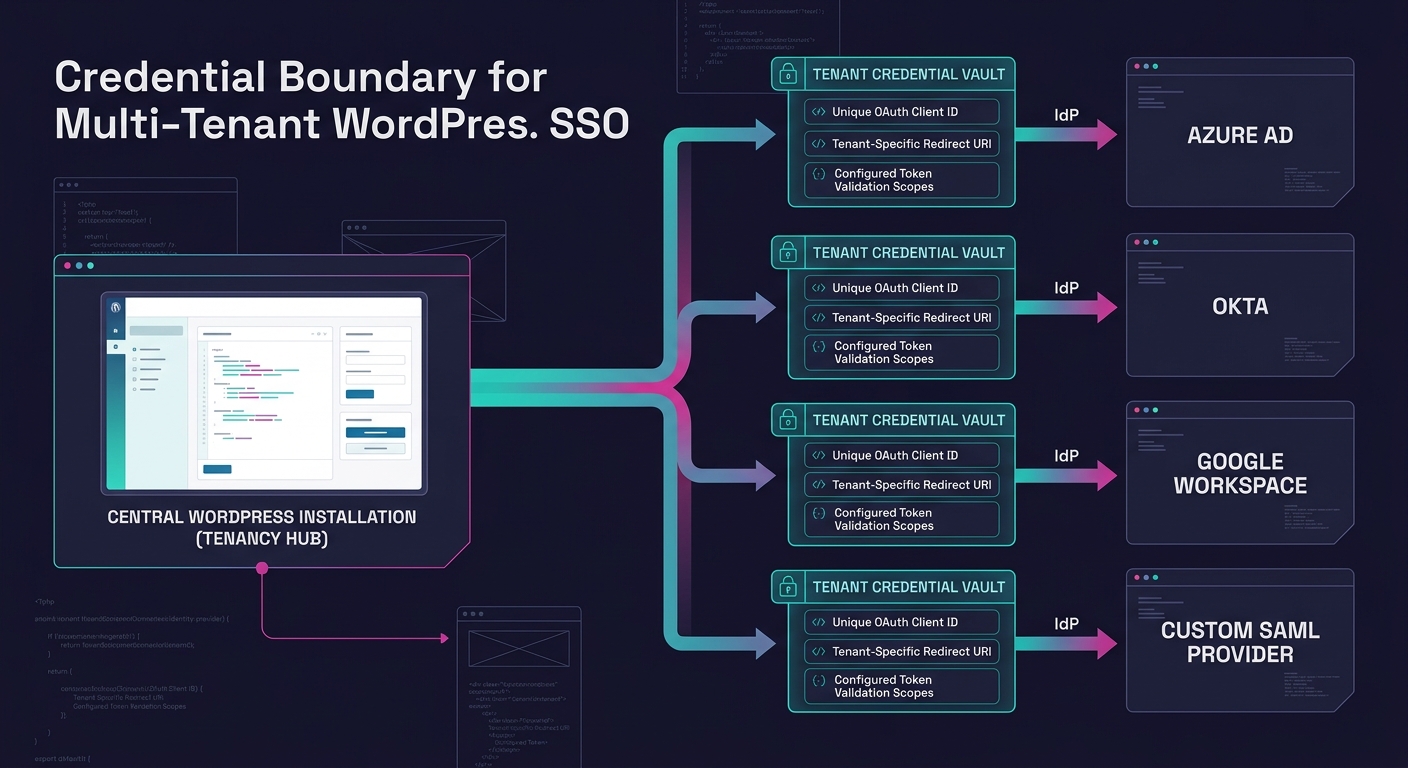
This credential-boundary approach also matters when you're managing role-scoped permissions across a Multisite network. The identity layer determines who gets in. The permissions layer determines what they can touch. Conflating the two is how cross-tenant data leaks happen.
SSO Redirect Chains Tax Performance on Every Login
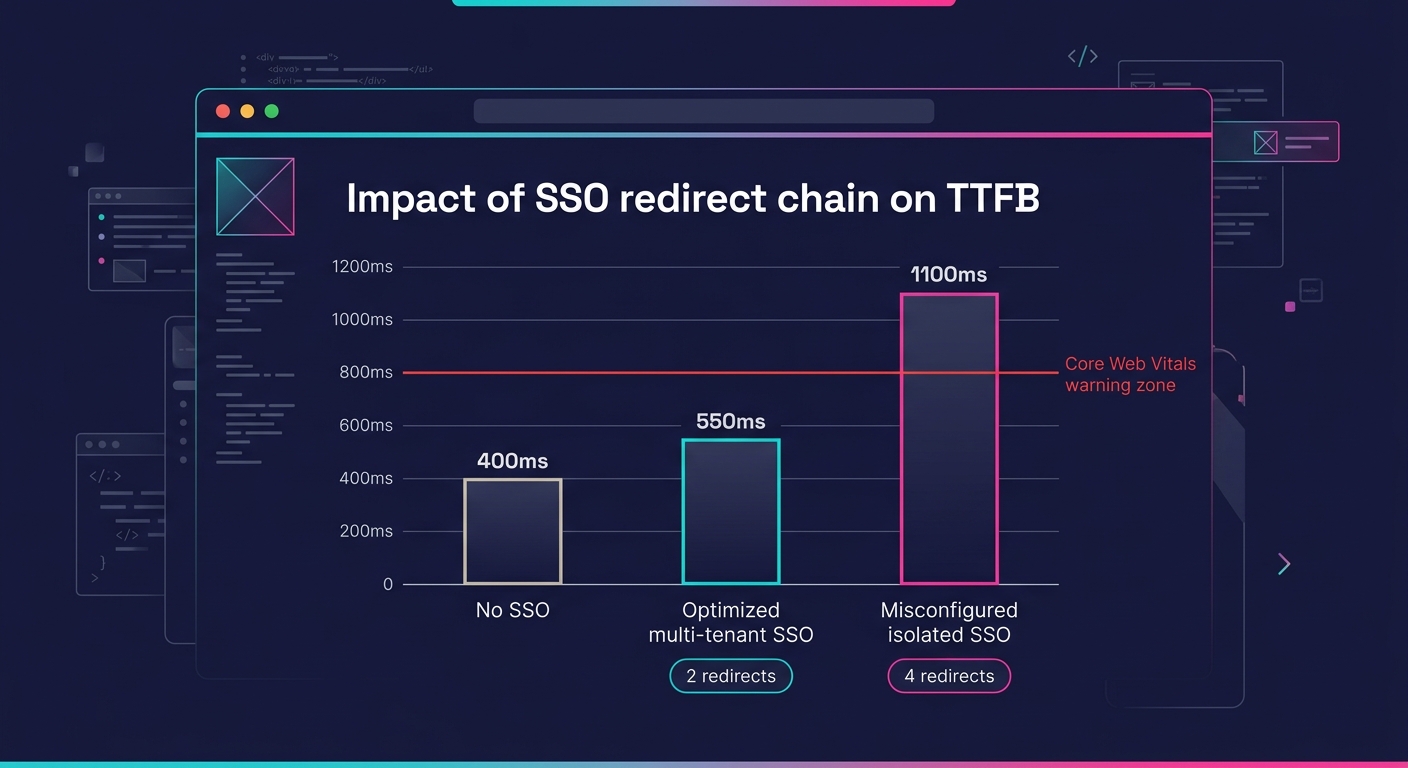
The performance cost of misconfigured white-label WordPress SSO is measurable and direct. A standard SAML or OIDC flow with PKCE involves 2 to 4 HTTP 302 redirects before the user lands on an authenticated page. Each redirect adds latency. Across a typical SSO chain, that adds 200 to 800 milliseconds to Time to First Byte on every login flow, according to analysis of multi-tenant SSO impact on Core Web Vitals.
On isolated installs, each client site manages its own redirect chain independently. If Client A's SSO config has a misconfigured callback URL that adds an extra redirect, you won't notice until their users complain about 1.2-second login delays. On a shared multi-tenant installation, you control all redirect URIs from one configuration layer. One place to optimize. One place to test.
A security model you can't maintain consistently isn't a security model. It's a liability schedule.
The SEO implications are real, too. Subdomain-based tenant routing fragments domain authority across tenants, diluting link equity that path-based routing would consolidate on a single root domain. And if Googlebot hits a login wall because your SSO flow isn't serving cached static HTML to crawlers, you'll see index drops across every tenant site simultaneously. The fix is straightforward: authentication should toggle UI components (login buttons, dashboard links) rather than replace core content blocks. Conditionally rendering entirely different page content based on auth state triggers Google's cloaking penalties.
| Architecture | Patch Cycle | Credential Isolation | Redirect Control | Domain Authority | Recommended Scale |
|---|---|---|---|---|---|
| Isolated installs | Per-site (40 separate updates) | Physical but unaudited | Per-site (inconsistent) | Fragmented if subdomains | 1-5 clients |
| WordPress Multisite | Single update, all tenants | Tenant-scoped vaults required | Centralized | Consolidated on root domain | 5-20 clients |
| Containerized (Kubernetes) | Orchestrated rollouts | Process-level + credential-level | Centralized with per-pod routing | Flexible | 20-50+ clients |
That TTFB penalty of 200 to 800ms per login flow compounds across every authenticated session. For agencies running WooCommerce stores where checkout authentication matters, this latency directly affects conversion rates and the performance issues you're already fighting.
The Claim, Pressure-Tested at Agency Scale
The thesis holds, but with a qualification. Shared infrastructure with per-tenant credential boundaries works better than isolated installs for white-label WordPress SSO because it reduces the number of things you have to get right. One SSO plugin to patch instead of 40. One set of redirect URIs to audit instead of 50. One centralized credential vault with tenant-scoped rows instead of 50 scattered wp_options tables holding OAuth secrets in plaintext.
The qualification: this architecture demands discipline at the credential layer. You need per-tenant OAuth client IDs, not shared credentials. You need dedicated redirect URIs per tenant, not wildcard callbacks. You need tenant-scoped token validation that checks the issuer claim against the expected identity provider for that specific tenant. And you need encrypted storage for every credential, with rotation policies that don't depend on someone remembering to update a wp_options row.
Data isolation strategies for WordPress multi-tenant architectures, as Plugintify documented, range from shared databases with tenant-scoped tables to fully separate database instances per tenant. The right choice depends on your compliance requirements and client count. But the authentication layer sits above all of these storage models, and that's where agencies building on shared infrastructure have a structural advantage. One well-built identity layer protects every tenant. Fifty separate identity layers protect nobody consistently.