

White-label WordPress authentication in a multi-tenant SSO architecture requires per-tenant identity provider isolation: separate OAuth credentials, dedicated redirect URIs, and tenant-scoped token validation, all layered on top of WordPress Multisite's shared database. The common mistake is treating this as a pure security problem. Every architectural choice in your authentication stack directly affects crawl budget, domain authority distribution, and Time to First Byte.
TL;DR: Multi-tenant SSO architecture determines how search engines interact with your white-label WordPress sites. Subdomain-based tenant routing fragments domain authority. Authentication redirect chains inflate TTFB by 200–800ms per login flow. And misconfigured session handling can serve Googlebot login walls instead of indexable content. The routing model, credential isolation, and caching layer are SEO decisions.
The Routing Layer: Where Domain Authority Lives or Dies
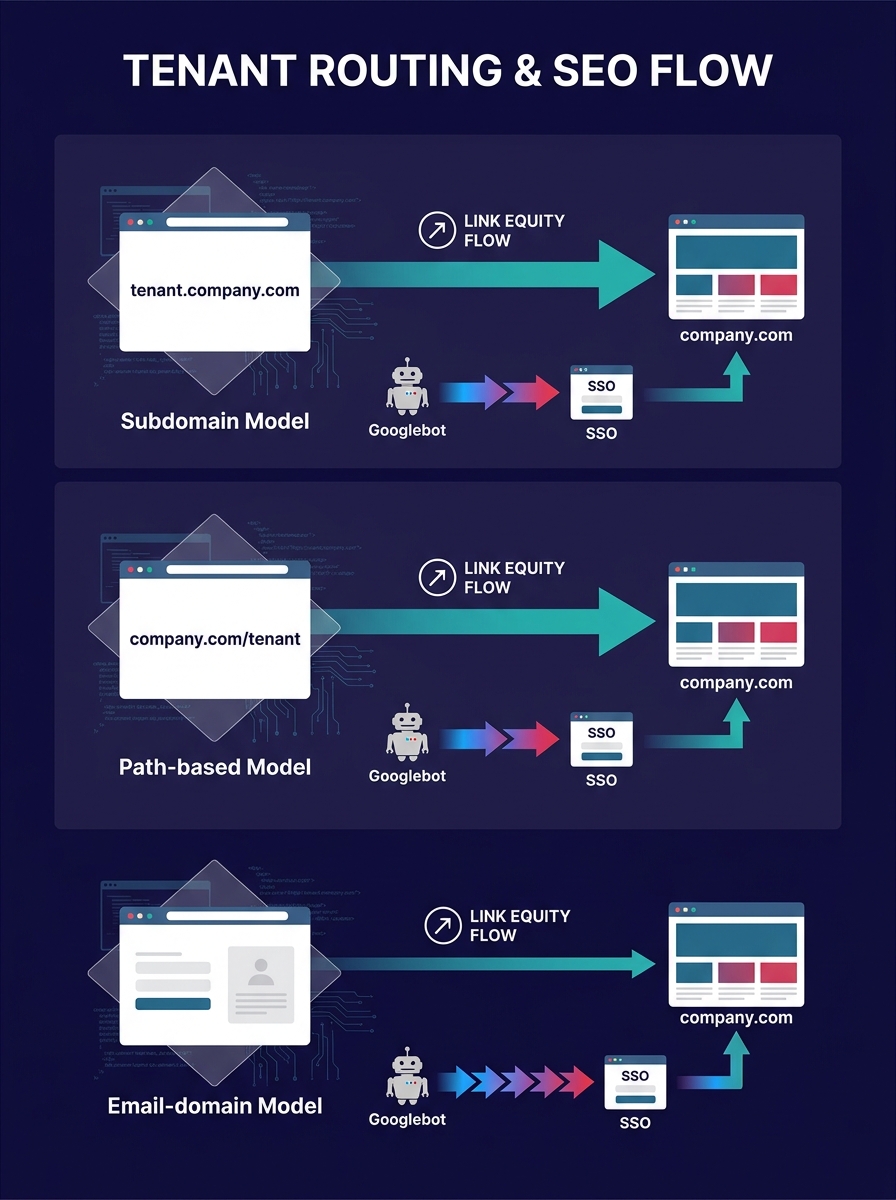
Why does tenant routing matter for search? The method you use to resolve which client's IdP handles a login request also determines your URL structure, and URL structure is the single most consequential SEO architecture decision you'll make.
Three routing patterns dominate multi-tenant SSO architecture. Subdomain routing (client1.yourdomain.com) gives each tenant a visually separate presence but splits link equity across subdomains. Google treats subdomains as semi-separate entities for ranking purposes, which means backlinks earned by one client's site contribute little to another's authority. For agencies managing 20+ white-label client sites, this fragmentation compounds fast.
Path-based routing (yourdomain.com/client1/) consolidates all link equity on a single root domain. Authentication flows route through the same origin, and Googlebot treats the entire path hierarchy as one crawlable entity. The tradeoff: SSO callback URLs become more complex, because the identity provider needs to return tokens to a path-specific endpoint rather than a subdomain-specific one.
Email-domain routing resolves the tenant at login time based on the user's email address (user@clientcompany.com maps to Client Company's IdP). This approach, documented in Security Boulevard's April 2026 analysis of B2B authentication platforms, decouples tenant identity from URL structure entirely. Your WordPress sites can use whatever URL pattern best serves SEO without the authentication layer dictating it.
| Routing Model | Domain Authority Impact | Redirect Complexity | Googlebot Visibility | Best For |
|---|---|---|---|---|
| Subdomain | Fragmented across tenants | Low (subdomain = redirect target) | Each subdomain crawled separately | Tenants needing branded URLs |
| Path-based | Consolidated on root domain | Medium (path-specific callbacks) | Single crawl budget, shared | SEO-priority white-label |
| Email-domain | No URL impact (auth-layer only) | High (dynamic IdP resolution) | Fully decoupled from auth | Enterprise clients with strict IdP requirements |
Credential Isolation Per Tenant
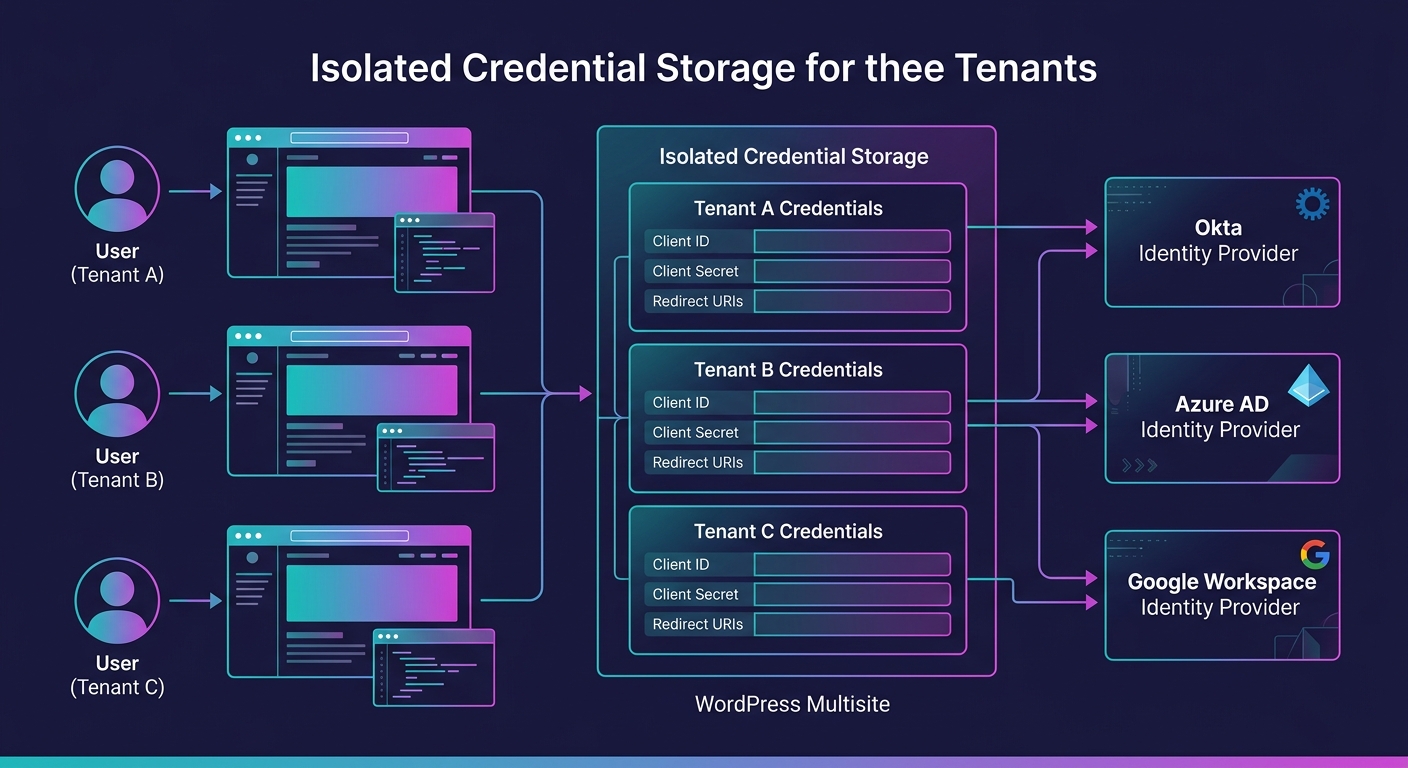
Each tenant in a multi-tenant SSO architecture needs its own set of OAuth client credentials: a distinct client ID, client secret, and redirect URI registered with their identity provider. WordPress Multisite uses a single database with separate tables per site, which means credential storage requires deliberate design to prevent cross-tenant access.
Architect Bojan Josifoski captures the core tension in his analysis of WordPress-based SaaS architecture: "WordPress Multisite provides the tenancy primitive for free. You do not need to build tenant isolation from scratch. You need to build the cross-tenant operations — authentication, billing, webhooks — that WordPress was not designed to handle."
The SEO consequence of poor credential isolation showed up publicly when the MonsterInsights plugin vulnerability exposed Google OAuth tokens to subscriber-level attackers. In a multi-tenant context, a compromised OAuth token from one tenant's IdP configuration could allow an attacker to modify another tenant's Google Search Console settings, disavow links, or alter sitemaps. Identity provider isolation prevents this lateral movement between tenants.
Store each tenant's IdP configuration (SAML metadata XML, OIDC discovery endpoints, client secrets) in tenant-scoped database rows or an encrypted vault. The miniOrange SAML SSO plugin for WordPress supports both single-tenant and multi-tenant Azure AD configurations, handling credential separation at the plugin level. For agencies running 10+ tenants, dedicated configuration tables with row-level access controls provide stronger guarantees than plugin-level separation alone.
The Redirect Chain Tax on Core Web Vitals
Every SAML or OIDC authentication flow involves a redirect chain: the user hits your WordPress site, gets redirected to their tenant's IdP, authenticates, receives a token, and gets redirected back to a callback URL. Authorization Code Flow with PKCE became the default authentication requirement across Microsoft Entra ID, Okta, and Google Workspace in early 2026, adding one additional round-trip for the code exchange step.
A typical SAML flow produces 2–3 HTTP 302 redirects. An OIDC flow with PKCE produces 3–4. Each redirect adds 100–300ms of network latency depending on the geographic distance between your server, the IdP, and the user. For a white-label site where the initial page load triggers an SSO check, this 300–800ms redirect overhead shows up directly in TTFB, one of the three Core Web Vitals that Google uses as a ranking signal.
The fix: separate your authentication paths from your publicly crawlable paths. Googlebot doesn't log in. If your architecture serves Googlebot the same SSO redirect chain it serves authenticated users, you're burning crawl budget on 302 redirects that never resolve to indexable content. Configure your caching layer (Varnish, Redis page cache, or your CDN) to serve static HTML to unauthenticated requests including bot traffic, and only trigger the SSO flow when a user action explicitly requires authentication.
This intersects with the broader speed penalty problem in white-label WordPress, where authentication middleware, multi-plugin stacks, and shared hosting compound to produce TTFB figures 40–60% slower than custom builds.
Warning: If your WordPress security hardening configuration blocks unauthenticated access to pages that should be publicly indexable, Googlebot will see a login wall. Audit your SSO-gated URLs against your sitemap monthly. Pages in your sitemap that return 302 redirects to an IdP login page will eventually be dropped from Google's index.
Session Handling and the Cloaking Risk
Auth0's documentation describes the session propagation model plainly: "Once you login to Auth0 and establish the first session, all the applications for that same tenant can use that session to determine whether the user is logged in or not." Convenient for users, since one login grants access across all sites sharing that tenant's session. For SEO, it creates a cloaking risk.
Cloaking occurs when the content served to Googlebot differs materially from what a logged-in user sees. In a multi-tenant SSO setup, authenticated users see personalized dashboards, tenant-specific navigation, and gated resources. Googlebot sees the public version of those same URLs. If your WordPress theme conditionally renders entirely different page content based on authentication state, swapping out the full page body rather than toggling a sidebar widget, Google's algorithms may flag this as cloaking and penalize the affected pages.
The safe pattern: use authentication state to toggle UI components (login/logout buttons, user avatars, dashboard links) rather than replacing the primary content block. Serve the same core content to all visitors, authenticated or not, and render gated sections as progressive disclosure after the page loads. This keeps Googlebot's view of the page consistent with what users see before they interact with SSO-protected elements.
A February 2026 Forbes Tech Council analysis captured the broader dynamic driving these architectural decisions: "Identity is no longer centralized. SaaS applications have evolved into independent security authorities with their own users, permissions and trust relationships." For white-label agencies, this means each client's IdP operates as an autonomous trust boundary, and your WordPress architecture needs to respect those boundaries without letting them fragment your search presence.
Googlebot doesn't log in. If your architecture serves Googlebot the same SSO redirect chain it serves authenticated users, you're burning crawl budget on 302 redirects that never resolve to indexable content.
Testing Isolation Without Breaking Production SEO
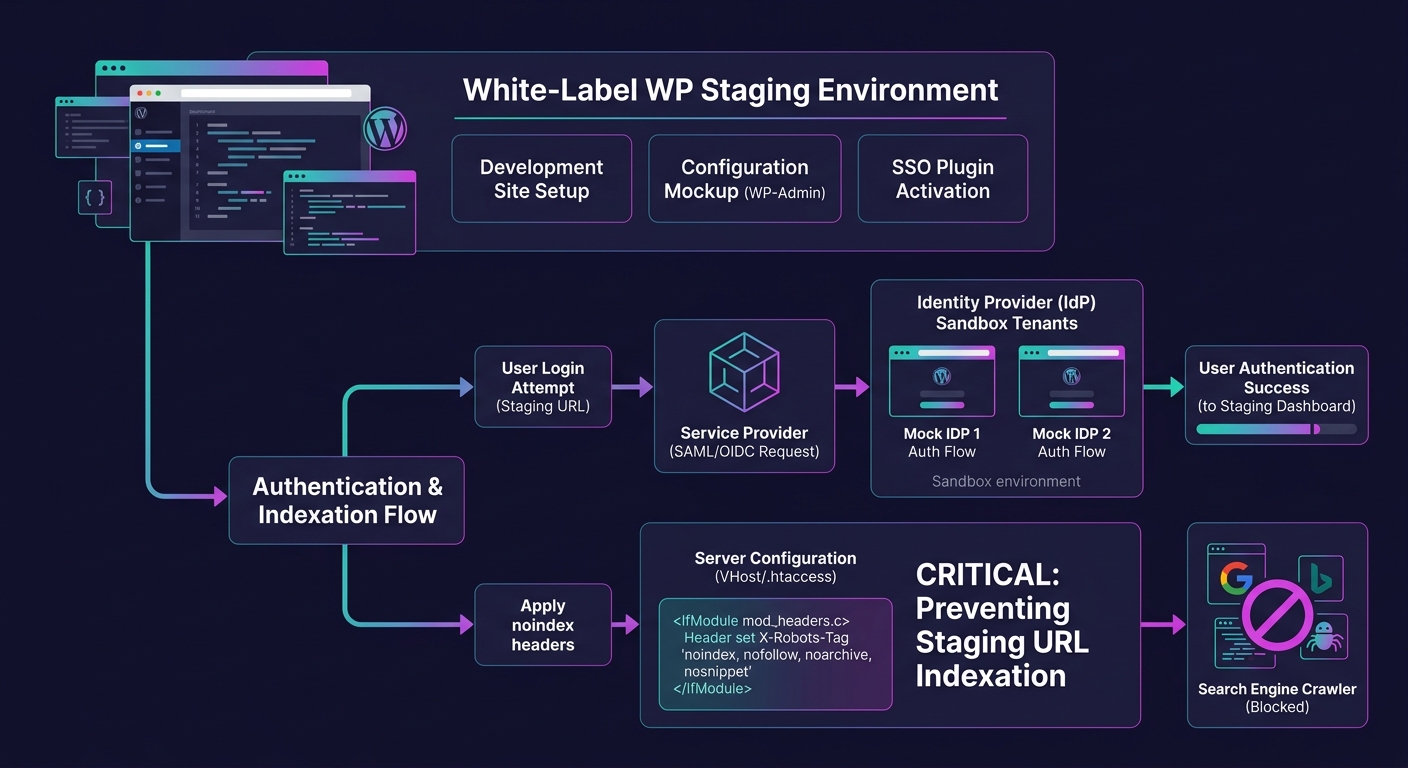
Building isolated staging environments for multi-tenant WordPress is already complex. Adding per-tenant SSO compounds the difficulty, because staging environments need valid IdP configurations to test authentication flows, but those configurations point to production identity providers.
Three testing approaches work without risking production search visibility. First, use IdP sandbox tenants (Okta Preview, Azure AD test directories) that mirror production configurations but issue test tokens against a non-production audience. Second, configure staging subdomains with X-Robots-Tag: noindex headers so any pages accidentally exposed during SSO testing don't pollute your production index. Third, maintain a tenant configuration manifest, a version-controlled file mapping each tenant to its IdP settings, redirect URIs, and token validation parameters, so you can diff staging against production before deployment.
Your architecture audit process should include SSO configuration as a first-class target. Check that every tenant's redirect URI points to the correct environment, that no staging client secrets have leaked into production, and that token expiration policies match the tenant's IdP settings.
Where the Model Breaks
This three-layer isolation stack (routing, credentials, sessions) handles the vast majority of multi-tenant SSO scenarios for white-label WordPress agencies. It breaks in specific, predictable situations.
Regulated industries like healthcare and financial services often require dedicated infrastructure per tenant, which means your shared WordPress Multisite database violates compliance requirements regardless of how well you isolate authentication. These clients need single-tenant WordPress instances with dedicated IdP integrations, and that collapses the cost advantages of multi-tenant architecture entirely.
IdP diversity at scale becomes an operational burden past 15–20 tenants. Each identity provider (Okta, Microsoft Entra ID, Google Workspace, Ping Identity, custom SAML implementations) has slightly different token formats, claim structures, and session timeout behaviors. The miniOrange SAML plugin handles many of these differences, but edge cases, like a client whose IdP returns group claims in a non-standard format, require custom mapping code that multiplies with each new provider type.
SEO recovery after misconfiguration is slow and unforgiving. If a botched SSO deployment gates your publicly indexable pages behind authentication for 48–72 hours, Google will recrawl those URLs, encounter 302 redirects, and temporarily de-index the affected pages. Re-indexation after fixing the issue takes 1–4 weeks depending on the site's crawl frequency. There's no fast-track mechanism. The damage compounds on sites with lower crawl budgets, where Google may not revisit the affected URLs for days after the fix goes live.
The architecture holds up despite these constraints because the alternative, building custom identity management from scratch, produces worse outcomes by every measurable dimension. Microsoft's Azure Architecture Center says it directly: building your own identity provider is an antipattern. The white-label WordPress authentication layer should function as a routing and translation layer between your clients' existing identity infrastructure and WordPress's native user system, with SEO-safe defaults baked into every configuration decision from the start.