

Coruzant published an analysis of offshore development center services on June 26, 2026, ranking ten providers that agencies can use to scale technical capacity without adding headcount, according to the firm's AppDev research team. The guide identifies Newxel, EPAM Systems, Netguru, ScienceSoft, Ciklum, ELEKS, N-iX, Innowise, Mobilunity, and Zoolatech as providers spanning Eastern Europe, Israel, India, and Latin America.
TL;DR: Coruzant's June 2026 analysis ranks ten offshore development center providers, highlighting Newxel's 98% retention rate and 2-4 week shortlist delivery as agencies address talent shortages through structured offshore teams.
The timing reflects sustained pressure on agency budgets and hiring, Coruzant noted, as tech layoffs across 2026 have placed experienced engineers back into the Central and Eastern European market while remote-work normalization has removed infrastructure barriers that previously limited offshore team adoption.
Provider Profiles Show Geographic Concentration in Eastern Europe
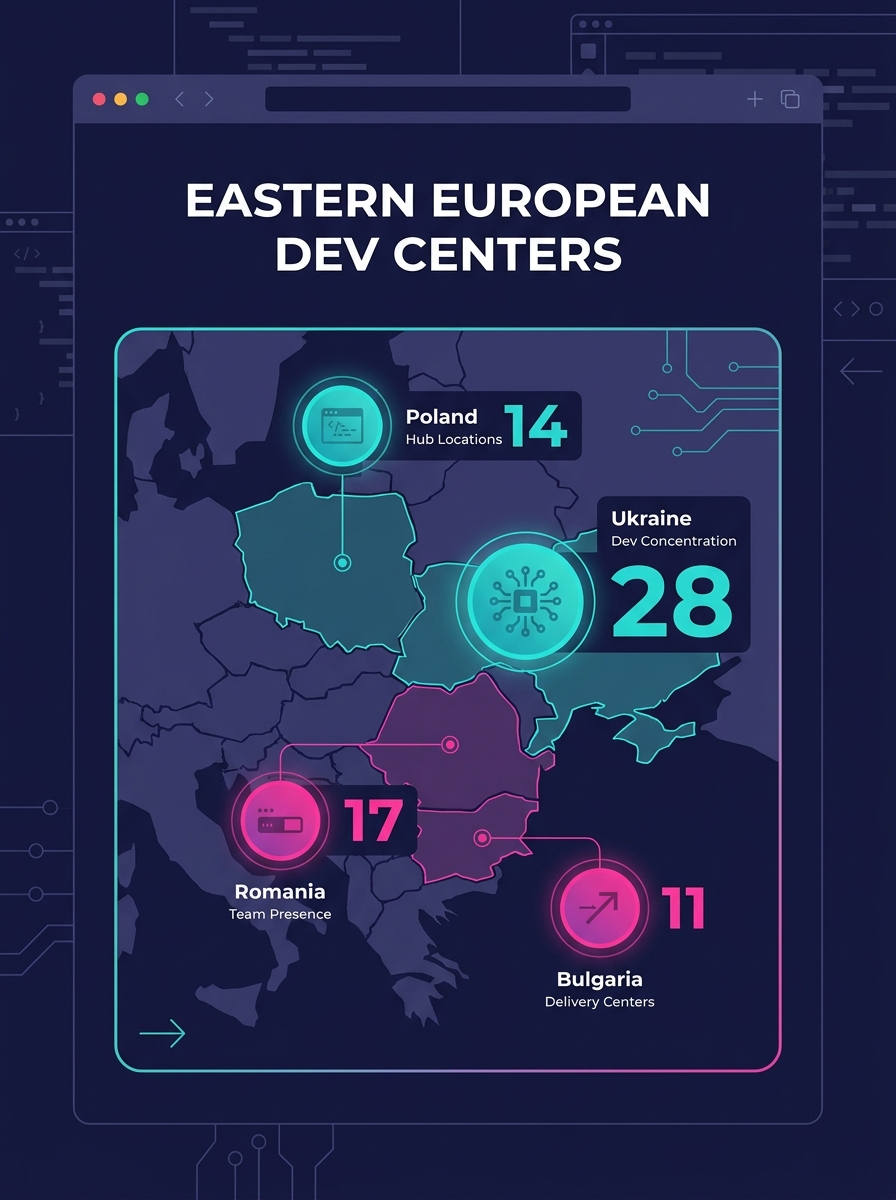
Coruzant's analysis places significant weight on Eastern European providers. Newxel operates eight recruitment hubs across Ukraine, Poland, Romania, Bulgaria, Turkey, Spain, Portugal, and Israel, the report states. The firm delivers first candidate shortlists within two to four weeks and maintains a 98% retention rate, according to the published data.
EPAM Systems covers Eastern Europe, India, and Latin America with delivery centers designed for enterprise-scale projects, Coruzant found. The firm handles multi-year cloud migrations and core-banking system rebuilds, the analysis states. Netguru, based in Poland, focuses on design-centered work paired with React and Node.js stacks, the report notes, with client concentration in fintech and e-commerce.
ScienceSoft maintains US headquarters alongside Eastern European delivery centers, a structure Coruzant identified as useful for clients requiring stateside contact points. The firm's portfolio tilts toward healthcare and manufacturing clients built over two decades, the analysis shows.
Ciklum structures teams as long-term product pods rather than rotating contractors, according to Coruzant, with capacity spread across Ukraine, Poland, and the Baltic states. ELEKS specializes in legacy modernization projects, the report states, a capability Coruzant highlighted for clients managing technical debt.
Compliance Certifications and Structured Models Replace Freelancer Networks
The shift from freelancer networks to structured offshore development centers reflects changing compliance requirements, Coruzant's analysis states. SOC 2, ISO 27001, and GDPR certifications now surface regularly in vendor evaluations, the report notes, creating a selection advantage for providers with established compliance infrastructure.
Agencies exploring offshore capacity should verify retention rates, compliance certifications, and pricing structures before committing, the analysis recommends. Flat-rate-per-headcount models provide clearer budget forecasting than milestone-based billing, Coruzant found, particularly for agencies managing multiple client projects simultaneously.
The distinction between offshore development centers and traditional outsourcing has clarified, the report states. ODCs function as dedicated teams running on the client's processes, tools, and roadmap rather than vendors executing discrete projects, according to Coruzant's framework. This model suits agencies seeking to scale development capacity without establishing foreign subsidiaries or navigating international payroll systems directly.
War Displacement and AI Tooling Reshape Engineering Labor Market
Ukraine's ongoing conflict has redistributed engineering talent across cities while keeping developers active in the labor market, Coruzant noted. AI development tools have narrowed the productivity gap between smaller offshore squads and larger in-house teams, the analysis states, changing hiring calculations for agencies evaluating headcount needs.
The combination of remote-work normalization, displaced talent pools, and productivity-enhancing tooling has made offshore development centers a structural capacity solution rather than a temporary cost measure, according to the report. Agencies managing multi-client WordPress portfolios can apply the ODC model to development work, though the providers Coruzant profiled focus primarily on broader web and mobile application development rather than platform-specific white-label services.
Newxel's two-to-four-week shortlist timeline addresses a common agency pain point: the lag between winning a project and staffing it, the analysis states. Traditional hiring processes can stretch across months, creating delivery risk when client deadlines remain fixed.
Reading Between the Lines
Coruzant's analysis speaks to a broader capacity challenge facing US digital agencies: hiring freezes and budget constraints haven't eliminated client demand, they've simply forced operations leads to find alternative staffing models. The offshore development center providers profiled here operate at enterprise scale, EPAM handles multi-year banking migrations, ScienceSoft maintains 20+ year client relationships, which raises a question the report doesn't address: do these structured ODC models translate cleanly to white-label WordPress work, or do agencies need more specialized partners who understand WordPress deployment patterns, client handoff protocols, and design system versioning?
The 98% retention rate Coruzant cites for Newxel matters significantly in agency contexts where developer turnover mid-project creates client-facing risk. But retention alone doesn't guarantee that an offshore team understands the specific quality standards and communication rhythms that keep white-label relationships viable when the developer never meets the end client. Agencies evaluating offshore capacity should layer Coruzant's compliance and retention criteria with questions about WordPress-specific technical depth and experience managing client handoffs at scale, capabilities that distinguish a generic ODC from a partner-class relationship that can absorb production workload without introducing silent quality drift.
The report's emphasis on Eastern Europe reflects current geopolitical and economic realities, but agencies should also weigh timezone overlap and cultural fit alongside cost savings when selecting providers. A team in Poland or Romania offers better working-hours alignment with US agencies than comparable providers in India or Southeast Asia, reducing the coordination friction that can erode the efficiency gains offshore models promise.