

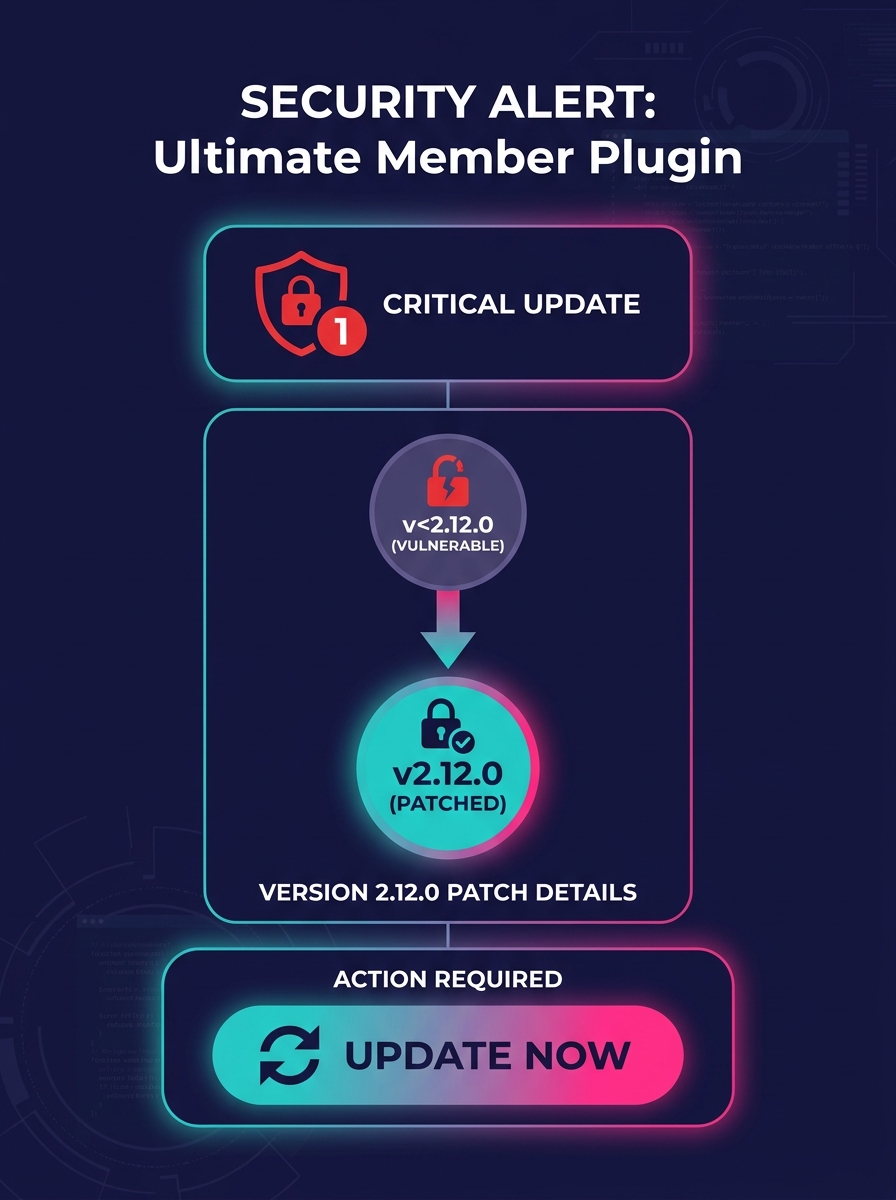
Ultimate Member released version 2.12.0 on June 24, 2026, patching an authenticated vulnerability that allowed attackers with contributor-level access to leak password reset URLs for any user account on up to 200,000 WordPress installations, according to SearchEngineJournal. The flaw, rated 8.8 out of 10 in severity by security researchers, chains three logic errors to expose temporary login credentials that should remain private during password recovery.
TL;DR: Ultimate Member 2.12.0 patches a vulnerability that let authenticated contributors extract password reset links for administrator accounts on 200,000 WordPress sites through chained directory validation flaws.
The vulnerability affects all Ultimate Member versions through 2.11.4. Ultimate Member is a membership and user profile plugin that powers community portals, member directories, and front-end registration systems on WordPress installations. The plugin enables user-generated content and searchable member databases.
How the Three-Flaw Chain Enables Account Takeover
The vulnerability chains three separate logic errors into a single exploit path. First, attackers manipulate the plugin to treat arbitrary posts as legitimate member directories, bypassing the intended scope of directory-related functions. Member directories normally display controlled user lists, but the flawed validation redirects that functionality toward attacker-controlled content.
Second, the plugin fails to enforce restrictions on protected metadata fields. WordPress metadata often contains internal information that plugins expect to remain inaccessible to standard users. The vulnerability allows contributors to bypass those metadata protections.
Third, the plugin does not validate field names when generating user card data. This missing validation lets attackers request internal fields that should never surface publicly—including the password reset link itself.
"This makes it possible for authenticated attackers with Contributor-level access and above to leak live password reset URLs for all users in the member directory response, including administrators," Wordfence stated in its disclosure.
Password reset links function as temporary login credentials. WordPress sends them only to account owners during password recovery, but the chained flaws expose those links to any authenticated user who can author posts or comments. An attacker who obtains an administrator's reset URL can change that account's password and seize full site control.
Authenticated Exploitation Threshold
The vulnerability requires authenticated contributor-level permissions before exploitation. Attackers cannot use the flaw remotely without first gaining access to a WordPress account with authoring privileges. Many sites grant contributor access during user registration or community enrollment, lowering the barrier to exploitation on membership-driven installations.
Once inside with contributor credentials, an attacker can extract reset links for every user in the site database, escalating from limited authoring permissions to full administrative control. The attack leaves minimal logs since directory queries appear as routine user lookups rather than unauthorized access attempts.
Sites that restrict contributor-level access through manual approval workflows or closed membership models face lower immediate risk, but any compromised contributor account—whether through credential reuse, phishing, or session hijacking—becomes a full takeover vector on unpatched Ultimate Member installations.
Patch Deployment and Mitigation Timeline
Ultimate Member 2.12.0 adds stricter validation around member directory handling and enforces allowed-field restrictions on user data requests. The patch prevents arbitrary posts from triggering directory logic, blocks metadata field manipulation, and explicitly whitelists which internal fields can appear in directory responses.
Agency owners managing client sites running Ultimate Member should verify the plugin version across their portfolio immediately. Sites still on 2.11.4 or earlier remain vulnerable to the chained exploit. WordPress does not automatically update plugins without opt-in configuration, meaning unpatched installations will persist until manual intervention.
For clients using Ultimate Member on membership portals or community sites where contributor accounts number in the hundreds or thousands, the update carries additional urgency. Each contributor account represents a potential exploitation entry point until the patch deploys. Sites that delay updates beyond 72 hours should audit recent contributor activity logs for unusual directory query patterns or unexpected user card data requests, though detecting exploitation after the fact remains difficult given the attack's stealth profile.
What This Means for Agency Owners
Authenticated vulnerabilities in membership plugins create a specific liability exposure for agencies managing community sites, online courses, and member directories. Unlike remote code execution flaws that attackers can exploit anonymously, this vulnerability requires contributor access—but membership sites grant that access routinely. If a client's site suffers an account takeover through an unpatched Ultimate Member installation, the remediation costs include password resets for every user, forensic log review to identify compromised accounts, and potential notification obligations under data breach laws.
Agencies should add Ultimate Member to their immediate patch queue and establish a 48-hour update SLA for authenticated vulnerabilities rated 8.0 or higher. Sites running membership plugins alongside open registration workflows face the highest risk. For clients where contributor accounts number above 100, consider temporarily disabling new user registrations until the patch deploys—a short enrollment freeze prevents new attack vectors while updates roll out.
This vulnerability also reinforces the need for white-label WordPress security baselines that include plugin update automation and role-based access audits. Contributor-level exploits emerge when plugins assume low-privilege accounts pose minimal threat, but membership sites intentionally distribute contributor access at scale. Regular contributor account reviews—flagging dormant accounts, removing inactive users, enforcing password rotation—shrink the exploitation surface even when zero-day flaws appear. The 200,000-site exposure on Ultimate Member demonstrates that popular membership plugins carry enterprise-level risk profiles despite their community positioning.