

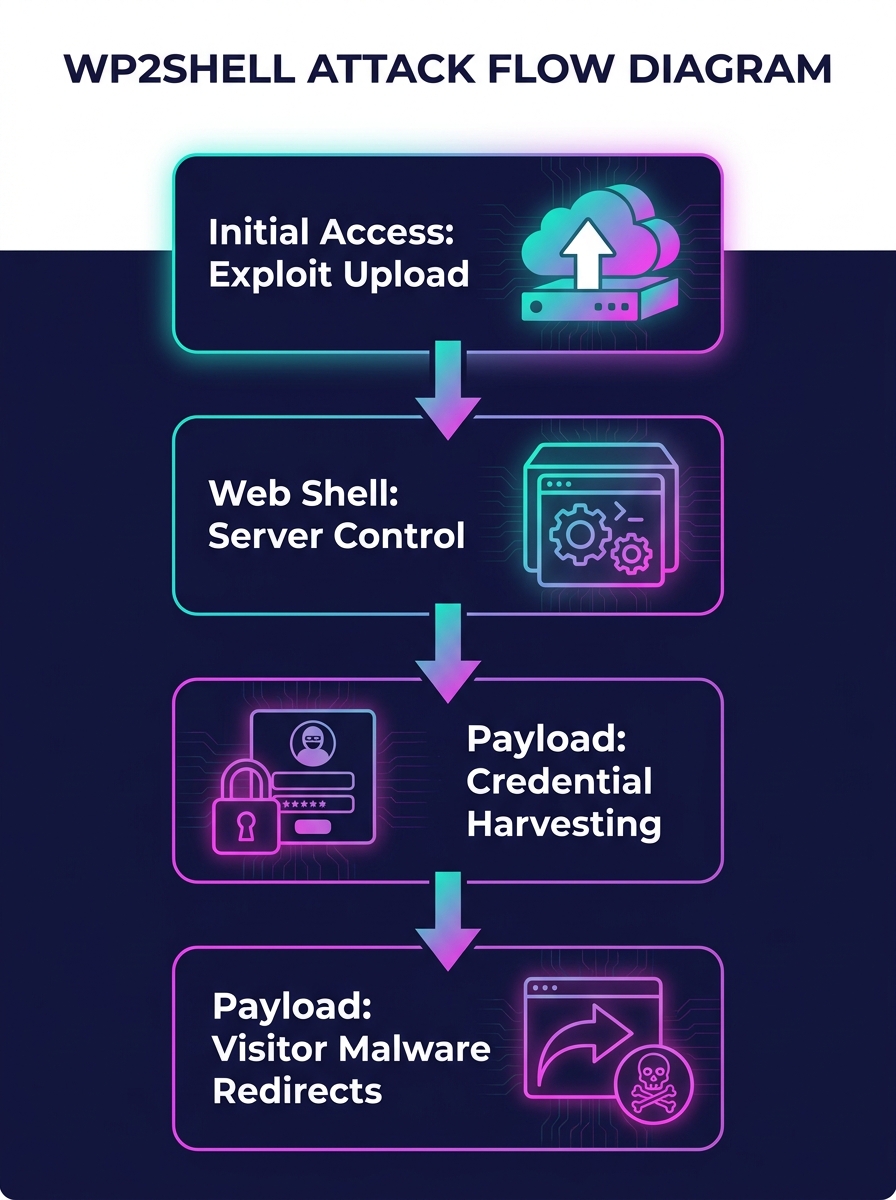
Attackers who gained control of WordPress sites through the wp2shell vulnerability chain are now delivering credential phishing, malware, and fraudulent redirects to ordinary visitors, according to Malwarebytes research published July 21, 2026. The exploited sites inject JavaScript to steal login credentials, serve fake Microsoft 365 and Google sign-in overlays, and redirect users to attacker-controlled infrastructure—turning legitimate client sites into distribution points for browser-based attacks.
TL;DR: WordPress sites compromised through wp2shell are actively delivering credential theft pages, malware, and scam redirects to visitors who land on previously trusted domains.
Exploitation Timeline Shows Rapid Weaponization
"Exploitation activity began within hours of the patch release," Wordfence reported in Malwarebytes' analysis. "Wordfence observed endpoint probing and SQL injection attempts the same evening, and public proof-of-concept code was reported in the days that followed."
The wp2shell vulnerability chain affects WordPress Core versions 6.9 and 7.0 without requiring any plugin involvement. Attackers exploit the flaw without authentication, achieving full administrative control and remote code execution with web server privileges. That level of access allows threat actors to modify what the site serves to every visitor—a capability cybercriminals began exercising immediately after the patch release, the Malwarebytes report shows.
Public exploit code for wp2shell became available on GitHub by July 19, 2026, accelerating the attacker adoption curve. Agencies managing WordPress portfolios now face a dual exposure: unpatched client sites under direct compromise risk, and patched sites whose visitors may still land on compromised third-party properties.
Five Visitor-Impact Vectors Agencies Must Address
Once attackers control a WordPress site through wp2shell, they deploy visitor-targeting payloads across five distinct categories, according to the Malwarebytes analysis.
Credential theft operations inject fake login forms or iframe overlays that replicate Microsoft 365, Google, banking, and social media authentication pages. The forms capture usernames and passwords submitted by users who trust the legitimate domain name. Malware delivery turns compromised sites into staging infrastructure for browser exploitation, malicious downloads, or redirect chains leading to malware-hosting servers.
Scam and fraud campaigns redirect visitors to fake technical support pages, fraudulent giveaways, or payment prompts disguised as legitimate service renewals. Tracking and profiling scripts fingerprint visitors, harvest browser configuration details, and track users across sessions—building attacker intelligence databases for subsequent campaigns.
Search and reputation damage compounds the initial technical compromise. Search engines and security tools flag compromised sites, serving warnings to visitors and eroding client trust long after the site owner patches the underlying vulnerability. Google Safe Browsing and Microsoft SmartScreen flags can persist for weeks beyond remediation, according to historical compromise data.
Agency Risk Mitigation for Managed WordPress Portfolios
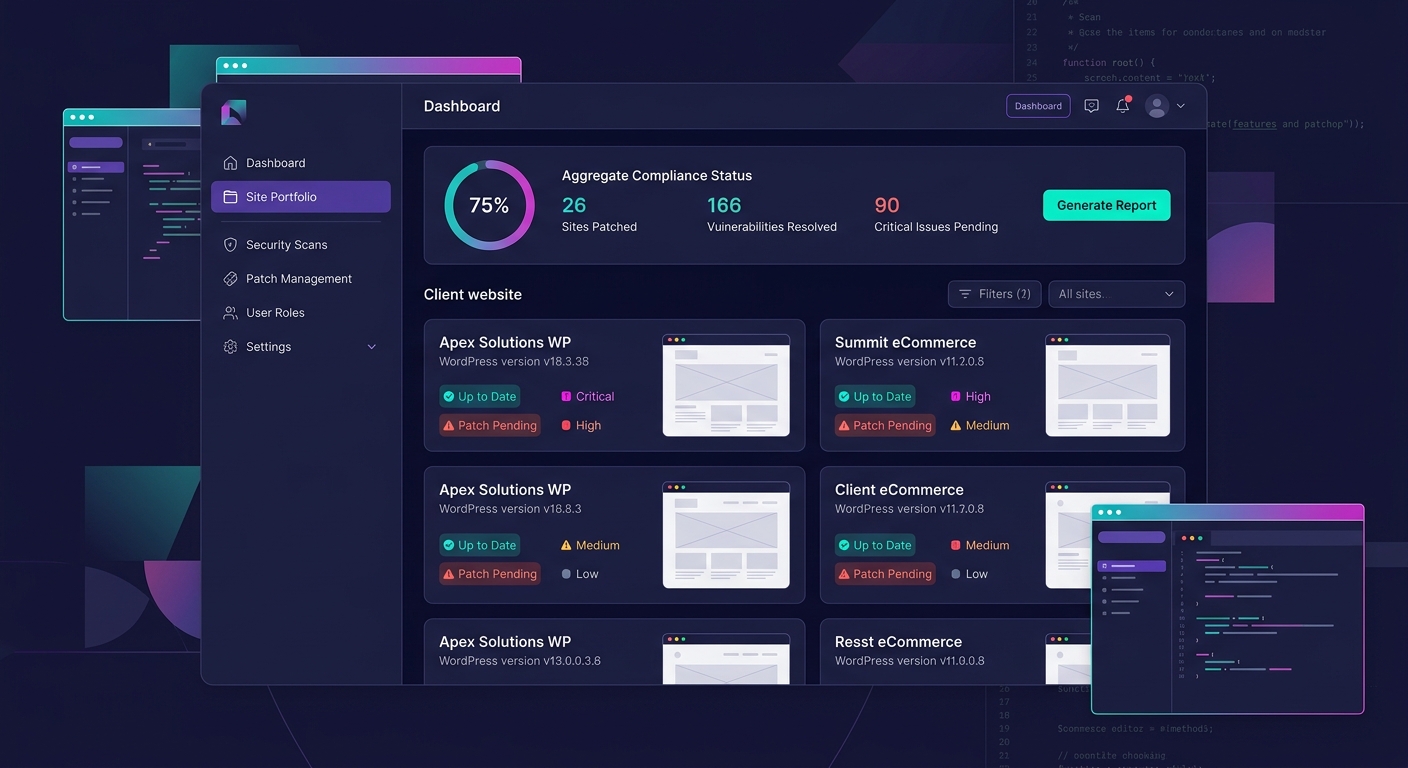
Agencies maintaining client WordPress sites face immediate operational requirements following wp2shell's active exploitation. Patch deployment becomes a priority task: all managed sites running WordPress 6.9 or 7.0 require immediate update to patched versions.
Site integrity audits should scan for injected JavaScript, modified core files, and unauthorized user accounts created during the exploitation window. File integrity monitoring tools can baseline legitimate WordPress installations and flag unauthorized changes. For agencies without in-house security capacity, hiring dedicated WordPress developers with security hardening expertise provides access to patch management and compromise detection protocols.
Client communication protocols must address visitor impact scenarios. Site owners need clear explanations of what visitors may have encountered if the site was compromised, enabling appropriate notifications to affected users. Legal and compliance teams at agencies managing sites in regulated industries should review breach notification requirements under applicable data protection laws.
For agencies evaluating white-label development partners, the wp2shell incident reinforces the requirement for explicit security SLAs covering patch turnaround times and vulnerability monitoring. Partners managing WordPress portfolios should demonstrate documented processes for tracking WordPress Core releases, testing patches against custom implementations, and deploying updates within defined windows—typically 24-48 hours for critical vulnerabilities affecting unauthenticated access.
Context and Outlook
The wp2shell vulnerability represents a category shift in WordPress security risk. Unlike plugin-specific flaws that affect isolated implementations, Core vulnerabilities expose every site running affected versions to identical exploitation paths. For agencies, that concentration of risk eliminates the traditional mitigation strategy of selective plugin audits—Core updates become non-negotiable operational requirements rather than discretionary maintenance tasks.
The rapid progression from patch release to active exploitation to public proof-of-concept code compresses the window for defensive action. Agencies managing WordPress portfolios without automated update pipelines or 24-hour patch deployment capacity now face structural disadvantages against threat actors who operate on accelerated timelines. The same-evening exploitation timeline Wordfence documented in this incident leaves no margin for manual review processes or extended testing cycles.
Visitor-facing impacts extend agency liability beyond site availability and data integrity. When a compromised client site delivers credential theft or malware to end users, the damage propagates to the client's customer relationships and regulatory posture—areas where agencies traditionally disclaim responsibility. Security incident response protocols must now account for visitor notification requirements, search engine de-listing remediation, and reputation recovery timelines that extend months beyond the initial technical fix.