

CVE-2026-64638, a cross-site scripting vulnerability affecting WordPress installations from version 4.7 forward, allows unauthenticated attackers to execute JavaScript on the login page and escalate to server control when paired with administrator interaction, according to security guidance published by Aardwolf Security on August 9, 2026. WordPress closed the flaw in version 7.0.3, released August 6, and backported the fix to every supported branch.
TL;DR: pwn.ai researchers discovered a method to bypass WordPress login-page sanitization filters, enabling unauthenticated JavaScript execution that can escalate to Application Password theft and plugin upload access when combined with admin interaction.
Security researchers at pwn.ai identified a technique to smuggle HTML through WordPress's login-page filters by inserting a stray space inside a tag—markup that PHP's built-in sanitizer allows but WordPress's filter still renders as valid code. The vulnerability exists in core code shipped since WordPress 4.7, meaning nearly every actively maintained installation contained the flaw before the August 6 patch. Proof-of-concept exploit detail is now public, narrowing the window between disclosure and active exploitation to days rather than months for documented vulnerabilities of this type.
The disclosure carries particular urgency for agencies managing client WordPress sites because the attack chain begins with zero authentication and targets a page every visitor can reach. Unlike most WordPress core vulnerabilities that require plugin misconfigurations or compromised accounts, CVE-2026-64638 starts from the login screen and needs only an administrator to click a malicious link elsewhere to complete the escalation to server access.
Attack Chain Begins on Unauthenticated Login Page
The vulnerability allows attackers to run JavaScript on the WordPress login page without any account credentials. pwn.ai researchers documented that the flaw bypasses sanitization by exploiting a discrepancy between PHP's native filtering and WordPress's own validation layer. The inserted space tricks the system into accepting what becomes executable markup in the browser.
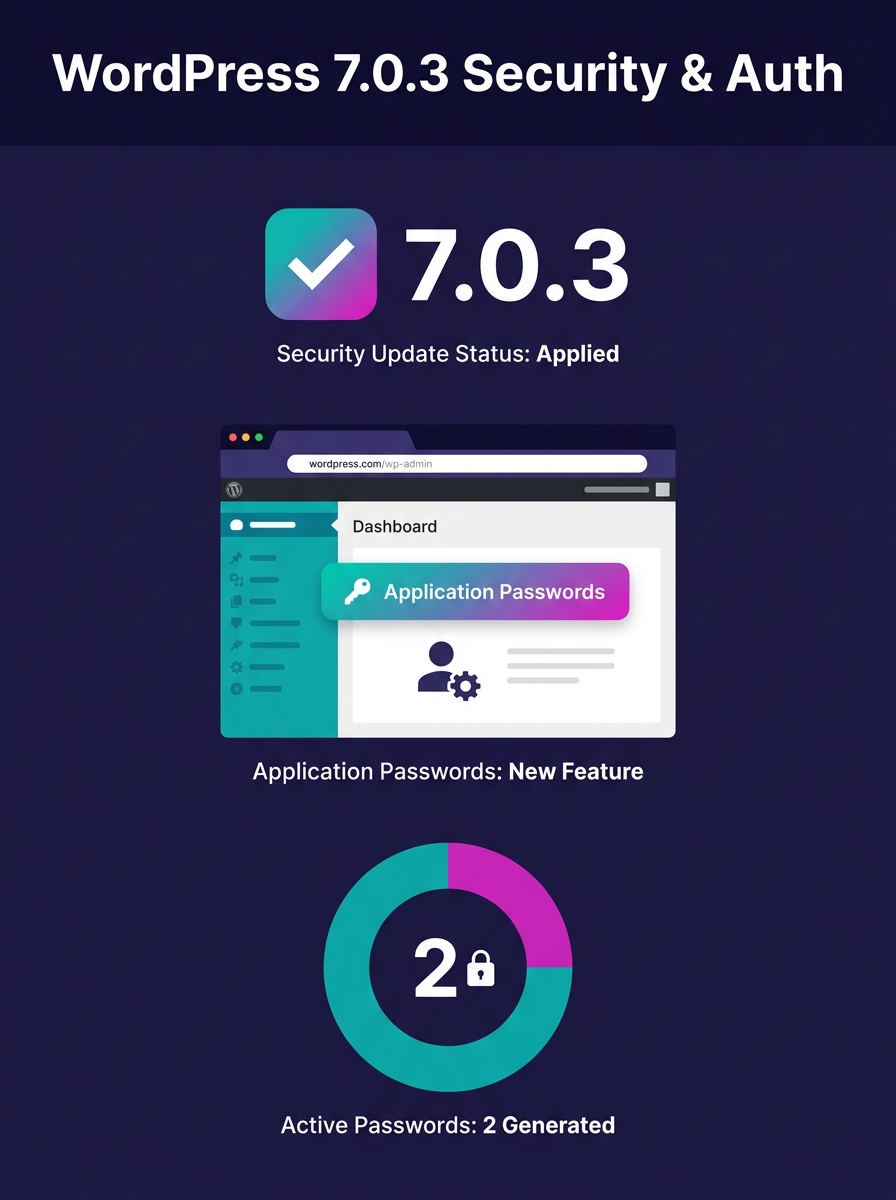
When paired with an administrator clicking a crafted link, the same vulnerability can reach Application Passwords—API-style credentials WordPress issues to user accounts for programmatic access. From there, the attack chain extends to plugin upload permissions and arbitrary code execution on the server. Rebecca Sutton, writing in Aardwolf Security's August 9 analysis, noted that "under the right conditions, that access can turn into full control of the server."
WordPress patched the vulnerability in the 7.0.3 security release that also addressed ten additional issues including stored XSS flaws in post content and Quick Edit, a privilege escalation route on multisite networks, and a server-side request forgery weakness in URL validation. The fix was backported to all supported branches reaching back to version 4.7, the release where the vulnerable code first appeared.
Agencies Managing Multiple Client Sites Face Elevated Risk
Digital marketing and web development agencies typically maintain administrator access across dozens or hundreds of client WordPress installations, multiplying the attack surface for a vulnerability that targets admin-level interactions. Each administrator account represents a potential entry point for the second stage of the exploit chain, and agency team members routinely access client wp-admin dashboards from shared networks or while traveling—scenarios that increase phishing and social-engineering risk.
Aardwolf Security's guidance identifies five immediate actions for agencies: verify all managed sites run WordPress 7.0.3 or the equivalent patched point release for older supported branches; audit and revoke unrecognized Application Passwords under each user account; reduce the count of accounts with administrator privileges to only staff whose workflows require full admin rights; review plugin upload permissions to remove unnecessary access; and assign specific ownership of patch management as an ongoing operational task rather than a reactive fire drill.
Organizations unable to deploy the update immediately due to change-control processes should request web application firewall or CDN rules for CVE-2026-64638 while the patch moves through approval, according to the August 9 guidance. IP allowlists or basic authentication in front of wp-admin can narrow exposure to the pre-authentication stage of the attack, though neither workaround addresses the admin-interaction component of the chain. Sutton emphasized that "neither of those replaces the actual update."
Managed Hosting Providers Applied Automatic Updates Within Hours
Most managed WordPress hosting platforms applied the 7.0.3 security update automatically within hours of the August 6 release, insulating customers from direct patching responsibility. Agencies running self-hosted or VPS-based WordPress installations for clients carry direct accountability for update deployment and should confirm version numbers across all managed properties this week. Sites running WordPress versions older than 4.7 that no longer receive security backports face exposure to CVE-2026-64638 and the ten additional vulnerabilities closed in the August 6 release.
The timing between the August 6 patch release and the August 9 publication of detailed exploitation guidance follows the pattern documented in recent WordPress plugin security research, where automated scanning and manual probing activity begins within hours of vulnerability disclosure. No active exploitation had been reported when WordPress shipped the 7.0.3 fix, but public availability of proof-of-concept code changes the threat timeline for unpatched installations.
Reading Between the Lines
Agencies managing white-label WordPress capacity for clients absorb reputational and liability exposure when security patches languish. CVE-2026-64638 represents the type of vulnerability that surfaces in client audits and compliance reviews—a pre-authentication attack vector targeting core code, not a third-party plugin—and creates documentation trails that clients and their legal teams reference when evaluating vendor performance. The delta between a managed hosting provider that patched automatically on August 6 and an agency that confirmed updates on August 9 may seem minor, but that three-day window appears in incident timelines and post-mortem reports.
The operational gap isn't the patch itself; most agencies can push a WordPress core update in under an hour once they decide to act. The gap is detection and decision latency—knowing that a critical security release shipped, triaging it against other priorities, and executing across a portfolio of client sites before exploitation begins. Organizations treating patch management as an ad-hoc task rather than an owned process consistently trail the threat curve by days or weeks, turning what should be routine maintenance into client-facing incidents.
For agencies considering white-label partnerships to manage technical operations including security patching, Webmastered's services provide defined SLAs on vulnerability response timelines that shift patch accountability from the agency's internal ops team to a dedicated WordPress development partner. The difference between "someone will get to it" and "patches deploy within X hours of disclosure" becomes material when clients ask who owns site security and what documentation exists to prove it.