

Ticket-based WordPress support looks cheap on paper. You submit a request, someone fixes it, you pay per task. Retainer agreements and embedded developer models cost more upfront but promise deeper outsourced development collaboration. The pricing gap between these three approaches can be 10x, which makes the cheapest option look obvious. Then you measure what each model actually costs in rework, context switching, and client trust over twelve months, and the math flips entirely.
Every agency facing agency scaling bottlenecks eventually arrives at this decision point. The mistake is treating it as a pricing question when it's really a workflow question. Here's what each model delivers, where each one breaks, and who should pick which.
The Ticket-Based Model and Why It Crumbles Under Agency Weight
Ticket-based outsourcing works like a help desk. You describe a problem or a small task, submit it to a queue, and a developer picks it up. Pricing is usually per-ticket or per-hour, with turnaround SLAs measured in hours or days.
For a freelancer managing three client sites, this can work fine. For an agency running 15, 30, or 60 WordPress sites with overlapping deadlines and client-facing commitments, the cracks appear fast.
The first problem is prioritization. As SparrowDesk's research on support ticket lifecycles documents, many ticketing systems default to first-in-first-out processing. Your client's broken WooCommerce checkout page gets the same queue position as a minor CSS tweak someone submitted two hours earlier. Without clear priority criteria baked into the system, critical revenue-impacting issues wait their turn alongside cosmetic requests.
The second problem is context loss. Every ticket starts from zero. The developer assigned to your request on Monday might not be the same person who handled your ticket on Friday. They don't know your theme structure, your plugin stack, or that your client's hosting environment has a specific caching quirk. You end up re-explaining context in every submission, which burns your project manager's time and introduces errors when details get lost in translation.
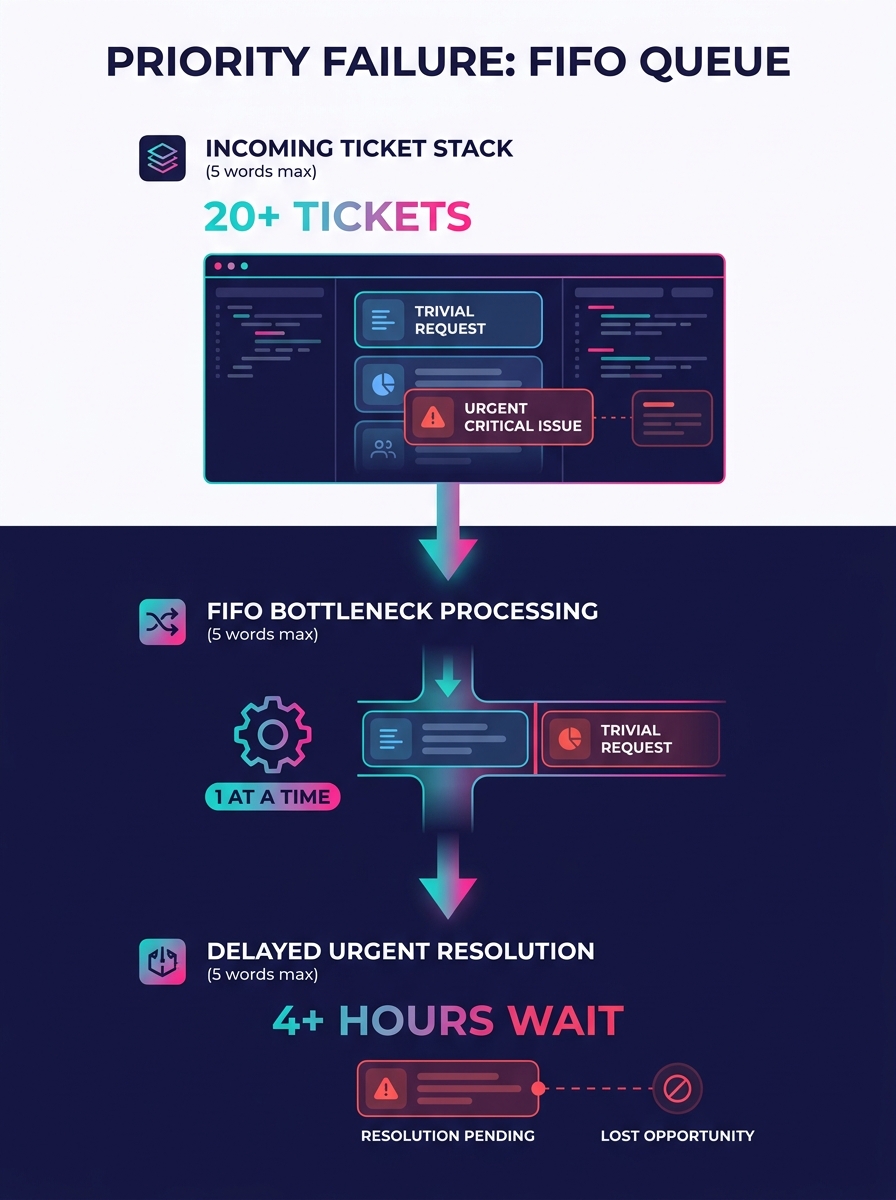
The third problem is the one agencies underestimate: rework compounding. When an outsourced developer doesn't understand your broader project goals, they solve the immediate ticket. But their fix might conflict with planned work on the same page next week, or introduce code that doesn't follow your agency's standards. According to Work Hero's research on outsourcing WordPress development for marketing agencies, managing an increasing number of WordPress websites requires consistency across development decisions, which ticket-based models inherently lack.
The hidden cost isn't the $49 or $99 per ticket. It's the 30 minutes your PM spends writing context into each submission, the 45 minutes debugging a fix that broke something else, and the client call you have to make when a "quick change" takes three days because it bounced between two different developers who didn't communicate.
If your agency handles fewer than five WordPress sites with simple maintenance needs, ticket-based models can be adequate. Beyond that threshold, you're paying for the illusion of affordability.
The Monthly Retainer and Its Tradeoffs
Retainer models give you a fixed block of hours per month with a designated outsourcing partner. You typically get access to a small team or a named developer, a project management channel in Slack or Basecamp, and some form of monthly reporting. Pricing ranges from $1,500 to $5,000/month depending on scope and partner quality.
This model solves the context problem. Your retainer partner learns your tech stack, your coding standards, your clients' recurring needs. They can reference previous work because they did that previous work. The WordPress outsourcing workflow improves dramatically when developers carry institutional knowledge between tasks.
The hidden cost isn't the $49 per ticket. It's the 30 minutes your PM spends writing context into each submission, the 45 minutes debugging a fix that broke something else, and the client call when a "quick change" takes three days.
Retainers also fix the priority problem. Because you're paying for dedicated capacity, your partner isn't juggling your tasks against fifty other agency clients in the same queue. You set the priorities. You decide what gets built this week versus next week.
But retainers have their own failure modes.
The biggest risk is utilization mismatch. Agency workloads are lumpy. You might burn through 60 hours in a launch-heavy month, then barely need 10 hours during a quiet stretch. If your retainer contract doesn't allow rollover or flexible scaling, you're paying for empty hours. And if it does allow rollover, that unused time often comes with expiration dates or restrictions that make it hard to actually recapture.
The second risk is what happens when you outgrow the retainer. If your agency lands three new clients in a quarter, a fixed-hour retainer can't absorb the spike without renegotiation. You end up supplementing with ticket-based overflow work, which reintroduces all the problems you were trying to avoid. Understanding how to evaluate a white-label development partner before signing a retainer contract helps you assess whether a partner can scale alongside you.
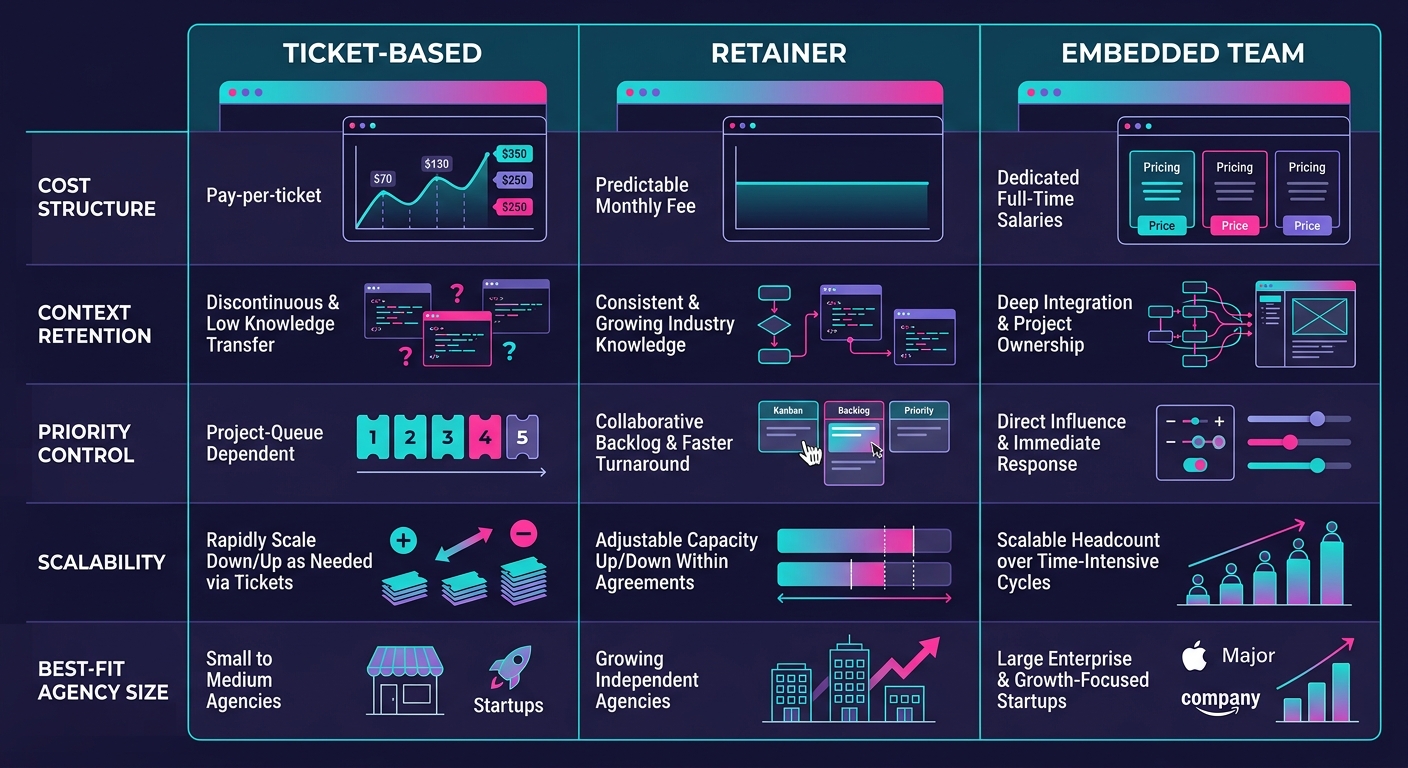
Retainer models work well for agencies in the 10-to-30-site range with predictable monthly workloads. If you can estimate your development needs with reasonable accuracy quarter over quarter, a retainer gives you the consistency that ticket-based models lack without the overhead of a fully embedded team.
Embedded Teams and the Integration Cost Nobody Talks About
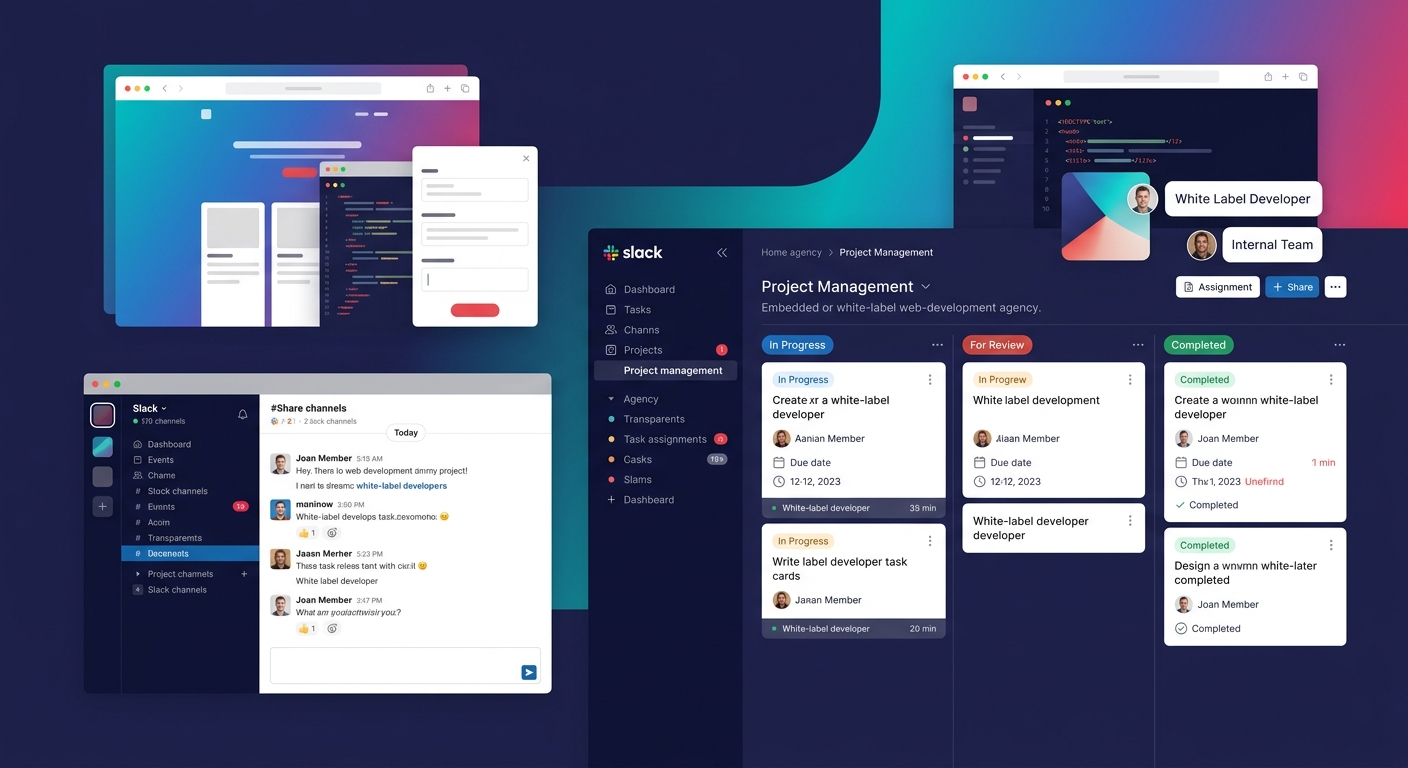
The embedded model places a dedicated developer or small team inside your agency's workflow. They use your project management tools, attend your standups, communicate directly with your PMs (and sometimes your clients, under your brand). White-label team management becomes part of your daily operations rather than an external handoff.
This is the model that agencies scaling past 30 sites and $1M+ in annual revenue tend to gravitate toward. E2M Solutions recommends that agencies bring white-label partners into their existing project management tools rather than working through email, and embedded models make that integration natural. Your embedded developer lives in your Asana, ClickUp, or Monday board the same way your internal team does.
The advantages are significant. Context retention is permanent. Priority control is total. And because the developer is dedicated to your agency, you can invest in onboarding them on your specific processes, plugins, and client expectations in a way that pays dividends across dozens of projects.
But here's the tradeoff that trips up agencies who jump to this model too early: management overhead.
When you embed an outsourced developer into your workflow, someone on your team needs to manage them. That means writing clear briefs, reviewing their work, giving feedback, and maintaining communication cadence. If you don't have a solid internal PM structure, an embedded developer can actually slow things down because your senior people spend more time directing the work than they would doing it themselves. This is one of the common mistakes agencies make with white-label services, and it catches teams off guard more often than cost overruns do.
Tip: Before committing to an embedded developer model, audit how your agency currently assigns and reviews work. If task briefs live in Slack threads and "the PM just knows," your process isn't documented enough to hand off to an external team member effectively.
The second consideration is cost commitment. Embedded team members typically run $4,000 to $8,000 per month, and the value only materializes if you have enough consistent work to keep them engaged. An embedded developer sitting idle for two weeks costs the same as one shipping three client sites. Understanding the differences between white-label and traditional outsourcing helps you decide whether the integration overhead is worth it for your current scale.
For agencies ready to hire dedicated web development talent or bring on web design talent through an embedded model, the key prerequisite is having documented workflows that an external person can follow without constant hand-holding.
Who Should Pick Which
The honest answer depends on three variables: your current site count, your workload predictability, and your internal project management maturity.
Ticket-based fits agencies with fewer than five active WordPress maintenance clients and occasional, small-scope requests. If your needs are truly ad hoc and you can afford multi-day turnaround times without client impact, per-ticket pricing keeps your fixed costs at zero. Accept the context loss as a known cost of doing business at that scale.
Retainer fits agencies managing 10 to 30 sites with relatively steady monthly workloads. You need a partner who carries context between tasks, but your volume doesn't justify a full-time dedicated resource. Negotiate contracts with flexible hour allocation and clear escalation paths. Make sure the retainer includes access to senior developers, because a retainer staffed with junior-level talent produces the same rework cycle as the ticket-based model.
Embedded team fits agencies past the 30-site mark or those running complex builds with WooCommerce, custom post types, and multi-site configurations. You need this model when the cost of re-explaining your setup to a new developer exceeds the cost of keeping one on retainer full-time. But you also need internal processes mature enough to onboard and direct that person effectively.
The pattern most agencies follow looks like a progression: ticket-based out of necessity, retainer when the pain becomes obvious, embedded when growth demands it. The expensive mistake is staying in the ticket-based model too long because the per-unit cost looks attractive. By the time you add up the context loss, the rework, and the PM hours spent translating your needs into ticket descriptions, you've already been paying retainer prices. You've just been paying them in hidden overhead instead of a predictable monthly line item.
Whatever model you're evaluating, Webmastered's white-label development services are built to match the collaboration depth your agency actually needs, rather than forcing you into a one-size-fits-all support queue. The outsourcing model should match how your agency actually works, not the other way around.