

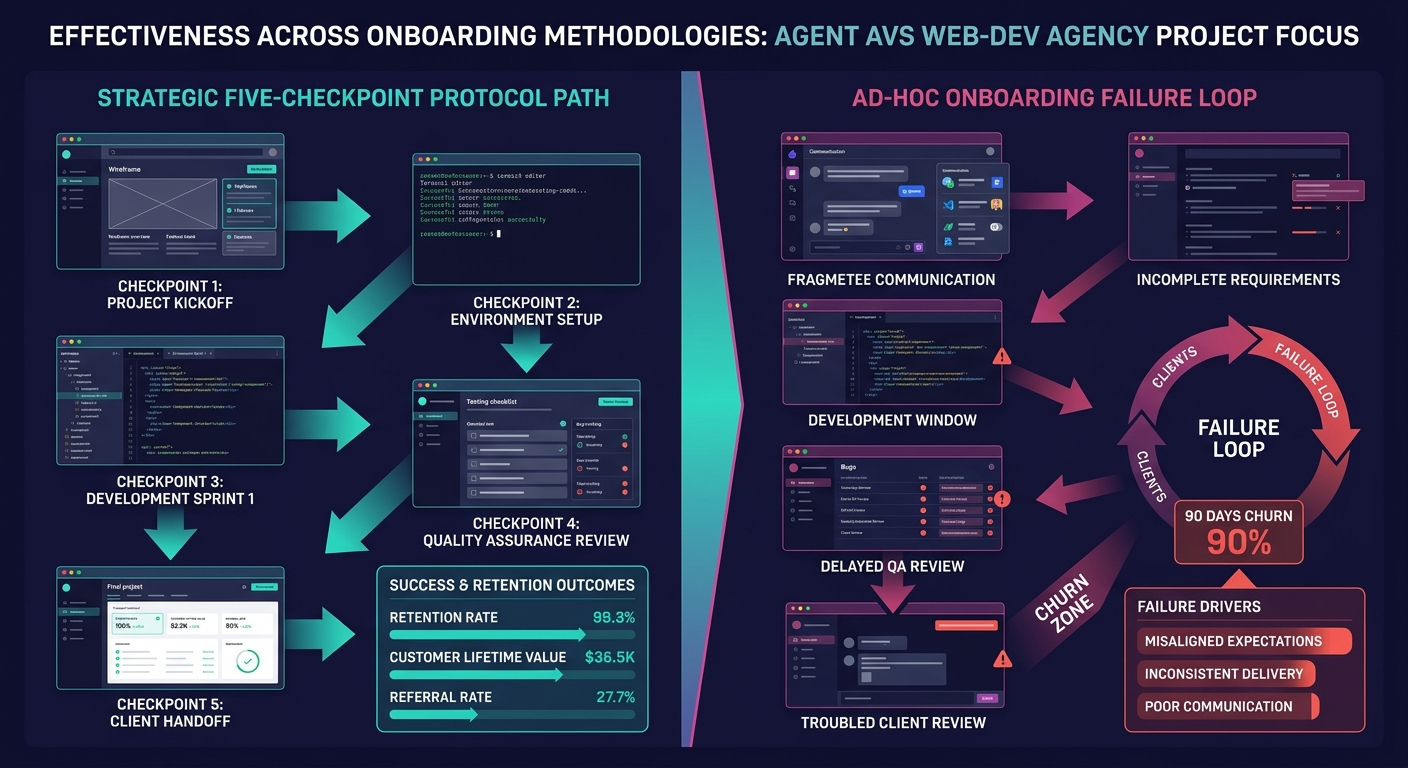
Trillet.ai's Q1 2026 agency onboarding analysis found that structured, phase-based white-label developer onboarding correlates with 40–60% higher partner retention compared to ad-hoc approaches. The gap between agencies that keep developers productive and those stuck in a revolving door of re-onboarding comes down to communication protocol design, applied in a specific sequence.
Phase Zero: The Handshake That Sets the Trap
The failure loop starts before any code gets written. An agency finds a white-label WordPress partner, exchanges a few emails about rates and turnaround, maybe hops on a 20-minute call, and kicks off the first project within 48 hours. Trillet.ai's data shows the first 30 days of a client relationship determine long-term success, yet most agencies burn a third of that window on logistics that should've been settled before day one.
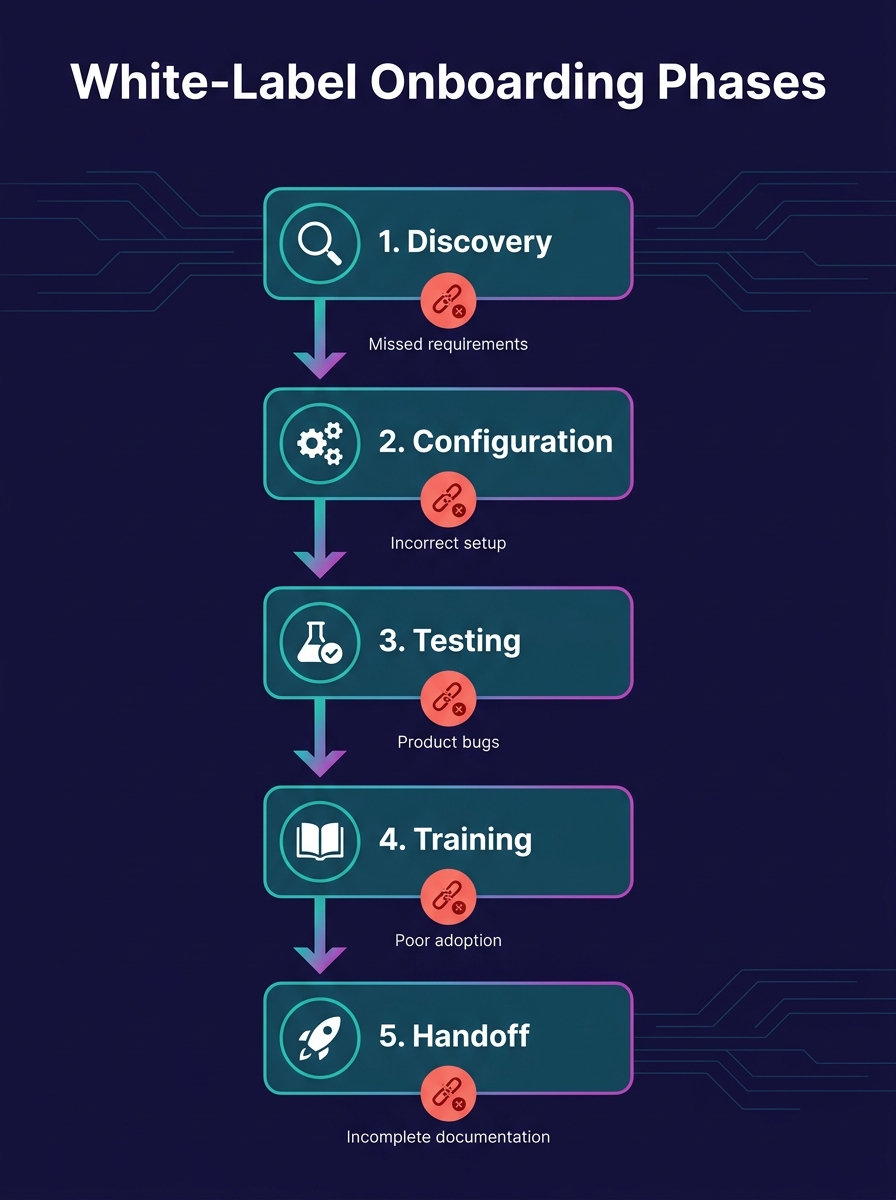
The White Label Agency's onboarding guide describes a five-phase process: discovery, configuration, testing, training, and handoff, with defined deliverables at each stage. Skipping discovery is, according to the guide, "a leading cause of misaligned expectations and churn." But agencies under pressure to deliver skip it constantly. They assume the developer will figure out their naming conventions, their staging workflow, their preferred plugin stack.
This mirrors the pattern we've seen with requirements-stage failures in white-label WordPress projects, where verbal briefs replace written specs and the misalignment compounds over weeks. Phase Zero is where the loop's momentum begins: no written protocol means every future miscommunication gets chalked up to the developer being "not a good fit."
Week One: When Documentation Gaps Become Assumptions
By day 3, the new developer has made at least 4–5 unverified assumptions about the agency's workflow. Which branch naming convention? What's the staging URL format? Does the agency want ACF field groups exported as JSON or PHP? Who reviews pull requests, and within what timeframe?
Without remote team documentation spelling out these answers, the developer defaults to their own habits. A Growthable white-label onboarding guide stresses the importance of providing "training materials, including manuals, video tutorials, and FAQs" so that teams are "well-equipped to use the product or service." That recommendation targets client-facing onboarding, but the principle transfers directly: every undocumented decision is a coin flip, and coin flips compound.
Growth Rocket's retention research describes what happens when ambiguity festers: "When two or more of these signals appear simultaneously, a proactive retention intervention should be triggered," which "typically means scheduling an unscripted, honest conversation at the senior level where the agency acknowledges the friction and asks directly what needs to change." The problem is that most agencies don't recognize the signals at this stage. Week one feels fine. The developer is quiet because they're guessing, not because they're confident.
Agencies that have already invested in standardizing their white-label partner briefs tend to survive this phase because the documentation already exists. Everyone else is building the plane mid-flight.
Days 7–14: The Silence Gap
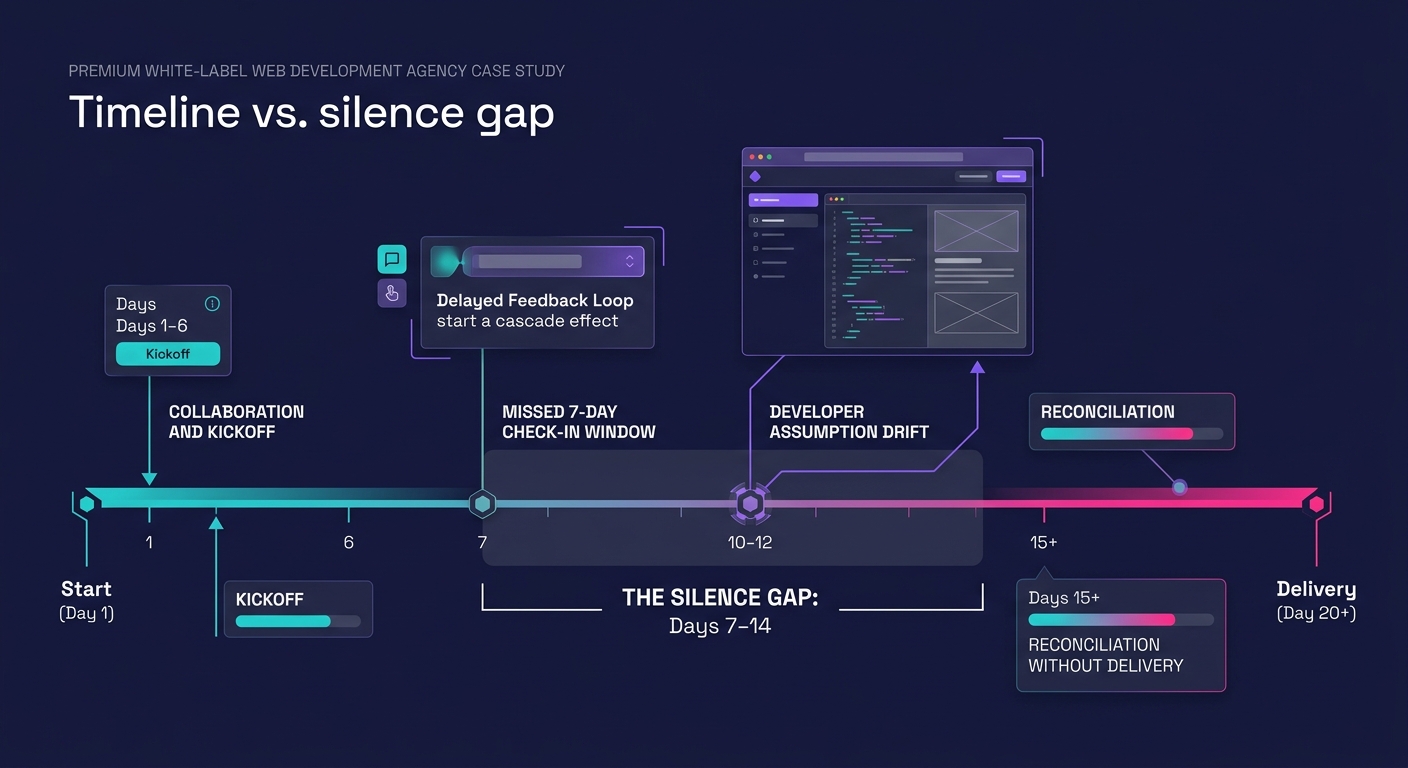
Here's where agency scaling friction gets expensive. The developer submits their first deliverable. Feedback is vague ("this isn't quite right") or delayed by 3–4 days because nobody defined a response-time SLA. The developer, unsure whether to wait or move forward, either stalls (costing billable hours) or pushes ahead on the next task using the same incorrect assumptions.
Remote Work Europe's analysis of effective communication protocols for distributed teams makes a critical distinction: "A design team may benefit from daily synchronous stand-ups over video calls to align quickly on projects, while a finance team might rely more on asynchronous written updates that allow for detailed documentation and time to process information." The takeaway for white-label agencies is that the protocol has to match the work type. WordPress development involving Elementor templates and WooCommerce configurations needs different communication cadence than a team doing SEO audits.
A 7-day check-in, according to Trillet.ai's framework, catches issues early enough to correct course. Agencies that skip this checkpoint lose an average of 5–7 additional working days before the misalignment surfaces through a client complaint or a blown deadline. By then, both sides are frustrated, and the developer starts looking like the problem.
The 30-Day Cliff
Trillet.ai's research identifies a specific inflection point: clients experiencing confusion, missed expectations, or delayed implementation are significantly more likely to cancel within 90 days. For white-label partnerships, "cancel" usually means the agency ghosts the developer, finds a new one, and restarts the entire onboarding cycle from scratch. Each restart costs 2–4 weeks of lost productivity plus the opportunity cost of projects that stalled during the transition.
Where.Team's 2026 async communication report recommends a specific countermeasure: "Create an async template for it. Set response time expectations for one team or project." The emphasis on templates is deliberate. Communication protocol templates that define response windows (e.g., Slack messages within 4 hours during overlap hours, Jira ticket updates within 24 hours, pull request reviews within 48 hours) remove ambiguity from the system. They also create accountability on both sides; when the agency itself misses a 48-hour review window, the developer can point to the documented SLA.
This is the moment where agencies either break the loop or feed it. Respona's agency scaling research frames the dynamic clearly: "understanding your client, setting clear expectations, and delivering consistently" determines retention. Replace "client" with "white-label partner" and the principle holds.
Each onboarding restart costs 2–4 weeks of lost productivity plus the opportunity cost of every project that stalled during the transition.
Rewinding the Loop: The Five-Checkpoint Protocol
Breaking the failure loop requires inserting documentation and communication checkpoints at the exact moments where assumptions typically take over. Here's what the research supports, organized as a protocol rather than a wish list:
Pre-kickoff (before any task assignment): A synchronous video call covering the agency's WordPress stack, plugin preferences, Git workflow, and staging environment setup. White Label Web Design's onboarding guide emphasizes that "physical meetings, video calls or telephone conversations are best to start off with" because you can "examine their body language as the first indication of trust." After this call, both parties sign off on a written brief document, not a Slack summary.
Day 3 async check-in: A Loom or written update from the developer confirming what they understand about the first task, what tools they're using, and what questions remain. This catches 80% of assumption drift before it reaches a deliverable.
Day 7 synchronous review: A 15-minute video call reviewing the first deliverable against the brief. Agencies that build quality scorecards for their white-label teams can score this deliverable against defined criteria rather than relying on gut feel.
Day 14 protocol audit: Both sides review whether the communication cadence is working. Are Slack response times meeting the SLA? Are Jira tickets getting updated within the agreed window? This is where you tune the protocol, not where you abandon the developer.
Day 30 retention review: A structured conversation about what's working, what's not, and whether the partnership moves to ongoing status. Trillet.ai's framework calls this the ROI confirmation step, and it maps directly to the outsourcing organism framework for diagnosing partnership breakdowns.
| Checkpoint | Format | Duration | Purpose | Failure if Skipped |
|---|---|---|---|---|
| Pre-kickoff | Video call + written brief | 45–60 min | Align on stack, tools, workflow | Assumption drift from day 1 |
| Day 3 | Async (Loom/written) | 10–15 min | Confirm understanding | Wrong direction on first deliverable |
| Day 7 | Synchronous review | 15 min | Score first deliverable | Misalignment hidden until client sees output |
| Day 14 | Protocol audit | 20 min | Tune communication cadence | SLA violations become normalized |
| Day 30 | Retention review | 30 min | Decide partnership status | Ghosting replaces structured offboarding |
Agencies scaling across platforms often need parallel onboarding tracks. If you're expanding into e-commerce builds, for example, you'd apply this same checkpoint structure when bringing on Shopify developers for client projects outside your core WordPress work.
Where This Lands Now
The onboarding failure loop persists because it feels faster to skip documentation. Every agency that's cycled through 3 or 4 white-label developers in a year has spent more total hours on re-onboarding than they would have spent building the protocol once.
The 40–60% retention improvement that Trillet.ai documented doesn't come from finding better developers. It comes from giving adequate developers a communication structure that lets them perform. Written briefs, defined response-time SLAs, checkpoint calls at days 3, 7, 14, and 30, and a shared project management tool with consistent update cadence: these are the components. None of them are complicated individually. The discipline is in executing all five checkpoints on every new partnership, even when the deadline pressure says otherwise.
Agencies that treat onboarding as a one-time setup cost rather than a recurring expense will stop feeding the loop. Those that keep hiring and hoping will keep paying for it.