

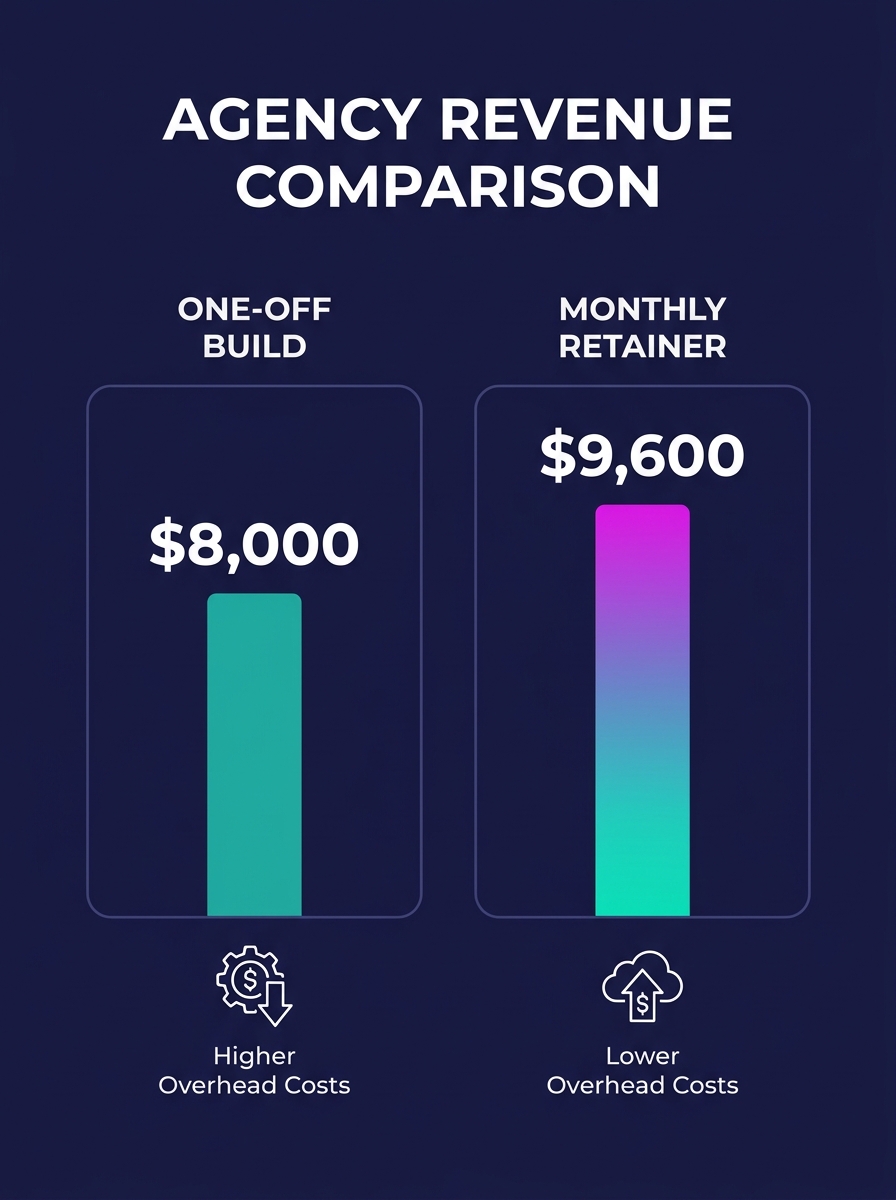
Web Help Agency's 2026 pricing analysis quantified what social media agencies building campaign infrastructure on WordPress consistently miss: a single client paying $800 per month for ongoing support generates more annual margin than a one-off $8,000 site build, with zero acquisition cost and negligible churn. For agencies already managing social accounts, the retainer math changes everything.
The Pricing Analysis That Reframes Project-Based Revenue
The numbers from Web Help Agency's breakdown tell a specific story. An agency billing $800 per month for white-label WordPress maintenance collects $9,600 per year from that single client. The equivalent $8,000 build carries discovery meetings, revision rounds, project management overhead, and a client acquisition cost that eats into the margin before development even starts.
At Standard tier with five retainer clients, an agency generates $1,000 to $2,500 in net margin per month with minimal active work, according to that same analysis. Scale to ten clients, and the range jumps to $2,000 to $5,000 per month. The partner doing the actual technical work (your white-label provider) costs $100 to $900 per month per site depending on scope. You bill $300 to $1,800 per month. The spread yields 40 to 65% gross margins on managed WordPress retainers.
Social media agencies sit in a particularly strong position here because they already own the client relationship. You're running their Instagram, managing their Meta ad spend, building their TikTok content calendar. When you also built the WordPress landing pages, microsites, or WooCommerce storefront those campaigns point to, pitching a maintenance retainer requires no new relationship building. You're extending an existing engagement, and the trust infrastructure is already in place.
As Technocrackers noted in their white-label agency revenue guide, "The agencies that scale treat it as a product. A properly structured WordPress maintenance offering, delivered through a white label partner, converts your existing client base into a predictable monthly income stream."
Campaign Infrastructure Rots Between Launches
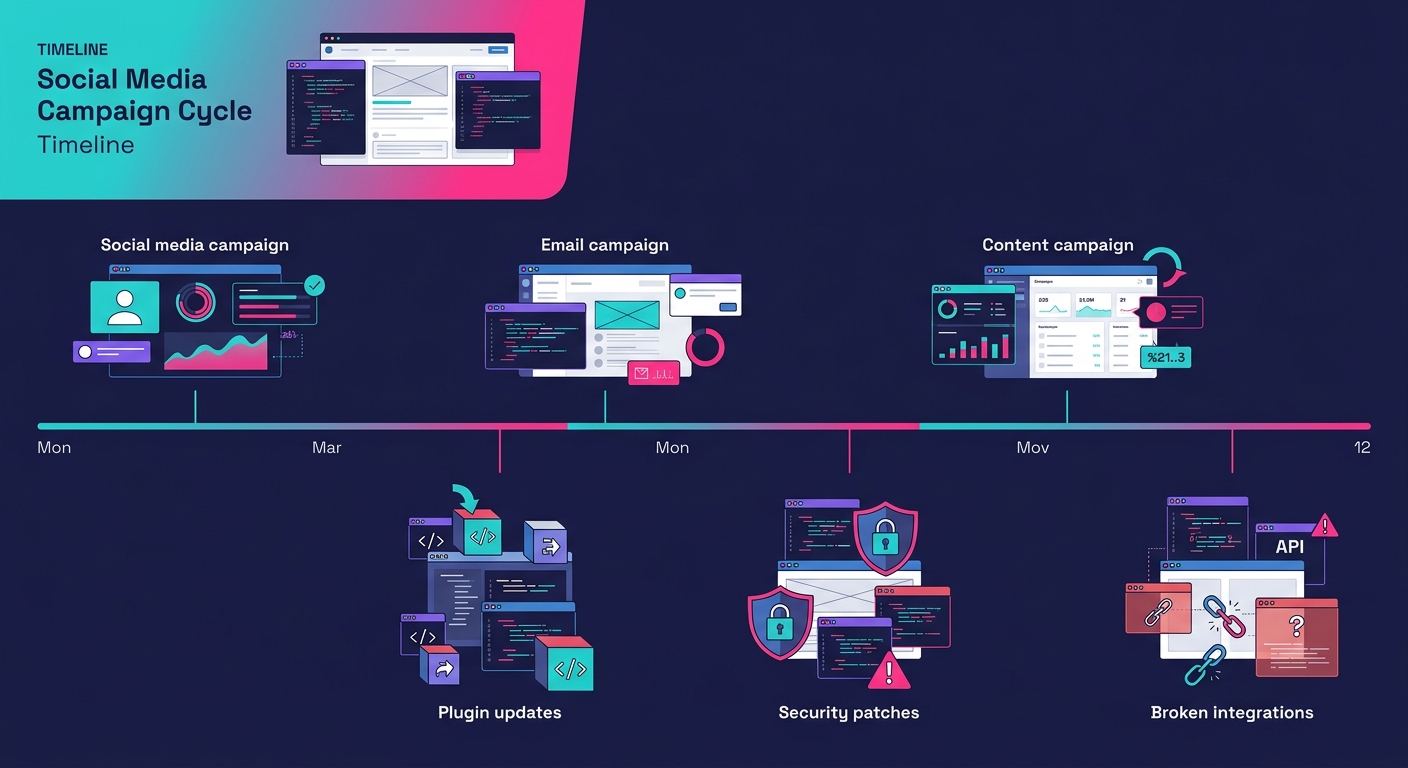
Social campaign sites have a unique decay pattern. A brand launches a holiday push in November. Your agency builds the WordPress landing pages, configures the WooCommerce discount logic, installs tracking pixels, and connects the lead capture forms. The campaign runs through December. By mid-January, the site sits idle, collecting plugin update notifications nobody acts on.
Between January and the next campaign cycle, WordPress core pushes 2 to 3 updates. WooCommerce ships patches. The forms plugin (Gravity Forms, WPForms, whatever you chose) releases security fixes. If the site runs any of the security-sensitive plugins that have seen recent exploits, those patches aren't optional. They're urgent. But nobody's watching the dashboard because the campaign ended six weeks ago.
When the next campaign spins up in March, the agency discovers a broken checkout flow, an expired SSL certificate, or a plugin conflict that cascades across the front-end. The "quick landing page refresh" turns into a two-day emergency rebuild. WP Engine's resource library on SLAs puts this bluntly: for agencies offering recurring services, "setting expectations around one of the most valuable services you provide" determines whether clients see maintenance as a cost or as protection.
The predictable recurring revenue from a retainer covers this gap. Weekly updates with staging testing, daily off-site backups, continuous uptime monitoring, and security hardening keep campaign infrastructure ready for reactivation at any point. Without it, every campaign relaunch starts with unbudgeted repair work. Agencies that track the actual hours spent on "quick fixes" between campaigns typically find they've been doing maintenance for free, subsidized by the next project's margin.
Warning: A $4,000 WordPress build quote that doesn't include post-launch support is, as DevVerx's 2026 pricing tier analysis notes, a Tier 2 build at a Tier 2 price. The maintenance plan is where Tier 3 and Tier 4 agencies differentiate.
The Forty-Eight-Hour Handoff Window
The single most important data point for agencies considering post-launch support SLAs is the conversion rate gap at project delivery versus delayed outreach. Agencies that pitch white-label WordPress maintenance at the moment of project handoff convert 40 to 60% of clients into retainer agreements. Wait 90 days and that figure drops to 10 to 15%.
The psychology here is straightforward. At handoff, the client has just seen what their site looks like, they understand how many moving parts are involved, and they're already writing checks. The cost of maintenance feels proportional to what they just invested. Three months later, the site "works fine," they've mentally closed the project budget, and a maintenance pitch feels like a new expense rather than an extension of an existing one.
For social media agencies specifically, the handoff window aligns with a natural conversation about campaign performance. You're reviewing analytics, discussing next-quarter social strategy, and presenting the finished WordPress build simultaneously. Adding a maintenance tier slides into that conversation without friction. Offering a 10 to 15% discount for signing within the first 30 days creates urgency without desperation.
If your agency lacks the internal WordPress bandwidth to fulfill retainers, a white-label partner handles the technical execution while you own the client-facing relationship. You can hire dedicated WordPress developers who work under your brand, or contract with a maintenance-focused partner. Either way, you're billing $75 to $150 per hour for development blocks at a markup, as Seahawk Media's profitability analysis documents, while the white-label team handles the actual plugin updates, backups, and security hardening.
Agencies that pitch WordPress maintenance at project handoff convert 40-60% of clients. Wait 90 days, and that rate collapses to 10-15%.
Three Tiers Mapped to Campaign Intensity
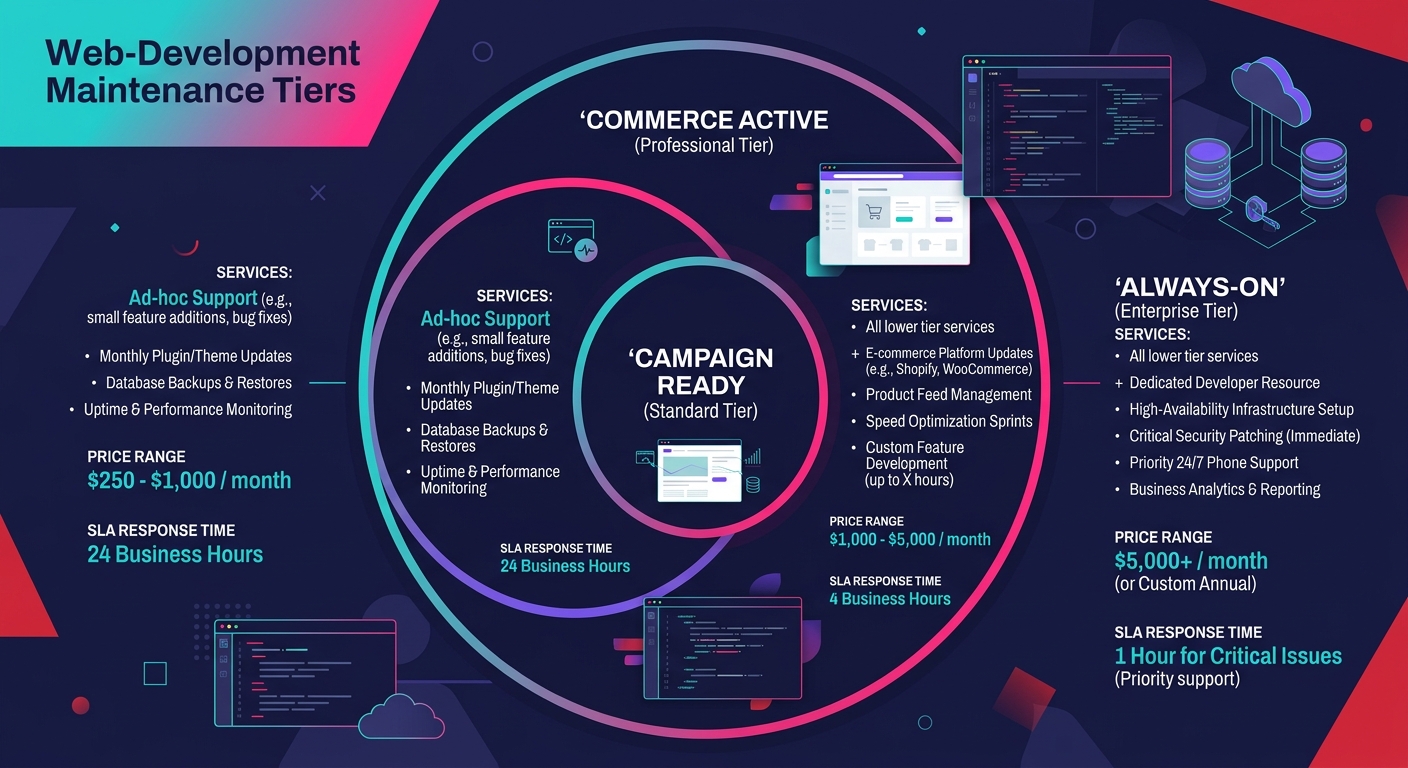
Building white-label support tiers that map to how social media clients actually use their WordPress sites produces better attach rates than generic "Basic / Pro / Enterprise" labels. The tier structure below reflects the documented pricing bands from multiple agency analyses and aligns SLA response times with campaign urgency.
| Tier | Monthly Client Price | What's Included | P1 Response (Site Down) | P2 Response (Broken Feature) | Best For |
|---|---|---|---|---|---|
| Campaign Ready | $300-$500 | Weekly core/plugin updates, daily backups, uptime monitoring, monthly performance report | 8 hours | 24 hours | Brochure sites, single landing pages |
| Commerce Active | $600-$1,000 | Everything in Campaign Ready + WooCommerce monitoring, staging environment testing, 2 hours dev time per month, security hardening | 4 hours | 12 hours | Social commerce stores, lead-gen sites with form integrations |
| Always-On | $1,200-$1,800 | Everything in Commerce Active + 5 hours dev time, priority queue, 99.9% uptime SLA, content edit hours, emergency escalation path | 4 hours | 8 hours | High-traffic campaign hubs, multi-language sites, WooCommerce stores with active ad spend |
The naming matters. "Campaign Ready" tells a social media client exactly what the tier does. It keeps their landing pages functional between campaign cycles. "Commerce Active" signals that their WooCommerce store, connected to Instagram Shopping or TikTok Shop, gets dedicated attention. "Always-On" communicates that sites receiving continuous paid traffic from social ads are never left unmonitored.
Your white-label partner's cost sits at roughly 40 to 60% of what you bill the client, leaving room for margin even after accounting for the light project management work of forwarding client requests and reviewing monthly reports. Agencies already running a structured security baseline for client sites can package those protocols directly into the Commerce Active and Always-On tiers.
E2M Solutions' pricing strategy guide for agency owners advises to "be open and honest with your pricing. Being clear about why you're charging what you are builds trust." For social media agencies, transparency about what the retainer covers (and what it doesn't) prevents the kind of scope creep that inflates costs across an entire client portfolio.
Ten Standard-Tier Clients and the Compound Effect
The Web Help Agency model reaches its most interesting point at scale. Ten clients on the Commerce Active tier at an average billing of $800 per month produces $96,000 in annual recurring revenue. Subtract white-label fulfillment costs at 40% ($38,400) and light administrative overhead, and the agency retains roughly $48,000 to $57,600 in annual margin from a service line that requires no prospecting, no proposals, and no competitive pitches.
Compare that to the build-and-move-on model. Ten $8,000 WordPress projects per year gross $80,000. After accounting for project management, client acquisition costs, revision cycles, and the inevitable scope overruns that compound across client portfolios, net margins on project work typically land between 20 and 35%. That's $16,000 to $28,000 in actual profit from a full year of project delivery.
The retainer model generated nearly double the net margin with a fraction of the operational complexity. And every month those ten clients stay on retainer, the revenue compounds without a sales cycle attached. Churn on well-delivered WordPress maintenance retainers stays below 5% annually when the work is reliable, according to the Web Help Agency analysis.
Social media agencies already possess the hardest part of this equation: the client relationship. You built the site. You're running the campaigns that send traffic to it. The conversation about maintaining the infrastructure underneath those campaigns is a natural extension of work you're already doing. The white-label partner handles the WordPress-specific execution, your team handles the client communication, and the margin accumulates month after month in a way that project revenue never will.