

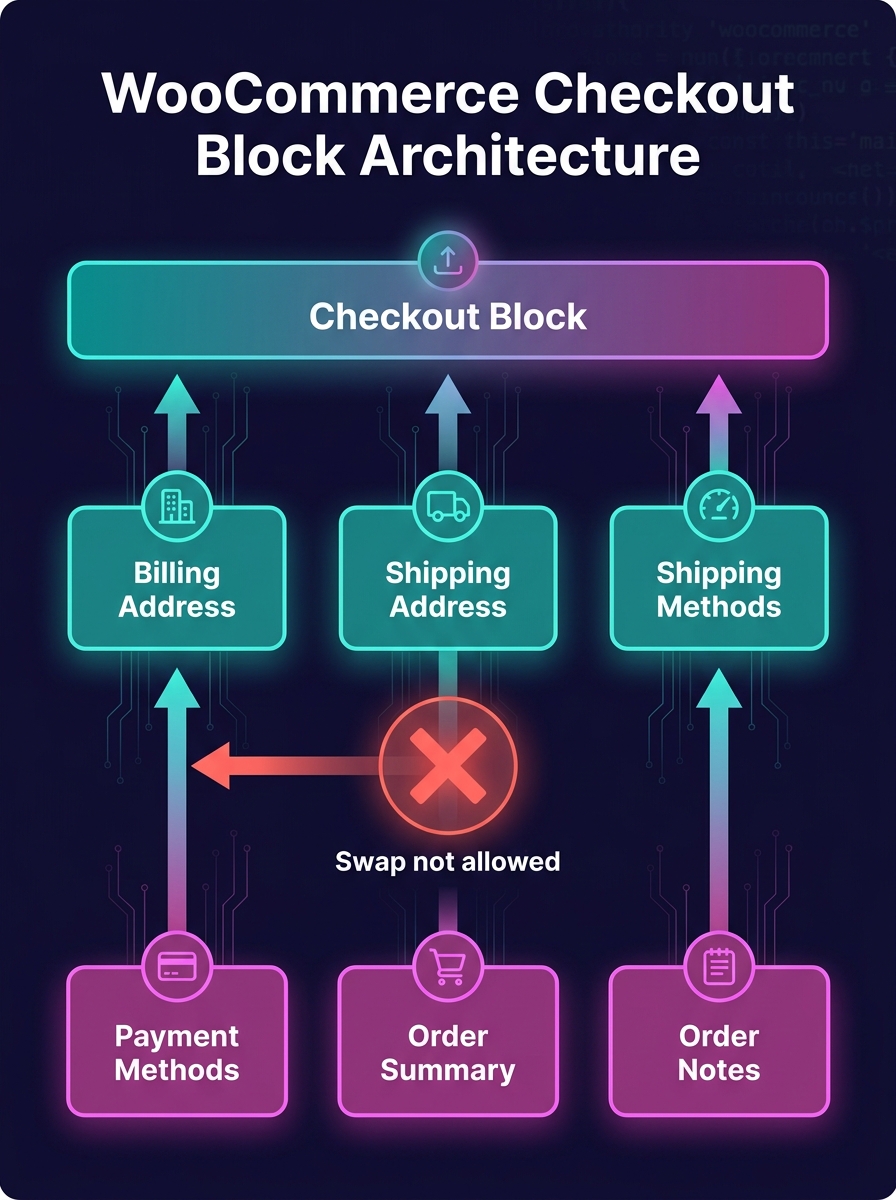
Swapping a core inner block inside WooCommerce's checkout with a custom third-party replacement is architecturally impossible. The parent block structure is explicitly non-decoupled, which means every white-label WooCommerce customization strategy built on replacing inner blocks starts from a false assumption and ends in wasted billable hours.
TL;DR: WooCommerce checkout blocks cannot be modified by replacing core inner blocks or relying on legacy PHP hooks. Agencies must use the Block Extensibility API — JavaScript filters, Slot and Fill, and REST API integration — or risk building customizations that break silently on every update. With 87% of stores still on classic checkout and a documented 27% conversion lift from blocks, the migration pressure is real.
The Non-Decoupled Architecture Problem
Why does this constraint matter so much for checkout customization WordPress workflows? Because agencies trained on classic WooCommerce assume they can decompose the checkout into modular parts and swap pieces at will. The WooCommerce developer blog states this directly: "the architecture of the parent blocks is not decoupled, and it won't be possible to take a core inner block and replace it with a third-party block." That sentence, published in a September 2023 architecture overview, defines the entire constraint surface for block-based checkout work.
Inner blocks handle rendering for individual sections — billing fields, shipping options, payment methods, order summary — and they communicate changes upward to the parent Checkout block through a strict data contract. You can't rip one out and drop in your own React component that renders the same section differently. The parent expects specific data shapes from each of its 6+ child blocks. Break that contract, and the checkout fails silently or throws errors that don't surface until a real customer hits the payment button in production.
For agencies running white-label WooCommerce builds across 10, 20, or 40 client stores, this constraint compounds fast. Every custom checkout modification that ignores the architecture creates a maintenance liability that multiplies across your portfolio. We've written about how technical debt spreads through client portfolios in agency contexts, and checkout blocks are one of the fastest-growing sources of that debt. A single incompatible customization copied across 15 stores produces 15 separate breakage points on the next WooCommerce update.
PHP Hooks Are Gone and the Replacement Is Entirely JavaScript
The WooCommerce block extensibility model abandons the PHP hook system that agencies have relied on for over a decade. If your developers are still writing functions hooked into woocommerce_checkout_fields or woocommerce_before_checkout_form and expecting them to modify block-based checkouts, those functions execute on the server but produce zero visible effect on the React-rendered frontend. The block checkout renders through React, processes through the Store API (introduced in WooCommerce 6.9), and exposes a completely separate set of JavaScript-based WooCommerce block hooks.
WooCommerce's own documentation on hook alternatives maps the old PHP filters to their block-based replacements. Changing existing core fields, removing billing or shipping address sections, applying quantity limits on cart items — all of these previously relied on PHP filters and actions. The block equivalents use 3 primary extension mechanisms: the Slot and Fill system for injecting custom UI components, JavaScript filters imported from @woocommerce/blocks-components for data modification, and checkout-specific Store API endpoints for server-side validation.
A Studio Wombat survey of 10,000 WooCommerce sites found that 87% still run the classic checkout shortcode, with only 13% having migrated to blocks. For sites launched after November 2023, when blocks became the default for new installations, adoption climbs to 18%. Those numbers tell you two things: your existing client portfolio almost certainly runs classic checkout, and your team's muscle memory is built entirely around PHP hooks. But every new WooCommerce install ships with block checkout active out of the box, and the migration pressure increases with each quarterly release.
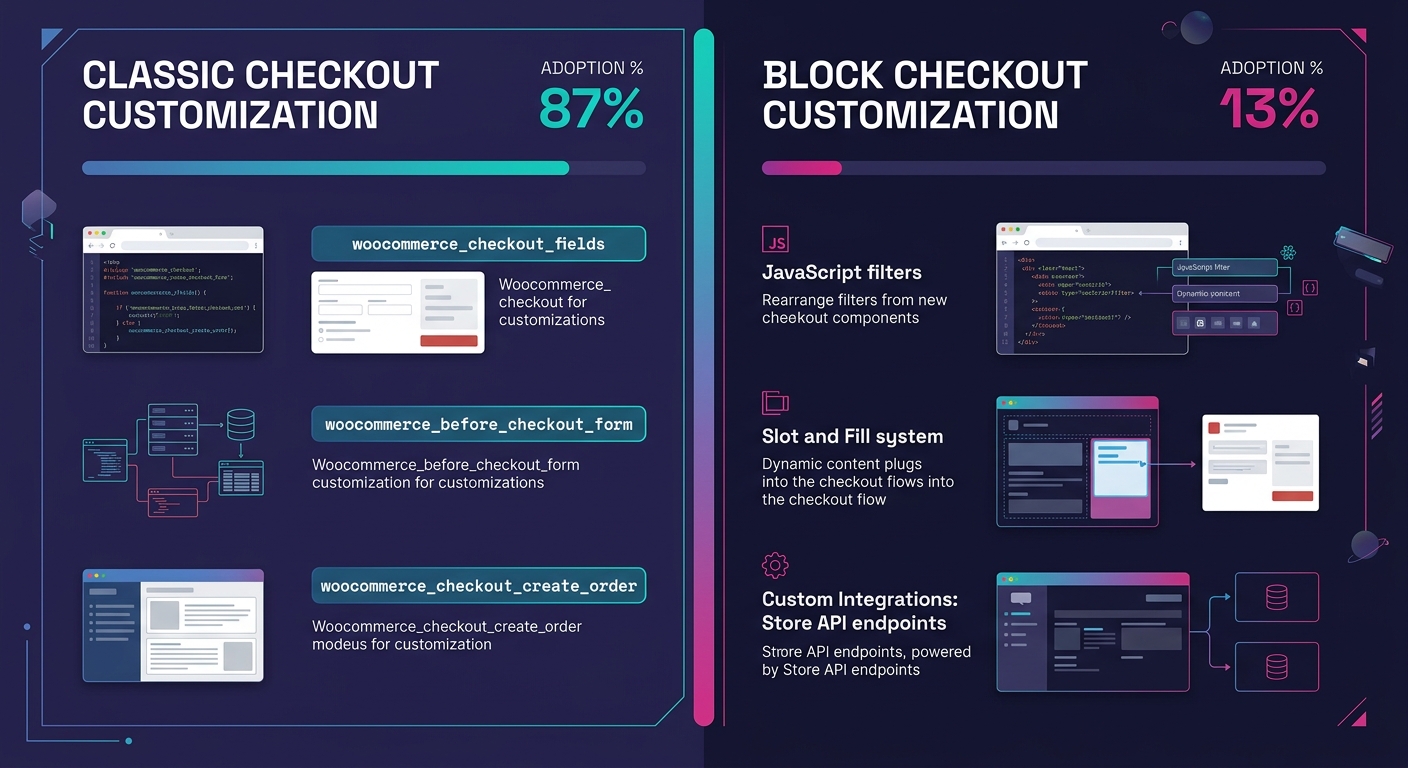
The practical gap shows up in 3 specific places:
- Field modifications: Classic checkout used the woocommerce_checkout_fields filter to add, remove, or reorder fields with a few lines of PHP. Block checkout requires registering custom fields through the extensibility API's JavaScript layer or using inner block configuration. A field change that took 15 minutes in PHP takes 2-4 hours in the block system the first time your team builds it.
- Payment gateway rendering: Classic gateways rendered through PHP templates. Block-compatible gateways register as payment method integrations through JavaScript, and gateways that haven't been updated for blocks don't appear at all. WooCommerce provides a 1-click revert to classic checkout when payment methods fail to load, but discovering this in production with a client watching destroys confidence.
- Order processing hooks: Server-side hooks like woocommerce_checkout_create_order still fire during order creation because the Store API processes orders on the backend. But anything touching the frontend — field validation, conditional field visibility, dynamic pricing display, coupon application UI — needs the JavaScript extensibility layer exclusively.
Agencies mapping out a WooCommerce migration path for client stores need to categorize every active customization against these 3 categories before switching. Over 60% of e-commerce transactions now happen on mobile, and the block checkout's dynamic update behavior — shipping calculations, promo code application, payment selection without page reloads — directly affects mobile conversion rates and Core Web Vitals scores like INP and LCP.
A field change that took 15 minutes in PHP takes 2-4 hours in the block system the first time your team builds it. The second time, it takes 30 minutes. The investment is front-loaded.
The Conversion Numbers Make Avoidance Expensive
WooCommerce's internal testing data reports a 27% increase in checkout conversions for block-based checkout compared to classic layouts. That figure reflects the cumulative effect of eliminating full page reloads during the checkout flow: shipping recalculations, coupon applications, and payment method switches all resolve dynamically within the same page context. Block checkout also ships WCAG-compliant by default, supporting screen readers and full keyboard navigation — something classic checkout required custom development to achieve.
For white-label WooCommerce agencies, this creates an uncomfortable tension. Your team's PHP expertise and existing customization codebase push you toward keeping clients on classic checkout. The 27% conversion data pushes clients toward blocks. And that 87% classic-adoption figure tells you most of the market hasn't resolved this tension either, which means agencies that build real competency in WooCommerce block extensibility and the JavaScript filter system now have a genuine competitive window before the rest of the market catches up.
The WooCommerce team has also been migrating blocks toward the WordPress Interactivity API, which their developer blog detailed in an October 2025 roadmap post. This API standardizes how blocks handle dynamic frontend behavior, replacing the ad-hoc JavaScript patterns that earlier block implementations used. For agencies building checkout customizations today, the extension points will shift again as the Interactivity API becomes the standard runtime.
Warning: If you build custom checkout extensions tightly coupled to current JavaScript filter patterns without awareness of the Interactivity API transition, you'll face a second migration within 12-18 months. Design extensions with loose coupling to the rendering layer from day one.
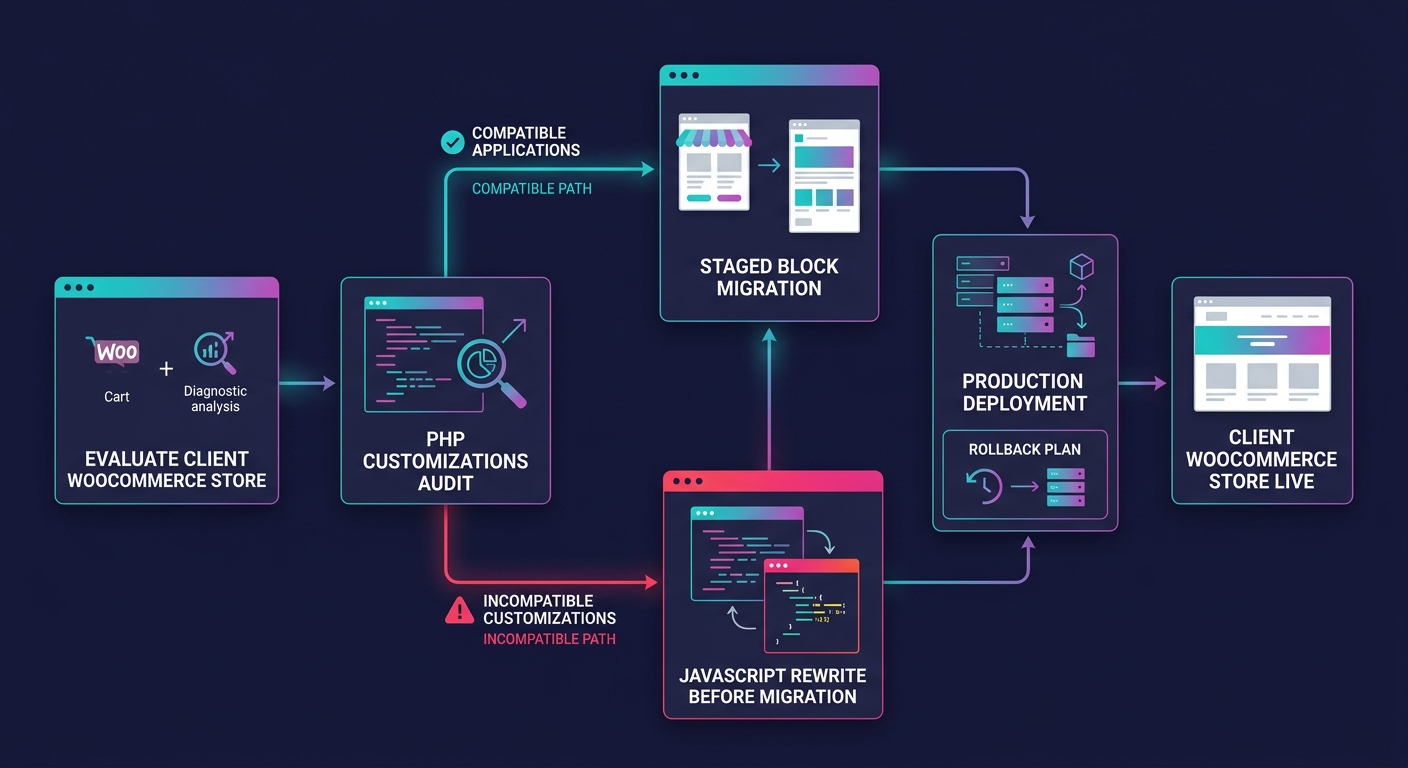
The practical path forward for agencies doing checkout customization WordPress work at scale involves 3 concrete decisions:
- Audit existing customizations by category (field modifications, payment gateway rendering, order processing) and tag each line of custom code as "block-compatible," "needs full rewrite," or "deprecated with blocks." Run this audit across every store in your portfolio, not one at a time.
- Build new checkout customizations exclusively through the Cart and Checkout extensibility API, even for clients still running classic checkout. Writing new PHP-hook customizations in 2026 produces throwaway code with a shelf life measured in quarters, not years.
- Stage every block migration in an isolated environment before touching production. We've covered why staging environment isolation matters at the multi-tenant level, and the checkout is precisely where staging catches payment gateway incompatibilities that local testing misses entirely.
If your team doesn't have deep experience building React-based WordPress block extensions, bringing in WooCommerce developers with block architecture experience for the initial setup prevents the false-start customizations that eat margins. The learning curve from PHP hooks to block extensibility is steeper than the documentation suggests, and the cost of getting the architecture wrong lands squarely on the client's checkout conversion rate.
The Claim, Revisited
The non-decoupled architecture of WooCommerce checkout blocks remains the governing constraint for every customization decision an agency makes. You cannot replace inner blocks. You cannot rely on PHP hooks for frontend behavior. You can extend through designated JavaScript extension points, Slot and Fill injection, and Store API integrations. Everything outside those 3 mechanisms is a workaround with an expiration date printed on the next WooCommerce release.
Agencies holding the feature-toggle line on block adoption are buying time, and the 87% classic-checkout figure shows that most of the market is doing the same thing. But the combination of 27% higher conversions, default-on status for new installs, and the Interactivity API transition means that timeline is compressing quarter by quarter. The agencies that invest in WooCommerce block extensibility now will own checkout work for the next product cycle. The ones writing PHP hooks for block checkouts will keep discovering, store by store and client by client, that their code produces nothing visible on the page.