

WordPress hosting infrastructure automation reduced maintenance hours by more than 30 percent at one digital agency while allowing another to grow client count by 60 percent without adding technical staff, according to case studies published Monday by Kinsta.
The operational shift stems from containerized hosting environments that execute recurring tasks—PHP process recovery, database optimization, security scanning, and uptime monitoring—without requiring manual intervention from agency teams. Kinsta's analysis, published April 21, examines how automation layers change the per-site cost structure for agencies managing dozens or hundreds of WordPress installations.
Three Automation Layers Replace Manual Workflows
Kinsta's platform operates WordPress sites in isolated Linux containers, each running its own MySQL instance. This architecture enables infrastructure-level automation that processes maintenance, restarts, and optimizations on a per-site basis without affecting other sites in an agency's portfolio, the company's documentation shows.
The platform's self-healing PHP monitoring system detects failed PHP processes and restarts them automatically. Uptime checks run every three minutes across all sites. Automatic MySQL optimization routines execute weekly, adjusting database settings based on site-specific workload patterns.
Security operations run continuously through Cloudflare's enterprise firewall and DDoS protection, filtering traffic before it reaches individual containers. Malware scanning operates across the platform independent of agency action.
Case Study: 250 Hours Redirected Annually
Adapting Social, managing more than 50 Kinsta-hosted sites, cut weekly maintenance time from 15 hours to under 10 hours by consolidating operations through MyKinsta's bulk management interface. The reduction amounts to more than 250 hours annually that the agency reallocated to client work and business development, according to the case study.
Straight Out Digital, overseeing a portfolio exceeding 400 sites, relies on automated error alerts and vulnerability notifications to identify issues without manual scanning. "The automated error and vulnerability email alerts provide a layer of security," the agency reported in materials cited by Kinsta.
Local Leap Marketing expanded its client base 60 percent after migrating to the platform, achieving the growth without adding technical headcount. The company attributed the capacity increase to infrastructure automation eliminating per-site maintenance tasks.
Manual Operations Carry Hidden Opportunity Cost
Traditional WordPress management allocates staff time to plugin updates across production and staging environments, security alert review, backup verification, and cache clearing after deployments. A two-hour plugin update cycle across 30 sites consumes billable hours without advancing client projects or creating revenue opportunities, Kinsta's analysis notes.
Each new hire incurs fixed costs for salary, onboarding, tooling access, and management overhead before touching client work. Scaling through additional headcount maintains a linear cost structure: two developers managing 40 sites manually costs the same per site as one developer managing 20.
Automated workflows operate differently. A process running across 20 sites carries nearly identical marginal cost when expanded to 200 sites, changing the economics of portfolio growth.
Bulk Operations Centralize Routine Tasks
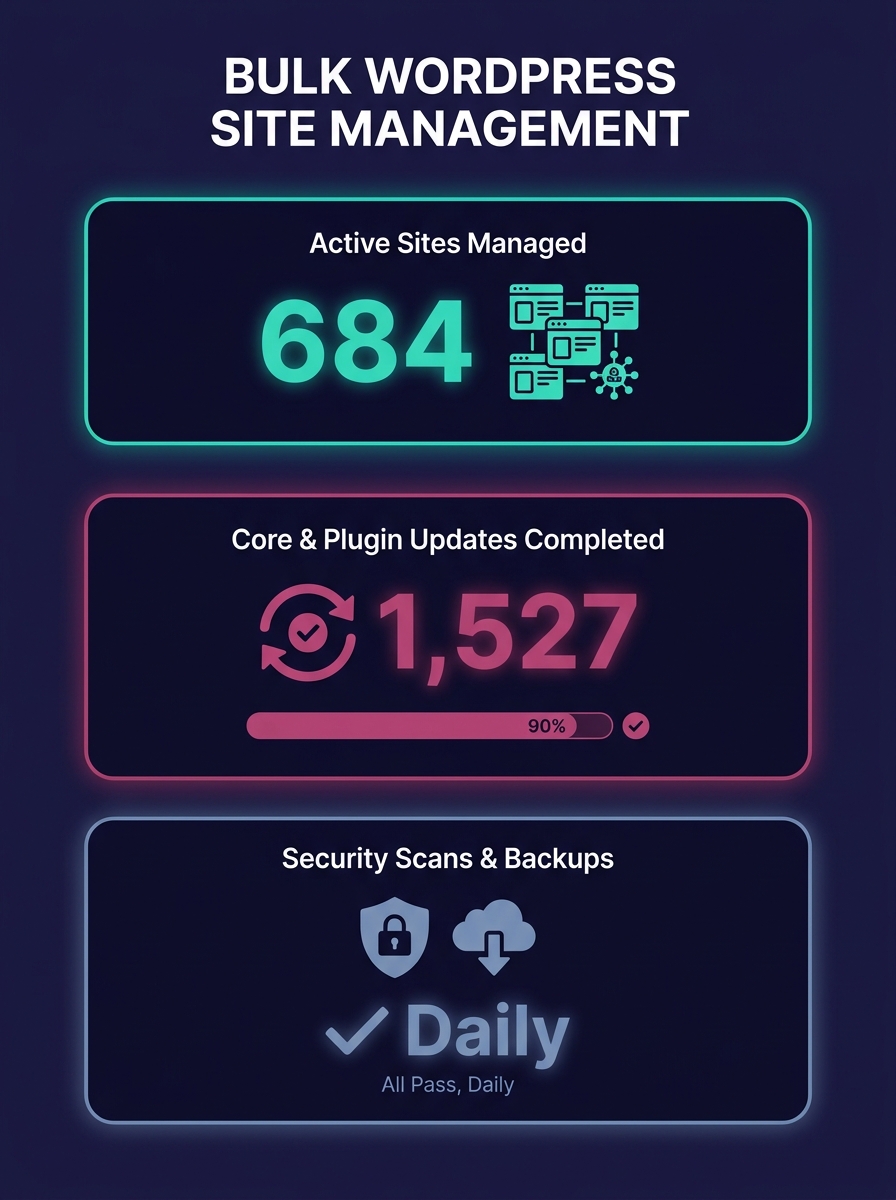
MyKinsta's dashboard enables agencies to execute backup restoration, plugin updates, PHP version changes, and SSL management across multiple sites simultaneously through bulk selection. The centralized interface removes the need to log into individual WordPress admin panels for recurring operational work.
The platform's three-level automation framework spans hosting infrastructure, platform tooling, and custom scripting connections to external systems. Each layer eliminates a distinct category of manual intervention, with compounding benefits when agencies implement all three.
Context and Outlook
The shift toward infrastructure automation addresses a scaling constraint common to agency WordPress management: revenue growth tied directly to operational load. Manual processes create consistency risks—skipped updates, stale caches, outdated PHP versions—that multiply across larger portfolios regardless of team size.
For agencies evaluating white-label partnerships or capacity expansion strategies, the case studies illustrate how automation changes the calculus around headcount versus tooling investment. The 60 percent growth at Local Leap Marketing without technical hires demonstrates capacity unlocked by removing recurring manual tasks from developer workflows. Adapting Social's 250-hour annual recapture shows the scale of time reallocation possible when bulk operations replace individual site administration.
Infrastructure automation doesn't eliminate agency technical work—it redirects staff hours from repetitive maintenance toward client-specific development, new business integration, and project delivery that drives revenue. The economic model favors agencies willing to standardize on platforms that automate the infrastructure and platform layers, reserving developer time for work that requires human judgment and client context.