

Every agency outsourcing model has a load-bearing limit, and most WordPress shops discover theirs somewhere between their eighth and fifteenth concurrent WooCommerce project. The breakdown doesn't arrive as a dramatic failure. It shows up as a missed staging deployment on a Tuesday, a plugin conflict nobody caught, a client email unanswered for three days because two developers each assumed the other one owned it.
The pattern is reliable enough to be predictable. An agency adds freelancers or white-label developers to meet e-commerce demand. The work gets done. Then the agency wins more clients, adds more developers, and suddenly the same approach that delivered at five projects produces chaos at twelve. The model didn't change. The load did. And because nobody redesigned the underlying system to absorb that load, the system cracked.
This is a structural problem, and it requires structural thinking to fix.
The Ceiling Nobody Plans For
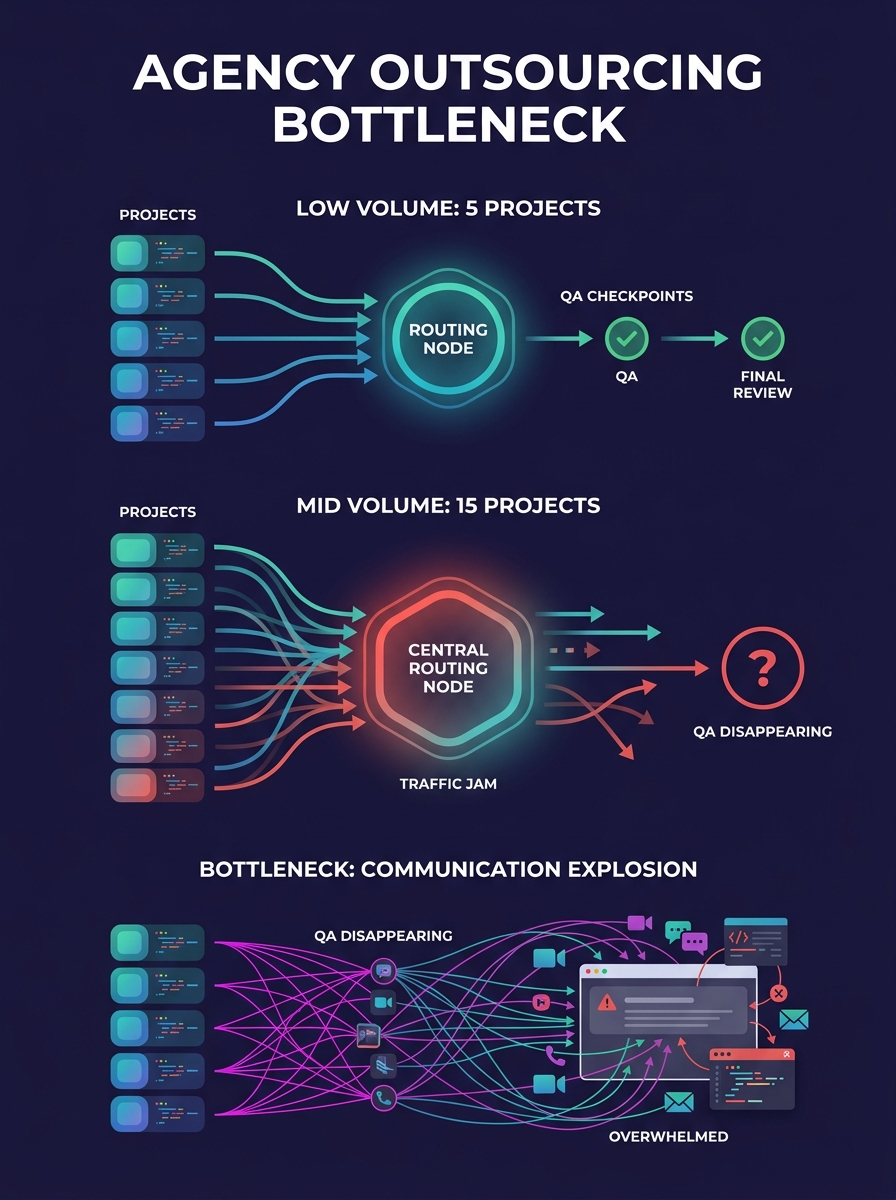
When an agency starts outsourcing WordPress and WooCommerce work, the owner or project lead typically acts as the central routing node. Every task flows through one person. Client requests go in, developer assignments go out, QA happens in someone's head, and deliverables ship through a combination of Slack messages and email threads.
At three or four active projects, this works fine. The routing node has enough context to catch conflicts, enough bandwidth to review work, and enough short-term memory to track which developer is handling which store build.
At ten projects, that same person becomes the bottleneck. They can't review every WooCommerce checkout flow, confirm every ACF field configuration, and manage client expectations simultaneously. So they start skipping steps. QA gets lighter. Communication gets slower. The outsourced developers, who were never given direct access to client context, start making assumptions. Those assumptions turn into rework.
Growth Rocket's research into outsourced marketing failures confirms what you'd expect: these failures are systemic, not accidental. They trace back to weak onboarding, misaligned KPIs, and missing quality control layers. The developers aren't the problem. The architecture around them is.
Why Adding Developers Makes It Worse
The instinct when work piles up is to add more people. An agency wins a large e-commerce migration, so they bring on two more white-label WordPress developers. Capacity increases. But so does coordination overhead, because every new developer needs onboarding context, environment access, coding standards documentation, and a clear understanding of which Slack channel to use for which project.
Without a system to handle that onboarding, each new developer actually reduces the effective output of the team for the first two to four weeks. The project lead spends time ramping them up instead of managing deliverables. The existing developers lose momentum answering questions. If you've run into this pattern before, the common pitfalls of white-label WordPress services tend to cluster around exactly this kind of coordination failure.
GoWP's scaling guide puts it well: scaling your agency means building systems that can be replicated for efficiency while staying flexible enough to adapt. The emphasis on replicable systems is the key phrase. If your onboarding process for a new developer lives entirely in someone's head, it can't be replicated. It can only be performed, one painful session at a time.
Systems Thinking Applied to WordPress Team Scaling
Systems thinking, borrowed from engineering and organizational theory, asks you to stop looking at individual components and start examining the connections between them. For an agency running outsourced e-commerce development, that means mapping four things:
- Inputs: Client requirements, design assets, brand guidelines, WooCommerce-specific configurations (payment gateways, shipping rules, tax logic)
- Processes: How those inputs get translated into developer tasks, who assigns them, what tools carry the task from assignment to completion
- Feedback loops: Where quality gets checked, how client feedback re-enters the workflow, what happens when a deliverable fails review
- Constraints: Time zones, tool access, security permissions, developer specialization limits
Most agencies have strong opinions about their inputs (detailed briefs, thorough discovery calls) and reasonable processes (Asana boards, Git repos, staging environments). Where they almost universally fall short is feedback loops and constraints.
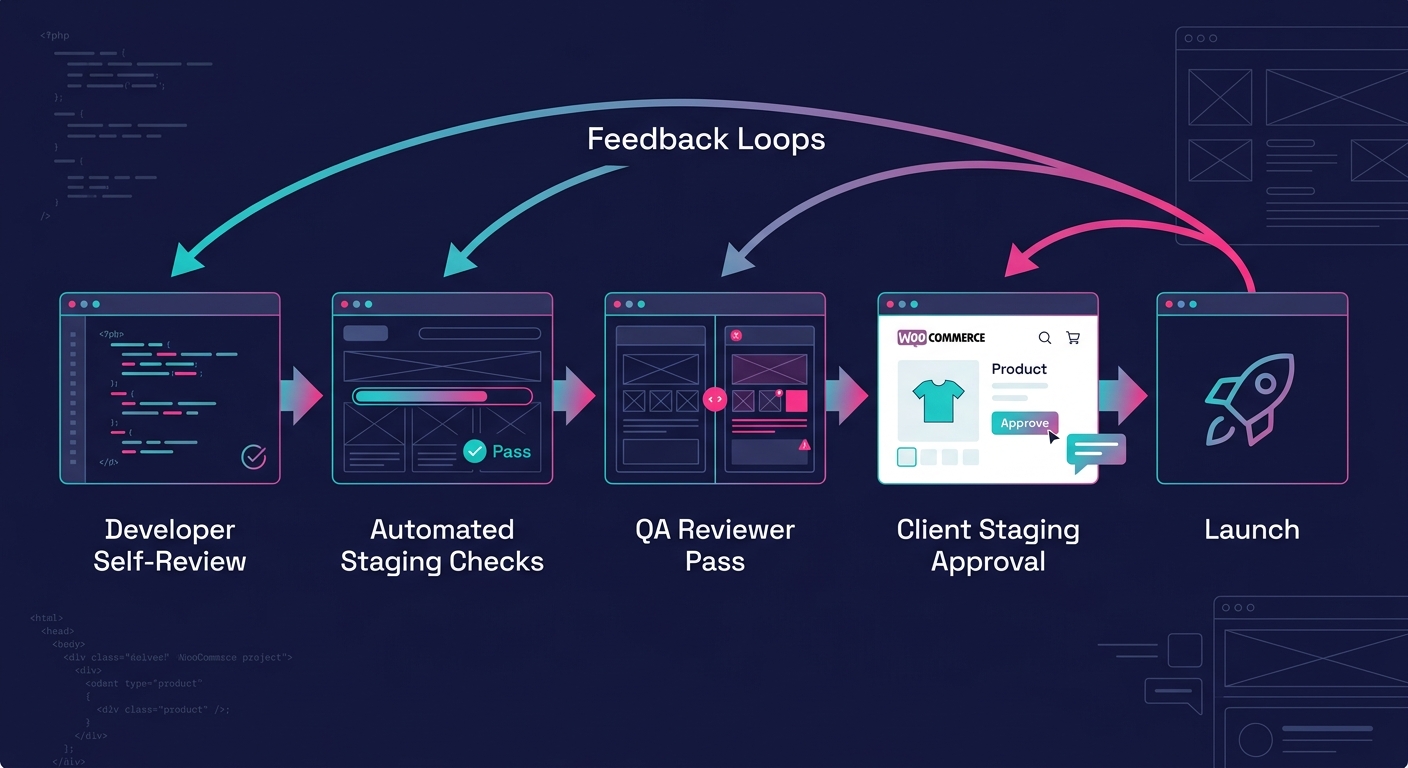
A feedback loop, in practical terms, is the mechanism that tells you something went wrong before the client tells you. It's a staging review checklist that a QA lead runs before any WooCommerce store goes to the client for approval. It's a weekly sync where the project lead reviews velocity against estimates. It's a post-launch retrospective that captures what took longer than expected and why.
Without these loops, problems compound silently. A developer builds a custom checkout flow using a deprecated WooCommerce hook. Nobody catches it during development. The client approves the staging site without deep testing. The store launches. Three weeks later, a WooCommerce update breaks the checkout. Now you've got a live e-commerce site losing orders, and the fix requires understanding decisions that were made weeks ago by a developer who may have already moved on to another project.
Outsourcing failures are systemic, not accidental. They stem from weak onboarding, misaligned KPIs, and absent quality control layers.
Building the Feedback Architecture
Here's where the practical work happens. If you're running white-label talent management across multiple WooCommerce builds, you need feedback architecture that operates independently of any single person's attention.
Automated Environment Checks
Your staging environments should flag issues before humans review them. Tools like WP Umbrella can monitor uptime and performance across multiple client sites. Git-based deployment workflows should include pre-merge checks that validate plugin compatibility. If you're building scalable white-label WordPress architecture, automated checks are the foundation everything else sits on.
Structured QA Gates
Every deliverable should pass through at least two review layers before a client sees it. The developer's own review is one. A separate QA pass by someone who didn't write the code is two. For e-commerce projects, that second pass needs to include transaction testing: does the checkout complete, does the payment gateway process correctly in test mode, do shipping calculations resolve for the client's actual shipping zones?
Asynchronous Communication Protocols
Email works for credentials and long-form updates. It's terrible for task management. Project management tools like Asana, Trello, Monday, or ClickUp give you task-level visibility that email threads can't. But the tool doesn't matter as much as the protocol around it. Define which updates go in the PM tool, which go in Slack, and which warrant a video call. Write it down. Share it with every new developer on day one. This kind of onboarding clarity is something we've covered in depth when looking at how to approach the outsourcing process from the ground up.
The Constraint Map for E-Commerce Teams
Constraints are the boundaries your system operates within, and ignoring them is how agencies end up with white-label developers pushing code directly to production at 2 AM in a time zone nobody's monitoring.
For WordPress team scaling on e-commerce projects specifically, the critical constraints include:
- Security access tiers: Not every developer needs wp-admin access to every client site. Segment permissions based on project assignment. Use role-based access through tools that let you control what each team member can touch.
- Specialization boundaries: A developer who's excellent at custom Elementor layouts may not be the right person to debug a WooCommerce REST API integration for a headless storefront. Know what your outsourced team members are good at, and route work accordingly. Treating all developers as interchangeable is one of the fastest ways to erode quality.
- Time zone coverage: If your clients expect same-day responses and your developers are eight hours ahead, you need overlap windows defined in your project schedule. Distributed teams like DevriX, which operates across three continents, make this work by designing explicit overlap periods rather than hoping for ad-hoc availability.
- Client-facing boundaries: Decide early whether outsourced developers ever communicate directly with clients or whether all communication routes through your team. Both models work. Ambiguity between them doesn't.
Warning: If you haven't documented your constraint map, you don't have one. Undocumented constraints are just accidents waiting to surface during your busiest month.
When the Model Outgrows Its Design
There's a moment in every agency's growth where the current outsourcing arrangement stops being a solution and starts being the problem. The signals are consistent: rework rates climb above 15-20%, client satisfaction scores dip without a clear cause, and your project lead is working nights to hold everything together.
This is the point where most agencies make one of two mistakes. They either throw more bodies at the problem (which compounds coordination costs) or they pull everything back in-house (which kills their margins and limits their capacity).
The third option is to redesign the system. That means auditing your entire delivery pipeline, from the moment a new WooCommerce project enters your queue to the moment it launches and enters maintenance. Where are the handoff points? Who owns each transition? What information gets lost between stages? The ticket-based model breakdown we've written about before is often the first crack that appears, because ticket systems treat each task as independent when the tasks are actually deeply interdependent.
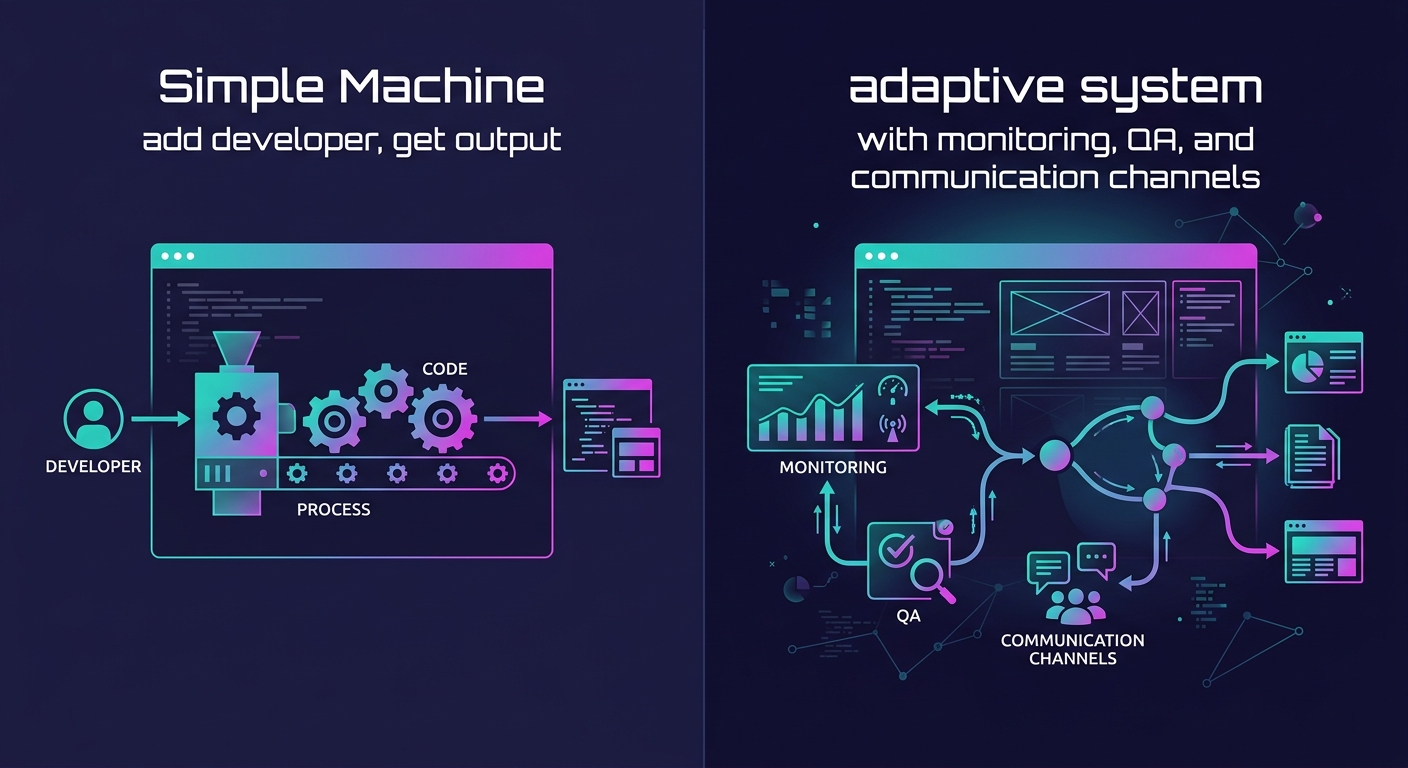
Systems thinking for agencies means accepting that your outsourcing model is an organism, not a machine. Machines scale linearly: add a gear, get more output. Organisms scale through adaptation: the circulatory system that works for a mouse doesn't work for an elephant. The underlying architecture has to change as the organism grows.
Remaining Questions
Systems thinking gives you a framework, but it doesn't give you a finished blueprint. Several tensions remain unresolved for agencies scaling their WordPress and WooCommerce outsourcing:
How much process is too much? Adding QA gates and communication protocols costs time. For a small e-commerce build (a five-page WooCommerce store with standard shipping and Stripe), three layers of review might be overkill. The system needs to scale down gracefully for small projects, not only up for large ones.
When should you move from freelancers to a dedicated white-label partner? The crossover point depends on your volume, but agencies handling more than six concurrent e-commerce projects typically find that a dedicated partnership offers more consistency than managing a rotating pool of independent contractors. Choosing the right white-label WordPress development partner becomes a strategic decision rather than a procurement task once you're at that scale.
Can AI tooling reduce coordination overhead enough to change the equation? Automated code review, AI-assisted QA, and intelligent task routing are all maturing. Whether they reduce the coordination tax enough to push the scaling ceiling higher is still an open question, and one that agencies will answer with real data over the next two years.
What's clear is that the old model of "hire more developers and hope the project lead can keep up" has a defined expiration date. The agencies that thrive at scale are the ones that build the connective tissue between their people before the strain of growth tears it.