

WordPress agencies don't fire their outsourced development teams over code quality. They fire them over silence — the three-day gap between submitting a ticket and getting a response that doesn't answer the original question. The pattern repeats across agencies of every size: you pick a white-label partner or offshore team, set up a shared project board in Jira or ClickUp or Asana, start filing tickets, and within six weeks the relationship feels adversarial. Deadlines slip. Revisions multiply. Your project manager spends more time writing clarifications than doing actual project management.
The structural failure here is almost always the same. Agencies default to ticket queues as their primary communication layer with outsourced teams, treating each request as a discrete transaction. But WordPress development — especially client-facing builds with shifting scope, brand guidelines, and live-site constraints — requires continuous feedback. These are fundamentally different communication architectures, and confusing them is why so many agency outsourcing workflows collapse before they produce a single satisfactory deliverable.
Here are six rules for building remote team collaboration models that survive contact with real client work.
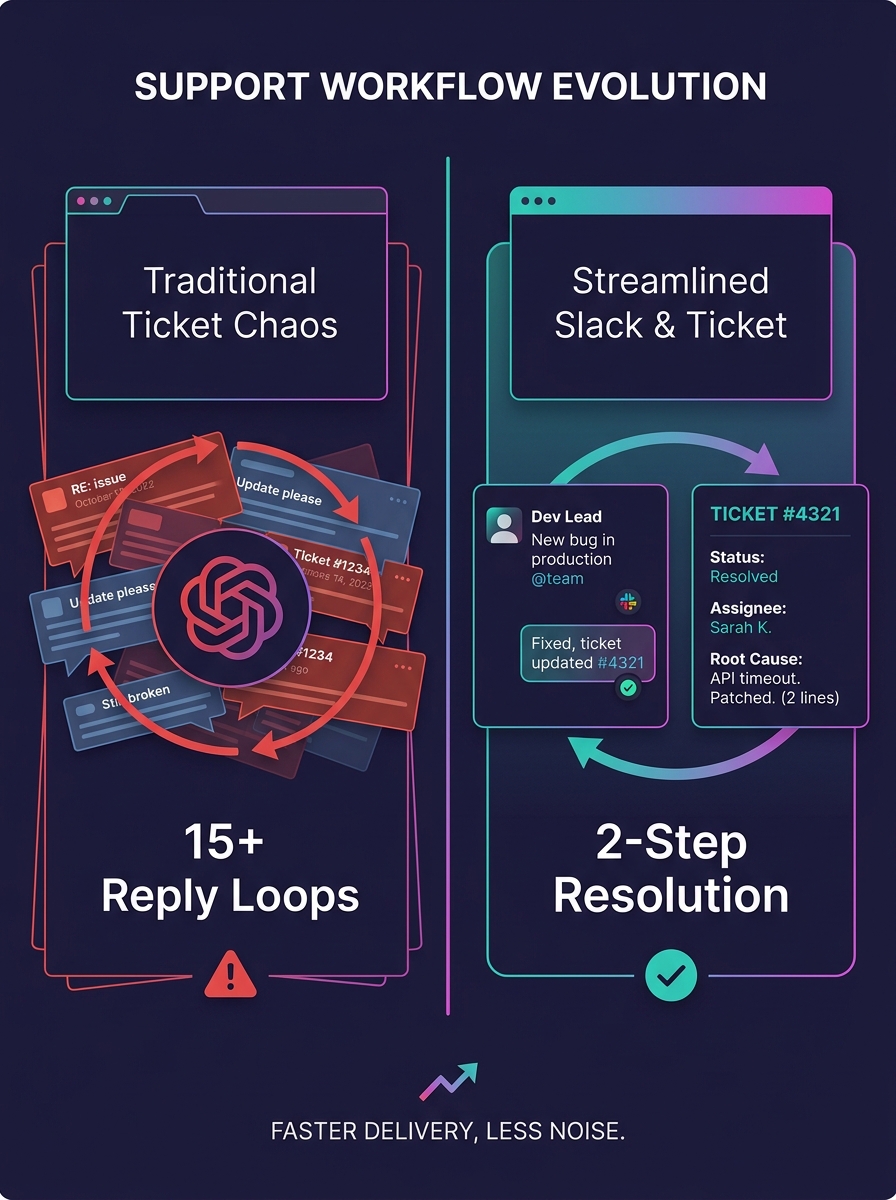
Treat every ticket as a record, never as a conversation
Tickets are documentation. They exist so that six months from now, someone can look up what was requested, what was delivered, and why a specific decision was made. The moment you start using the comment thread on a Jira ticket as your primary back-and-forth with an outsourced developer, you've turned a filing system into a chat room — and a bad one, because ticket comment interfaces are designed for status updates, not nuanced discussion.
When a developer at ExperiencedDevs on Reddit observed that "people complain about the process or just do what's in the ticket — even if it doesn't make sense — rather than thinking about the actual problem," the complaint wasn't about tickets themselves. The complaint was about teams that had no communication channel outside the ticket system, so the ticket became the only place to ask questions, raise concerns, or flag ambiguity.
Your ticket queue should capture the what and the outcome. The why and the how belong in Slack threads, Loom recordings, or scheduled calls. If your outsourced team only ever talks to you through ticket comments, you've built a relationship with no room for judgment, only compliance.
Keep QA and feature work in separate queues
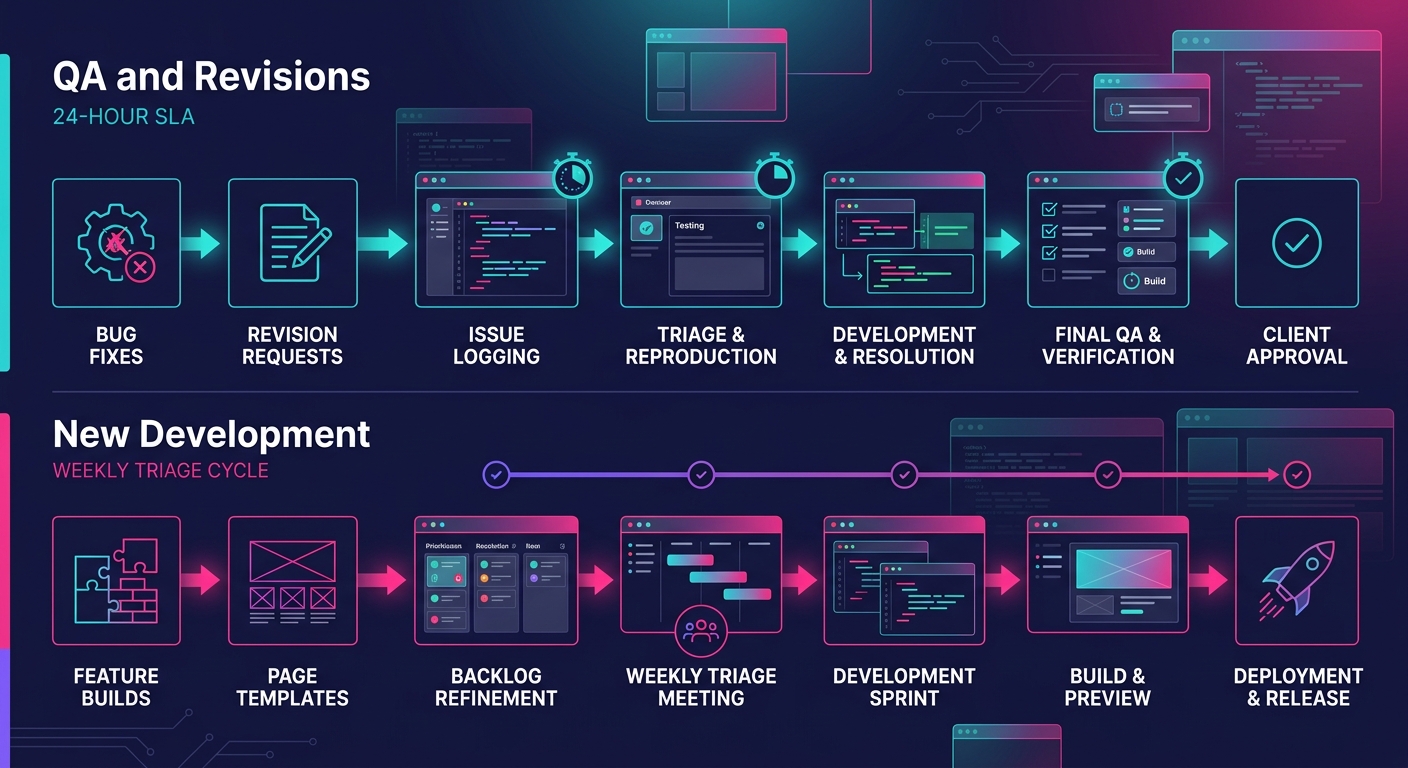
This is the fastest structural fix you can make to any outsourced WordPress engagement. When bug reports, revision requests, and new feature tickets all live in the same backlog, priority becomes invisible. A broken WooCommerce checkout on a live client site sits in the same list as "update footer copyright year" and "build new landing page template." The outsourced team picks what's easiest or what came in most recently, not what matters most.
Create two boards, or at minimum two clearly labeled swimlanes. One handles defects and revisions on existing work. The other handles new development. Assign different SLAs to each. QA items on live sites get a 24-hour response window. New feature tickets get triaged weekly. This separation alone eliminates the single biggest source of frustration in ticket-based development limitations: the feeling that urgent fixes are competing with planned work and losing.
We've written about why ticket-based models break down at scale in detail, and the root cause is almost always this kind of structural ambiguity in how work gets categorized and prioritized.
Demand context on every ticket — screenshots, URLs, environment details
A ticket that says "the header looks wrong on mobile" is useless to an outsourced developer who doesn't have access to your staging environment, doesn't know which browser the client was using, and can't see the Figma file your designer referenced. The instinct to write tickets quickly — because you're busy, because the client is breathing down your neck — is the single largest driver of revision cycles in outsourced WordPress work.
Enforce a ticket template. Every submission should include the page URL (staging or production), a screenshot or screen recording, the expected behavior described in plain language, and a link to the relevant design file. For WordPress-specific work, include the active theme, the page builder in use (Elementor, Divi, Oxygen, or custom blocks), and whether the issue involves a plugin conflict.
As one research source on hiring remote developers put it plainly: "Ambiguous expectations kill remote team performance." Set measurable targets and specific context before the developer writes a single line of code. This applies to every ticket, not just the onboarding brief. The five minutes you spend adding a Loom video to a ticket saves two days of back-and-forth revision.
Tip: If you're using ClickUp or Jira, build a required-fields template for your outsourced team's intake board. Block ticket submission unless the URL, screenshot, and expected-behavior fields are filled in. This one automation cuts clarification requests by roughly half.
Give your outsourced developers a weekly demo slot
The single most effective structure for maintaining alignment with an external WordPress team is a 30-minute weekly call where the developers show their work in progress. Not a status update meeting where a project manager reads ticket titles aloud. A demo. Screen shared, browser open, clicking through the actual build.
This accomplishes three things that ticket queues never will. First, you catch problems at 40% completion instead of 100%, which means fixes are cheap. Second, your team develops a shared understanding of quality standards that no amount of written documentation can convey. When your creative director sees a developer's spacing choices live on screen and says "tighten that up by about 8px," that interaction calibrates future work in ways a Figma redline never does. Third, the outsourced team starts to feel like part of your operation rather than a vendor processing orders.
A 30-minute weekly demo catches problems at 40% completion instead of 100%, which makes fixes cheap and keeps both teams calibrated on quality standards.
The demo slot is the highest-ROI investment in any outsourced engagement. It's where scalable feedback systems actually get built — not through tooling, but through repeated, low-stakes exposure to each other's work and judgment. If you've been building an offshore team without quality control mechanisms, this is the first mechanism to add.
Set async feedback deadlines that everyone can see
Time zones make synchronous communication expensive. If your outsourced team is in Southeast Asia and your agency is on the US East Coast, the overlap window is maybe two hours. You can't solve every question in real time, so you need structured asynchronous feedback with explicit deadlines.
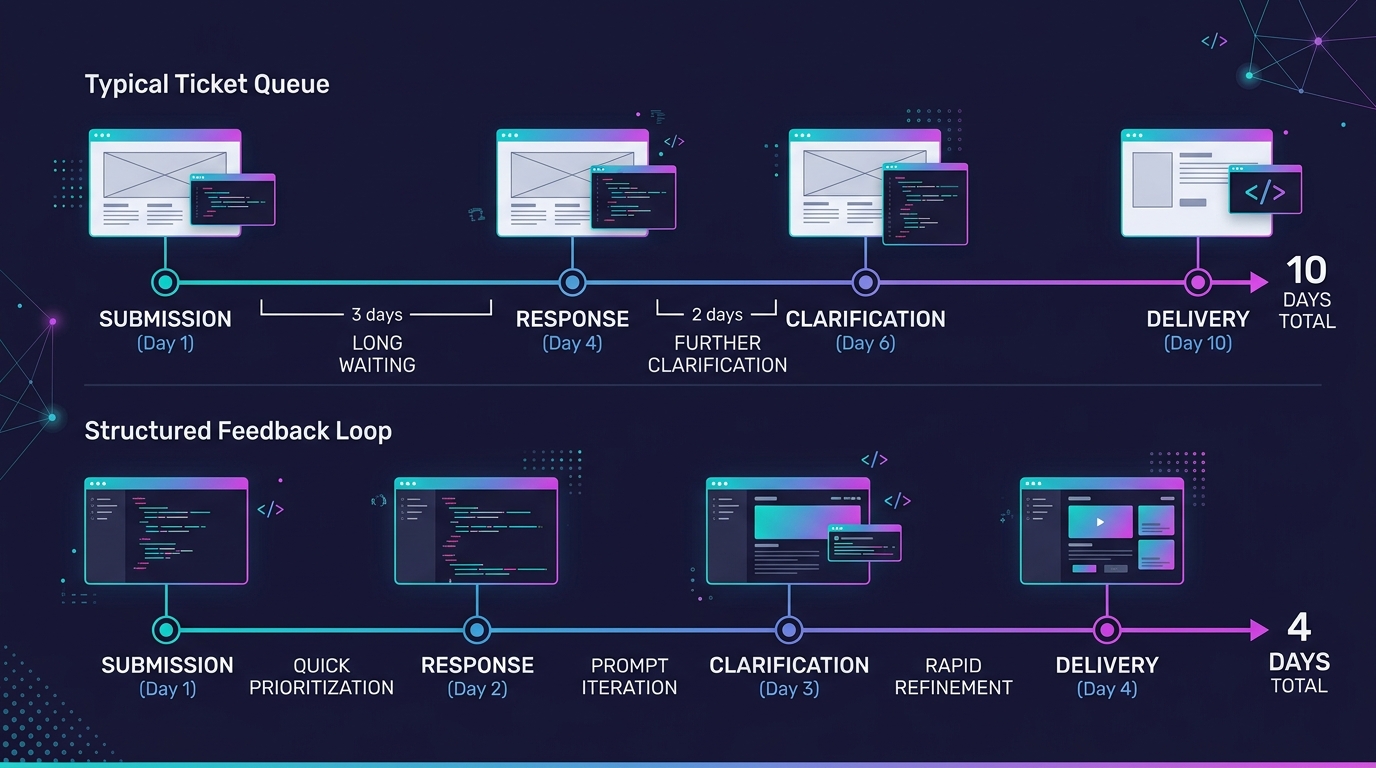
The rule is simple: every piece of work submitted for review gets feedback within one business day. Not "when we get to it." Not "by end of week." One business day. And that commitment runs in both directions — when you send a revision request, the outsourced team acknowledges it within the same window.
This sounds obvious. Almost nobody does it. Agencies treat feedback turnaround as a soft commitment, and outsourced teams mirror that behavior. The result is the familiar drift: a task that should take three days stretches to ten because each feedback cycle includes 48 hours of waiting.
Put the deadlines in your project management tool. Make them visible. If you're using Slack, pin a shared expectations doc in the project channel. According to research comparing in-house and outsourced conversion teams, quality "depends on process discipline, QA ownership, and review standards rather than team location." Process discipline means deadlines that are enforced, not suggested.
Run retrospectives with your external team, not about them
If your agency runs sprint retrospectives or monthly reviews, and your outsourced development team isn't in the room, you're building a process designed to complain about them rather than improve with them. This is a predictable failure mode in remote team collaboration models. The internal team vents about the external team's performance, builds workarounds, and never addresses root causes because the people who could fix those causes aren't present.
Invite your outsourced developers (or their team lead, at minimum) to a biweekly or monthly retrospective. Use a simple format: what's working, what's not, what should we change. Let the external team speak first. You'll hear things like "we don't get feedback until Thursday so we can't start the next sprint on time" or "the design files we receive don't include mobile breakpoints." These are solvable problems that stay invisible when the retrospective is internal-only.
This practice also surfaces the kind of systemic issues we've covered in how outsourcing models break at scale. When your external team has a voice in process improvement, they're invested in making the structure work rather than waiting for the next round of criticism to arrive via ticket comment.
When These Rules Collide With Reality
Every agency has weeks where the demo gets skipped, the ticket templates get ignored, and feedback takes three days instead of one. A new client onboards with an aggressive deadline, or a developer goes on vacation, or a production emergency eats the entire QA queue. The system degrades.
The question isn't whether that happens. The question is whether you have a named recovery path. When the process breaks, who calls the meeting to reset expectations? If nobody owns that responsibility, the rules above will hold for six weeks and then quietly dissolve, and you'll be back to filing tickets into the void.
Assign one person on your side — your project manager, your ops lead, whoever manages the web design outsourcing process day-to-day — as the owner of the feedback structure itself. Their job isn't to manage tickets. Their job is to make sure the system around the tickets keeps functioning: that demos happen, that feedback deadlines hold, that retrospectives produce actual changes. When the structure survives its first real stress test, you'll know the outsourced relationship has a chance of lasting. Until then, you're running on goodwill, and goodwill doesn't scale.