

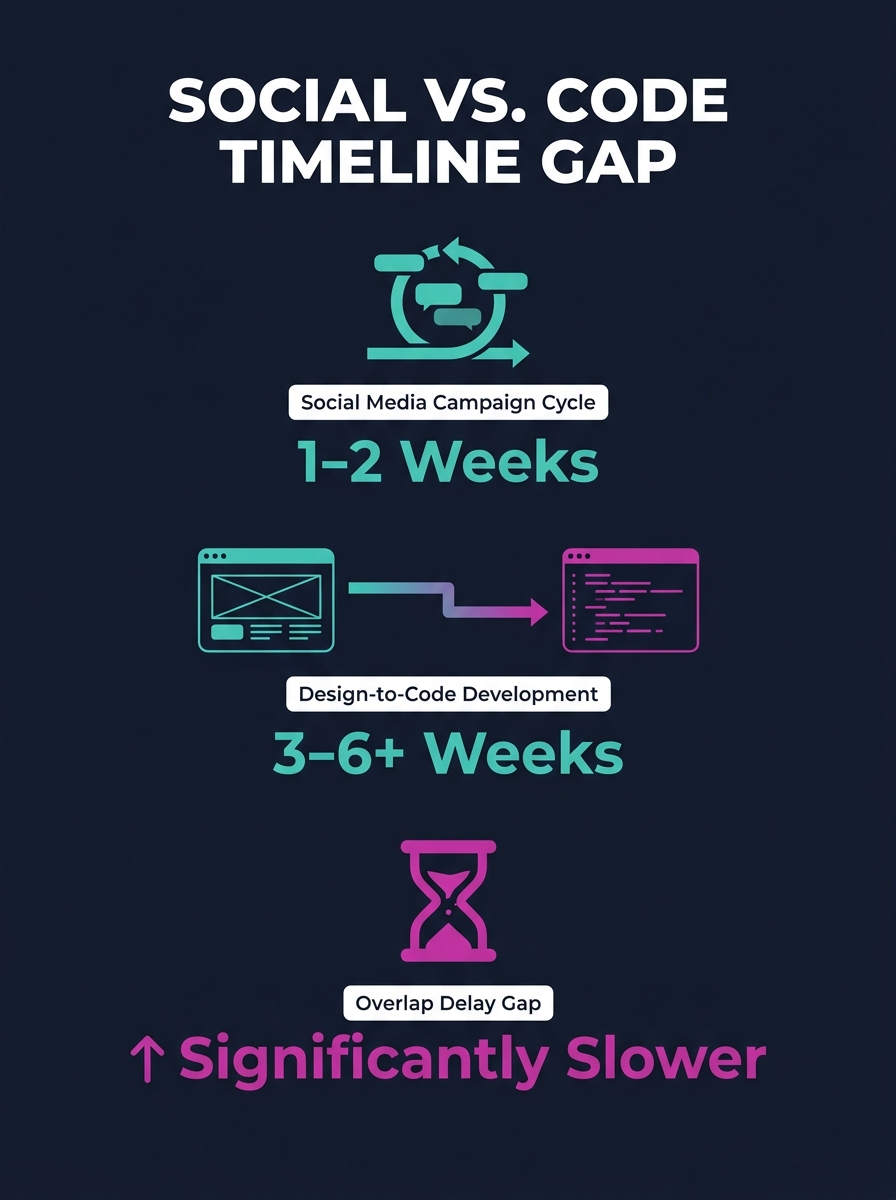
Figma exports for social campaign landing pages follow a predictable path inside an agency: the designer finishes the comp, drops it into a shared folder or Zeplin board, pings a developer on Slack, and then waits. The wait is where the budget leaks. Custom WordPress builds take two to six weeks for basic sites and eight to twenty weeks for complex projects, timelines that collide head-on with a social calendar demanding new campaign-specific pages every couple of weeks. That collision, the design-to-code workflow gap, is the bottleneck most agency leads know about but underestimate in dollar terms.
And social media makes the problem worse than almost any other service line. Paid campaigns have launch windows. Organic trends have shelf lives measured in days. When your design team can produce three landing page variants in an afternoon but your dev queue won't touch them for a week, you've introduced a delay that eats into ad performance, client patience, and your own margins.
The Handoff Gap That Social Campaigns Expose
The standard design-to-development handoff has been studied to death, and the consensus is clear. As UXPin puts it, effective handoff is about "delivering specs, sharing design intention, giving context about user journeys, and reinforcing a design system so that developers can do their job efficiently." That sounds simple in principle. In practice, agencies running social media campaigns face a version of this problem that is particularly acute because of the volume and velocity involved.
A brand awareness campaign on Instagram might need a dedicated landing page with a specific hero layout, a lead capture form, and mobile-first styling that matches the ad creative. A retargeting campaign on Facebook might need a variant of that same page with different copy, a testimonial block, and a countdown timer. A TikTok-driven product launch might need something entirely different, built from scratch. Each of these requests starts with a designer, and each of them stalls at the same point: the gap between a visual file and production-ready WordPress code. Understanding how the design outsourcing process works helps, but even agencies with clear documentation practices lose hours in translation.
The handoff gap shows up in three concrete ways. First, specs are incomplete. Designers working at campaign speed often skip documenting interaction states, responsive breakpoints, or spacing tokens, leaving developers to guess or ask follow-up questions that add days to the cycle. Second, feedback loops multiply. A developer builds what they interpret from the comp, the designer flags discrepancies, the project manager mediates, and the social media lead weighs in with last-minute copy changes they got from the client. Third, context switching kills throughput. Developers pulled between maintenance tickets, WooCommerce bug fixes, and campaign page builds end up doing none of them well.
Where Automation Targets the Right Stage
Here's what makes the bottleneck conversation tricky: AI coding tools have made individual developers faster, but they haven't proportionally accelerated project delivery. Faros AI's analysis of over 10,000 developers found that teams using AI coding assistants completed 21% more tasks and merged 98% more pull requests, yet PR review time increased by 91%. A separate study by METR found developers were actually 19% slower when factoring in the time spent debugging and refining AI-generated code. The bottleneck didn't disappear. It moved upstream, into specification quality and review cycles.
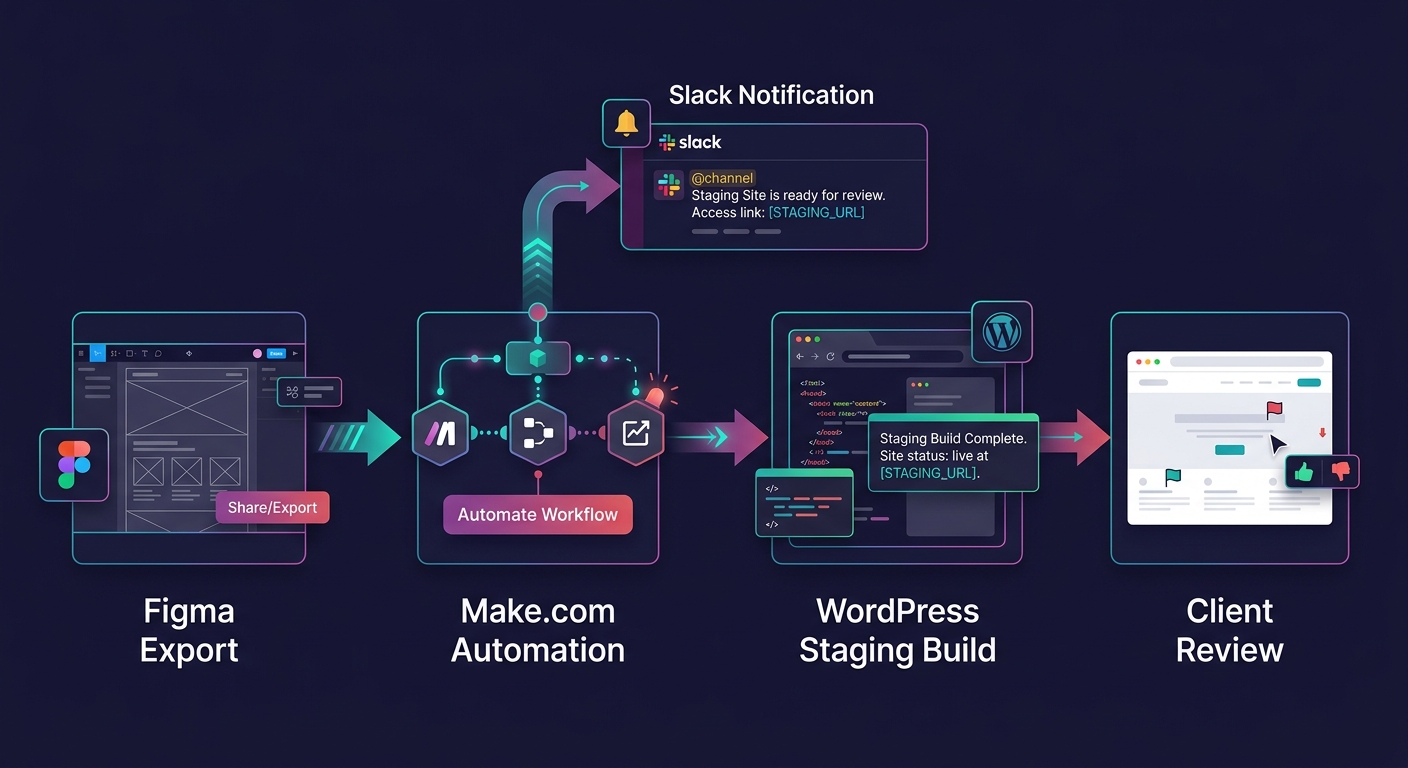
For agencies, this means the answer to agency development efficiency problems isn't "give your developers Copilot and call it a day." The answer is automating the workflow stages that surround the code: the handoff documentation, the asset organization, the component mapping, and the deployment pipeline. Creative operations (CreativeOps) has emerged as a distinct discipline for exactly this reason. In 2026, it's dominated by low-code automation platforms, with Make.com becoming the preferred tool over Zapier for agencies that need multi-branching logic in their design workflows. An agency might use Make to automatically route Figma exports to the right Slack channel based on project tags, generate a Trello card with pre-filled specs, and notify the developer queue—all without a project manager touching it.
The bottleneck didn't disappear when agencies adopted AI coding tools. It moved upstream, into specification quality and review cycles.
The real gains from WordPress automation tools come when you connect the dots between systems that currently require manual intervention. When a designer exports a campaign page layout, an automation can parse the component structure, match it against your existing block library, and surface a build estimate before a developer even opens the project. That kind of pre-work used to take a 15-minute standup and a back-and-forth thread on Slack. Automating it reclaims those minutes across dozens of projects per month, which is exactly how infrastructure automation reshapes agency maintenance economics at scale.
Gutenberg Blocks and the Campaign Page Assembly Line
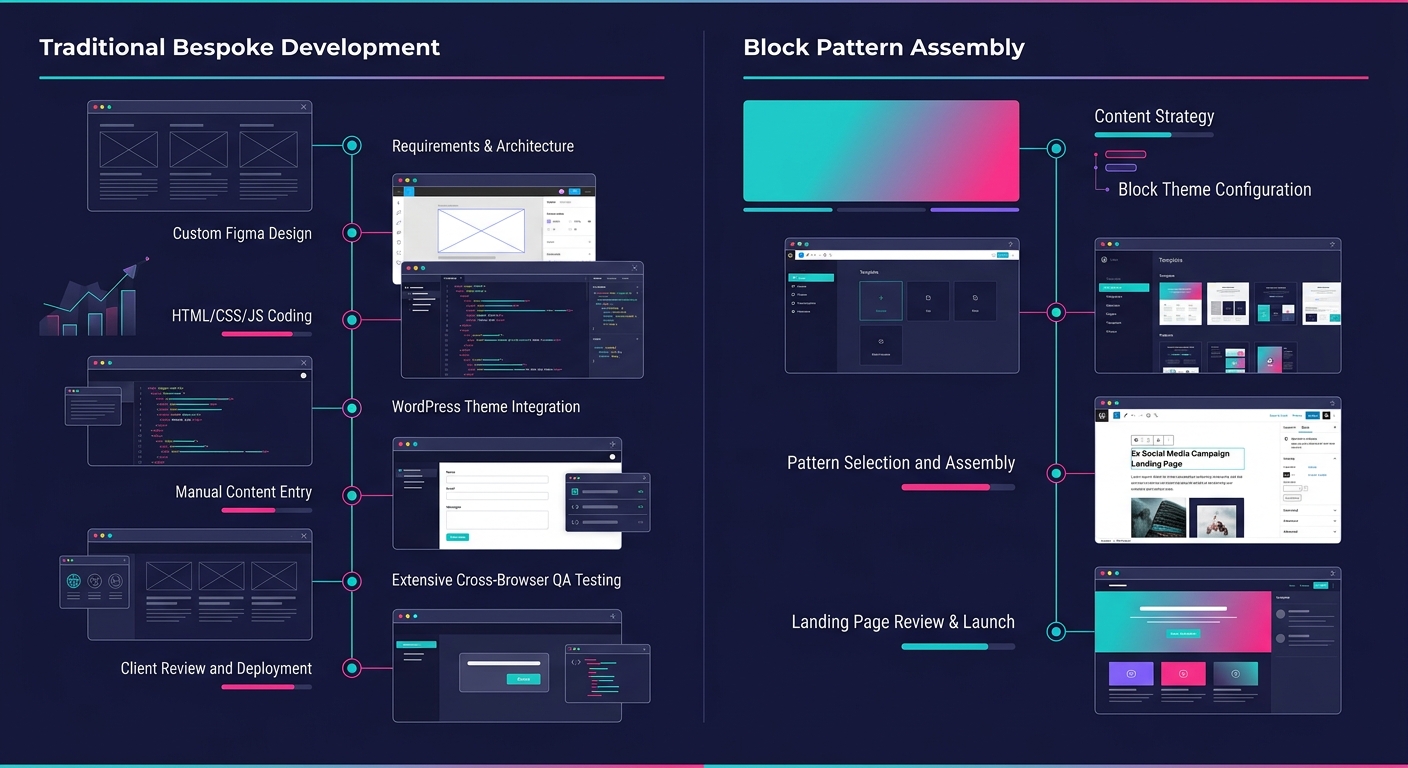
The practical application of all this theory lives in how you build WordPress pages for social campaigns, and Gutenberg's block architecture is the most underused asset in the agency toolkit for this purpose. Gutenberg blocks automation becomes viable when you stop treating every campaign page as a bespoke build and start treating it as an assembly problem.
Consider what a typical social media landing page actually contains: a hero section with a background image and headline, a two-column benefits area, a testimonial slider, a form block, and a footer CTA. If your agency builds ten social campaign pages a month, you're rebuilding those same five components repeatedly with minor variations in copy, color, and imagery. The alternative is maintaining a curated block pattern library where each component is already coded, responsive, and tested. Developers shift from writing new markup to configuring pre-built blocks, and the time per page drops from eight hours to under two.
The 10up team's Convert to Blocks plugin demonstrates one piece of this puzzle, transforming classic editor content into Gutenberg blocks on the fly, which matters for agencies managing legacy client sites that need to support modern campaign pages without a full theme migration. The plugin's WP-CLI command can convert posts iteratively without manual input, though it's worth noting that Gutenberg is CPU-intensive, so batch conversions on shared hosting will crawl.
Where this gets powerful is when you combine the block library approach with the automation layer discussed above. A designer creates a campaign page comp in Figma. An automation identifies which blocks from your library map to each section of the comp, generates a JSON structure for those blocks with placeholder content, and drops it into a staging environment for review. The developer's role shifts from translation (turning pixels into code) to validation (confirming the automated assembly matches design intent and client requirements). Agencies that have made this shift report that choosing the right development partner becomes less about raw coding speed and more about block library depth and maintenance discipline.
And if your agency doesn't have the design bandwidth to keep up with campaign demand in the first place, the option to hire graphic design talent specifically for social campaign asset production can make the entire pipeline flow faster, since a dedicated designer working within established block constraints produces comps that translate to WordPress pages with far fewer handoff gaps.
Where the Friction Persists
Automation solves a real set of problems in the design-to-code workflow, and I've laid out the mechanisms clearly enough. But there's an uncomfortable dimension to this conversation that the tooling vendors won't mention: automating the middle of a broken process sometimes just makes the broken parts at the edges more visible.
When you speed up page production, you expose how slow your client approval cycle really is. An agency that can now build a campaign landing page in two hours instead of eight often discovers that the page then sits in a client review queue for five days, waiting for a marketing director to sign off on headline copy. The Faros AI data hinting at 91% longer review times in AI-accelerated workflows points to this same dynamic—speed in one stage creates congestion in the next. Identifying and addressing workflow bottlenecks requires looking at the entire pipeline, not just the segment you've automated.
There's also a skills question that agencies need to sit with honestly. As AI reshapes how agencies approach development work, the developer role increasingly tilts toward specification review and system architecture rather than hands-on markup. That's a different skill profile than what most agencies hired for, and retraining takes time and intention that no automation platform provides. The agencies getting the most out of Gutenberg block automation and CreativeOps workflows are the ones that invested in documentation culture and design system governance before they invested in tools. The tools accelerate whatever process already exists. If that process is messy, you get faster mess. If it's disciplined, you get something that actually scales to meet the relentless pace a social media campaign calendar demands. The gap between those two outcomes is wider than any tool can bridge on its own.