

The difference between a 40% gross margin and a 65% one often comes down to which pricing structure an agency picked when it first signed with a white-label WordPress partner. Fixed-price projects, monthly retainers, and hourly billing each protect your margins in different situations and expose them in others. And yet most agency owners pick one model based on gut instinct during onboarding and never revisit it, even after their client roster doubles.
This matters because your WordPress development cost structure is the single biggest lever you have for profitability. Your clients don't see what you pay. They see what you charge. The gap between those two numbers is your business.
According to industry pricing breakdowns from Web Help Agency, there are four standard white label pricing models, but three account for the vast majority of agency-partner relationships. Here's an honest look at each one: what it costs, where it breaks, and which agency profile it actually suits.
Fixed-Price Projects and Where They Break
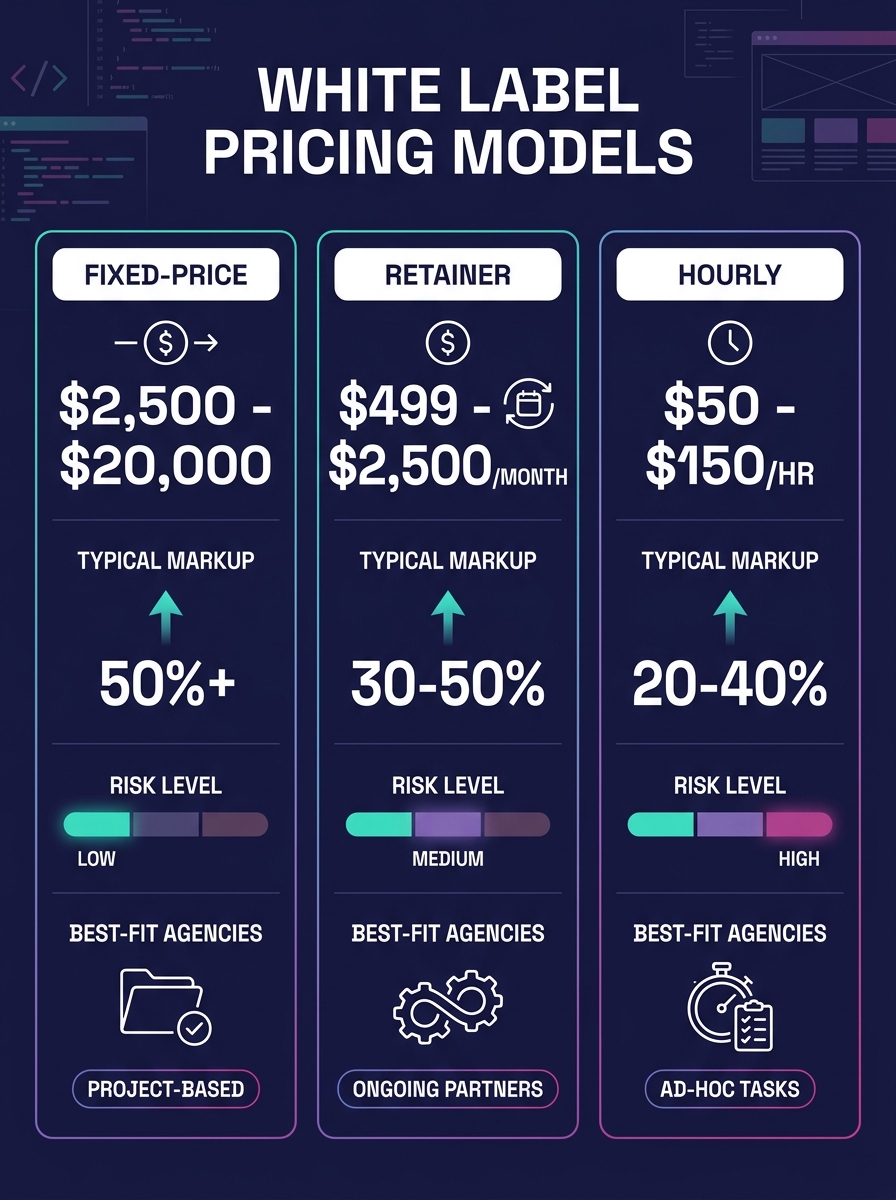
Fixed-price is the model most agencies start with. You get a quote for the full build—say, $6,000 for a custom WordPress site or $12,000 for a WooCommerce store—and you mark it up 50-75% on your client invoice. A $6,000 build becomes a $10,000-$12,000 line item. Clean and simple.
The appeal is obvious: you know your costs before the project starts, and your margin is locked in from day one. For well-defined projects with tight scope documents, Figma files, and a clear feature list, fixed-price is genuinely the best model. Basic theme-based sites typically run $2,500-$5,000 on the wholesale side. Custom builds land in the $6,000-$12,000 range. Full WooCommerce stores with payment integrations and custom product logic can push $8,000-$20,000.
The risk lives in scope creep. As Codeable's analysis of white-label development notes, fixed-price projects absorb unbilled work. When a client asks for "one more small change" after sign-off, someone eats that cost. If your white-label partner quoted a fixed price, they eat it. If you scoped loosely with your client, you eat it. Either way, the margin you calculated at kickoff starts eroding.
Fixed-price works best when your agency runs a disciplined intake process. That means written scope documents with explicit exclusions, wireframes or prototypes approved before development starts, and a change-order process your project managers actually enforce. If your team tends to say "sure, we can add that" in client calls without checking the SOW, fixed-price will quietly drain your margins over six months.
Tip: Premium plugin licenses (Elementor Pro, ACF Pro, Gravity Forms) are almost never included in fixed-price quotes. Budget an extra $200-$600 per project for licensing, or negotiate bundled pricing with your partner.
Monthly Retainers: The Margin Machine (If You Monitor Utilization)
Retainer packaging for agencies is where the real money lives, and where the most common waste hides. A typical white-label retainer runs $499-$2,000 per month and covers a defined block of development hours or tasks. You mark it up and sell it to your client as an ongoing care plan, development partnership, or maintenance agreement.
The economics are compelling. You're collecting predictable monthly revenue from each client, your white-label partner has guaranteed work, and everybody's cash flow stabilizes. Retainer clients also tend to stay longer because they're invested in the relationship and switching costs feel high.
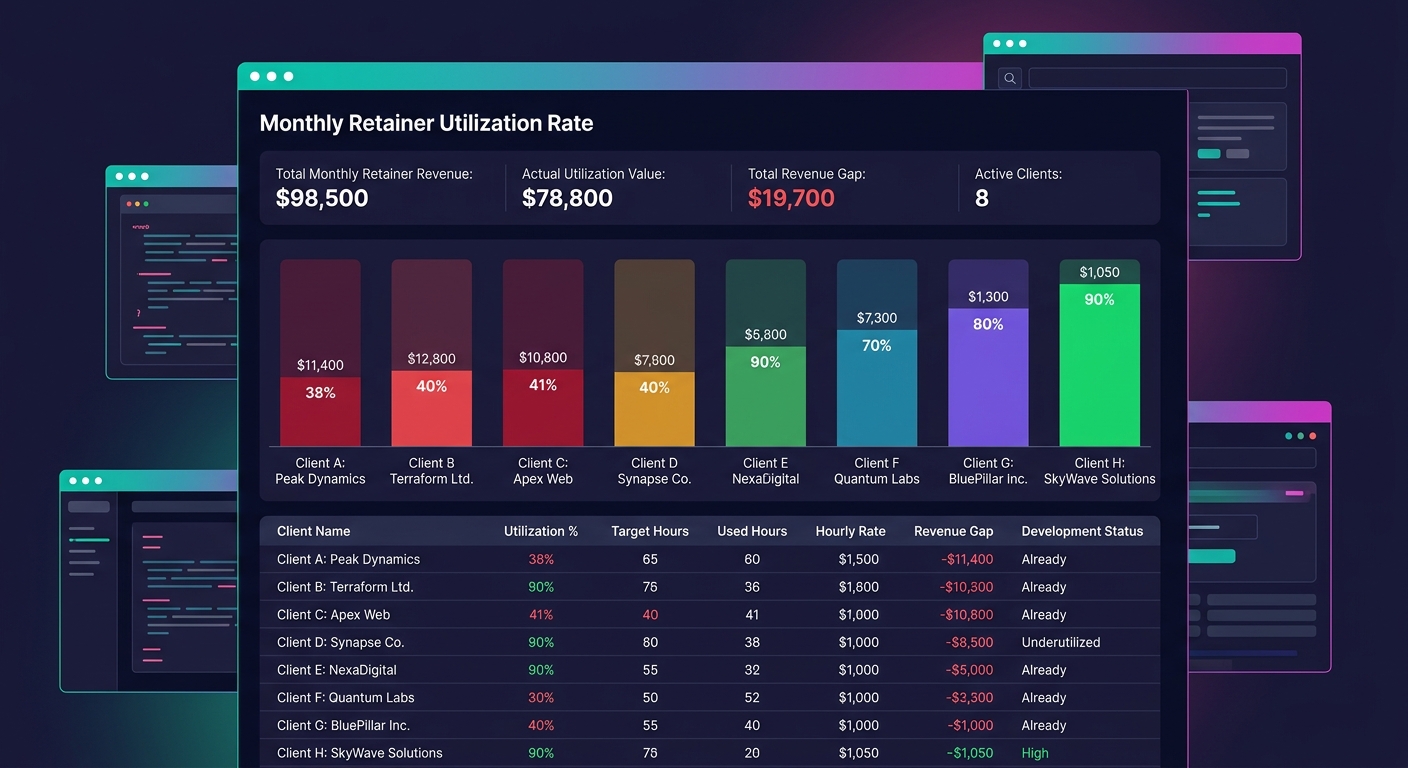
But here's where agencies lose money: unused hours. If your retainer includes 20 hours of development per month and your client only uses 12, those 8 hours typically expire. You paid for them. You can't roll them over (most partners won't allow it). And if you're reselling the same retainer to your client with a markup, your client is overpaying too, which eventually becomes a retention problem.
The fix is tiered retainer packaging. Instead of one-size-fits-all, structure three tiers:
- Starter ($499-$800/month wholesale): Plugin updates, security monitoring, minor content changes. Best for brochure sites with low change velocity.
- Growth ($1,000-$1,500/month wholesale): Everything in Starter plus 10-15 hours of development for new features, landing pages, or design tweaks.
- Scale ($1,500-$2,500/month wholesale): Dedicated development capacity, priority response times, and project-level work like new page templates or WooCommerce customizations.
You sell each tier at a 50-100% markup depending on how much project management and client communication your team handles on top. The key is matching each client to the right tier so utilization stays above 75%. Below that threshold, you're subsidizing idle capacity.
Your clients don't see what you pay. They see what you charge. The gap between those two numbers is your business.
Agencies managing ten or more retainer clients should track utilization monthly in a shared spreadsheet or project management tool. If a client consistently uses fewer than half their hours, drop them to a lower tier. If they're regularly exceeding their allocation, that's a signal to upsell. This kind of systems-level thinking about your outsourcing model is what separates agencies growing profitably from agencies growing broke.
Why Hourly Billing Costs More Than You Think
Hourly rates for white-label WordPress developers range from $50 to $150 per hour depending on the partner's location, expertise level, and the complexity of the stack. Agencies typically add a 30-50% markup when passing costs to clients.
The appeal of hourly billing is flexibility. There's no scope document to fight over. The client needs something, the developer builds it, and you bill for the time. For projects with fuzzy requirements, discovery phases, or Agile-style iterative builds, hourly can make sense. You're never locked into a bad fixed-price quote because the number adjusts in real time.
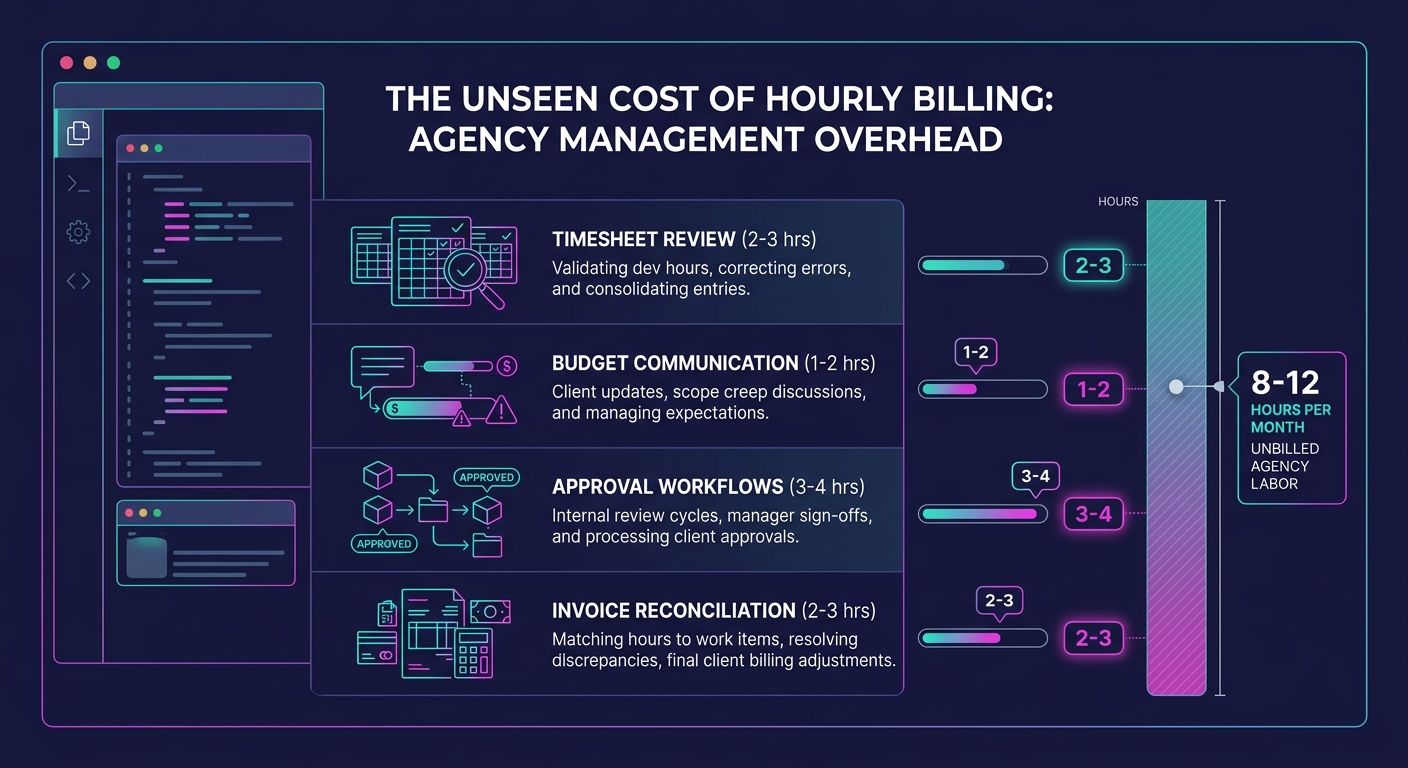
The cost of that flexibility is overhead. Someone at your agency needs to review timesheets, verify that reported hours match delivered work, communicate budget status to clients, and get approval before hours run over. That's project management labor that often goes untracked and unbilled.
As Anders CPA's research on agency profitability points out, gross profit margin is the number that actually matters for agency margin optimization, and hourly models tend to compress it because the management cost of hourly billing is higher than most agencies account for. You're spending 15-20 minutes per project per week on budget oversight alone. Multiply that across 15 active projects and you've created a part-time administrative role that doesn't appear on any invoice.
Hourly billing also creates an uncomfortable dynamic with clients. Nobody likes watching a clock. Clients on hourly arrangements tend to second-guess every line item, request more granular time breakdowns, and delay approvals because they're worried about costs. This friction slows projects down and increases your communication overhead even further. We've written about how ticket-based models create similar friction, and the hourly trap is a close cousin.
Where hourly genuinely shines is for agencies with a small number of high-value clients who need unpredictable development work. Think of a SaaS company that needs WordPress marketing site updates tied to product launches, or an e-commerce brand running frequent A/B tests on their WooCommerce store design. When the work is sporadic and variable, hourly is the honest model. Trying to force that kind of client into a retainer just wastes their money during quiet months.
Warning: If you're running hourly engagements with your white-label partner while selling fixed-price packages to your clients, you're carrying all the scope risk yourself. Make sure your client-facing quotes include a buffer of at least 15-20% above the estimated hours.
How To Choose Between These Three
The honest answer is that most successful agencies don't pick one model. They use a hybrid approach, and the split usually looks like this:
Fixed-price for new builds. When a client needs a new WordPress site, a WooCommerce store, or a major redesign, fixed-price keeps everyone aligned. Define the scope, get the quote, mark it up, deliver. If your white-label partner selection process is solid, these projects should hit their budgets consistently.
Retainers for ongoing work. Once the build is done, transition the client to a monthly retainer for maintenance, updates, and incremental development. This is where your margin optimization happens over time, because retainer revenue compounds month after month while your acquisition cost was paid once.
Hourly for edge cases. Reserve hourly billing for discovery phases, consulting engagements, or clients whose needs are genuinely unpredictable. Keep these arrangements short-term when possible, and convert to retainers as soon as the work pattern stabilizes.
The in-house comparison is worth knowing: a mid-level WordPress developer in the US costs $110,000-$155,000 per year in salary and overhead. A comparable white-label arrangement runs $72,000-$216,000 annually in wholesale fees, but that capacity scales up and down with demand. You're not paying someone to sit idle during a slow month. And if you need to absorb a burst of new clients, the partner handles that growth without requiring new hires.
The model that protects your margins best is the one that matches your actual delivery pattern. Track your project types for a quarter. Count how many are new builds, how many are ongoing maintenance, and how many are unpredictable requests. Then structure your cost-effective white label delivery around those real numbers instead of a theoretical ideal. Your clients will never see the wholesale side of your pricing, and they shouldn't need to. What they will see is whether your delivery is consistent, your communication is clear, and your pricing feels fair for the value they receive. The white label pricing models you choose determine all three of those things.