

Twelve design tokens power a typical white-label WordPress theme at launch: brand colors, a font stack or two, spacing units, border radii. By the time the fifteenth client goes live on that same system, the token count has ballooned past 200, and nobody on the team can confidently explain what half of them control. This is theme customization debt in action, and it compounds faster than any agency budgets for.
The reason this matters for marketing agencies specifically: every additional hour spent untangling overridden variables is an hour not spent on campaign work, conversion optimization, or client strategy. Design system scalability sounds like an engineering problem. In practice, it's a margin problem. When your web designers spend 40% of their time debugging inherited CSS overrides instead of building new landing pages, the economic damage shows up on every project scope.
How Token Sprawl Actually Happens
The pattern is predictable. Client one gets the base theme: primary color, secondary color, body font, heading font, a few spacing values. Everything maps cleanly to CSS custom properties. The design system feels elegant.
Client two needs a dark mode variant. Client three requires an additional accent color for their CTA buttons. Client four's brand guidelines specify different heading weights for mobile and desktop. Client five insists on custom border treatments that don't exist in your component library.
Each of these requests is individually reasonable. None of them trigger a conversation about architecture. And that's precisely how the debt accumulates—one "quick addition" at a time, until your token file reads like a dictionary nobody wrote definitions for.
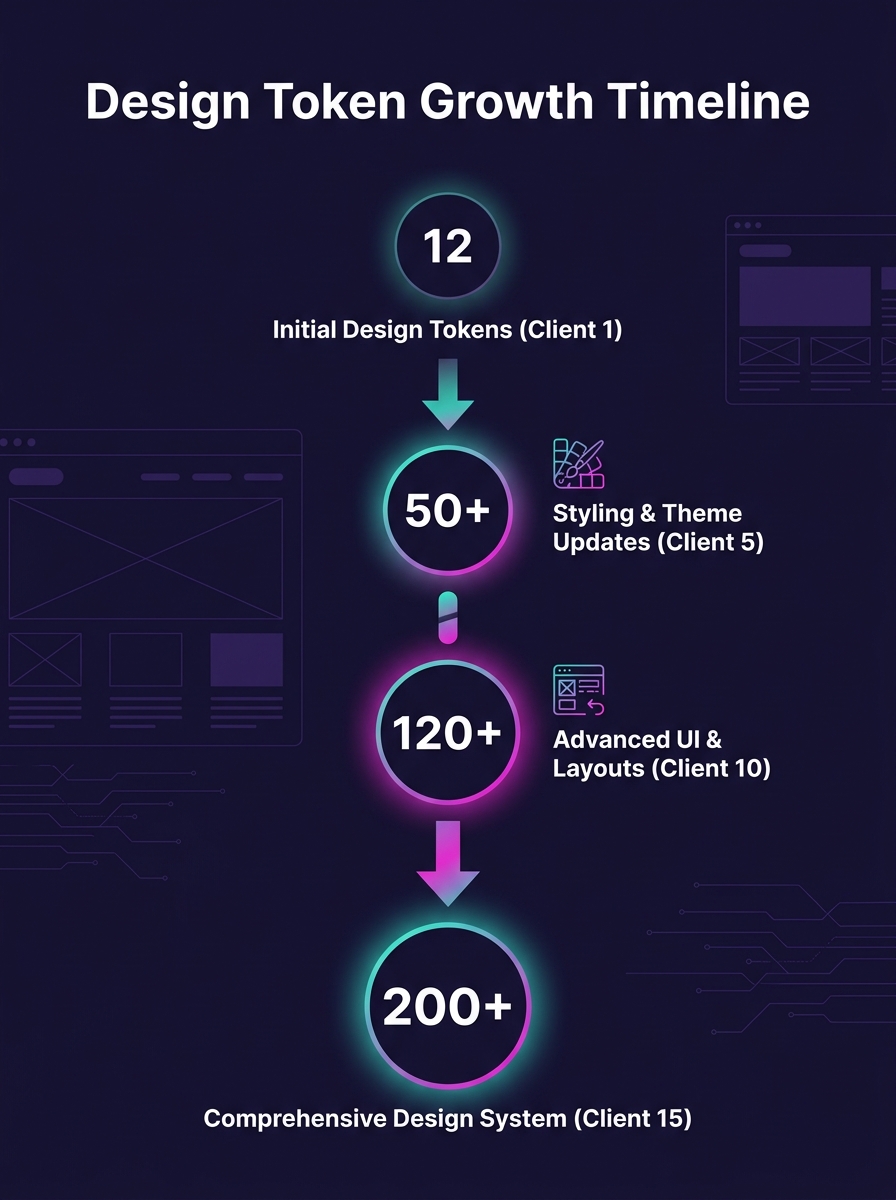
By the time you're managing multi-tenant WordPress theming across 20+ client sites, you've effectively created 20 slightly different design systems wearing one system's name. Updates to the base theme now require regression testing across every variant. A color change to the primary button component might cascade correctly for 18 clients and break rendering for two, because those two had overrides your team forgot about.
The Component Library vs. Design System Distinction
A thread on the DesignSystems subreddit raised an important question that agencies routinely skip: are you building a Figma style sheet, a component library, or an actual design system? These are three different things with three different maintenance costs.
The experienced practitioners in that thread recommend starting with a component library and letting it evolve into a design system organically. The reasoning is sound: premature abstraction creates tokens and rules for scenarios you haven't encountered yet. Those abstractions then become constraints that don't match real client needs, which leads to overrides, which leads to debt.
For agencies running white-label design systems on WordPress, this distinction matters because your theming layer (whether it's built on block themes, Elementor's global styles, or a custom theme.json structure) determines how much flexibility clients actually get. If you're weighing the architecture decision between block themes and ACF, the theming implications should be part of that evaluation. Block themes give you native token-like control through theme.json. ACF gives you structured data but punts the styling question to your CSS layer entirely.
Where Rebrand Automation Breaks Down
The promise of rebrand automation is compelling: swap out a set of design tokens and an entire site transforms to match a new client's brand. UXPin's guide on building rebrandable products with flexible design systems frames theme switching as the backbone of white-label flexibility, and in theory, that's correct.
In practice, automated rebranding works reliably for about three things: primary and secondary colors, font families, and logo placement. After that, client-specific requirements start demanding manual intervention.
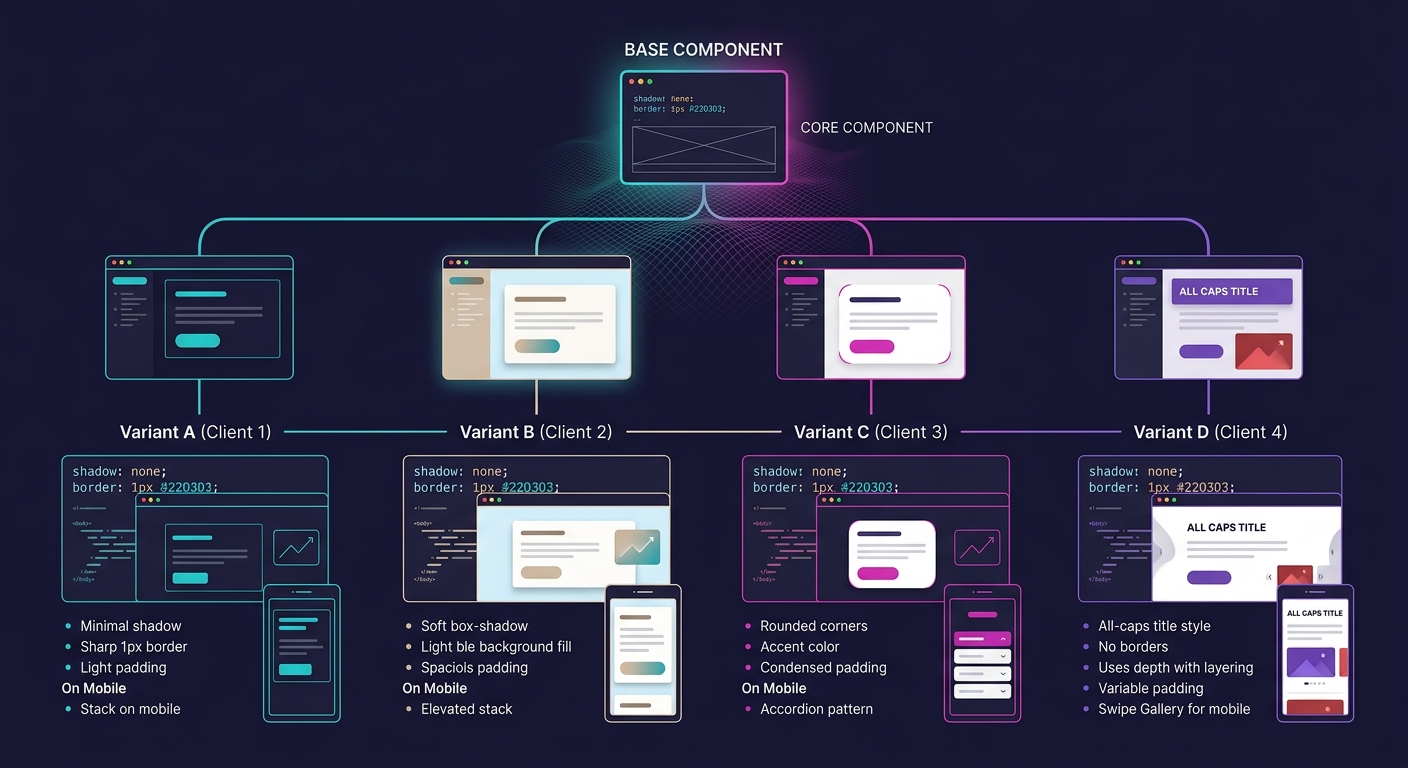
Consider a typical scenario. Your base component library includes a card component with a drop shadow, 8px border radius, and 16px internal padding. Client A's brand is minimal and flat, so they want no shadows and sharp corners. Client B wants a 2px colored border instead of a shadow. Client C is fine with the shadow but needs 24px padding for accessibility reasons. Client D wants the card to behave as an accordion on mobile.
You now have four variants of one component. Multiply that across headers, footers, navigation patterns, form styles, and hero sections, and the permutations become unmanageable. This is why agencies often struggle with the tension between customization and standardization. The customization pressure always wins in the short term because it's tied directly to revenue.
The Multi-Tenant Isolation Problem
Multi-tenant architecture best practices emphasize that tenants should be able to customize their experience without affecting each other. In a SaaS product, this is handled through database-level tenant IDs and application-level configuration. In a white-label WordPress operation, the isolation mechanisms are far cruder.
If you're running WordPress Multisite, each subsite gets its own theme customizer settings, but they all share the same theme codebase. A PHP or CSS change to a shared component propagates everywhere. If you're running separate WordPress installations per client, you've solved the isolation problem but created a deployment problem: pushing an update means touching every instance individually unless you've invested in orchestration tooling.
Either way, the cost of a change increases linearly with the number of clients. There's no economy of scale once customization enters the picture. Planning for this from the start costs slightly more upfront but prevents the kind of architectural decay that makes every future change expensive and risky.
Every client-specific override you accept without updating the base system is a small loan against your team's future velocity, and the interest rate is steeper than anyone quotes in the project scope.
Controlled Escape Hatches and How They Fail
The standard recommendation for managing design system scalability is to provide "controlled escape hatches," which are structured ways for clients to override defaults without breaking the underlying system. In WordPress, this usually takes the form of custom CSS fields in the Customizer, additional theme options panels, or client-specific child themes.
The problem is that controlled escape hatches assume discipline on both sides. Your team needs to document what's safe to override and what isn't. The client (or the agency reselling your work) needs to respect those boundaries. In practice, someone always pastes a block of CSS into the custom CSS field that targets a class name three levels deep in your component hierarchy, because it was the fastest way to fix a visual issue before a campaign launch.
If your feature toggle architecture is mature enough, you can gate certain customization surfaces behind permission levels. But most agencies don't get there. They ship the escape hatch wide open, and twelve months later, they're maintaining client-specific CSS overrides that nobody documented and nobody wants to remove because "it might break something."
When this situation escalates, having graphic designers who understand token-based systems becomes essential. They can audit visual inconsistencies and trace them back to override conflicts, which is detective work that pure developers often lack the visual literacy to perform well.
The Handoff Gap That Feeds the Debt
Design system debt doesn't originate in code. It originates in the gap between what a designer specifies and what a developer implements. When a client's brand guidelines call for a "warm gray" background, the designer picks a specific hex value. The developer implements it as a one-off override instead of mapping it to an existing token. Nobody catches it in review because the visual output looks correct.
This is why automating the design-to-development handoff matters so much for white-label operations. When tokens are the shared language between design tools and the codebase, one-off hex values get flagged automatically. Without that automation, every handoff is an opportunity for debt to enter the system silently.
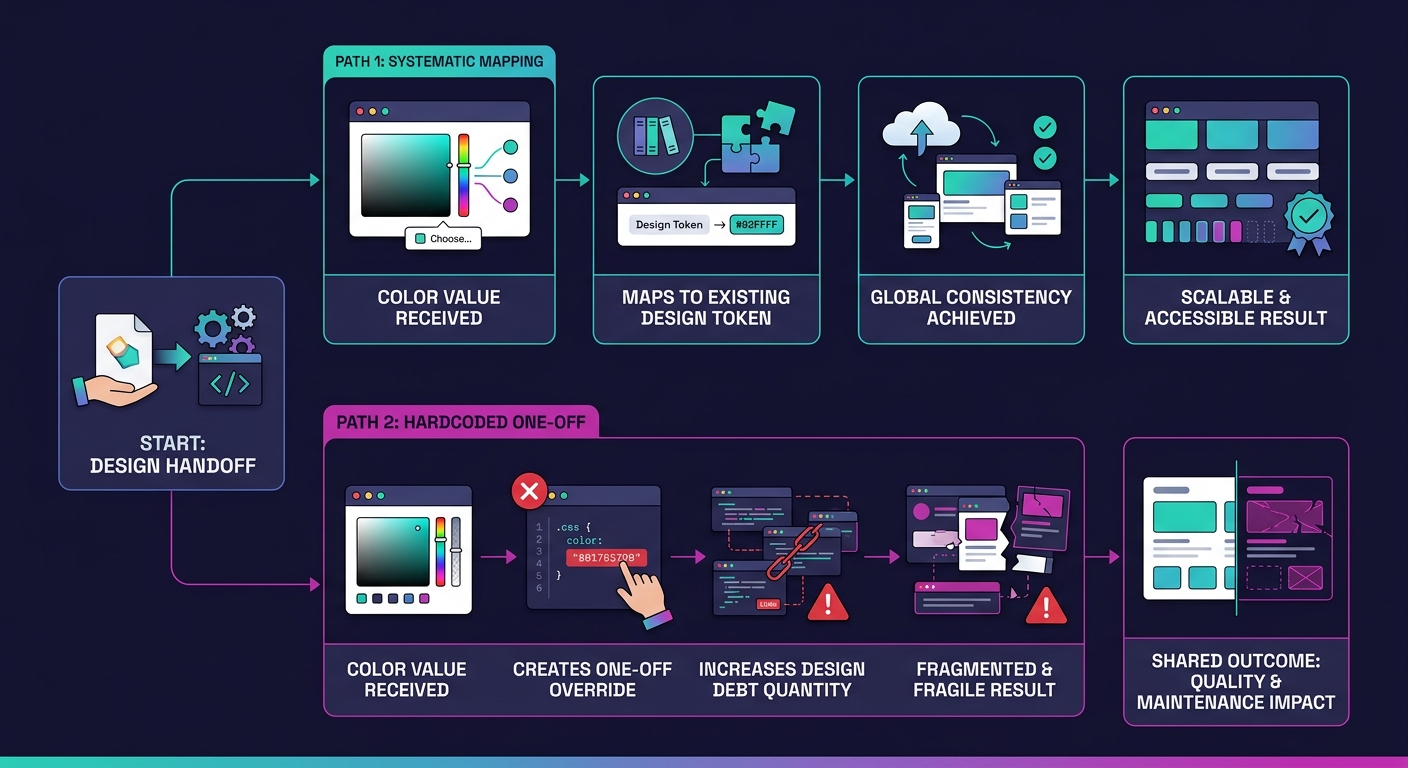
Warning: If your team can't answer the question "how many unique color values exist across all client sites?" within five minutes, your design system has already accumulated significant untracked debt.
The Remaining Questions
The fundamental tension in white-label design systems hasn't been resolved by better tooling or smarter token architectures. The tension is economic: agencies get paid to say yes to client customization requests, but every yes adds maintenance cost that doesn't appear on any invoice.
A few questions remain genuinely open. How many active client brands can a single token-based design system support before the maintenance cost exceeds the efficiency gains? Nobody has published reliable benchmarks. The case studies that exist describe systems built by product companies with dedicated design ops teams, sometimes managing 500+ interconnected components across 12 partners with reported 500% faster onboarding times. Those numbers come from environments with resources that a ten-person agency simply doesn't have.
And there's the deeper question of whether WordPress's theming layer can ever provide the kind of tenant isolation that true multi-tenant SaaS platforms achieve. Right now, the answer is no. WordPress wasn't designed for it, and the workarounds all carry tradeoffs. Agencies building white-label design systems on WordPress are essentially maintaining a custom multi-tenancy layer on top of a platform that doesn't natively support one. That architectural mismatch is the largest source of theme customization debt, and no amount of token naming conventions will eliminate it entirely. The agencies that thrive with this model will be the ones who stop pretending the debt doesn't exist and instead build explicit budgets, both in time and money, for paying it down on a regular cycle.