

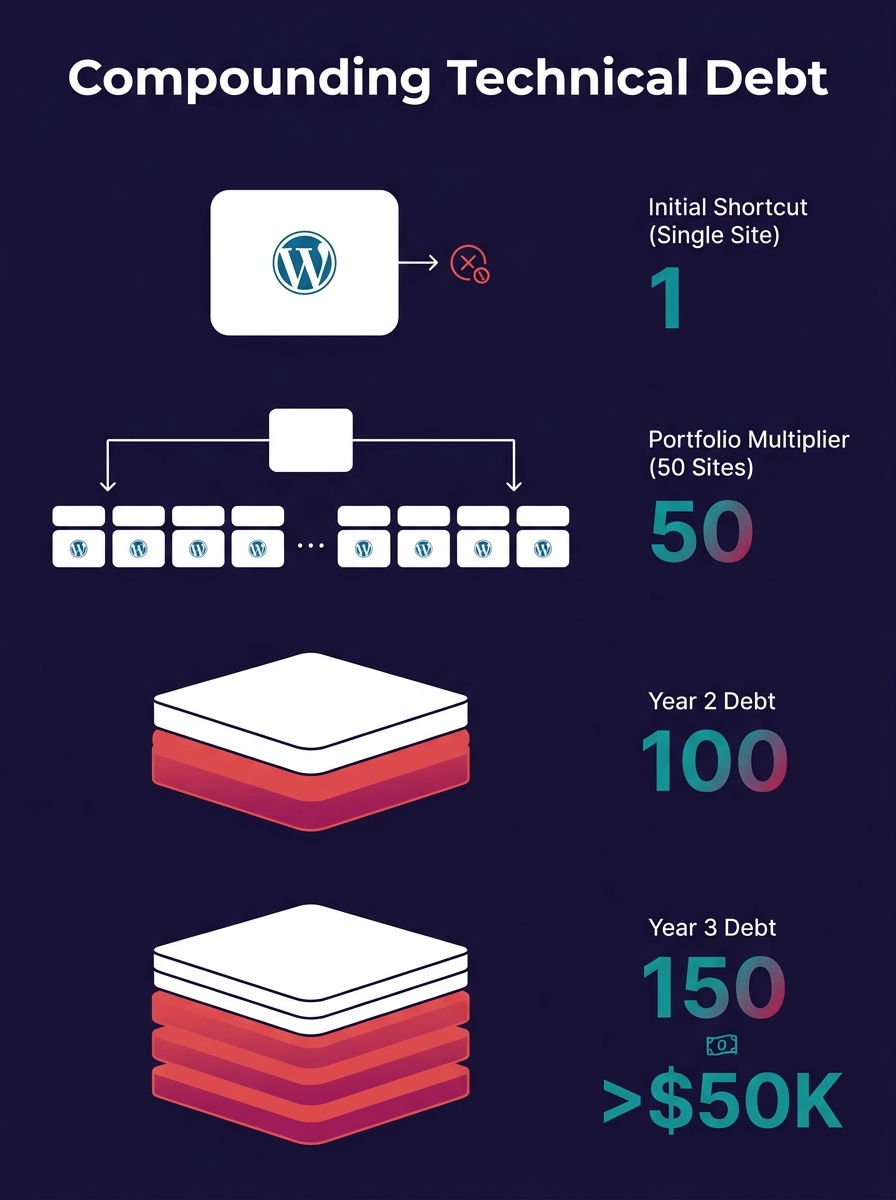
Forty WordPress sites under management, each carrying two or three undocumented quick-fixes from the original build, produce 80 to 120 invisible debt items before a single client opens a support ticket. That number typically doubles within eighteen months without a structured audit, and the cost hides inside shrinking margins and slower delivery cycles rather than on any balance sheet.
How Portfolio Scale Turns Small Shortcuts Into Structural Problems
A single WordPress site with one hardcoded widget override or one plugin conflict papered over with a function snippet is manageable. An agency running 30, 50, or 100 white-label sites with those same shortcuts embedded across different developers' work creates a different kind of problem entirely: each site's debt interacts with every other site's maintenance schedule, update cadence, and client expectation. The compounding effect is geometric, not linear, because shared infrastructure decisions (a common starter theme, a reused plugin stack, a standard hosting configuration) propagate the same flaw across the entire portfolio simultaneously.
Accenture's Digital Core research, cited in a 2026 FocustApps analysis, found that companies with lower-than-average technical debt grew revenue at 5.3% annually compared to 4.4% for high-debt organizations. That 0.9 percentage-point gap sounds modest until you compound it across a five-to-seven year period. For agencies, the parallel is clear: the margin you lose to debt compounding WordPress problems is invisible in any given month but devastating over the life of a client relationship. A site that takes 3.5 hours to update cleanly in year one absorbs 6 to 8 hours by year three when accumulated patches, abandoned plugin experiments, and undocumented customizations pile up without remediation.
The white-label model intensifies this dynamic because the agency selling the work and the team building it are different organizations with different incentive structures. Your white-label partner optimizes for delivery speed on the current sprint. You're left holding the maintenance obligation for years afterward. When the partner's quick fix becomes your quarterly headache, the agency cost architecture shifts in ways nobody priced into the original project scope.
The Margin Erosion Nobody Models at Kickoff
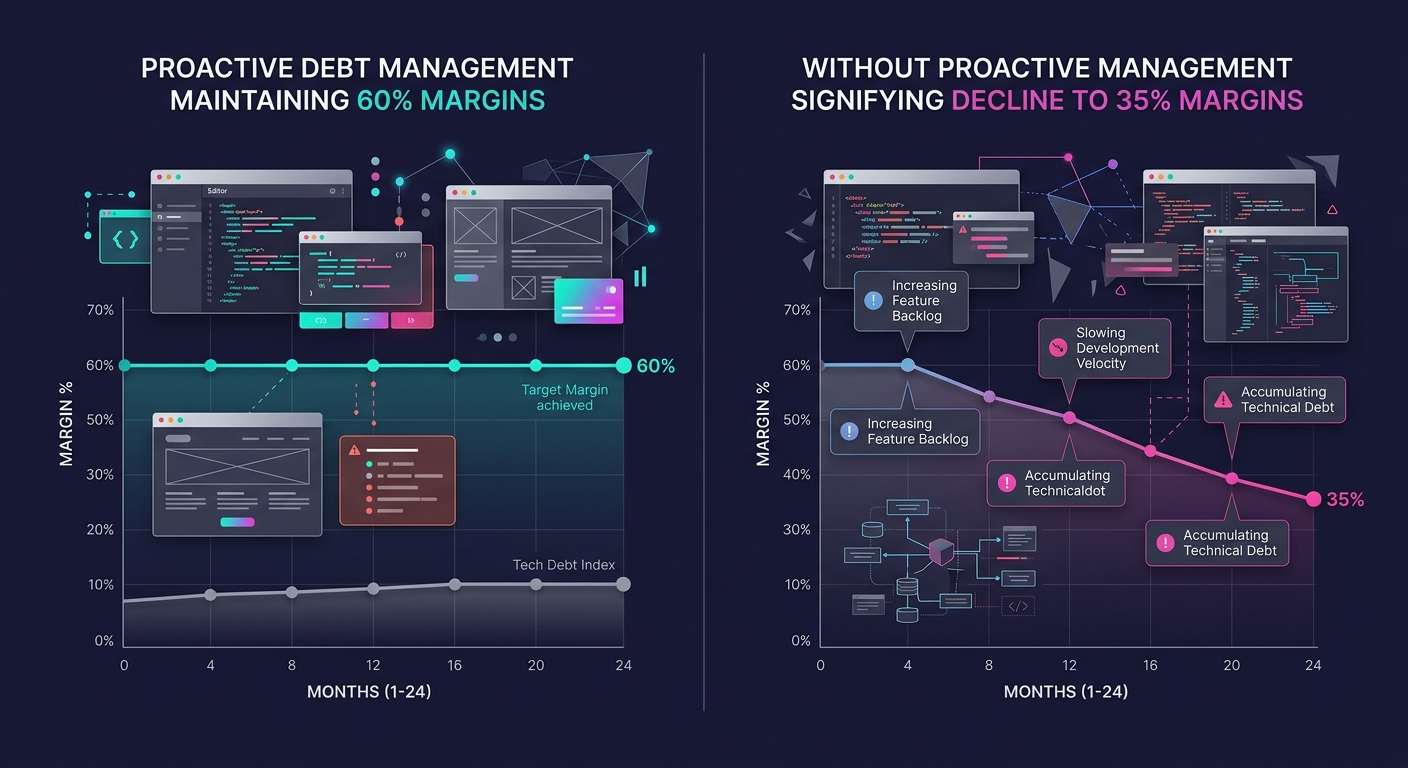
Agency margins on white-label WordPress work typically fall between 40% and 75% depending on project type, and the gap between the high and low end of that range correlates tightly with how well the agency manages post-delivery maintenance costs. The difference between a 40% margin and a 65% one often traces back to the pricing structure chosen when the agency first engaged its white-label partner. Agencies that price on a per-project fixed basis without modeling ongoing debt remediation into retainer contracts discover that their effective margin drops 8 to 15 percentage points within the first 18 months of a client relationship.
Consider how this plays out in practice. A client requests "one more small change" after sign-off. If the white-label partner quoted a fixed price, they absorb that cost and are incentivized to implement it as quickly (and cheaply) as possible. If you scoped loosely with your client, you absorb it yourself. Either way, the margin calculated at kickoff starts eroding. Multiply that erosion across a portfolio of 40 clients, each making two or three post-launch change requests per quarter, and you're looking at hundreds of unbilled hours annually. Those hours don't appear in your project P&L because they're classified as "support" or "maintenance," but they represent real developer time diverted from revenue-generating work.
The content marketing implications compound the financial damage further. White-label sites carrying technical debt load slower, score worse on Core Web Vitals, and generate lower organic visibility for the content your clients publish. An agency promising SEO-optimized content delivery on a WordPress site dragging 4.2 seconds of load time because of unresolved plugin conflicts and bloated database queries is selling a promise the infrastructure can't keep. The content strategy looks sound on paper, but the technical foundation undermines every piece published on it. Agencies that have audited their architecture for hidden debt before it tanks margins understand this connection intuitively; agencies that haven't are subsidizing poor performance with their own time and money.
Why Governance Failures Accelerate Everything
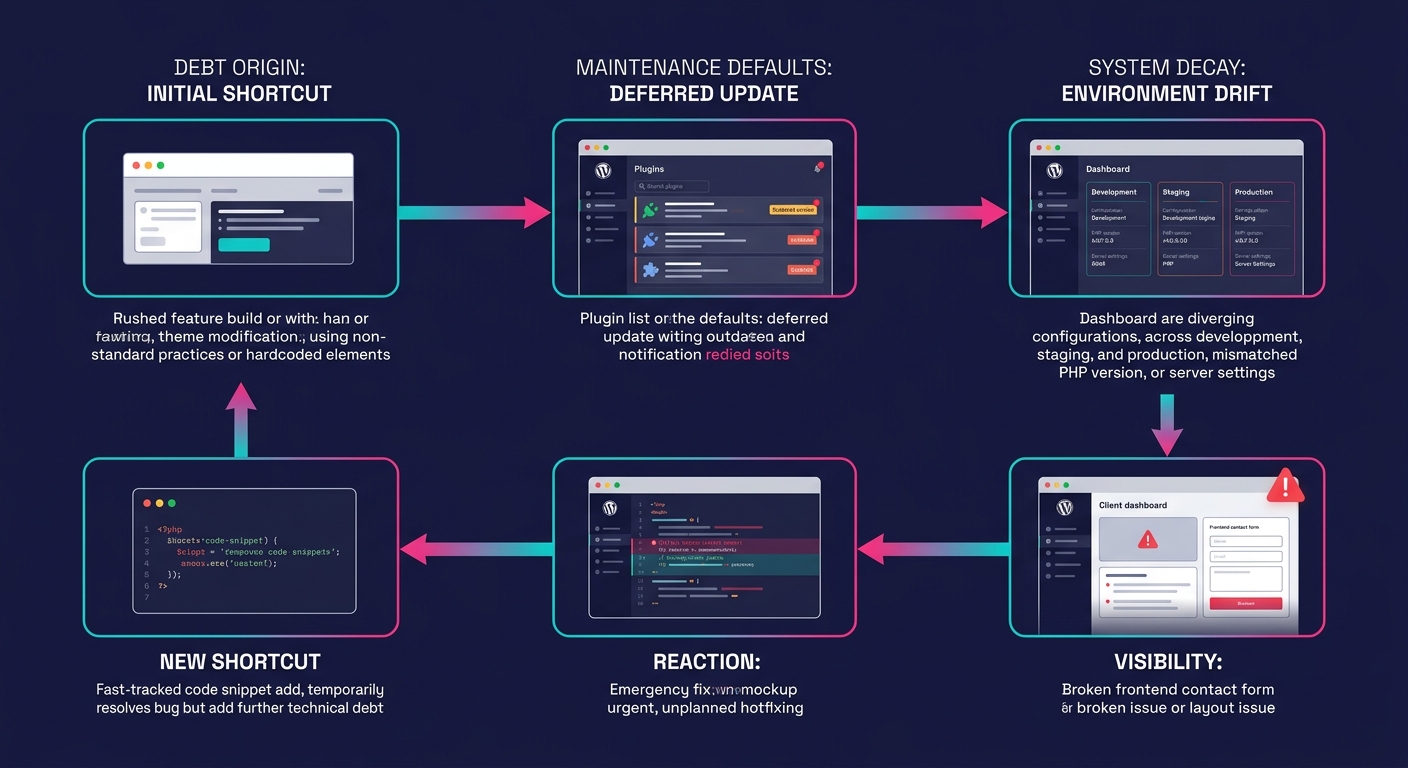
The Software Improvement Group's research on technical debt and IT budgets identifies insufficient governance and quality assurance as the primary accelerant: when QA processes aren't embedded into the development lifecycle, debt accumulates undetected and its costs compound over time. In white-label WordPress delivery, governance failures take specific and predictable forms. Development environments drift from production configurations, so fixes tested in staging break differently on live sites. Code review standards vary between the agency's internal team and the white-label partner's developers. Plugin update schedules get deferred because nobody owns the decision of when to push updates across a portfolio of 50 sites with varying customization levels.
The environment parity problem alone accounts for a disproportionate share of white-label technical debt. When your staging environment runs PHP 8.2 but three client sites still run PHP 8.0 because a legacy plugin hasn't been updated, every deployment carries implicit risk. Agencies that maintain role-scoped permissions across multisite installations reduce one category of governance failure, but permissions are a fraction of the problem. The deeper issue is that white-label WordPress portfolio management requires a maintenance governance model that most agencies never build because the cost of building it feels unjustifiable against any single client's revenue contribution.
Modern frameworks like Sage and Bedrock help manage debt by enforcing better practices from the start, separating concerns properly, using dependency management, and providing clear project structure. But adopting these frameworks retroactively across a portfolio of 40 sites originally built on disparate starter themes and plugin configurations is a migration project, not a configuration change. The governance gap between "knowing the right architecture" and "having the budget and authority to implement it across every active client site" is where most agency technical debt lives permanently. Allocating 10 to 20% of sprint capacity to refactoring and cleanup, as systematic audit approaches recommend, requires a cultural shift that treats debt reduction as billable infrastructure investment rather than overhead.
The governance gap between knowing the right architecture and having the budget to implement it across every active client site is where most agency technical debt lives permanently.
Where the Accounting Stays Blind
The uncomfortable part of this argument is that the standard tools agencies use to track profitability are structurally incapable of surfacing white-label margin erosion caused by technical debt. Project management platforms track hours against scopes. Accounting software tracks revenue against cost of goods sold. Neither system captures the 45 minutes a developer spends investigating why a contact form broke after a plugin update that wouldn't have broken anything if the original build hadn't overridden a core function three years ago. That 45 minutes gets logged as "support," averaged into a monthly retainer cost, and absorbed. Across a portfolio of 50 clients, those absorbed minutes aggregate into one or two full-time developer salaries' worth of untracked debt servicing annually.
This is why agencies that build examples of their work around clean, well-maintained portfolio sites tend to attract clients who value ongoing quality—and why agencies that optimize solely for acquisition volume find themselves trapped in a cycle where each new client adds proportionally more maintenance burden than revenue. The design system debt that accumulates under customization pressure mirrors this same pattern at the component level: flexible theming promises scalability until the 15th client's brand requirements push the shared system past its structural limits, and every subsequent client site inherits the instability of the workarounds required to accommodate the ones before it.
What remains genuinely unresolved is whether any agency pricing model adequately accounts for the compounding nature of this cost. Retainer pricing amortizes maintenance across months but doesn't scale with debt accumulation. Per-ticket pricing creates an incentive to fix symptoms rather than root causes. Value-based pricing sidesteps the question entirely by anchoring to client outcomes rather than internal costs, which works until the internal costs overwhelm the margin regardless of what the client perceives they're paying for. The honest answer is that white-label technical debt operates on a timeline and at a granularity that existing agency financial models weren't designed to see, and until the tooling and the accounting catch up, the compounding will continue to be felt before it's measured.