

Boutique WordPress agencies face three realistic paths to scale delivery beyond a small internal team: freelance marketplace sourcing, dedicated white-label agency partnerships, or a hybrid model blending both. Each carries distinct tradeoffs in cost predictability, quality consistency, and how far the model actually stretches before it breaks.
TL;DR: Freelance pools offer the lowest entry cost but collapse under volume. Dedicated white-label partners deliver consistency at higher minimums. The hybrid approach—keeping strategy internal while distributing builds across 2-3 vetted partners—gives most boutique agencies the best balance of margin and capacity for outsourced WordPress delivery.
The Three-Path Capacity Framework
Before diving into each option, it helps to name what you're evaluating. Agency capacity scaling decisions come down to three measurable axes: cost predictability (how stable is your per-project spend?), quality consistency (does output stay even across 5, 10, 20 concurrent builds?), and scale ceiling (at what point does the model stop absorbing new projects?). Every path below performs differently on these three axes, and the right choice depends on where your agency sits today, how many concurrent WordPress projects you're managing, and what your margins need to look like in 12 months.
Hiring a full-time senior WordPress developer runs between $80,000 and $120,000 per year in salary alone, before benefits, equipment, management overhead, and the 3-to-6-month recruiting timeline. That math is what drives agency growth without hiring in the first place. The question is which alternative model holds up under real client load.
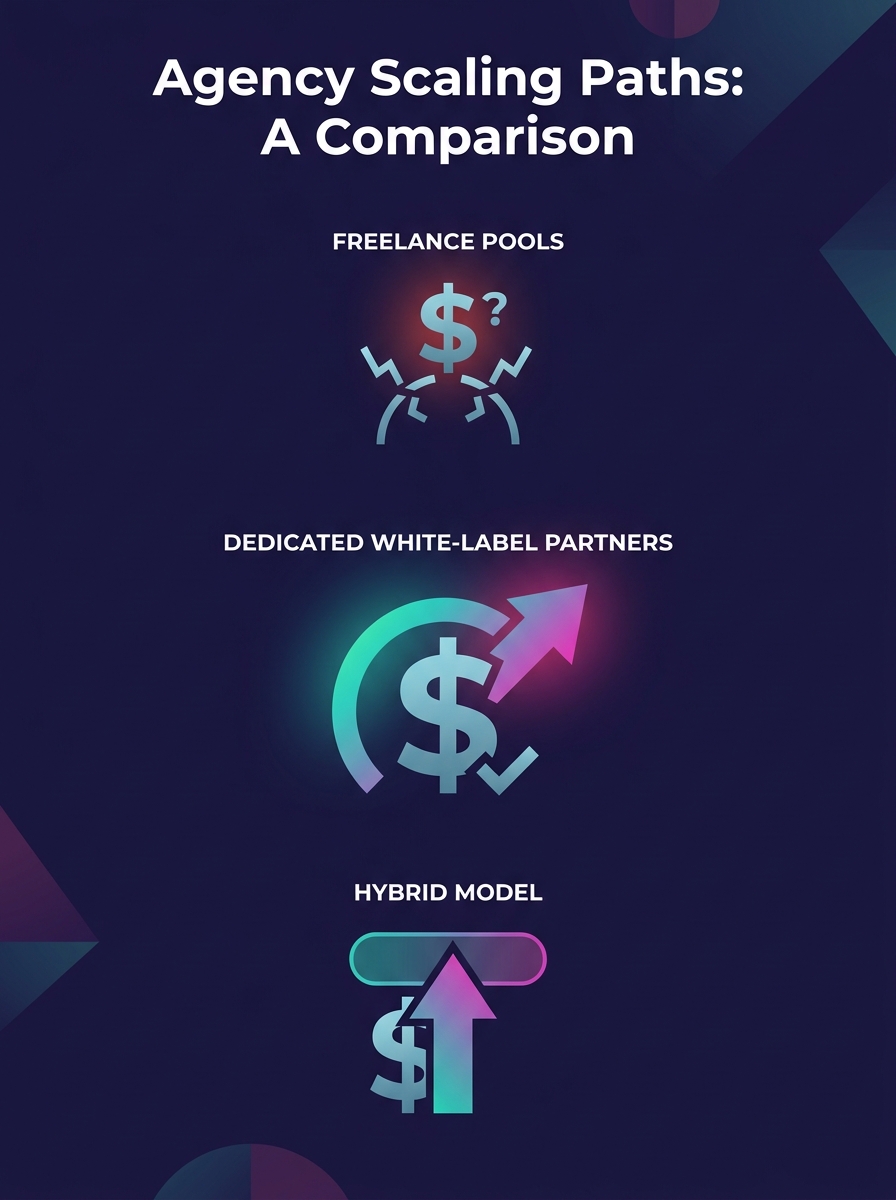
Freelance Marketplace Pools
Platforms like Upwork and Freelancer.com give you access to thousands of WordPress developers within hours. You post a project, review portfolios, and have someone writing code by the end of the week. For agencies running fewer than 3 concurrent client builds, this can work fine. Entry cost is near zero. You pay per project or per hour, there's no monthly commitment, and you can test multiple developers simultaneously.
The problems show up at volume. When you're juggling 8 or 10 client sites, freelance pools introduce three specific failure modes. First, availability becomes unpredictable. Your best freelancer takes a full-time job, and you're back to vetting. Second, quality variance spikes. One developer writes clean, accessible markup; the next delivers bloated page builders layered three deep. Third, you absorb the project management burden entirely. Every freelancer needs onboarding, every handoff needs documentation, and every revision cycle lands on your calendar.
The financial picture looks attractive on paper. Hourly rates range from $25 to $75 depending on geography and specialization, and you can mark up that labor 30% to 60% when billing clients. An $8,000 build cost becomes a $12,000 to $15,000 client invoice. But the hidden cost is your own team's time spent managing fragmented relationships. Agencies that try to scale past 6 or 7 concurrent projects through freelance pools alone typically find their internal team spending 15 to 20 hours per week on coordination that produces zero billable revenue.
Warning: The single biggest risk with freelance pools is the silent quality drop. When you're managing 4 freelancers across 8 projects, you won't catch the developer who skips mobile testing or ignores accessibility until a client complains. Build a [quality scorecard](/blog/partner-vetting-quality-scorecard-wordpress) before you hit that volume, not after.
Cost predictability: Low. Rates fluctuate, scope creep is harder to manage with individual contractors, and replacing a freelancer mid-project can double your budget.
Quality consistency: Variable. Depends entirely on individual developers, with no organizational quality layer between you and the code.
Scale ceiling: Around 6 to 8 concurrent projects before coordination overhead consumes your internal team.
Dedicated White-Label Agency Partnerships
A dedicated white-label WordPress partner operates as an invisible extension of your agency. As SiteMile's 2026 analysis of white-label providers emphasizes, the vetting criteria that matter most include strict NDAs, branded handoffs with no client-facing contact from the partner, and proven agency-volume experience. You're buying a team, a process, and a quality layer rather than renting individual hours.
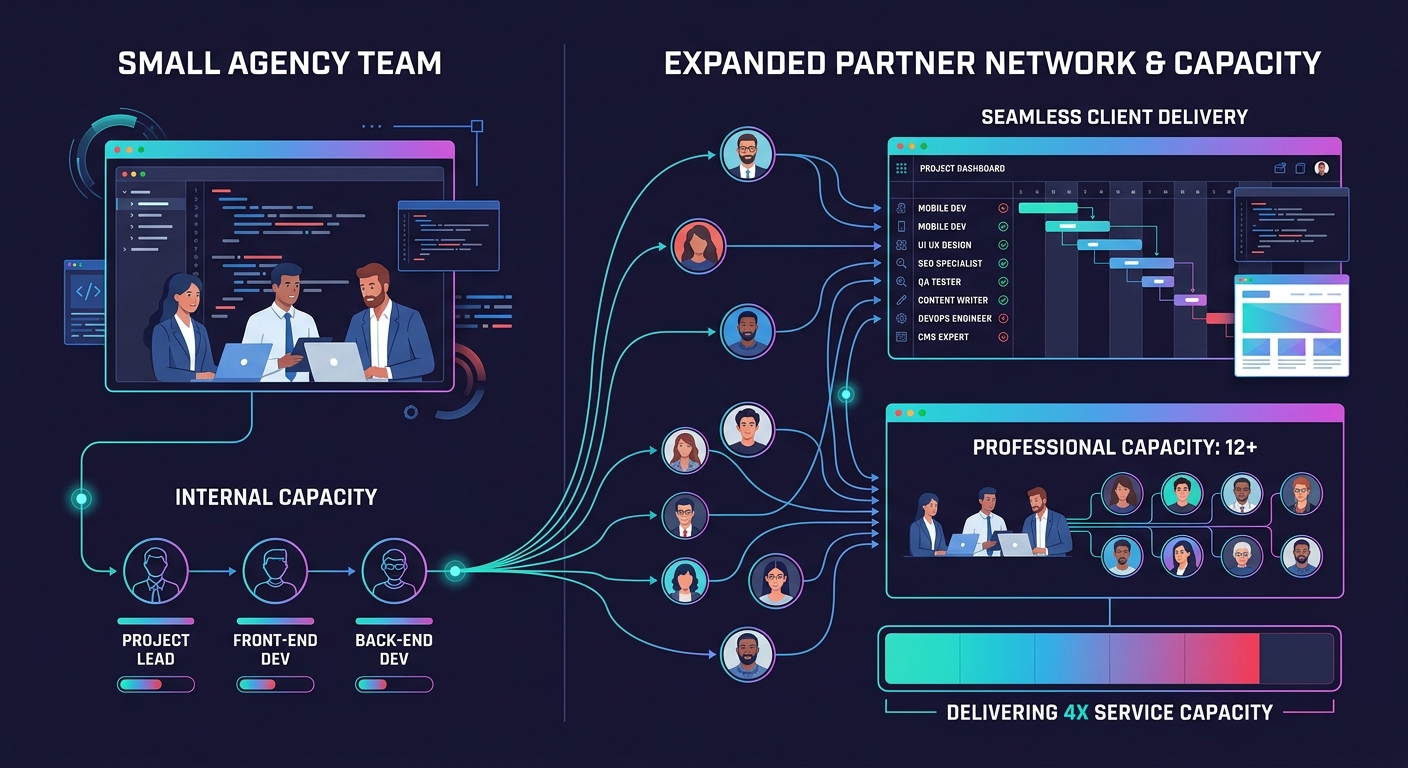
The capacity numbers are where this model separates from freelancing. Agencies using dedicated white-label partnerships report handling 40% to 60% more client work without adding headcount. Partner network expansion at this level means your 3-person internal team can realistically support 12 to 15 concurrent WordPress builds because the partner handles development execution while you retain client relationships, strategy, and creative direction.
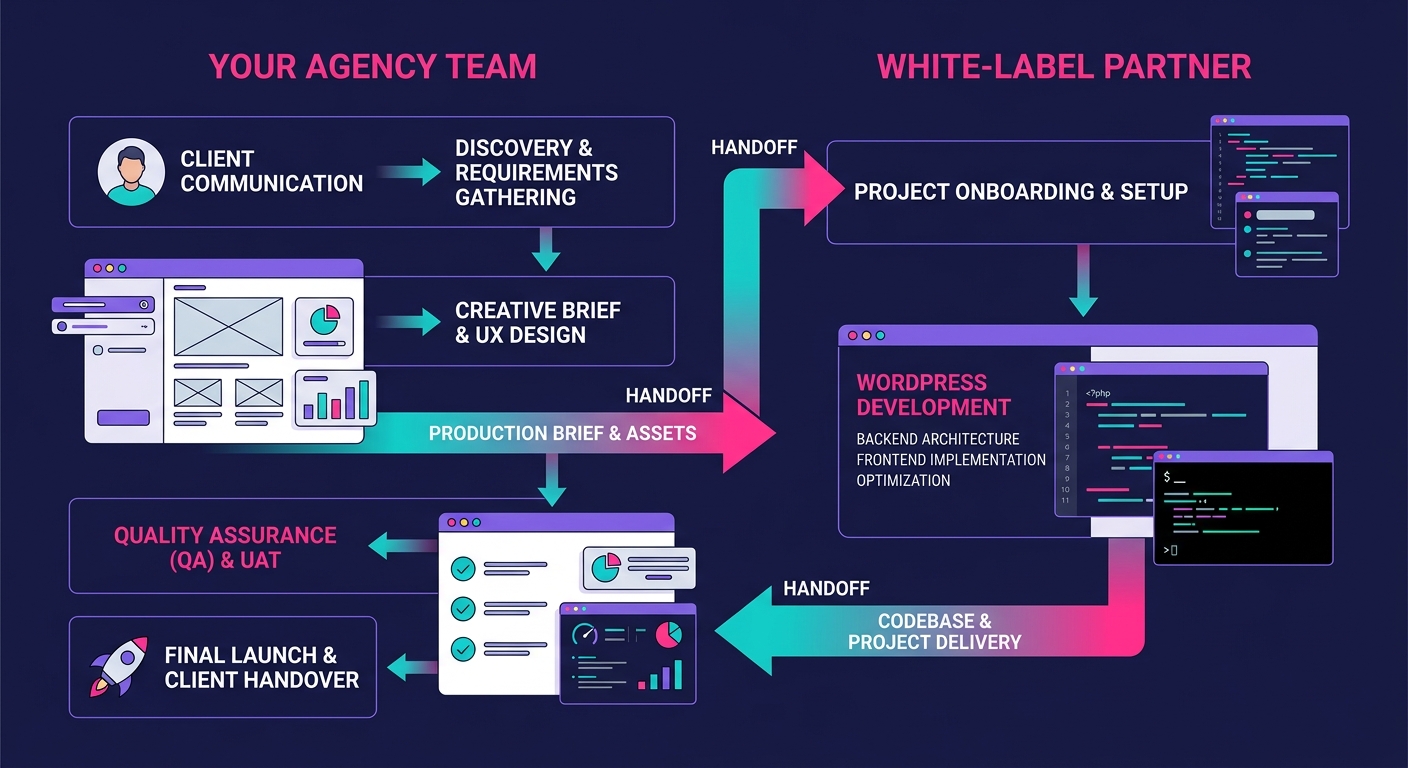
The tradeoff is upfront investment. Good white-label partners require minimum monthly commitments, pilot project periods, and operational alignment. You'll spend 2 to 4 weeks integrating communication workflows before the first client project ships. And the per-project cost runs higher than freelance rates because you're paying for project management, QA, and organizational reliability baked into the partner's pricing.
One area that trips agencies up is the requirements handoff. When you outsource WordPress delivery to a dedicated partner, ambiguous project briefs cause the same revision spirals you'd see with freelancers. The difference is that a structured partner will push back on vague scopes, which protects both sides. Agencies that implement scope lock protocols before sending briefs to partners report cutting revision rounds by more than half.
Cost predictability: High. Monthly retainers or per-project pricing with defined scope. You know your cost before the build starts.
Quality consistency: High, assuming proper vetting. The partner maintains internal standards, code reviews, and testing processes independent of your oversight.
Scale ceiling: 15 to 25+ concurrent projects, depending on partner capacity. Some white-label agencies serve dozens of agency clients simultaneously.
The Hybrid Model That Actually Scales
The hybrid approach keeps 2 to 3 senior developers on your internal team for client-facing work, rush fixes, and strategic builds while routing 60% to 70% of standard WordPress delivery through 2 or 3 vetted white-label partners. This is the model that takes an agency from 3 internal developers to a functional capacity of 12 or more delivery professionals without a single W-2.
Why multiple partners instead of one? Specialization and risk distribution. One partner handles WooCommerce migrations and custom plugin work. Another focuses on content-heavy sites built on block themes or ACF. A third covers maintenance, updates, and ongoing support retainers. If one partner hits a capacity wall during your busy season, the others absorb overflow.
The financial structure here protects your WordPress pricing margins better than either pure model. Your internal team handles the 20% to 30% of projects that carry the highest margins (custom enterprise builds, complex integrations, long-term retainers with strategic components). Your partners handle the 70% to 80% of builds that are more standardized (brochure sites, template-based redesigns, WooCommerce setups) where the margin on a $10,000 to $15,000 project still nets you $3,000 to $5,000 after partner costs.
The hybrid model works because it matches your agency's internal expertise to the projects that need it most, while treating everything else as a capacity problem with a known solution.
The operational risk here is coordination complexity. Managing 2 or 3 partner relationships requires documented workflows, consistent brief formats, and clear routing logic that determines which partner gets which project. But that's a systems problem, and systems problems have systems solutions. Slack channels per partner, shared Trello or Asana boards with standardized columns, and weekly 15-minute syncs keep the machine running.
Start with a pilot. Migrate 2 to 5 existing client projects to your first partner before adding a second. Validate delivery quality, communication speed, and revision handling on real work. Then expand methodically—add a second partner only after the first relationship produces consistent results across 8 to 10 delivered projects.
Cost predictability: Moderate to high. Internal team costs are fixed; partner costs are predictable per project. Total spend is forecastable within 10% to 15%.
Quality consistency: High, provided you vet partners thoroughly and maintain internal QA as the final checkpoint before client delivery.
Scale ceiling: 20 to 30+ concurrent projects. The ceiling moves upward as you add partners.
How the Three Paths Compare Side by Side
| Attribute | Freelance Pools | Dedicated White-Label Partner | Hybrid Model |
|---|---|---|---|
| Setup time | Hours to days | 2-4 weeks | 4-8 weeks |
| Monthly minimum | None | $3,000-$10,000+ | Varies by partner mix |
| Per-project cost | $2,000-$8,000 | $5,000-$15,000 | Blended, lower average |
| Concurrent project ceiling | 6-8 | 15-25+ | 20-30+ |
| Quality variance | High | Low | Low with internal QA |
| Management overhead | 15-20 hrs/week at scale | 3-5 hrs/week | 5-8 hrs/week |
| Risk if provider leaves | Significant | Moderate (team-based) | Low (redundant partners) |
| Best for revenue range | Under $300K/yr | $300K-$1M/yr | $500K+ /yr |
Who Should Pick Which
Agencies billing under $300,000 annually with 1 to 3 concurrent WordPress projects should start with freelance pools and invest the savings in building the operational documentation (brief templates, QA checklists, staging protocols) they'll need when they graduate to partners. The freelance model's weakness at scale is real, but at low volume, its flexibility is an advantage.
Agencies between $300,000 and $1 million in annual revenue that are turning away work or missing deadlines need a dedicated white-label partner. The 40% to 60% capacity increase without hiring is the inflection point that lets a small agency compete for mid-market projects it would otherwise decline. Pick one partner, run 5 pilot projects, and evaluate using a structured vetting scorecard before committing to a retainer.
Agencies above $500,000 that want to push past $1 million without building a 10-person development team should adopt the hybrid model. Keep strategy, client relationships, and final QA internal. Route standard WordPress delivery through 2 to 3 specialized partners. This is white-label WordPress scaling at its most intentional—your agency grows its revenue and project count while your payroll stays lean, your margins stay healthy, and your capacity flexes with demand instead of sitting idle during slow months.
The path from 3 developers to 12 delivery professionals isn't a hiring plan. It's a partner network expansion plan with clear routing rules, documented handoff processes, and enough operational discipline to treat outside teams like an extension of your own. The agencies that scale this way tend to keep scaling. The ones that try to hire their way to the same capacity tend to stall at 6 or 7 people, burdened by overhead they can't shed when a slow quarter hits.