

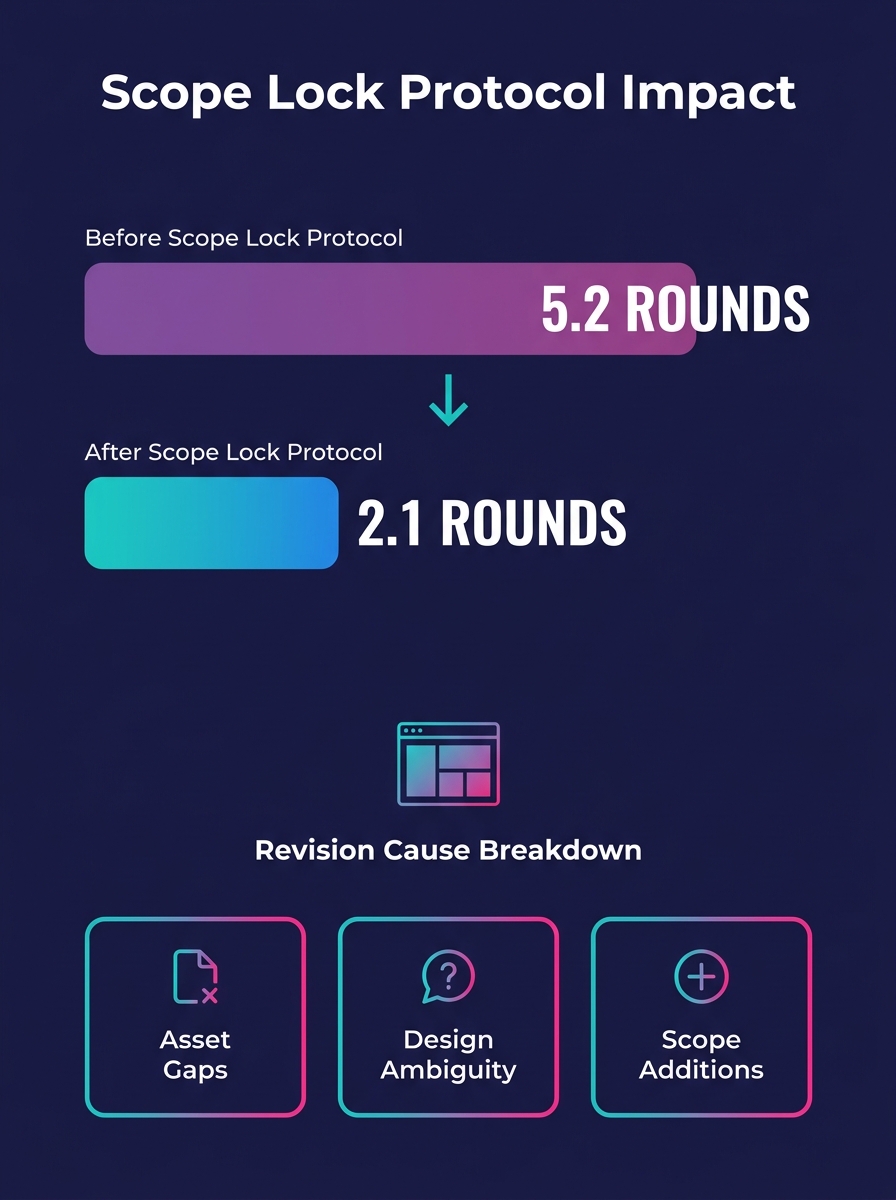
A mid-size digital marketing agency running white-label WordPress builds across 14 concurrent client accounts introduced a three-gate scope lock protocol in early 2026 and dropped its average revision rounds from 5.2 per project to 2.1 within 90 days. The protocol's core mechanic is straightforward: no build phase begins until the previous phase receives a documented, criteria-specific sign-off from both the agency partner and the production team.
The Revision Hemorrhage Before the Gates
The agency's delivery logs from 2025 told a brutal story. Across 47 completed WordPress client delivery projects, the team averaged 5.2 revision rounds per build. Each round consumed between 3.8 and 6.1 billable hours depending on complexity, and roughly 38% of those revisions addressed items that should have been resolved before development started: brand color mismatches, missing logo assets, ambiguous navigation structures, and contradictory wireframe annotations.
That 38% figure matters because it represents pure waste. The developer wasn't building the wrong thing because they lacked skill. They were building the wrong thing because nobody locked the inputs. Creative agencies broadly face this problem. Research from The Klay Studio's analysis of revision cycles found that agencies implementing structured review processes save between 15% and 45% of total project hours within the first quarter of deployment. One New York-based branding firm documented a $120,000 annual cost reduction by adding audit gates across all deliverables. The pattern is consistent: unstructured handoffs generate unstructured revisions.
This agency's problem was typical of what we see in white-label projects that fail at the requirements stage. The brief existed, technically. But "brief exists" and "brief is locked" are two very different operational states. Their briefs contained phrases like "modern feel" and "clean layout" without reference images, pixel specs, or component inventories. Each phrase became a revision round.
Three Gates, Three Sign-Off Criteria Sets
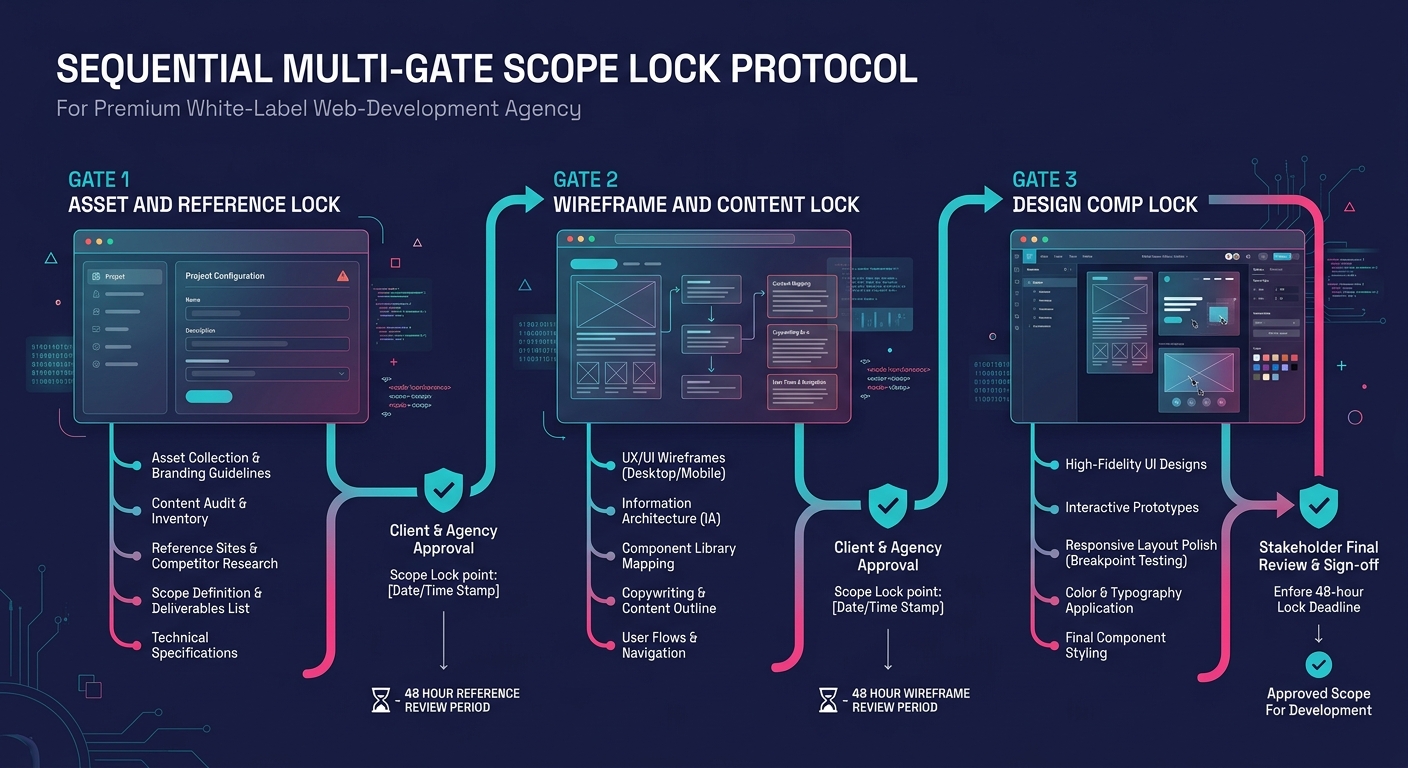
The scope lock protocol the agency adopted uses three sequential gates. Each gate has a defined checklist, a required sign-off from the partner agency, and a 48-hour window for approval. If the window passes without response, the project pauses rather than proceeding on assumptions.
Gate 1: Asset and Reference Lock. Before any design or development begins, the partner agency must deliver every brand asset (logos in SVG and PNG at minimum three sizes, brand color hex codes, typography files or Google Fonts specifications, and photography/iconography libraries). The gate also requires three to five reference URLs showing layouts and interactions the client has approved. The checklist has 22 items. If any item is missing, the gate doesn't open.
Gate 2: Wireframe and Content Lock. After the production team delivers wireframes, the partner agency has 48 hours to approve the information architecture, page structure, navigation hierarchy, and content placement. The approval form isn't a single "looks good" email. It's a page-by-page sign-off document where the reviewer initials each section. Content must be final, not placeholder. Lorem ipsum in a wireframe sign-off document is an automatic gate rejection.
Gate 3: Design Comp Lock. Full-fidelity design comps receive a similar section-by-section approval. The sign-off document explicitly states that post-approval changes to layout, color, typography, or component structure constitute a scope change and trigger a change order with a separate timeline and cost estimate.
The framework resembles what Ravetree identified in their workflow optimization research as the key margin driver: agencies that increase profitability by 30% to 50% do so through operational discipline, not by raising rates or adding clients. Scope management sits at the center of that discipline.
"Brief exists" and "brief is locked" are two very different operational states. Each ambiguous phrase in an unlocked brief becomes a revision round.
Agencies that have already worked on standardizing their white-label partner briefs will recognize the structure. The scope lock protocol extends brief standardization into the build phases, turning what's usually a one-time document into a recurring enforcement mechanism.
Enforcing the Gates Without Destroying Partner Relationships
The hardest part of this scope lock protocol wasn't designing the gates. It was enforcing them without alienating the partner agencies sending work. Agency project management depends on relationships, and telling a partner "your brief isn't ready, we're pausing" can feel adversarial if the framing is wrong.
The agency solved this with two specific tactics. First, they built the gates into the onboarding contract. Every new partner receives a scope lock protocol document during the partnership kickoff that explains the three gates, the sign-off criteria, and the 48-hour windows. The document includes a section showing the agency's own historical data: 5.2 average revision rounds without gates, 2.1 with gates, and the associated cost difference per project. When partners see that the protocol protects their margins too, resistance drops.
Second, they created templated sign-off forms in Google Docs with conditional formatting. Each form auto-highlights incomplete fields in red. A partner can't submit the form until every field is filled, which eliminates the "I thought that section was optional" conversation. The templates take about 15 minutes to complete per gate, according to the agency's time-tracking data across 31 projects that used the full protocol.
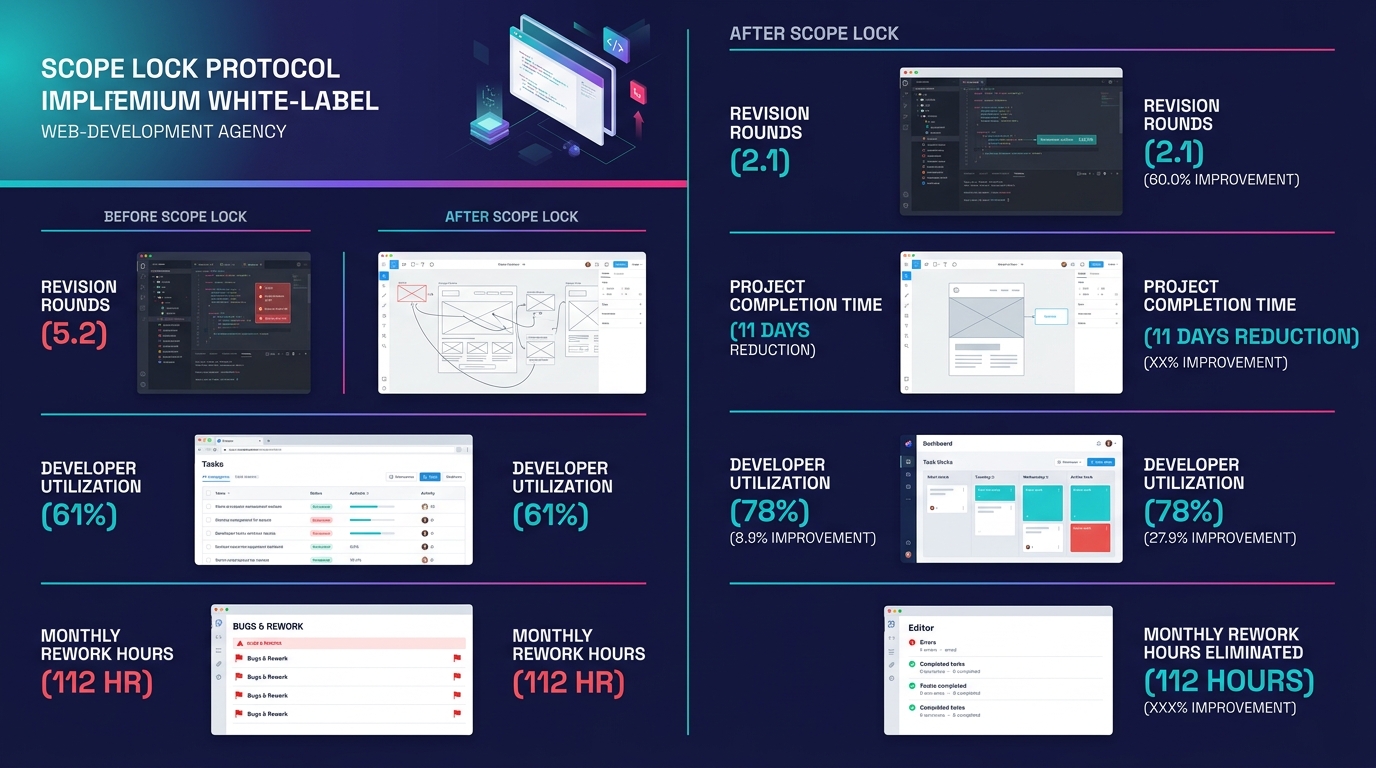
The 48-hour pause mechanism proved especially important. Before the protocol, developers would fill gaps with assumptions when assets were missing. A missing hero image might get replaced with a stock photo the developer chose. That stock photo would get rejected in review, triggering a revision round that cost 2-4 hours. Multiplied across 8-12 pages per site and 14 concurrent projects, those assumption-driven revisions consumed an estimated 112 hours per month.
This connects to a broader pattern we've written about regarding communication protocols that actually stick in white-label onboarding. The protocol works because it removes the need for judgment calls. Developers don't decide whether an asset gap is minor enough to work around. The gate decides.
Info: The 48-hour pause window is the protocol's most controversial element. Partners occasionally push back on the delay. But pausing for 48 hours at Gate 1 is consistently cheaper than absorbing three extra revision rounds during development, which the agency's data showed averaged 14.4 hours of rework per project.
The 90-Day Revision Data
After 90 days and 31 completed projects using the full three-gate scope lock protocol, the numbers told a clear story. Average revision rounds dropped from 5.2 to 2.1 per project, a 59.6% reduction that the agency rounds to 60%. Average project completion time decreased by 11 days. Developer utilization on billable work increased from 61% to 78%, because fewer hours went to unbilled rework.
The remaining 2.1 revision rounds per project break down into two categories. Roughly 1.4 rounds address legitimate design refinement where the client sees the built page and wants to adjust content hierarchy, CTA placement, or image selection within the approved layout structure. These revisions are expected and budgeted. The other 0.7 rounds come from technical implementation questions about responsive behavior, animation timing, or plugin-specific rendering differences that the wireframe couldn't fully specify.
Research on cycle time reduction from academic case studies confirms what this agency's data shows: reducing cycle time improves competitiveness against businesses offering similar services to the same customer base, because faster delivery at consistent quality creates a durable operational advantage. The savings compound. Fewer revision rounds mean shorter project timelines, which mean higher throughput per developer, which means the agency can take on more concurrent projects without adding headcount.
For agencies already tracking where their QA processes collapse under scale, the scope lock protocol addresses the upstream cause. QA catches defects. Scope lock prevents defects from being introduced.
The Sign-Off Document as Revenue Protection
The scope lock protocol's least discussed benefit is its effect on scope creep disputes. Before the protocol, the agency reported an average of 2.3 scope disagreements per month with partner agencies, situations where the partner insisted a requested change was part of the original brief and the production team disagreed. These disputes consumed project manager time, strained relationships, and often ended with the production team absorbing the cost to preserve the partnership.
After implementing the gated sign-off documents, scope disagreements dropped to 0.4 per month. The signed, section-by-section approval forms serve as unambiguous documentation of what was agreed at each phase. When a partner requests a post-Gate 3 layout change, the project manager can reference the specific sign-off line item and route the request through a change order process. The conversation shifts from "I think we agreed on X" to "here's the document you signed approving X."
White-label revision management, at its core, is a documentation problem dressed up as a creative problem. Agencies burn margin on revisions because they treat scope as a conversation rather than a contract. The three-gate scope lock protocol converts that conversation into three discrete, documented, enforceable agreements. And the 60% revision cycle reduction that results doesn't require better designers, faster developers, or more expensive tools. It requires forms, checklists, and the willingness to pause a project for 48 hours when the inputs aren't ready.
The agency still refines the protocol. Gate 1's checklist grew from 18 items to 22 after the first quarter, adding requirements for favicon files, Open Graph image specifications, and 404 page content that were initially overlooked. Gate 2 now includes a mobile-first wireframe requirement after three projects hit revision cycles caused by desktop-only wireframe approvals. Each revision to the protocol itself follows the same principle: if a recurring revision type can be prevented by locking an input earlier, add it to the gate.