

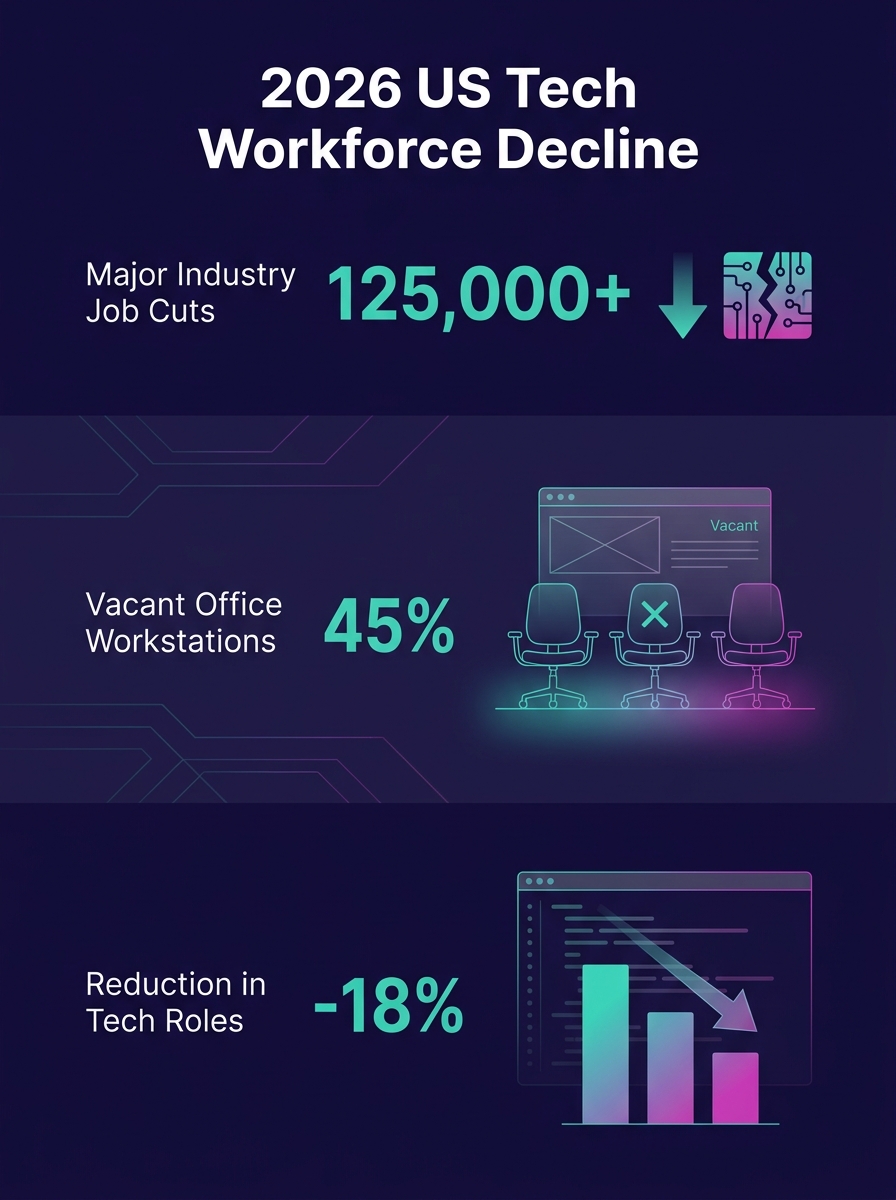
US technology companies announced 38,242 job cuts in May 2026—the sector's heaviest single month of reductions since August 2024—bringing year-to-date layoffs to 123,653, according to outplacement firm Challenger, Gray & Christmas data published by Bloomberg. The driver has shifted from pandemic-era overcorrection to explicit AI adoption restructuring, with Cisco, Meta, Oracle, and Block all linking reductions to workflow automation.
TL;DR: US tech layoffs topped 123,000 through May 2026, with companies now citing AI workflow adoption rather than pandemic rightsizing as the primary justification for workforce reductions.
Year-to-date cuts are up 65% from the same period in 2025, with Q1 2026 alone recording 81,700 layoffs—the highest quarterly figure since early 2023, according to KRON4 citing Layoffs.fyi and Statista data. By mid-May, 137 companies had conducted layoffs affecting more than 108,000 employees. The TrueUp layoffs tracker reports 368 separate reduction events at tech companies in 2026, impacting 150,096 people at roughly 950 per day.
The May spike marks a turning point in both scale and rationale. Where 2023's wave centered on post-COVID overcapacity corrections, 2026 reductions are structurally tied to automation. Companies are not trimming pandemic-era hiring excesses—they are reorganizing around AI-augmented workflows that require fewer developers per output unit.
AI Displacement Replaces Overcapacity Narrative
Cisco, Meta, Oracle, and Block have been "explicitly clear that the layoffs are motivated by a push toward AI adoption," according to the KRON4 analysis of Layoffs.fyi data. LinkedIn cut several hundred positions in recent rounds. The pattern spans both legacy infrastructure vendors and platform companies.
Anthropic co-founder Jack Clark revealed this week that Claude now writes 80% of the company's code and could reach 100% within a couple of years, according to Crypto Briefing. Clark described 8× productivity gains for engineers using Claude Code. The same tooling that is reshaping work inside frontier AI labs is now driving employment decisions across the broader industry.
The skills being cut are increasingly the ones AI can replicate—routine coding, basic data analysis, standard QA workflows. The skills companies are retaining center on system architecture, product strategy, research direction, and what Anthropic describes as "research taste"—the judgment to identify which problems warrant solving.
Offshore Expansion Compounds Domestic Cuts
T-Mobile opened a 250,000-square-foot Global Capability Center in Hyderabad, India on June 4, 2026, with plans for roughly 1,000 employees by 2027—while conducting multiple rounds of US layoffs through late 2025 and early 2026. The company attributed some domestic reductions to AI adoption and efficiency drives, PhoneArena reported.
T-Mobile pushed back on characterizations that the India hub represented job transfers. "To say or imply that we shifted roles from the US to India is not accurate," a company spokesperson told PhoneArena, stating that the Hyderabad center formalized an existing team of long-term contractors and vendors rather than relocating US positions.
The timing—simultaneous domestic layoffs and a prominent offshore expansion—has drawn criticism. The pattern is not unique to T-Mobile; it reflects a broader dual pressure on domestic tech employment where companies pair AI automation with global talent arbitrage.
Retraining Programs Face Skepticism
A CNA commentary this week questioned whether corporate AI retraining programs represent realistic transition paths for displaced workers. "The second part sounds like a list of desirable traits, not a transition plan for laid-off workers," the piece noted regarding reskilling promises. Some laid-off workers are using AI tools to launch their own companies, according to the Straits Times, though outcomes remain uneven.
The net effect on builder communities depends on which side of the divide workers land—and how quickly they can adopt the tools that are displacing traditional roles. While 2026 cuts remain below the Q1 2023 peak of 160,000-plus layoffs, the current trajectory puts 2026 on track to rival 2023's total of 260,000 reductions. The difference is structural: companies are not trimming excess capacity but reorganizing around fundamentally altered workflows.
Agencies Implications
White-label agencies navigating capacity expansion without adding full-time headcount now operate in a market where both enterprise clients and competing agencies face identical AI-displacement pressures. The T-Mobile pattern—simultaneous offshore expansion and AI adoption—signals that mid-market clients will increasingly demand proof that agency partners deliver productivity gains comparable to what in-house teams could achieve with AI tooling.
Agencies that rely on traditional developer-hour arbitrage face compression from two directions. Enterprise layoff waves increase the supply of available freelance and contract developers, putting downward pressure on hourly rates. At the same time, AI-augmented workflows inside client organizations raise the baseline productivity expectation for external teams. The 8× gains Anthropic reports are not aspirational—they define the new competitive threshold.
The structural shift creates an opening for agencies that build partner vetting protocols around AI-assisted output rather than raw developer hours. Clients experiencing layoffs internally are more likely to test white-label partnerships if those partnerships demonstrably deliver faster turnarounds than reduced in-house teams can manage. Scaling models that prove capacity expansion without headcount growth align with what clients are now doing internally—which makes the pitch easier but raises the bar on execution quality.