

Agencies that pay white-label WordPress developers per ticket get per-ticket behavior. The mechanism behind partner-class talent relationships works differently: retainer contracts, shared communication channels, and integrated toolchains create accumulated context that compounds delivery quality across every client in the portfolio.
TL;DR: The difference between a vendor and a partner is structural, not sentimental. Contract type, communication architecture, and toolchain integration determine whether your white-label developers accumulate useful context or reset to zero on every project. Evaluate relationships on all three dimensions before deciding what you actually have.
How Payment Structure Shapes Developer Behavior
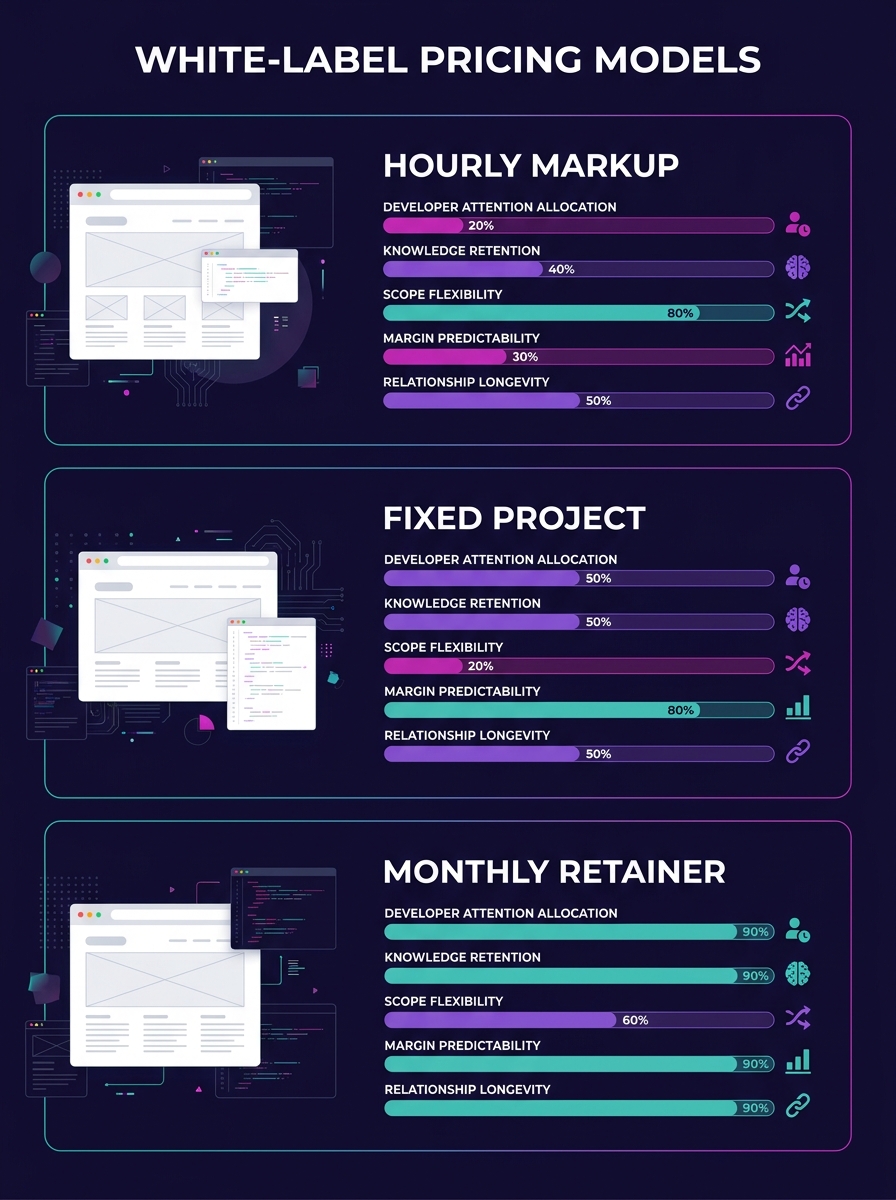
The pricing model you choose for your white-label developer relationships dictates how those developers allocate attention, manage risk, and prioritize your work relative to other clients. Three models dominate WordPress outsourcing strategy, and each creates different incentive structures that cascade through every project.
Hourly pass-through with markup—typically 30–50% above the developer's rate—rewards time spent. The developer has no reason to optimize for efficiency and no incentive to learn your agency's patterns. Fixed project fees reward speed: the developer finishes fast, moves on, and has zero motivation to invest in understanding your clients' long-term needs. Monthly retainers create something neither of the other models can: a shared time horizon. When a developer knows they'll be working with your agency next month, they start remembering your client's brand guidelines, your preferred plugin stack, and the quirks in your staging environment.
Startup agencies with fewer than three employees often default to white-label partnerships as their primary delivery model from day one. The contract structure they choose at launch shapes their entire operational DNA. Picking hourly billing because "we're small and can't commit" locks in a transactional dynamic that's expensive to unwind 18 months later.
The retainer model also changes how scope creep gets handled. In a per-project arrangement, every out-of-scope request triggers a change order negotiation. Under a retainer, the developer and agency absorb small fluctuations together, reducing the friction that kills agency partner management relationships. If you've dealt with the scope creep spiral on white-label projects, you know how much billable time those negotiations consume.
Shared Context vs. Ticket Queues
Why does communication architecture matter more than communication frequency? Because the channel determines what information persists and who can access it over time.
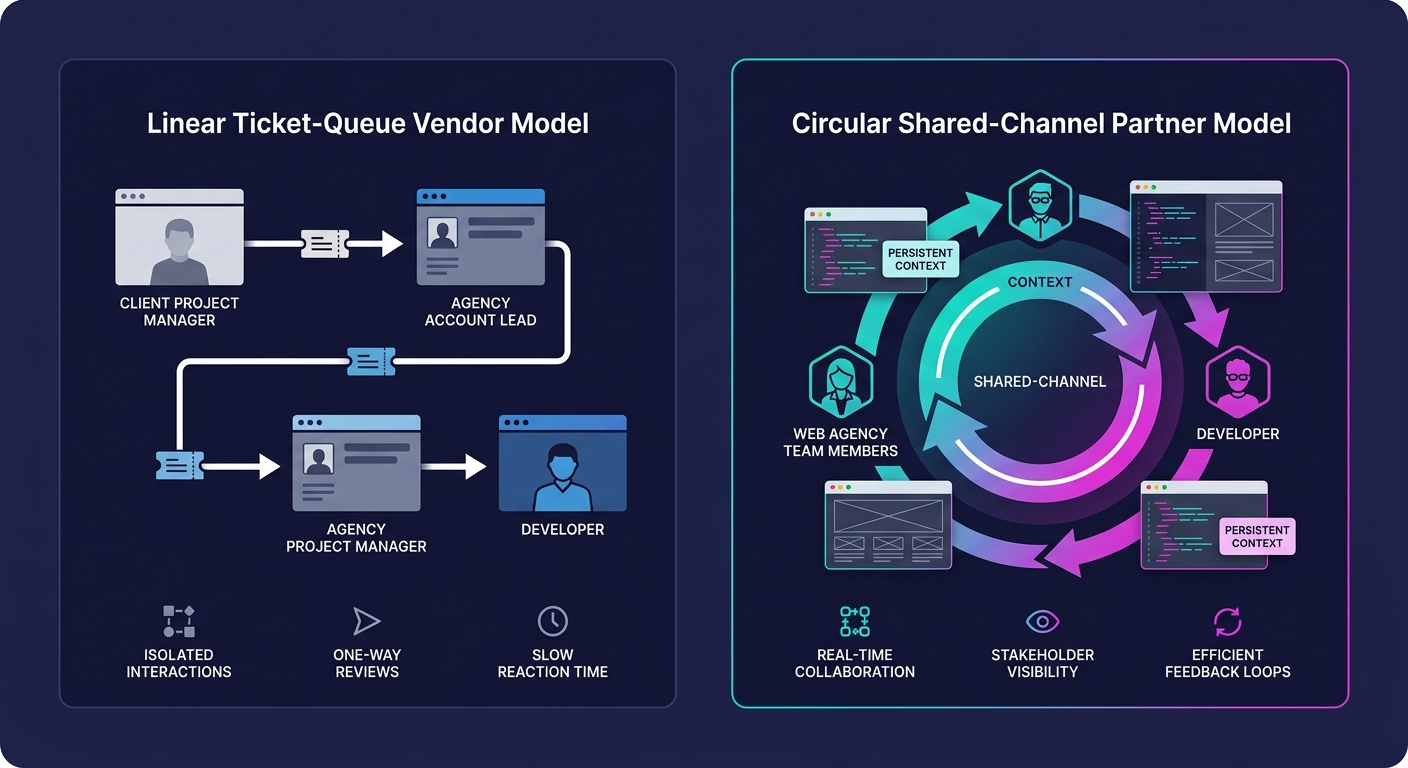
Vendor relationships run on ticket queues. You submit a request, a developer picks it up, completes it, and marks it done. The context for that request lives in the ticket. When the next request arrives, the developer reads a new ticket—often with incomplete background—and starts from scratch. Every interaction is self-contained and disposable.
Partner relationships run on shared channels: a Slack workspace, a shared project board in ClickUp or Monday, access to your agency's internal documentation. The developer sees the ongoing conversation. They read a client's design feedback from last Tuesday. They catch the notes from your account manager's call. This ambient context accumulates over weeks and months, producing developers who understand why your agency makes certain decisions, not just what to build next.
As The Office Gurus note in their analysis of the vendor vs partner agencies distinction: "Unlike a vendor focused solely on delivering a product or service, a partner is committed to your success and dedicated to building a lasting relationship." The structural reason that commitment is possible is shared context. A developer who can see your pipeline, your client feedback, and your internal priorities can make decisions that align with your agency's direction without explicit instructions every time.
This is where onboarding communication protocols matter so much. The first 30 days of a white-label relationship set the permanent pattern for how information flows. Agencies that invest in structured onboarding—shared style guides, documented plugin preferences, Slack channel hierarchies—build the infrastructure for a partner relationship. Agencies that send a project brief and wait for a deliverable build the infrastructure for a vendor transaction.
As 5k (formerly Conklin Media) frames it in their strategic marketing analysis: "One keeps you stuck approving tactics and micromanaging campaigns." The other drives growth tied to profit. The same dynamic applies to your development relationships: vendor-mode white-label developers require more management overhead per hour of productive output than partner-mode developers who've absorbed your agency's context.
Toolchain Integration as a Trust Signal
Giving a white-label developer access to your Git repos, staging servers, and project management tools is a trust decision. It also determines whether they can do partner-quality work or are capped at vendor-quality output.
A vendor receives a ZIP file of design mockups and a Word document of requirements. They build in their own environment, test against their own standards, and hand back a deliverable that your team then needs to deploy, test again, and fix environment-specific bugs on. The handoff friction is real, and the gap between a developer's local setup and your production stack causes a measurable percentage of post-delivery bugs.
A partner has direct access to your staging environment. They push code to the same Git repository your internal team uses. They run builds through the same CI/CD pipeline. They see the same error logs. This eliminates an entire category of integration bugs and reduces revision cycles substantially. Toolchain integration was a prerequisite for the agency that documented a 60% reduction in revision cycles after implementing structured scope lock protocols.
Partners working within your stack also catch problems that vendor-mode developers would never see. A developer with access to your WooCommerce error logs might flag a recurring timeout on a high-SKU store before the client complains. A developer receiving tickets in isolation would only learn about the problem when you file a bug report.
I evaluate white-label developer relationships on three axes. I call this the Integration Depth Score:
- Contract depth (1 = per-project, 2 = rolling SOW, 3 = monthly retainer)
- Communication depth (1 = email and tickets only, 2 = shared project board, 3 = shared Slack plus documentation access)
- Systems depth (1 = deliverable handoff, 2 = staging access, 3 = full Git and CI/CD integration)
A score of 3-4 means you have a vendor. A score of 5-7 is a preferred vendor. A score of 8-9 is a genuine partner. Agencies managing 100-500 client portfolios that grow profitably almost always operate at 8-9 with their primary white-label team.
The Feedback Loop That Drives Quality Gains
Vendor relationships have no built-in quality improvement mechanism. Each project is graded pass/fail, the vendor gets paid or doesn't, and the next project starts from a blank slate. If the work is bad enough, you fire them. If it's adequate, you keep sending tickets. There's no middle ground where quality actually gets better over time.
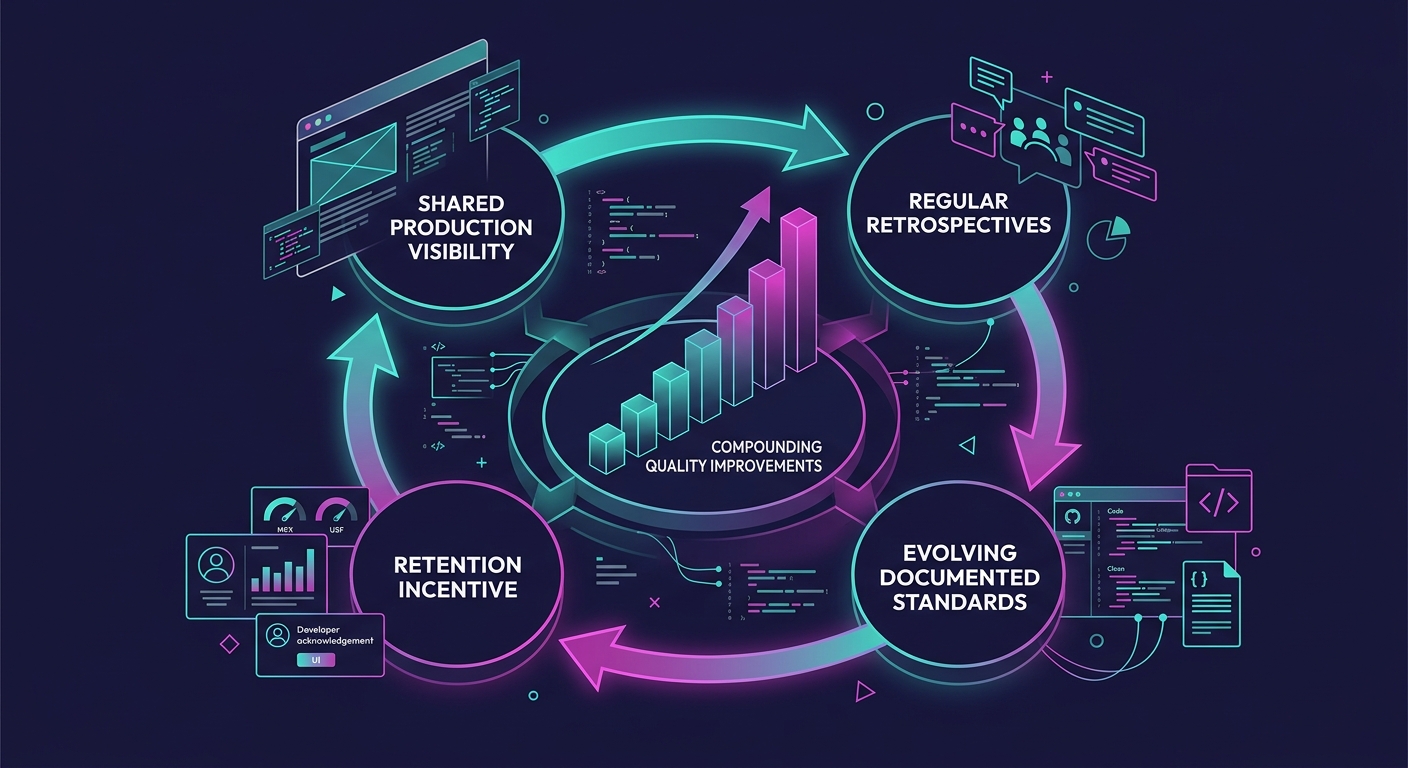
Partner relationships create a feedback loop with four components: shared visibility into outcomes (the partner sees how their code performs in production), regular retrospectives (even 15-minute bi-weekly syncs count), documented standards that evolve over time, and the white-label talent retention incentive created by the retainer model. When your agency tracks quality trend data across months rather than point-in-time assessments, you can measure whether the relationship is actually improving.
A developer who sees your production error logs, reads your client feedback, and knows they'll be working with you next month makes different decisions than a developer who receives a ticket and returns a ZIP file.
This feedback loop also compounds across clients. A partner-class developer who learns your agency's accessibility standards on Client A's site applies those standards automatically to Client B. Knowledge transfers between projects without your project manager specifying it every time. Over 12 months, this accumulated institutional knowledge represents thousands of dollars in avoided rework and skipped quality control steps.
Why Partners Compound and Vendors Plateau
Approximately 66% of American businesses outsource at least one department or process, according to industry data cited across multiple 2026 outsourcing analyses. The agencies that turn outsourcing into a growth engine rather than a cost center are the ones whose partner retention stays high, because switching costs in a partner relationship are genuinely steep. That's by design.
When a partner developer has 18 months of accumulated context about your client portfolio, replacing them means losing that context. Your new developer needs to relearn your style guide, your plugin preferences, your deployment workflow, your clients' brand personalities. For agencies running white-label development services across multiple builders like Elementor, Bricks, Divi, and ACF custom themes, that institutional knowledge about which stack works for which client type is worth more than the retainer itself.
This is also why the vendor model plateaus. Vendor-mode developers deliver consistent quality at best. They don't get better at serving your specific agency because the relationship architecture doesn't support learning. You can swap one vendor for another without losing much, which feels like flexibility but is actually a ceiling on how good your delivery can get.
As Studio FLACH writes: "A vendor relationship might feel faster or cheaper upfront, but a true partnership is what delivers transformational, long-term value." The mechanism behind that claim is compounding context. Every month a partner stays embedded in your operations, their effective productivity increases because they spend less time asking questions, less time misunderstanding requirements, and less time building things that need revision.
Agencies that scaled from small teams to managing 12+ white-label partners didn't get there by cycling through vendors. They built partner-class relationships with a small number of developers and let those relationships compound over years.
The Tradeoffs
The partner model has real costs and real risks that the vendor model avoids. Ignoring them leads to partner relationships that fail in predictable ways.
Concentration risk. When 80-90% of your delivery runs through one or two partner-class developers, losing one creates a genuine operational emergency. Vendor diversification—spreading work across five or six interchangeable providers—is a hedge against this. Agencies managing partner relationships need bench strength: a secondary partner running 10-20% of volume who can absorb overflow if the primary relationship breaks.
Higher floor cost. Monthly retainers cost money even during slow months. A vendor you pay per-project costs nothing when you have no projects. The retainer model requires enough pipeline consistency to justify the fixed expense, and agencies with lumpy, unpredictable project flow may not be able to sustain it.
Slower onboarding. Building a partner relationship takes 60-90 days before the developer has enough accumulated context to outperform a vendor-mode developer on your projects. During that ramp-up period, you're paying partner-class rates for vendor-class output. Agencies that evaluate white-label developer relationships on a 30-day trial are measuring the wrong timeframe entirely.
Mutual dependency. The same accumulated context that makes a partner valuable also makes the relationship harder to exit cleanly. Your deployment workflows, your documentation, your client communication patterns—they all start to assume this specific developer's presence. That's a feature when things work and a liability when they don't. The technical debt that accumulates in a deteriorating partner relationship is harder to unwind than in a clean vendor arrangement.
Warning: Agencies that build partner-class relationships without documenting processes, standards, and deployment procedures are creating single points of failure. The partner model works because accumulated context compounds. Compound effects cut both ways. Build exit procedures before you need them.
The agencies that make this model succeed accept the concentration risk, budget for the retainer floor, plan for the 60-90 day onboarding ramp, and build contingency procedures while the relationship is healthy. The mechanism itself is simple: context accumulates, quality compounds, and your clients get better work every quarter. Whether that mechanism serves you or traps you depends entirely on the structural decisions you make in the first 90 days.