

WP Services, a white-label WordPress maintenance provider, published a comprehensive agency scaling framework May 29, 2026, positioning third-party maintenance outsourcing as a direct alternative to hiring additional technical staff for digital agencies managing 15 or more client sites, according to the guide. The 12-section resource outlines service delivery models, per-site pricing structures, and margin calculations designed to help agency operators expand client capacity without proportional increases in payroll overhead.
TL;DR: WP Services released a white-label WordPress maintenance framework May 29 that positions third-party maintenance outsourcing as the primary scaling path for agencies managing 15+ client sites without adding developers to payroll.
The guide addresses what WP Services identifies as a recurring agency bottleneck: WordPress sites require daily updates, security patches, backups, and performance monitoring, consuming developer hours that scale linearly with client count. The framework proposes a service arrangement where specialized maintenance providers handle technical tasks under the agency's branding while the agency retains client relationships and billing control.
Service Scope and Predictable Cost Structure
White-label WordPress maintenance packages typically cover seven core functions, the guide notes: WordPress core updates, theme and plugin management, security monitoring and hardening, malware removal, performance optimization, automated backup systems, and uptime monitoring with branded client reporting. Providers operate without client-facing visibility, handling work through agency-branded dashboards and support tickets.
The pricing model follows a predictable per-site monthly fee structure, allowing agencies to build margin calculations based on fixed provider costs rather than variable hourly developer rates. WP Services positions this as distinct from freelance marketplace sourcing, emphasizing defined service-level agreements and structured processes over ad-hoc contractor relationships. Agencies looking to hire WordPress developers on retainer often face similar capacity planning challenges that white-label maintenance models attempt to address.
Testing Protocols and Quality Assurance
The framework dedicates substantial coverage to staging environment testing protocols, noting that comprehensive white-label providers test core, theme, and plugin updates in isolated staging environments before applying changes to live client sites. This testing layer addresses compatibility risks across diverse client site configurations without requiring agencies to maintain separate staging infrastructure for each client relationship.
Database optimization, caching configuration, image compression, and server response improvements fall under performance optimization services outlined in the guide. WP Services notes that site speed directly impacts visitor retention and conversion metrics, positioning ongoing performance monitoring as a client retention tool rather than a one-time project deliverable.
Security Monitoring and Incident Response
Security functions include continuous threat monitoring, file integrity scanning, login protection implementation, firewall rule configuration, and malware removal with site recovery when attacks succeed. The guide emphasizes 24/7 monitoring coverage as a differentiator from in-house teams operating standard business hours.
Automated backup systems with off-site storage and verified restore testing provide disaster recovery capabilities, the framework notes. WP Services specifies that backup verification—actually testing restore procedures rather than assuming backups function correctly—represents a critical quality control step many agencies skip when handling maintenance internally.
Support ticket handling represents the client-facing layer of white-label maintenance arrangements. Under this model, clients submit requests to the agency, which routes technical issues to the white-label provider for resolution. The provider resolves issues without direct client contact, and the agency delivers solutions under its own brand. This structure maintains client relationship ownership while outsourcing technical execution.
Margin Economics and Revenue Expansion
The guide presents white-label maintenance as a margin calculation exercise: agencies pay fixed monthly provider fees per site and bill clients at marked-up rates, with gross margins typically ranging from 30% to 60% depending on service tier and client billing structures. WP Services argues this model allows revenue growth faster than cost growth, breaking what it calls the "time-for-revenue trade" where developer hours directly limit agency income.
For agencies managing 30 client sites, the framework estimates white-label maintenance eliminates 60-90 developer hours monthly that would otherwise go toward update testing, security monitoring, and backup verification. Those reclaimed hours can redirect toward higher-margin custom development work or new client onboarding without headcount additions. The white-label margin math of pricing services to sustain growth remains a central challenge for agencies evaluating outsourcing models.
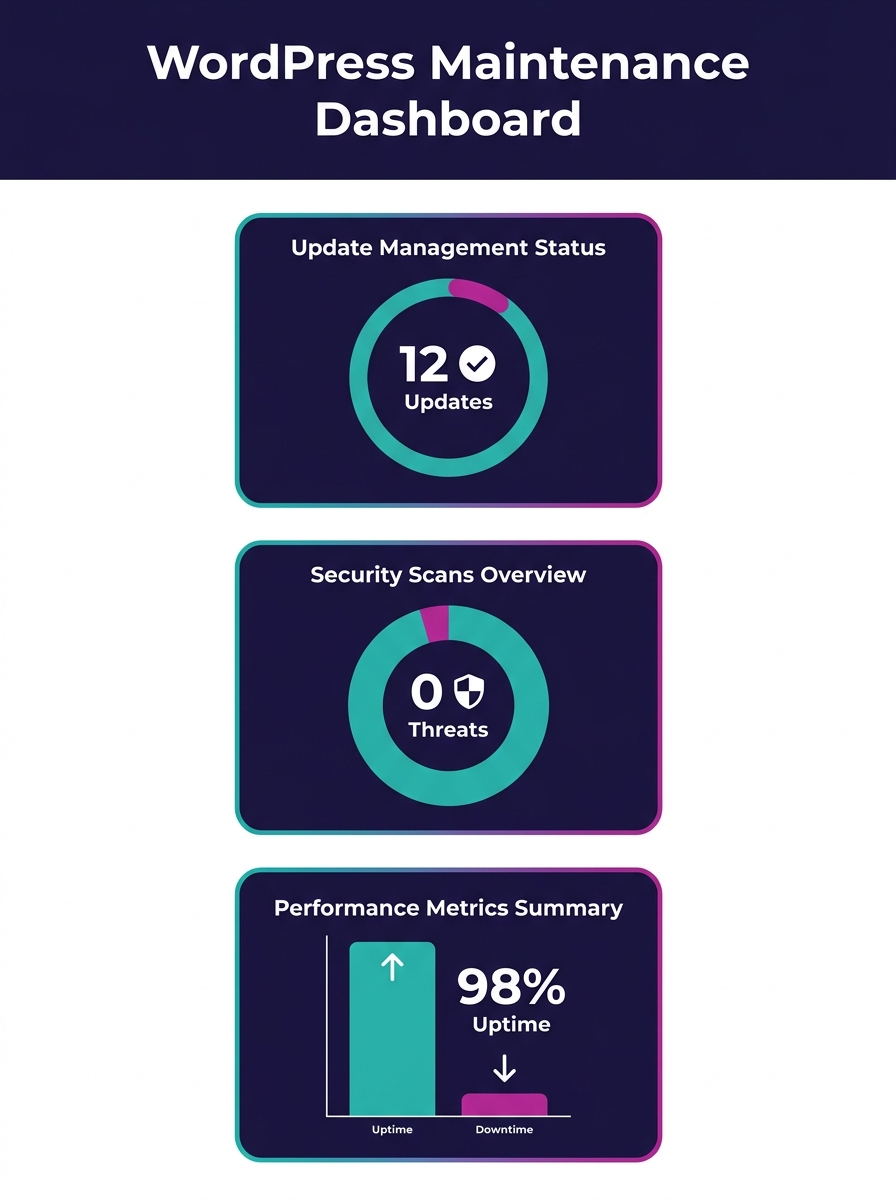
Monthly reporting provides branded client deliverables showing completed updates, security scan results, uptime metrics, and performance benchmarks. These reports serve as client retention tools, making invisible maintenance work visible to stakeholders who fund ongoing service contracts.
Partner Selection and Service-Level Commitments
The framework outlines criteria for evaluating white-label providers: defined response time SLAs for critical issues, staging environment testing confirmation, backup verification protocols, transparent communication channels with agency teams, and established escalation procedures when standard processes fail. WP Services emphasizes that structured provider relationships differ from general freelance hiring through formal service agreements and performance guarantees.
The guide notes that agencies often begin white-label maintenance relationships by outsourcing 3-5 client sites as a pilot program before expanding coverage across their full client portfolio. This staged approach allows operations teams to validate provider quality, test communication protocols, and refine internal handoff procedures before committing larger client bases to third-party management.
What Happens Next
Digital agencies managing 15 or more WordPress client sites face a documented capacity constraint: maintenance work scales linearly with client count while developer hiring cycles lag 60-90 days behind demand spikes. White-label maintenance frameworks like the May 29 WP Services guide position third-party outsourcing as the primary alternative to headcount expansion, trading fixed monthly per-site costs for reclaimed developer hours.
The framework's emphasis on staging environment testing, verified backup procedures, and 24/7 security monitoring targets agencies that have experienced quality inconsistencies with freelance marketplace sourcing. Whether white-label maintenance delivers sustained margin advantages depends on provider SLA adherence and agencies' ability to bill clients at marked-up rates without competing solely on price. Agencies considering dedicated WordPress developers versus maintenance-specific white-label partnerships will need to calculate margin thresholds where fixed provider fees outperform hourly developer costs at scale.
The guide's publication timing—late May 2026—positions white-label maintenance as a mid-year scaling decision for agencies planning Q3-Q4 client expansion without fall hiring cycles. Agencies currently handling maintenance in-house have roughly 90 days to pilot white-label relationships before year-end budget planning locks 2027 operational structures.